GROUND WATER
HYDROLOGY
       Prepared by:
       Rebecca Sandra V
       III Civil-Surya college of
       Engg & Tech
       2010-2014
GROUND WATER
• Groundwater is water located beneath the earth's surface
  in soil pore spaces and in the fractures of rock formations.
• The depth at which soil pore spaces or fractures and voids
  in rock become completely saturated with water is called
  the water table
SUB SURFACE WATER
• Water in a soil mantle is called as sub surface water.
• Water beneath the surface can essentially be divided into two
  zones
  • the unsaturated zone (also known as the "zone of aeration")
    which includes soil water zone,
  • The zone of saturation which includes ground water.
• Sometimes, especially during times of high rainfall, these pore
  spaces are filled with water.
• The water table divides the zone of aeration from the zone of
  saturation.
• In the saturation zone, all the pores of soil are filled with water.
• In the aeration zone, soil pores are partially saturated with
  water.
• The aeration zone has 3 sub-zones.
       i) Soil water zone
       ii) Intermediate zone
       Iii) Capillary fringe


SOIL WATER ZONE:
• Soil water is held in the pore spaces between particles of soil.
• Soil water is the water that is immediately available to plants.
• This water can be removed by air drying or by plant
  absorption, but cannot be removed by gravity.
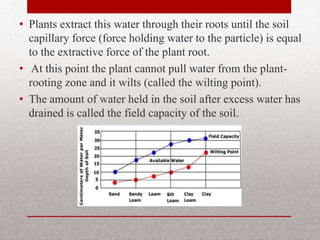
• Plants extract this water through their roots until the soil
  capillary force (force holding water to the particle) is equal
  to the extractive force of the plant root.
• At this point the plant cannot pull water from the plant-
  rooting zone and it wilts (called the wilting point).
• The amount of water held in the soil after excess water has
  drained is called the field capacity of the soil.
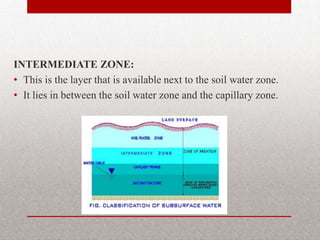
INTERMEDIATE ZONE:
• This is the layer that is available next to the soil water zone.
• It lies in between the soil water zone and the capillary zone.
CAPILLARY ZONE:
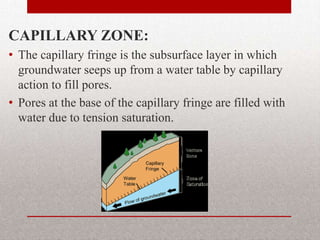
• The capillary fringe is the subsurface layer in which
  groundwater seeps up from a water table by capillary
  action to fill pores.
• Pores at the base of the capillary fringe are filled with
  water due to tension saturation.
• This saturated portion of the capillary fringe is less than total
  capillary rise because of the presence of a mix in pore size.
• If pore size is small and relatively uniform, it is possible that
  soils can be completely saturated with water for several feet
  above the water table.
• Alternately, the saturated portion will extend only a few inches
  above the water table when pore size is large.
• Saturated zone is classified into 4 categories.

       i) Aquifer
       ii) Aquiclude
       iii) Aquifuge
       iv) Aquitard
AQUIFER
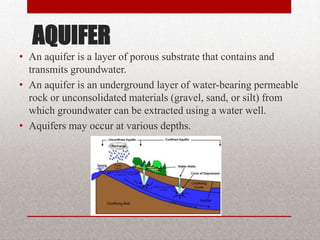
• An aquifer is a layer of porous substrate that contains and
  transmits groundwater.
• An aquifer is an underground layer of water-bearing permeable
  rock or unconsolidated materials (gravel, sand, or silt) from
  which groundwater can be extracted using a water well.
• Aquifers may occur at various depths.
TYPES OF AQUIFER
UNCONFINED AQUIFER:
• Unconfined aquifers are sometimes also called water table or
  phreatic aquifers, because their upper boundary is the water
  table
• When water can flow directly between the surface and the
  saturated zone of an aquifer, the aquifer is unconfined.
• The deeper parts of unconfined aquifers are usually more
  saturated since gravity causes water to flow downward.
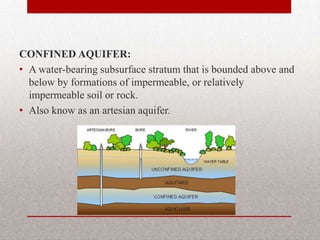
CONFINED AQUIFER:
• A water-bearing subsurface stratum that is bounded above and
  below by formations of impermeable, or relatively
  impermeable soil or rock.
• Also know as an artesian aquifer.
PROPERTIES OF THE AQUIFER

   i) Porosity
   ii) Specific yield
   iii) Specific retention
   iv) Storage by efficiency ( field capacity)
   v) Permeability
   vi) Transmissibility
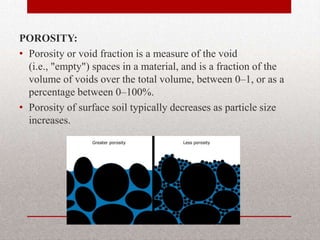
POROSITY:
• Porosity or void fraction is a measure of the void
  (i.e., "empty") spaces in a material, and is a fraction of the
  volume of voids over the total volume, between 0–1, or as a
  percentage between 0–100%.
• Porosity of surface soil typically decreases as particle size
  increases.
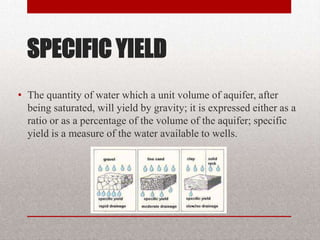
SPECIFIC YIELD
• The quantity of water which a unit volume of aquifer, after
  being saturated, will yield by gravity; it is expressed either as a
  ratio or as a percentage of the volume of the aquifer; specific
  yield is a measure of the water available to wells.
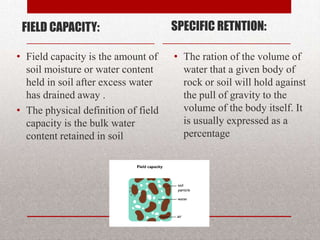
FIELD CAPACITY:                     SPECIFIC RETNTION:

• Field capacity is the amount of    • The ration of the volume of
  soil moisture or water content       water that a given body of
  held in soil after excess water      rock or soil will hold against
  has drained away .                   the pull of gravity to the
• The physical definition of field     volume of the body itself. It
  capacity is the bulk water           is usually expressed as a
  content retained in soil             percentage
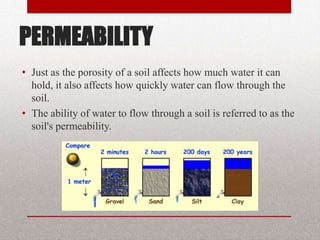
PERMEABILITY
• Just as the porosity of a soil affects how much water it can
  hold, it also affects how quickly water can flow through the
  soil.
• The ability of water to flow through a soil is referred to as the
  soil's permeability.
TRANSMISSIBILITY
• A measure of the ratio of the response amplitude of the
  system in steady-state forced vibration to the excitation
  amplitude; the ratio may be in forces, displacements,
  velocities, or accelerations.
• The transmissibility of an unconfined aquifer depends
  upon the depth of the GWT.
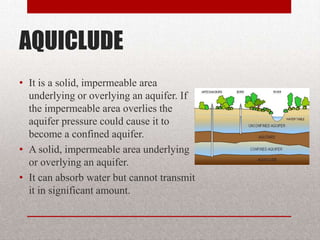
AQUICLUDE
• It is a solid, impermeable area
  underlying or overlying an aquifer. If
  the impermeable area overlies the
  aquifer pressure could cause it to
  become a confined aquifer.
• A solid, impermeable area underlying
  or overlying an aquifer.
• It can absorb water but cannot transmit
  it in significant amount.
AQUIFUGE:                      AQUITARD:
 • An impermeable body of      • A bed of low permeability
   rock which contains no        adjacent to an aquifer;
   interconnected openings       may serve as a storage
   or interstices and            unit for
   therefore neither absorbs     groundwater, although it
   nor transmits water.          does not yield water
                                 readily.
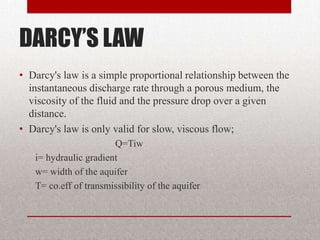
DARCY’S LAW
• Darcy's law is a simple proportional relationship between the
  instantaneous discharge rate through a porous medium, the
  viscosity of the fluid and the pressure drop over a given
  distance.
• Darcy's law is only valid for slow, viscous flow;
                       Q=Tiw
   i= hydraulic gradient
   w= width of the aquifer
   T= co.eff of transmissibility of the aquifer
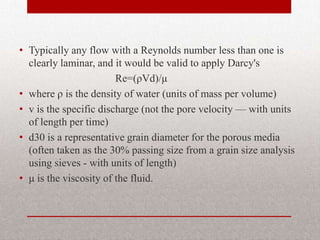
• Typically any flow with a Reynolds number less than one is
  clearly laminar, and it would be valid to apply Darcy's
                        Re=(ρVd)/μ
• where ρ is the density of water (units of mass per volume)
• v is the specific discharge (not the pore velocity — with units
  of length per time)
• d30 is a representative grain diameter for the porous media
  (often taken as the 30% passing size from a grain size analysis
  using sieves - with units of length)
• μ is the viscosity of the fluid.
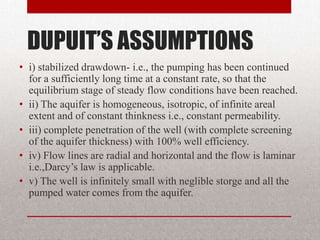
DUPUIT’S ASSUMPTIONS
• i) stabilized drawdown- i.e., the pumping has been continued
  for a sufficiently long time at a constant rate, so that the
  equilibrium stage of steady flow conditions have been reached.
• ii) The aquifer is homogeneous, isotropic, of infinite areal
  extent and of constant thinkness i.e., constant permeability.
• iii) complete penetration of the well (with complete screening
  of the aquifer thickness) with 100% well efficiency.
• iv) Flow lines are radial and horizontal and the flow is laminar
  i.e.,Darcy’s law is applicable.
• v) The well is infinitely small with neglible storge and all the
  pumped water comes from the aquifer.
PUMPING TEST
• The water level in the well is depressed to an amount equal to
  the safe working head for the sub- soil.
• The water level is kept constant by making the pumping rate
  equal to the percolation into the well.
• The quantity of water pumped in a known time gives an idea of
  the probable yield of the wel of the given diameter.
• This test may be carried out in an existing open well.
• Rate of seepage into the well = (volume of water
                                 pumped out – volume
                                 of stored in the well)/
                                 time of pumping
THANK YOU…

Ground water hydrology

  • 1.
    GROUND WATER HYDROLOGY Prepared by: Rebecca Sandra V III Civil-Surya college of Engg & Tech 2010-2014
  • 2.
    GROUND WATER • Groundwateris water located beneath the earth's surface in soil pore spaces and in the fractures of rock formations. • The depth at which soil pore spaces or fractures and voids in rock become completely saturated with water is called the water table
  • 3.
    SUB SURFACE WATER •Water in a soil mantle is called as sub surface water. • Water beneath the surface can essentially be divided into two zones • the unsaturated zone (also known as the "zone of aeration") which includes soil water zone, • The zone of saturation which includes ground water.
  • 4.
    • Sometimes, especiallyduring times of high rainfall, these pore spaces are filled with water. • The water table divides the zone of aeration from the zone of saturation. • In the saturation zone, all the pores of soil are filled with water. • In the aeration zone, soil pores are partially saturated with water.
  • 5.
    • The aerationzone has 3 sub-zones. i) Soil water zone ii) Intermediate zone Iii) Capillary fringe SOIL WATER ZONE: • Soil water is held in the pore spaces between particles of soil. • Soil water is the water that is immediately available to plants. • This water can be removed by air drying or by plant absorption, but cannot be removed by gravity.
  • 6.
    • Plants extractthis water through their roots until the soil capillary force (force holding water to the particle) is equal to the extractive force of the plant root. • At this point the plant cannot pull water from the plant- rooting zone and it wilts (called the wilting point). • The amount of water held in the soil after excess water has drained is called the field capacity of the soil.
  • 7.
    INTERMEDIATE ZONE: • Thisis the layer that is available next to the soil water zone. • It lies in between the soil water zone and the capillary zone.
  • 8.
    CAPILLARY ZONE: • Thecapillary fringe is the subsurface layer in which groundwater seeps up from a water table by capillary action to fill pores. • Pores at the base of the capillary fringe are filled with water due to tension saturation.
  • 9.
    • This saturatedportion of the capillary fringe is less than total capillary rise because of the presence of a mix in pore size. • If pore size is small and relatively uniform, it is possible that soils can be completely saturated with water for several feet above the water table. • Alternately, the saturated portion will extend only a few inches above the water table when pore size is large.
  • 10.
    • Saturated zoneis classified into 4 categories. i) Aquifer ii) Aquiclude iii) Aquifuge iv) Aquitard
  • 11.
    AQUIFER • An aquiferis a layer of porous substrate that contains and transmits groundwater. • An aquifer is an underground layer of water-bearing permeable rock or unconsolidated materials (gravel, sand, or silt) from which groundwater can be extracted using a water well. • Aquifers may occur at various depths.
  • 12.
    TYPES OF AQUIFER UNCONFINEDAQUIFER: • Unconfined aquifers are sometimes also called water table or phreatic aquifers, because their upper boundary is the water table • When water can flow directly between the surface and the saturated zone of an aquifer, the aquifer is unconfined. • The deeper parts of unconfined aquifers are usually more saturated since gravity causes water to flow downward.
  • 13.
    CONFINED AQUIFER: • Awater-bearing subsurface stratum that is bounded above and below by formations of impermeable, or relatively impermeable soil or rock. • Also know as an artesian aquifer.
  • 14.
    PROPERTIES OF THEAQUIFER i) Porosity ii) Specific yield iii) Specific retention iv) Storage by efficiency ( field capacity) v) Permeability vi) Transmissibility
  • 15.
    POROSITY: • Porosity orvoid fraction is a measure of the void (i.e., "empty") spaces in a material, and is a fraction of the volume of voids over the total volume, between 0–1, or as a percentage between 0–100%. • Porosity of surface soil typically decreases as particle size increases.
  • 16.
    SPECIFIC YIELD • Thequantity of water which a unit volume of aquifer, after being saturated, will yield by gravity; it is expressed either as a ratio or as a percentage of the volume of the aquifer; specific yield is a measure of the water available to wells.
  • 17.
    FIELD CAPACITY: SPECIFIC RETNTION: • Field capacity is the amount of • The ration of the volume of soil moisture or water content water that a given body of held in soil after excess water rock or soil will hold against has drained away . the pull of gravity to the • The physical definition of field volume of the body itself. It capacity is the bulk water is usually expressed as a content retained in soil percentage
  • 18.
    PERMEABILITY • Just asthe porosity of a soil affects how much water it can hold, it also affects how quickly water can flow through the soil. • The ability of water to flow through a soil is referred to as the soil's permeability.
  • 19.
    TRANSMISSIBILITY • A measureof the ratio of the response amplitude of the system in steady-state forced vibration to the excitation amplitude; the ratio may be in forces, displacements, velocities, or accelerations. • The transmissibility of an unconfined aquifer depends upon the depth of the GWT.
  • 20.
    AQUICLUDE • It isa solid, impermeable area underlying or overlying an aquifer. If the impermeable area overlies the aquifer pressure could cause it to become a confined aquifer. • A solid, impermeable area underlying or overlying an aquifer. • It can absorb water but cannot transmit it in significant amount.
  • 21.
    AQUIFUGE: AQUITARD: • An impermeable body of • A bed of low permeability rock which contains no adjacent to an aquifer; interconnected openings may serve as a storage or interstices and unit for therefore neither absorbs groundwater, although it nor transmits water. does not yield water readily.
  • 22.
    DARCY’S LAW • Darcy'slaw is a simple proportional relationship between the instantaneous discharge rate through a porous medium, the viscosity of the fluid and the pressure drop over a given distance. • Darcy's law is only valid for slow, viscous flow; Q=Tiw i= hydraulic gradient w= width of the aquifer T= co.eff of transmissibility of the aquifer
  • 23.
    • Typically anyflow with a Reynolds number less than one is clearly laminar, and it would be valid to apply Darcy's Re=(ρVd)/μ • where ρ is the density of water (units of mass per volume) • v is the specific discharge (not the pore velocity — with units of length per time) • d30 is a representative grain diameter for the porous media (often taken as the 30% passing size from a grain size analysis using sieves - with units of length) • μ is the viscosity of the fluid.
  • 24.
    DUPUIT’S ASSUMPTIONS • i)stabilized drawdown- i.e., the pumping has been continued for a sufficiently long time at a constant rate, so that the equilibrium stage of steady flow conditions have been reached. • ii) The aquifer is homogeneous, isotropic, of infinite areal extent and of constant thinkness i.e., constant permeability. • iii) complete penetration of the well (with complete screening of the aquifer thickness) with 100% well efficiency. • iv) Flow lines are radial and horizontal and the flow is laminar i.e.,Darcy’s law is applicable. • v) The well is infinitely small with neglible storge and all the pumped water comes from the aquifer.
  • 25.
    PUMPING TEST • Thewater level in the well is depressed to an amount equal to the safe working head for the sub- soil. • The water level is kept constant by making the pumping rate equal to the percolation into the well. • The quantity of water pumped in a known time gives an idea of the probable yield of the wel of the given diameter. • This test may be carried out in an existing open well. • Rate of seepage into the well = (volume of water pumped out – volume of stored in the well)/ time of pumping
  • 26.