CE 461
ENGINEERING HYDROLOGY
LECTURE 1
QUAZI FAISAL BARI PURNO
LECTURER
SONARGAON UNIVERSITY
• Hydrology
• Hydrology deals with the waters of the earth, their distribution and
circulation, their physical and chemical properties, and their
interaction with the environment, including interaction with living
things and, in particular, human beings.
• Engineering Hydrology
• Engineering hydrology includes those segments of the field pertinent
to design and operation of engineering projects for the control and
use of water.
• Practical Applications of Hydrology
• Design and operation of hydraulic structures
• Water supply
• Wastewater treatment and disposal
• Irrigation and drainage
• Hydropower generation
• Flood control
• Navigation
• Erosion and sediment control
• Salinity control
• Recreational use of water
• Fish and wildlife protection
• Geologic Cycle
• Throughout the nearly 4.6 billion years of earth’s history, chemical compounds
that make up the surface and bedrock near the surface have been continuously
created from the chemical elements, maintained, and changed by physical,
chemical, and biological processes. Collectively, the processes responsible for
formation and change of earth materials are referred to as the geologic cycle,
which is actually a group of sub cycles: tectonic, hydrologic, rock, and
biogeochemical.
• Hydrologic cycle (Water cycle)
• The hydrologic cycle is a continuous process by which water is transported from
the oceans to the atmosphere to the land and back to the sea. Water on earth
exists in a space called the hydrosphere which extends about 15 km up into the
atmosphere and about 1 km down into the lithosphere, the crust of the earth.
Water circulates in the hydrosphere through the maze of paths constituting the
hydrologic cycle.
• Processes in hydrologic cycle
Evaporation
• Water evaporates from the oceans and the land surface due to the heat energy provided by
the solar radiation to become part of the atmosphere.
Evapotranspiration
• Evaporation from the land surface is accompanied by transpiration by plants. Transpiration
is the evaporation of water from aerial parts and of plants, especially leaves but also
stems, flowers and fruits. Transpiration is a side effect of the plant needing to open its
stomata in order to obtain carbon dioxide gas from the air for photosynthesis.
Precipitation
• Water vapor is transported and lifted in the atmosphere until it condenses and precipitates
on the land or the oceans as rain, snow, hail, sleet etc. Some precipitation falls as snow and
can accumulate as ice caps and glaciers, which can store frozen water for thousands of
years.
Interception by vegetation and depression storage
• A part of the precipitated water may be intercepted by vegetation or temporarily
retained in the soil in surface depressions (depression storage) near where it falls and
is ultimately returned to the atmosphere by evaporation and transpiration by plants.
Infiltration and percolation
• A portion of the water that reaches the ground enters the earth’s surface through
infiltration. Some part of it then penetrates further into the ground to reach the
ground water table (percolation).
Subsurface flow and base flow
• A part of the infiltrated water flows laterally through the unsaturated soil (subsurface
flow). Lateral movement of groundwater in the saturated zone is known as base flow.
Some groundwater stays close to the land surface and can seep back into surface-
water bodies (e.g. lakes, rivers etc.) and the ocean. Some ground water finds openings
in the land surface and emerges as freshwater springs.
Surface runoff
• A portion of the precipitated water flows over the soil surface
(surface runoff). Initially it is a thin layer of sheet flow known
as overland flow. Ultimately it reaches minor channels (gullies,
rivulets etc.), flows to major streams and rivers, and finally
reaches an ocean. Sometimes, surface runoff flows into closed
water bodies (i.e. lakes).
Snowmelt
• Snow packs in warmer climates often melt when spring arrives,
and the melted water flows overland as snowmelt
Estimated world water quantities
Table 1.1: Estimated world water quantities
• The Table 1.1 lists estimated quantities of water in various forms on the earth.
About 96.5% of all the earth’s water is in the oceans. If the earth were a uniform
sphere, this quantity would be sufficient to cover it to a depth of about 2.6 km.
Of the remainder, 1.7% is in the polar ice, 1.7% in groundwater and only 0.1% in
the surface and atmospheric water systems. The atmospheric water system, the
driving force of surface water hydrology, contains only 12,900 km3 of water, or
less than one part in 100,000 of all the earth’s water.
• Of the earth’s fresh water, about two-thirds is polar ice and most of the
remainder is groundwater going down to a depth of 200 to 600 m. Most
groundwater is saline below this depth. Only 0.006% of fresh water is contained
in the rivers. Biological water, fixed in the tissues of plants and animals, make up
about 0.003% of all fresh water, equivalent to half the volume contained in
rivers.
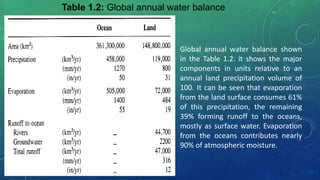
Table 1.2: Global annual water balance
Global annual water balance shown
in the Table 1.2. it shows the major
components in units relative to an
annual land precipitation volume of
100. It can be seen that evaporation
from the land surface consumes 61%
of this precipitation, the remaining
39% forming runoff to the oceans,
mostly as surface water. Evaporation
from the oceans contributes nearly
90% of atmospheric moisture.
• Residence time
• The residence time Tr is the average duration for a water molecule to pass through a
subsystem of the hydrologic cycle. It is calculated by dividing the volume of water S in
storage by the flow rate Q (i.e. Tr = S/Q).
• The volume of atmospheric moisture (Table 1.1) is 12,900 km3. The flow rate of
moisture from the atmosphere as precipitation (Table 1.2) is 458,000 + 119,000 =
577,000 km3/yr (or the flow rate of moisture to the atmosphere as evaporation is
505,000 + 72,000 = 577,000 km3/yr), so the average residence time for moisture in the
atmosphere is Tr = 12,900/577,000 = 0.022 yr = 8.2 days. The very short residence time
for moisture in the atmosphere is one reason why weather cannot be forecast
accurately more than a few days ahead.
• Similarly, the volume of water in the rivers (Table 1.1) is 2,120 km3. The average flow
rate of water in global rivers (Table 1.2) is 44,700 km3/yr, so the residence time for
global rivers is Tr = 2,120/44,700 = 0.0474 yr = 17.3 days. The global residence time for
groundwater is Tr = (10,530,000+12,870,000)/2,200 = 10,636.36 yrs. The very long
residence time for groundwater is the reason why it takes long time to clean
groundwater if it is contaminated.
Thanks to all

HYDROLOGY_LECTURE.pptx

  • 1.
    CE 461 ENGINEERING HYDROLOGY LECTURE1 QUAZI FAISAL BARI PURNO LECTURER SONARGAON UNIVERSITY
  • 2.
    • Hydrology • Hydrologydeals with the waters of the earth, their distribution and circulation, their physical and chemical properties, and their interaction with the environment, including interaction with living things and, in particular, human beings. • Engineering Hydrology • Engineering hydrology includes those segments of the field pertinent to design and operation of engineering projects for the control and use of water.
  • 3.
    • Practical Applicationsof Hydrology • Design and operation of hydraulic structures • Water supply • Wastewater treatment and disposal • Irrigation and drainage • Hydropower generation • Flood control • Navigation • Erosion and sediment control • Salinity control • Recreational use of water • Fish and wildlife protection
  • 4.
    • Geologic Cycle •Throughout the nearly 4.6 billion years of earth’s history, chemical compounds that make up the surface and bedrock near the surface have been continuously created from the chemical elements, maintained, and changed by physical, chemical, and biological processes. Collectively, the processes responsible for formation and change of earth materials are referred to as the geologic cycle, which is actually a group of sub cycles: tectonic, hydrologic, rock, and biogeochemical. • Hydrologic cycle (Water cycle) • The hydrologic cycle is a continuous process by which water is transported from the oceans to the atmosphere to the land and back to the sea. Water on earth exists in a space called the hydrosphere which extends about 15 km up into the atmosphere and about 1 km down into the lithosphere, the crust of the earth. Water circulates in the hydrosphere through the maze of paths constituting the hydrologic cycle.
  • 6.
    • Processes inhydrologic cycle Evaporation • Water evaporates from the oceans and the land surface due to the heat energy provided by the solar radiation to become part of the atmosphere. Evapotranspiration • Evaporation from the land surface is accompanied by transpiration by plants. Transpiration is the evaporation of water from aerial parts and of plants, especially leaves but also stems, flowers and fruits. Transpiration is a side effect of the plant needing to open its stomata in order to obtain carbon dioxide gas from the air for photosynthesis. Precipitation • Water vapor is transported and lifted in the atmosphere until it condenses and precipitates on the land or the oceans as rain, snow, hail, sleet etc. Some precipitation falls as snow and can accumulate as ice caps and glaciers, which can store frozen water for thousands of years.
  • 7.
    Interception by vegetationand depression storage • A part of the precipitated water may be intercepted by vegetation or temporarily retained in the soil in surface depressions (depression storage) near where it falls and is ultimately returned to the atmosphere by evaporation and transpiration by plants. Infiltration and percolation • A portion of the water that reaches the ground enters the earth’s surface through infiltration. Some part of it then penetrates further into the ground to reach the ground water table (percolation). Subsurface flow and base flow • A part of the infiltrated water flows laterally through the unsaturated soil (subsurface flow). Lateral movement of groundwater in the saturated zone is known as base flow. Some groundwater stays close to the land surface and can seep back into surface- water bodies (e.g. lakes, rivers etc.) and the ocean. Some ground water finds openings in the land surface and emerges as freshwater springs.
  • 8.
    Surface runoff • Aportion of the precipitated water flows over the soil surface (surface runoff). Initially it is a thin layer of sheet flow known as overland flow. Ultimately it reaches minor channels (gullies, rivulets etc.), flows to major streams and rivers, and finally reaches an ocean. Sometimes, surface runoff flows into closed water bodies (i.e. lakes). Snowmelt • Snow packs in warmer climates often melt when spring arrives, and the melted water flows overland as snowmelt
  • 9.
    Estimated world waterquantities Table 1.1: Estimated world water quantities
  • 10.
    • The Table1.1 lists estimated quantities of water in various forms on the earth. About 96.5% of all the earth’s water is in the oceans. If the earth were a uniform sphere, this quantity would be sufficient to cover it to a depth of about 2.6 km. Of the remainder, 1.7% is in the polar ice, 1.7% in groundwater and only 0.1% in the surface and atmospheric water systems. The atmospheric water system, the driving force of surface water hydrology, contains only 12,900 km3 of water, or less than one part in 100,000 of all the earth’s water. • Of the earth’s fresh water, about two-thirds is polar ice and most of the remainder is groundwater going down to a depth of 200 to 600 m. Most groundwater is saline below this depth. Only 0.006% of fresh water is contained in the rivers. Biological water, fixed in the tissues of plants and animals, make up about 0.003% of all fresh water, equivalent to half the volume contained in rivers.
  • 11.
    Table 1.2: Globalannual water balance Global annual water balance shown in the Table 1.2. it shows the major components in units relative to an annual land precipitation volume of 100. It can be seen that evaporation from the land surface consumes 61% of this precipitation, the remaining 39% forming runoff to the oceans, mostly as surface water. Evaporation from the oceans contributes nearly 90% of atmospheric moisture.
  • 12.
    • Residence time •The residence time Tr is the average duration for a water molecule to pass through a subsystem of the hydrologic cycle. It is calculated by dividing the volume of water S in storage by the flow rate Q (i.e. Tr = S/Q). • The volume of atmospheric moisture (Table 1.1) is 12,900 km3. The flow rate of moisture from the atmosphere as precipitation (Table 1.2) is 458,000 + 119,000 = 577,000 km3/yr (or the flow rate of moisture to the atmosphere as evaporation is 505,000 + 72,000 = 577,000 km3/yr), so the average residence time for moisture in the atmosphere is Tr = 12,900/577,000 = 0.022 yr = 8.2 days. The very short residence time for moisture in the atmosphere is one reason why weather cannot be forecast accurately more than a few days ahead. • Similarly, the volume of water in the rivers (Table 1.1) is 2,120 km3. The average flow rate of water in global rivers (Table 1.2) is 44,700 km3/yr, so the residence time for global rivers is Tr = 2,120/44,700 = 0.0474 yr = 17.3 days. The global residence time for groundwater is Tr = (10,530,000+12,870,000)/2,200 = 10,636.36 yrs. The very long residence time for groundwater is the reason why it takes long time to clean groundwater if it is contaminated.
  • 17.