Railway engineering
Points and crossings
 A crossing or frog is a device
introduced at the point.
 where two gauge faces cross each other
to permit the flanges of a railway
vehicle to pass from one track to
another.
 A gap is provided from throw to the
nose of crossing.
Turn out
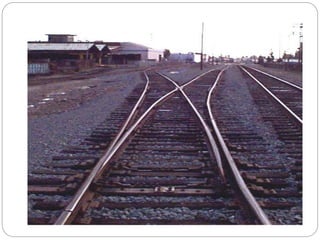
 The combination of lead rails with curved
rails helps in diverting rolling stock from
one track to another track.
 Rails depending on curvature
Lead rails are straight
Curved rails have curvature
 Turnouts are also provided in yards and
sidings.
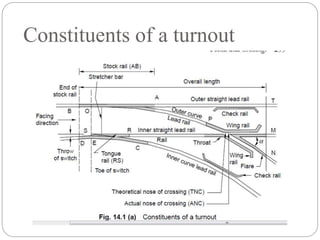
Constituents of a turnout
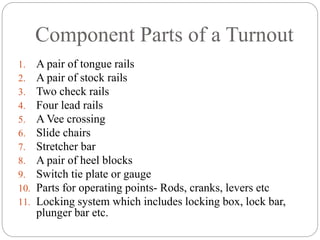
Component Parts of a Turnout
1. A pair of tongue rails
2. A pair of stock rails
3. Two check rails
4. Four lead rails
5. A Vee crossing
6. Slide chairs
7. Stretcher bar
8. A pair of heel blocks
9. Switch tie plate or gauge
10. Parts for operating points- Rods, cranks, levers etc
11. Locking system which includes locking box, lock bar,
plunger bar etc.
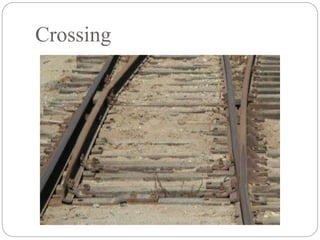
Crossing
A crossing is a device introduced at the
junction where two rails cross each other
to permit the wheel flange of a railway
vehicle to pass from o.ne track to
another.
Crossing
Types of crossings
Based on the angle of crossing:
Acute angle
 2 rail gauge faces cross at acute angle.
Obtuse angle
 2 gauge faces meet at obtuse angle.
Square crossing
 Two tracks cross at right angles.
For manufacturing purposes
 Spring crossing
 Cross over
 Scissors crossing
 Diamond crossing
 Ladder track crossing
Crossings - Components
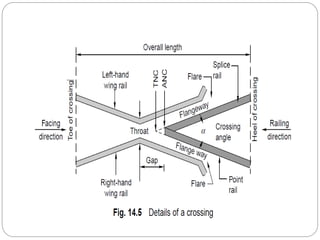
 Two wing rails consisting of a right-hand and a left-
hand wing rail that converge to form a throat and
diverge again on either side of the nose.
 Wing rails are flared at the ends to facilitate the entry
and exit of the flanged wheel in the gap.
 A pair of check rails are used to guide the wheels.
Railway engineering

Railway engineering

  • 1.
  • 2.
    Points and crossings A crossing or frog is a device introduced at the point.  where two gauge faces cross each other to permit the flanges of a railway vehicle to pass from one track to another.  A gap is provided from throw to the nose of crossing.
  • 3.
    Turn out  Thecombination of lead rails with curved rails helps in diverting rolling stock from one track to another track.  Rails depending on curvature Lead rails are straight Curved rails have curvature  Turnouts are also provided in yards and sidings.
  • 5.
  • 6.
    Component Parts ofa Turnout 1. A pair of tongue rails 2. A pair of stock rails 3. Two check rails 4. Four lead rails 5. A Vee crossing 6. Slide chairs 7. Stretcher bar 8. A pair of heel blocks 9. Switch tie plate or gauge 10. Parts for operating points- Rods, cranks, levers etc 11. Locking system which includes locking box, lock bar, plunger bar etc.
  • 7.
    Crossing A crossing isa device introduced at the junction where two rails cross each other to permit the wheel flange of a railway vehicle to pass from o.ne track to another.
  • 8.
  • 9.
    Types of crossings Basedon the angle of crossing: Acute angle  2 rail gauge faces cross at acute angle. Obtuse angle  2 gauge faces meet at obtuse angle. Square crossing  Two tracks cross at right angles.
  • 10.
    For manufacturing purposes Spring crossing  Cross over  Scissors crossing  Diamond crossing  Ladder track crossing
  • 12.
    Crossings - Components Two wing rails consisting of a right-hand and a left- hand wing rail that converge to form a throat and diverge again on either side of the nose.  Wing rails are flared at the ends to facilitate the entry and exit of the flanged wheel in the gap.  A pair of check rails are used to guide the wheels.