Measurement of 
Rainfall 
By:-Sulakshya Gaur(121684)
Rainfall 
 Precipitation is expressed in terms of the depth to which rainfall 
water would stand on an area if all the rain water were collected on 
it. 
 In case of snowfall an equivalent depth of water is used as depth of 
precipitation. 
 The precipitation is measured in raingauge also called as 
pluviometer, ombrometer, hyetometer etc. 
 A raingauge consists of a cylindrical vessel assembly kept in open 
to collect rain.
 A raingauge is affected by its exposure conditions and thus its 
setting is important. For setting up a raingauge, the following 
considerations are important: 
The ground must be level and instrument must present a 
horizontal catch surface. 
The gauge must be as near the ground as possible to reduce 
wind effects but it must be sufficiently high to prevent 
splashing. 
The instrument must be surrounded by an open fenced area.
 Raingauges can be classified into two 
categories: 
(i) nonrecording gauges and 
(ii) recording gauges
1. Nonrecording Gauges: 
 The nonrecording gauge used in India is Symons gauge. 
 Consists of a circular collecting area of 12.7 cm diameter connected 
to the funnel and the rim of the collector is set in a horizontal plane 
at a height of 30.5 cm above the ground level.
 The funnel discharges the rainfall catch into a receiving vessel 
which is housed in a metallic container. 
 The water in the receiving vessel is measured by a graduated 
measuring glass with an accuracy of 0.1 mm. 
 The rainfall is measured at 8:30 a.m. and is recorded as the rainfall 
of that day. 
 The collecting bottle cannot hold more than 10 cm of rain and thus 
in case of heavy rainfall frequent readings must be taken. 
 However last reading must be taken at 8:30 a.m. and the sum of 
previous readings in the past 24 hours is the rainfall of that day.
 Precautions must be taken and raingauges must be inspected 
regularly. 
 The details of non recording raingauges and measurement of rain 
are specified in IS:4986-1968. 
 It can also be used to measure snowfall. During snowfall the funnel 
and receiving bottle are removed and snow is collected in metallic 
container which is then melted and depth of resulting water is 
measured. 
Antifreeze agents may also be used. 
In areas of heavy rainfall special snowgauges are used with storage 
pipes.
2. Recording gauges: 
These produce a continuous plot of 
rainfall against time and are used for 
hydrological analysis of storms. 
Commonly used recording raingauges: 
 Tipping-bucket type 
 Weighing bucket type 
 Natural-Syphon type
(a) Tipping-Bucket type: 
 This is a 30.5 cm size raingauge used by US Weather Bureau. 
 The catch from the funnel falls onto one of a pair of small buckets. 
 These buckets are so balanced that when .25 mm of rainfall collects 
in one bucket it tips and brings the other bucket in position and the 
water is collected in storage can. 
 The tipping actuates an electrically driven pen to plot the intensity of 
rainfall with time. 
 The water in storage can is measured regularly to give total rainfall.
(b) Weighing-Bucket type 
 In this the catch empties into a bucket mounted on a weighing 
scale. 
 The weight of the bucket are recorded with time. 
 The mechanism has the capacity to run for as long as one week. 
 The instrument gives a plot of accumulated rainfall against time.
(c) Natural-Syphon type: 
 Also called as float type gauge. 
 In this the rainfall collected by a funnel shaped collector is led into a 
float chamber causing a float to rise. 
 Due to this, a pen attached to the float through a lever records the 
elevation of float driven by clockwork mechanism. 
 A syphon arrangement empties the float chamber when float 
reaches the maximum preset value. 
 Its details are prescribed in IS: 5235-1969
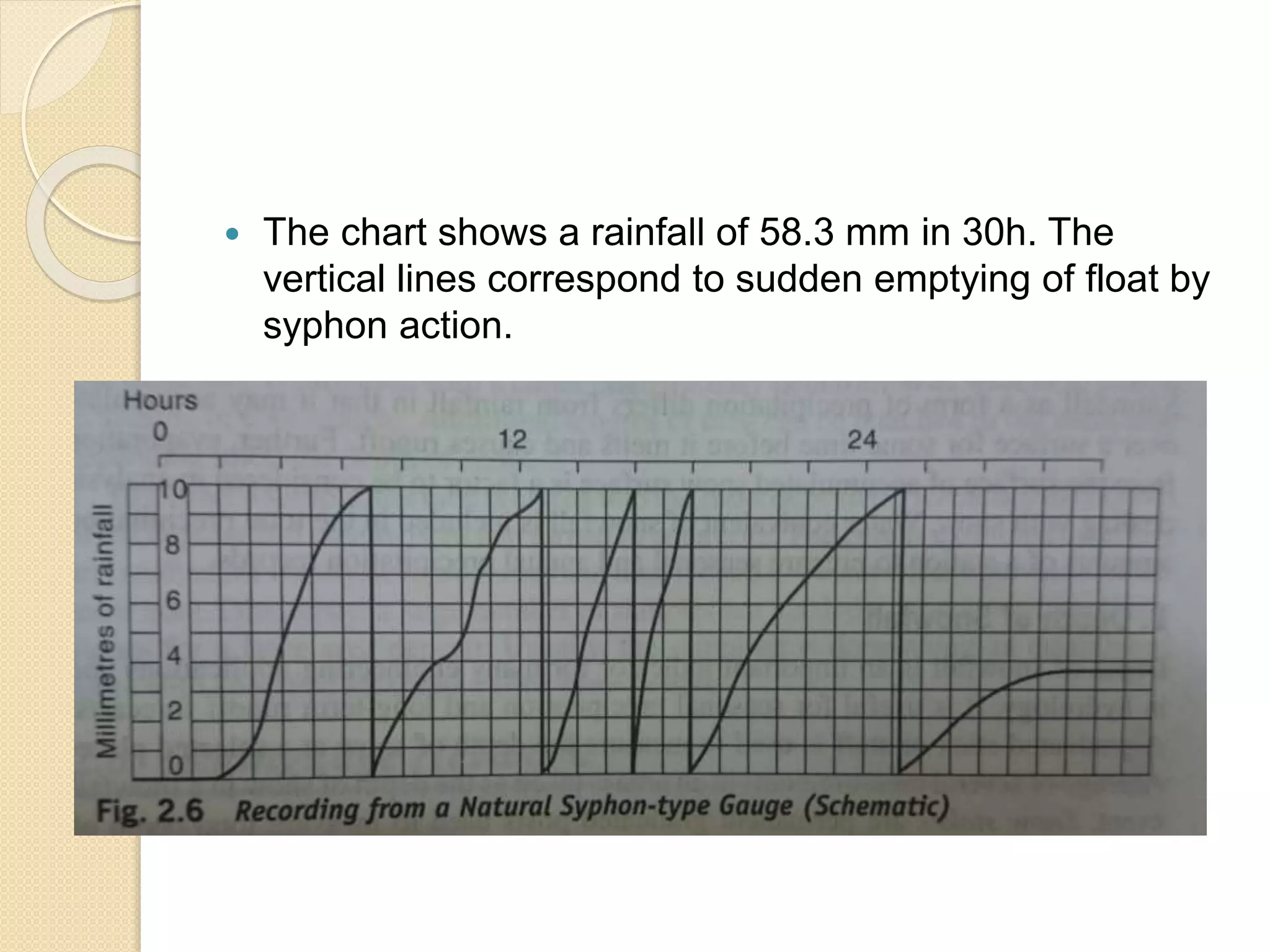
 The chart shows a rainfall of 58.3 mm in 30h. The 
vertical lines correspond to sudden emptying of float by 
syphon action. 
 It gives a plot of mass curve of rainfall.

Measurement of precipitation (rainfall )

  • 1.
    Measurement of Rainfall By:-Sulakshya Gaur(121684)
  • 2.
    Rainfall  Precipitationis expressed in terms of the depth to which rainfall water would stand on an area if all the rain water were collected on it.  In case of snowfall an equivalent depth of water is used as depth of precipitation.  The precipitation is measured in raingauge also called as pluviometer, ombrometer, hyetometer etc.  A raingauge consists of a cylindrical vessel assembly kept in open to collect rain.
  • 3.
     A raingaugeis affected by its exposure conditions and thus its setting is important. For setting up a raingauge, the following considerations are important: The ground must be level and instrument must present a horizontal catch surface. The gauge must be as near the ground as possible to reduce wind effects but it must be sufficiently high to prevent splashing. The instrument must be surrounded by an open fenced area.
  • 4.
     Raingauges canbe classified into two categories: (i) nonrecording gauges and (ii) recording gauges
  • 5.
    1. Nonrecording Gauges:  The nonrecording gauge used in India is Symons gauge.  Consists of a circular collecting area of 12.7 cm diameter connected to the funnel and the rim of the collector is set in a horizontal plane at a height of 30.5 cm above the ground level.
  • 6.
     The funneldischarges the rainfall catch into a receiving vessel which is housed in a metallic container.  The water in the receiving vessel is measured by a graduated measuring glass with an accuracy of 0.1 mm.  The rainfall is measured at 8:30 a.m. and is recorded as the rainfall of that day.  The collecting bottle cannot hold more than 10 cm of rain and thus in case of heavy rainfall frequent readings must be taken.  However last reading must be taken at 8:30 a.m. and the sum of previous readings in the past 24 hours is the rainfall of that day.
  • 7.
     Precautions mustbe taken and raingauges must be inspected regularly.  The details of non recording raingauges and measurement of rain are specified in IS:4986-1968.  It can also be used to measure snowfall. During snowfall the funnel and receiving bottle are removed and snow is collected in metallic container which is then melted and depth of resulting water is measured. Antifreeze agents may also be used. In areas of heavy rainfall special snowgauges are used with storage pipes.
  • 8.
    2. Recording gauges: These produce a continuous plot of rainfall against time and are used for hydrological analysis of storms. Commonly used recording raingauges:  Tipping-bucket type  Weighing bucket type  Natural-Syphon type
  • 9.
    (a) Tipping-Bucket type:  This is a 30.5 cm size raingauge used by US Weather Bureau.  The catch from the funnel falls onto one of a pair of small buckets.  These buckets are so balanced that when .25 mm of rainfall collects in one bucket it tips and brings the other bucket in position and the water is collected in storage can.  The tipping actuates an electrically driven pen to plot the intensity of rainfall with time.  The water in storage can is measured regularly to give total rainfall.
  • 10.
    (b) Weighing-Bucket type  In this the catch empties into a bucket mounted on a weighing scale.  The weight of the bucket are recorded with time.  The mechanism has the capacity to run for as long as one week.  The instrument gives a plot of accumulated rainfall against time.
  • 11.
    (c) Natural-Syphon type:  Also called as float type gauge.  In this the rainfall collected by a funnel shaped collector is led into a float chamber causing a float to rise.  Due to this, a pen attached to the float through a lever records the elevation of float driven by clockwork mechanism.  A syphon arrangement empties the float chamber when float reaches the maximum preset value.  Its details are prescribed in IS: 5235-1969
  • 12.
     The chartshows a rainfall of 58.3 mm in 30h. The vertical lines correspond to sudden emptying of float by syphon action.  It gives a plot of mass curve of rainfall.

Editor's Notes