SEAWATER INTRUSION
INTRODUCTION
Almost two thirds of the world's population lives within 400
km of the ocean shoreline; just over half live within 200 km,
an area only taking up 10% of the earth's surface (Hinrichsen,
2007).
Most of these coastal regions rely on groundwater as their
main source of fresh water for domestic, industrial and
agricultural purposes.
As the world's population continues to grow at an alarming
rate, fresh water supplies are constantly being depleted,
bringing with it issues such as saltwater intrusion and
increasing the importance of groundwater monitoring,
management, and conservation.
Saltwater intrusion
Saltwater intrusion is a major concern commonly
found in coastal aquifers around the world.
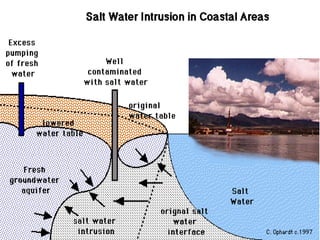
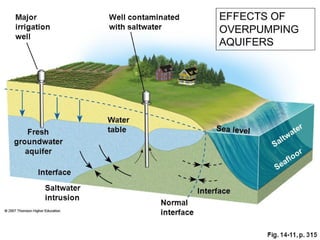
Saltwater intrusion is the movement of saline water
into freshwater aquifers.
Most often, it is caused by ground-water pumping
from coastal wells, or from construction of navigation
channels or oil field canals.
The channels and canals provide conduits
for salt water to be brought into fresh
water marshes. Salt water intrusion can
also occur as the result of a natural
process like a storm surge from a
hurricane.
Saltwater intrusion occurs in virtually
all coastal aquifers, where they are in
hydraulic continuity with seawater.
Cause and Impact of
Saltwater Intrusion
• Saltwater intrusion happens when saltwater is drawn
in (from the sea) into fresh water aquifers .
• Sea water has a higher density (which is because it
carries more solutes) than freshwater.
causes
• This density causes the pressure under a column of
salt water to be greater than the pressure under a
column of the same height of freshwater.
• If these two columns are connected at the bottom,
then the pressure difference would cause a flow of
saltwater column to the freshwater until the
pressure equalizes
• To prevent this more and more countries adopt
Extensive monitoring schemes and numerical models
to assess how water can be pumped without problems
Saltwater intrusion into freshwater aquifers is also
influenced by factors such as:
 tidal fluctuations,
long-term climate and sea level changes,
fractures in coastal rock formations
seasonal changes in evaporation and recharge rates.
Recharge rates can also be lowered in areas with
increased urbanization and thus impervious surfaces.
 Intrusion has also occurred in areas because of
water levels being lowered by the construction of
drainage canals (Barlow, 2003).
IMPACTS
• Salt-water intrusion from rising sea levels
will reduce the quality and quantity of
freshwater supplies as it is happening along
Atlantic and Gulf coasts. 
• This is a major concern, since billions of people
already lack access to freshwater.
• Salt water intrusion leads to the loss of fresh water
vegetation
• Spread of mudflats into previously vegetative areas.
GHYBEN-HERZBERG RELATION
The first physical formulations of saltwater intrusion were
made by W. Badon-Ghijben(1888,1889) and A.Herzberg
(1901), thus called the Ghyben-Herzberg relation.
They derived analytical solutions to approximate the
intrusion behavior , which are based on a number of
assumptions that do not hold in all field cases.
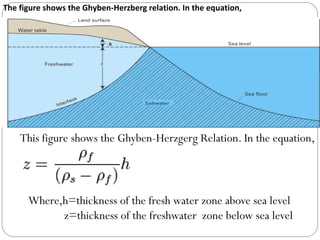
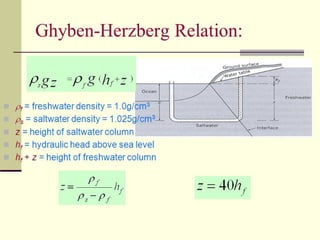
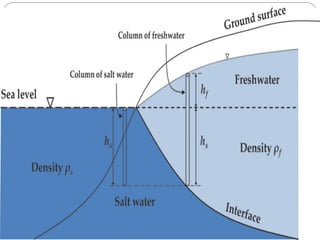
The figure shows the Ghyben-Herzberg relation. In the equation,
This figure shows the Ghyben-Herzgerg Relation. In the equation,
Where,h=thickness of the fresh water zone above sea level
z=thickness of the freshwater zone below sea level
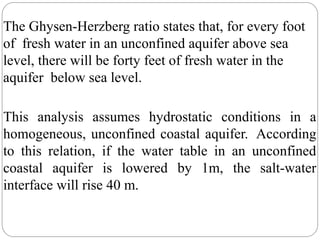
The Ghysen-Herzberg ratio states that, for every foot
of fresh water in an unconfined aquifer above sea
level, there will be forty feet of fresh water in the
aquifer below sea level.
This analysis assumes hydrostatic conditions in a
homogeneous, unconfined coastal aquifer. According
to this relation, if the water table in an unconfined
coastal aquifer is lowered by 1m, the salt-water
interface will rise 40 m.
CONTROL AND
MANAGEMENT OF
SEAWATER INTRUSION
• To maintain the proper balance between water
being pumped from an aquifer and the amount of
water recharging it.
• Constant monitoring of the salt-water interface is
necessary in determining the proper management
technique. .
• Efforts towards the promotion of water
conservation, and restricting withdrawals from
coastal aquifers have been the focus in many
areas.
• Using alternative freshwater sources has also been
encouraged. Ocean water desalination plants are
showing up in coastal regions around the world.
• Where there are no other options for fresh water, efforts
to maintain groundwater levels by ponding surface water
and storm water runoff, or using river water to recharge
the groundwater table have been successfully
implemented.
• Aquifer Storage and Recovery (ASR) systems can help
restore aquifers that have experienced long-term declines
in water levels due to over-pumping.
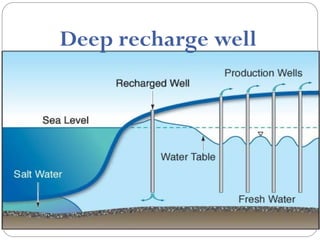
Other methods to control saltwater intrusion, such as
using deep recharge wells, have also been successful.
These wells create a high Potentiometric surface,
which allows for the pumping of groundwater below
sea level landward of a groundwater ridge created.
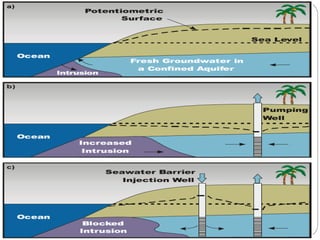
In some instances, barrier wells have been set up near
the shore to pump out salt water and recharge a fresh
water gradient toward the sea.
Physical separation by barriers – construction of
artificial subsurface barriers.
Recharge pits – artificial recharge in areas of
production wells
Injection wells – to create pressure ridge( barrier) to
prevent intrusion
Deep recharge well
Monitoring well networks allow continuous observation of
the saltwater interface, after management strategies have been
put in place.
This provides early warnings of saltwater intrusion and tracks
the effectiveness of the strategy. Overall, proper groundwater
monitoring techniques and groundwater management,
combined with groundwater conservation are needed to keep
saltwater intrusion under control, and ensure fresh water
supplies are sustained for future generations.

Sea water intrusion

  • 1.
  • 2.
    INTRODUCTION Almost two thirdsof the world's population lives within 400 km of the ocean shoreline; just over half live within 200 km, an area only taking up 10% of the earth's surface (Hinrichsen, 2007). Most of these coastal regions rely on groundwater as their main source of fresh water for domestic, industrial and agricultural purposes. As the world's population continues to grow at an alarming rate, fresh water supplies are constantly being depleted, bringing with it issues such as saltwater intrusion and increasing the importance of groundwater monitoring, management, and conservation.
  • 3.
    Saltwater intrusion Saltwater intrusionis a major concern commonly found in coastal aquifers around the world. Saltwater intrusion is the movement of saline water into freshwater aquifers. Most often, it is caused by ground-water pumping from coastal wells, or from construction of navigation channels or oil field canals.
  • 4.
    The channels andcanals provide conduits for salt water to be brought into fresh water marshes. Salt water intrusion can also occur as the result of a natural process like a storm surge from a hurricane. Saltwater intrusion occurs in virtually all coastal aquifers, where they are in hydraulic continuity with seawater.
  • 6.
    Cause and Impactof Saltwater Intrusion
  • 7.
    • Saltwater intrusionhappens when saltwater is drawn in (from the sea) into fresh water aquifers . • Sea water has a higher density (which is because it carries more solutes) than freshwater. causes
  • 8.
    • This densitycauses the pressure under a column of salt water to be greater than the pressure under a column of the same height of freshwater. • If these two columns are connected at the bottom, then the pressure difference would cause a flow of saltwater column to the freshwater until the pressure equalizes • To prevent this more and more countries adopt Extensive monitoring schemes and numerical models to assess how water can be pumped without problems
  • 9.
    Saltwater intrusion intofreshwater aquifers is also influenced by factors such as:  tidal fluctuations, long-term climate and sea level changes, fractures in coastal rock formations seasonal changes in evaporation and recharge rates.
  • 10.
    Recharge rates canalso be lowered in areas with increased urbanization and thus impervious surfaces.  Intrusion has also occurred in areas because of water levels being lowered by the construction of drainage canals (Barlow, 2003).
  • 13.
    IMPACTS • Salt-water intrusionfrom rising sea levels will reduce the quality and quantity of freshwater supplies as it is happening along Atlantic and Gulf coasts.  • This is a major concern, since billions of people already lack access to freshwater. • Salt water intrusion leads to the loss of fresh water vegetation • Spread of mudflats into previously vegetative areas.
  • 14.
    GHYBEN-HERZBERG RELATION The firstphysical formulations of saltwater intrusion were made by W. Badon-Ghijben(1888,1889) and A.Herzberg (1901), thus called the Ghyben-Herzberg relation. They derived analytical solutions to approximate the intrusion behavior , which are based on a number of assumptions that do not hold in all field cases.
  • 15.
    The figure showsthe Ghyben-Herzberg relation. In the equation, This figure shows the Ghyben-Herzgerg Relation. In the equation, Where,h=thickness of the fresh water zone above sea level z=thickness of the freshwater zone below sea level
  • 18.
    The Ghysen-Herzberg ratiostates that, for every foot of fresh water in an unconfined aquifer above sea level, there will be forty feet of fresh water in the aquifer below sea level. This analysis assumes hydrostatic conditions in a homogeneous, unconfined coastal aquifer. According to this relation, if the water table in an unconfined coastal aquifer is lowered by 1m, the salt-water interface will rise 40 m.
  • 19.
  • 20.
    • To maintainthe proper balance between water being pumped from an aquifer and the amount of water recharging it. • Constant monitoring of the salt-water interface is necessary in determining the proper management technique. . • Efforts towards the promotion of water conservation, and restricting withdrawals from coastal aquifers have been the focus in many areas.
  • 21.
    • Using alternativefreshwater sources has also been encouraged. Ocean water desalination plants are showing up in coastal regions around the world. • Where there are no other options for fresh water, efforts to maintain groundwater levels by ponding surface water and storm water runoff, or using river water to recharge the groundwater table have been successfully implemented. • Aquifer Storage and Recovery (ASR) systems can help restore aquifers that have experienced long-term declines in water levels due to over-pumping.
  • 22.
    Other methods tocontrol saltwater intrusion, such as using deep recharge wells, have also been successful. These wells create a high Potentiometric surface, which allows for the pumping of groundwater below sea level landward of a groundwater ridge created. In some instances, barrier wells have been set up near the shore to pump out salt water and recharge a fresh water gradient toward the sea.
  • 23.
    Physical separation bybarriers – construction of artificial subsurface barriers. Recharge pits – artificial recharge in areas of production wells Injection wells – to create pressure ridge( barrier) to prevent intrusion
  • 24.
  • 26.
    Monitoring well networksallow continuous observation of the saltwater interface, after management strategies have been put in place. This provides early warnings of saltwater intrusion and tracks the effectiveness of the strategy. Overall, proper groundwater monitoring techniques and groundwater management, combined with groundwater conservation are needed to keep saltwater intrusion under control, and ensure fresh water supplies are sustained for future generations.

Editor's Notes

  • #3 <number>
  • #17 1.000/(1.025-1.000) <number>