10/8/2016 1
WATER BALANCE CALCULATION
PRESENTED BY :
VINAY . C
M. Sc Geology
DOS in Earth Science
GUIDED BY :
Prof .Dr. A.BALASUBRAMANIAN
Professor of Earth Science
Dos in Earth Science
University of Mysore
10/8/2016
2
CONTENT
 INTRODUCTION
 DEFINATION
 WATER BALANCE COMPONENTS
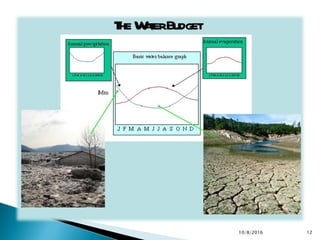
 WATER BALANCE GRAPH
 TYPES
 APPLICATION OF THE WATER BALANCE CALCULATION
 LIMITATION OF THE WATER BALANCE CALCULATION
 CONCLUSION
 REFERENCE
10/8/2016 3
A water balance calculation can be used to describe
the flow of water in and out of a system. A system
can be one of several hydrological domains, such as a
column of soil or a drainage basin. Water balance can
also refer to the ways in which an organism maintains
water in dry or hot conditions.
Introduction
10/8/2016 4
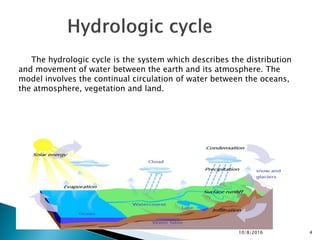
The hydrologic cycle is the system which describes the distribution
and movement of water between the earth and its atmosphere. The
model involves the continual circulation of water between the oceans,
the atmosphere, vegetation and land.
10/8/2016 5
Water balance components
 Potential evapotranspiration.
 Precipitation.
 Actual evapotanspiration.
 Soil moisture utilisation.
 Soil moisture recharge.
 Water deficit.
 Water surplus.
 Input-output= balance
 In water balance all components of input and
output are considered
 Methods vary- as:
◦ Surface water balance
◦ Groundwater balance
◦ Soil water balance
◦ Lake water balance
◦ Oceanic water balance
 Input components are= rainfall, snowfall
 Output components are = Runoff, infiltration,
baseflow, evapotranspiration
10/8/2016 6
10/8/2016 7
GROUND WATER BALANCE
All elements of the groundwater balance equation should be
computed using independent methods. Computations of various
components usually involve errors, due to shortcomings in the
estimation techniques. The groundwater balance equation therefore
generally does not balance, even if all its components are computed
by independent methods.
10/8/2016 8
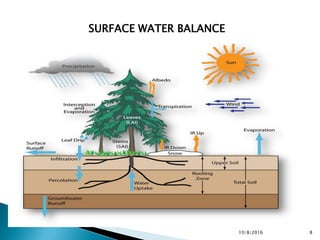
SURFACE WATER BALANCE
10/8/2016 9
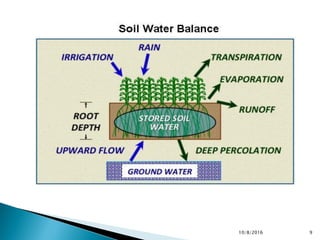
SOIL WATER BALANCE
10/8/2016 10
LAKE WATER BALANCE
The most basic in river basin hydrology is the water balance – and so it
is for lakes. Most lakes have outflows, but some of the most famous
lakes of the world are terminal lakes with no outflow, for example, the
Caspian Sea, Lake Chad, and the Dead Sea. The water level in the
overflowing lakes is rather stable, while the water level in the terminal
lakes varies with the climate. In some lakes with small upstream
catchment, the inflow to the lake is dominated by the precipitation on
the lake, but usually inflow rivers are the dominating source of inflow to
a lake. Some lakes only have subsurface inflow, but in most lakes, the
most important inflow is from rivers. There also exist kettle lakes,
which are part of the groundwater system with only subsurface inflow
and outflow.
10/8/2016 11
OCEANIC WATER BALANCE
10/8/2016 12
10/8/2016 13
 Models using precipitation (rainfall) as input
 Models using rainfall and temperature as input
 Model using rainfall and potential evaporation as input
Models using daily input data
Types
10/8/2016
14
Application
 Evaluate the components of the hydrologic cycle.
 Snowmelt simulation.
 Climate change impact assessment.
 Flow forecasting and project design.
 Assess agriculture water management.
10/8/2016 15
LIMITATION & PROBLEM
 It is a very complex work process and needs to be
done by qualified experts and this requires
considerable time and resource.
 Temporal and spatial boundaries are not defined.
 The quality of input data is poor.
 Double counting of water flows when water flows
within an area added to water flow exiting area.
 Political or other pressures result in unreliable
estimates that have been manipulated.
10/8/2016 16
CONCLUSION
Water balance estimation is an important
tool to assess the current status and trends in
water resource availability in an area over a
specific period of time. Furthermore, water
balance estimates strengthen water
management decision-making, by assessing and
improving the validity of visions, scenarios and
strategies.
10/8/2016 17
A water balance can be assessed for any
subsystem of the hydrologic cycle, for any size of
area, and for any period of time;
A water balance can serve to check whether all
flow and storage components involved have been
considered quantitatively;
A water balance can serve to calculate one
unknown of the balance equation, provided that
the other components are known with sufficient
accuracy;
10/8/2016 18
REFERENCE
 MASATOSHI M. YOSHUNO
TEXT BOOK OF WATER BALANCE OF MONSOON ASIA
,(1971)
 LALITA DEVI
CLIMATIC CHARACTERISTICS AND WATER BALANCE. (1992)
 WIKIPEDIA
 D.L.PETER (RESEARCH PAPER)
UNIVERSITY OF VICTORIA
W-CIRC (2000)
10/8/2016 19Thank you

Water balance calculation

  • 1.
    10/8/2016 1 WATER BALANCECALCULATION PRESENTED BY : VINAY . C M. Sc Geology DOS in Earth Science GUIDED BY : Prof .Dr. A.BALASUBRAMANIAN Professor of Earth Science Dos in Earth Science University of Mysore
  • 2.
    10/8/2016 2 CONTENT  INTRODUCTION  DEFINATION WATER BALANCE COMPONENTS  WATER BALANCE GRAPH  TYPES  APPLICATION OF THE WATER BALANCE CALCULATION  LIMITATION OF THE WATER BALANCE CALCULATION  CONCLUSION  REFERENCE
  • 3.
    10/8/2016 3 A waterbalance calculation can be used to describe the flow of water in and out of a system. A system can be one of several hydrological domains, such as a column of soil or a drainage basin. Water balance can also refer to the ways in which an organism maintains water in dry or hot conditions. Introduction
  • 4.
    10/8/2016 4 The hydrologiccycle is the system which describes the distribution and movement of water between the earth and its atmosphere. The model involves the continual circulation of water between the oceans, the atmosphere, vegetation and land.
  • 5.
    10/8/2016 5 Water balancecomponents  Potential evapotranspiration.  Precipitation.  Actual evapotanspiration.  Soil moisture utilisation.  Soil moisture recharge.  Water deficit.  Water surplus.
  • 6.
     Input-output= balance In water balance all components of input and output are considered  Methods vary- as: ◦ Surface water balance ◦ Groundwater balance ◦ Soil water balance ◦ Lake water balance ◦ Oceanic water balance  Input components are= rainfall, snowfall  Output components are = Runoff, infiltration, baseflow, evapotranspiration 10/8/2016 6
  • 7.
    10/8/2016 7 GROUND WATERBALANCE All elements of the groundwater balance equation should be computed using independent methods. Computations of various components usually involve errors, due to shortcomings in the estimation techniques. The groundwater balance equation therefore generally does not balance, even if all its components are computed by independent methods.
  • 8.
  • 9.
  • 10.
    10/8/2016 10 LAKE WATERBALANCE The most basic in river basin hydrology is the water balance – and so it is for lakes. Most lakes have outflows, but some of the most famous lakes of the world are terminal lakes with no outflow, for example, the Caspian Sea, Lake Chad, and the Dead Sea. The water level in the overflowing lakes is rather stable, while the water level in the terminal lakes varies with the climate. In some lakes with small upstream catchment, the inflow to the lake is dominated by the precipitation on the lake, but usually inflow rivers are the dominating source of inflow to a lake. Some lakes only have subsurface inflow, but in most lakes, the most important inflow is from rivers. There also exist kettle lakes, which are part of the groundwater system with only subsurface inflow and outflow.
  • 11.
  • 12.
  • 13.
    10/8/2016 13  Modelsusing precipitation (rainfall) as input  Models using rainfall and temperature as input  Model using rainfall and potential evaporation as input Models using daily input data Types
  • 14.
    10/8/2016 14 Application  Evaluate thecomponents of the hydrologic cycle.  Snowmelt simulation.  Climate change impact assessment.  Flow forecasting and project design.  Assess agriculture water management.
  • 15.
    10/8/2016 15 LIMITATION &PROBLEM  It is a very complex work process and needs to be done by qualified experts and this requires considerable time and resource.  Temporal and spatial boundaries are not defined.  The quality of input data is poor.  Double counting of water flows when water flows within an area added to water flow exiting area.  Political or other pressures result in unreliable estimates that have been manipulated.
  • 16.
    10/8/2016 16 CONCLUSION Water balanceestimation is an important tool to assess the current status and trends in water resource availability in an area over a specific period of time. Furthermore, water balance estimates strengthen water management decision-making, by assessing and improving the validity of visions, scenarios and strategies.
  • 17.
    10/8/2016 17 A waterbalance can be assessed for any subsystem of the hydrologic cycle, for any size of area, and for any period of time; A water balance can serve to check whether all flow and storage components involved have been considered quantitatively; A water balance can serve to calculate one unknown of the balance equation, provided that the other components are known with sufficient accuracy;
  • 18.
    10/8/2016 18 REFERENCE  MASATOSHIM. YOSHUNO TEXT BOOK OF WATER BALANCE OF MONSOON ASIA ,(1971)  LALITA DEVI CLIMATIC CHARACTERISTICS AND WATER BALANCE. (1992)  WIKIPEDIA  D.L.PETER (RESEARCH PAPER) UNIVERSITY OF VICTORIA W-CIRC (2000)
  • 19.