By – N.G.Palit
Hydrologic Cycle
Hydrologic Cycle
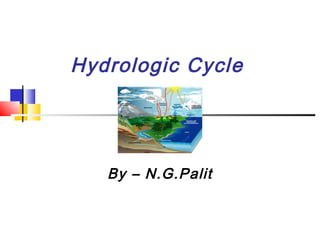
This is about the movement of
water on Earth
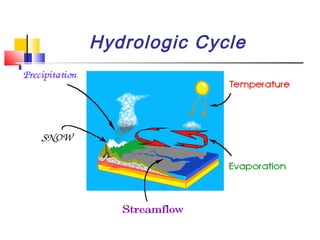
 Hydrologic Cycle is also
called Water Cycle.
It deals with the origin and
distribution of water on
the globe.
 Complex pathways
include passage of water from gaseous stage
in the atmosphere to oceans, lakes, rivers etc.
Hydorlogical Process
 Hydrological cycle includes the
following processes:
evaporation, condensation,
precipitation, interception,
infiltration, percolation,
transportation, runoff and storage.
Evaporation
 Evaporation occurs when
water changes from liquid
state to gaseous state.
 Evaporation occurs on
water surfaces like lakes,
seas etc. Evaporated moisture is lifted
into atmosphere. But, some vapor always
exists in the atmosphere.
Condensation
 Condensation is the
process by which water
vapor changes into water.
 Water vapor condenses
to form dew, fog or clouds.
 Condensation takes place due to cooling
of air.
Precipitation
 Precipitation is the process
that occurs when water
particles fall from the
atmosphere and reach the
ground.
 Precipitated water may fall into water
bodies or on land. It can then go to streams
or penetrate into the soil.
Interception
 Interception is the process
of interrupting the movement
of water in the chain of
transportation events
leading to streams.
 When rain first begins, water striking the
leaves and other materials spreads over
the surface or collects at points of edges.
Infiltration
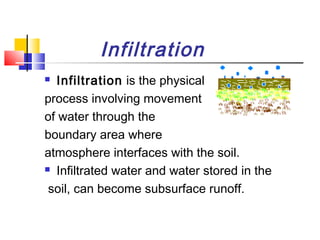
 Infiltration is the physical
process involving movement
of water through the
boundary area where
atmosphere interfaces with the soil.
 Infiltrated water and water stored in the
soil, can become subsurface runoff.
Percolation
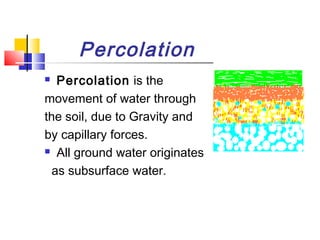
 Percolation is the
movement of water through
the soil, due to Gravity and
by capillary forces.
 All ground water originates
as subsurface water.
Transpiration
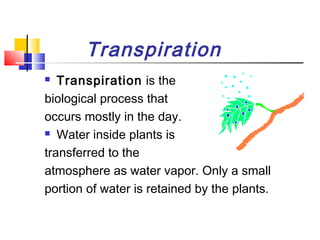
 Transpiration is the
biological process that
occurs mostly in the day.
 Water inside plants is
transferred to the
atmosphere as water vapor. Only a small
portion of water is retained by the plants.
Runoff
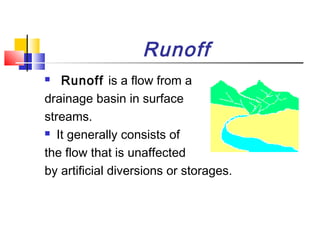
 Runoff is a flow from a
drainage basin in surface
streams.
 It generally consists of
the flow that is unaffected
by artificial diversions or storages.
Storage
 There are three basic water
storage places:
in atmosphere, on earth’s
surface, and in the ground.
 Surface storage places are:
ocean, lake, reservoirs, glaciers.
 Underground storage occurs in soil, in the
cracks of rocks etc.
Floods & Droughts
 Uneven distribution
and movement of
water can cause
extreme phenomena
such as Floods
and
Droughts.
Questions?
Thank You
By –
N.G.Palit
At the End
Please feel free to send your valuable
feedback to me at:
nandapalit@yahoo.co.in
OR
through facebook @nandapalit

Hydrologic cycle

  • 1.
  • 2.
  • 3.
    This is aboutthe movement of water on Earth  Hydrologic Cycle is also called Water Cycle. It deals with the origin and distribution of water on the globe.  Complex pathways include passage of water from gaseous stage in the atmosphere to oceans, lakes, rivers etc.
  • 4.
    Hydorlogical Process  Hydrologicalcycle includes the following processes: evaporation, condensation, precipitation, interception, infiltration, percolation, transportation, runoff and storage.
  • 5.
    Evaporation  Evaporation occurswhen water changes from liquid state to gaseous state.  Evaporation occurs on water surfaces like lakes, seas etc. Evaporated moisture is lifted into atmosphere. But, some vapor always exists in the atmosphere.
  • 6.
    Condensation  Condensation isthe process by which water vapor changes into water.  Water vapor condenses to form dew, fog or clouds.  Condensation takes place due to cooling of air.
  • 7.
    Precipitation  Precipitation isthe process that occurs when water particles fall from the atmosphere and reach the ground.  Precipitated water may fall into water bodies or on land. It can then go to streams or penetrate into the soil.
  • 8.
    Interception  Interception isthe process of interrupting the movement of water in the chain of transportation events leading to streams.  When rain first begins, water striking the leaves and other materials spreads over the surface or collects at points of edges.
  • 9.
    Infiltration  Infiltration isthe physical process involving movement of water through the boundary area where atmosphere interfaces with the soil.  Infiltrated water and water stored in the soil, can become subsurface runoff.
  • 10.
    Percolation  Percolation isthe movement of water through the soil, due to Gravity and by capillary forces.  All ground water originates as subsurface water.
  • 11.
    Transpiration  Transpiration isthe biological process that occurs mostly in the day.  Water inside plants is transferred to the atmosphere as water vapor. Only a small portion of water is retained by the plants.
  • 12.
    Runoff  Runoff isa flow from a drainage basin in surface streams.  It generally consists of the flow that is unaffected by artificial diversions or storages.
  • 13.
    Storage  There arethree basic water storage places: in atmosphere, on earth’s surface, and in the ground.  Surface storage places are: ocean, lake, reservoirs, glaciers.  Underground storage occurs in soil, in the cracks of rocks etc.
  • 14.
    Floods & Droughts Uneven distribution and movement of water can cause extreme phenomena such as Floods and Droughts.
  • 15.
  • 16.
  • 17.
    At the End Pleasefeel free to send your valuable feedback to me at: nandapalit@yahoo.co.in OR through facebook @nandapalit

Editor's Notes

  • #2 Psychoanalytical Theory of Personality James J. Messina, Ph.D. Dr Sigmund Freud 1856-1939 Oldest of eight children Married with 3 girls and 3 boys Physician-Biologist – Scientific oriented and Pathology oriented theory Jewish-anti-religion-All religion an illusion used to cope with feelings of infantile helplessness In Vienna Austria 78 years till 1938 Based theory on personal experiences Died of cancer of jaw & mouth lifelong cigar chain-smoker What is the Unconscious That portion of the mind inaccessible to usual, conscious thought Get to unconscious through Free Association: spontaneous free flowing associations of ideas and feelings Dream Interpretation Manifest Content: what a person remembers and consciously considers-only a partial representation Latent Content: underlying hidden meaning-vast underlying Unconscious can manifest itself symbolically in a dream Structure of the Mind Id – Pleasure Seeking Ego – Reality Focused Superego – Conscience over the Ego and Id ID basic psychic energy and motivations Operates to demands of Pleasure Principle-strive to satisfy desires and reduce inner tension Sea around an Island EGO deals with real world Operates to demands of Reality Principle solves problems by planning & acting City Hall on island roots and foundation in sea - id Superego internalized social norm & moral forces pressing on and constraining individual action The “over-I” over ego Church on island roots and foundation in sea - id Freudian Slip Psychological error in speaking or writing Evidence of some unconscious urge, desire, or conflict & struggle When ego or superego are not doing their job properly elements of id slip out or are seen Libido Sexual energy which underlies the tension between selfishness and society and inner tensions that strive for relief Psychosexual Theory of Development Five Stages of Development Oral Stage Anal Stage Phallic Stage Latency Period Genital Stage Oral Stage: Birth to 2 year Satisfy drive of hunger and thirst by breast or bottle If fixated after weaned: Over Dependency Over Attachment “Intake” of interesting substances/ideas Anal Stage: 2- 4 years Id wants pleasure of reducing tension by defecating & urinating Toilet training – get superego to impose societal norms Self-control Holding back Freedom of action no control Fixated at Anal Stage Enjoy bathroom humor-making messes-even of other people’s lives Neatness, order & organization and Obstinacy & Stinginess – Anal retentive- passive aggressive Phallic Stage: 4 – 6 years Sexual energy focused on genitals Masturbation Differences between boys and girls Emerging sexual gender identity Personality fixed by end of this stage Oedipus Complex A boy’s sexual feeling for his mother and rivalries with his father Psychological defenses against these threatening thoughts and feelings Form reaction pattern used throughout life Form personality through identification with father Diminish fear of castration-vicariously obtain mother through father Castration Anxiety Unconscious fear of loss of penis and becoming like a female Fear of powerful people overcoming them Fear of revenge of the powerful people Penis Envy A girl’s feelings of inferiority and jealousy Turns affections from mother to father since blame mom for no penis Although can’t have penis can have baby Wants to find a good man like her father and produce a baby Latency Period 5-11 years of age Time between resolution of Oedipus complex and puberty Usually not possible for sexual urges to be directly expressed Sexual energies are channeled into school and friends Genital Stage Adolescence - Adulthood Normal sexual relations Marriage Child-rearing Defense Mechanisms To protect the ego against the painful and threatening impulses arising from the id we distort the reality The processes that distort the reality for the ego are called defense mechanisms Types of Defense Mechanisms Repression Reaction Formation Denial Projection Displacement Sublimation Regression Rationalization Repression Pushes threatening thoughts back into the unconscious Posttraumatic Stress Disorder- PTSD – Common with veterans and victims of sexual abuse False memories – suggested through psychotherapist intentionally or unintentionally Reaction Formation Process of pushing away threatening impulses by overemphasizing the opposite in one’s thoughts and actions Examples: Jim Bakker & Jimmy Swaggart Denial Refusing to acknowledge anxiety-provoking stimuli Mind’s means of keeping its own sensations out of conscious awareness Or That fabulous river which runs down the middle of Egypt which many of us sail on Projection Anxiety-arousing impulses are externalized by placing them, or projecting them, onto others. A person’s inner threats are attributed to those around them Newt Gingrich: public diatribe against infidelity of president while engaged in ownlong term infidelity out of public eye Displacement The shifting of the targets of one’s unconscious fears or desires Hydraulic Replacement Model Some release valve must be found for the bottled-up aggressive impulses triggered by frustration and humiliation Example: Man angry at boss kicks dog, kids Tools for Anger Workout-www.coping.org Sublimation Transforming of dangerous urges into positive, socially acceptable motivation Turns sexual energy away fro sexual ends and towards societal goals Is is possible that as society becomes more sexually liberated, art, creativity and even civilization will suffer? Regression Returning to earlier, safer stages of our lives There may be regression to the stage where there was previous fixation Rationalization A mechanism involving post hoc logical explanations for behaviors that were actually driven by internal unconscious motives Explanation for behavior not even remotely related to the true causes Contributions of Freud First personality theory Emphasis on sexuality as influence Importance of early childhood experience Concept of unconscious Scientific approach to mental health on continuum from physical health Limitations of Freud’s Work Pessimistic and deterministic approach to personality Pathology based theory Hydraulic model of psychic energy exaggerated No controlled studies-poor research Overemphasis on differences between men and women Unconcerned with interpersonal relations, individual identity and adaptation over one’s lifetime Hypermnesia “Excessive memory” situation in which a later attempt to remember something yields information that was not reportable on an earlier attempt to remember. Memory flooding Infantile Amnesia Most adults cannot remember much of what happened to them before age three or four Adults cannot remember any things be they traumatic or not Still not clear why Subliminal Perception Very weak stimuli could be perceived and processed without conscious awareness of such stimulus having occurred. Not consciously aware of stimuli that are nevertheless being processed by some parts of our brain Memory Fact: every person experiences every event from a unique, individual perspective that depends on a person’s needs, goals, assumptions and other experiences Fact: individualized memory is a complex, multifaceted, constantly changing representation -What is reported about the event varies tremendously with the circumstances under which the memory is probed Explicit vs Implicit Memory Explicit memory: can recall or recognize something Implicit memory: change how think or behave as a result of some experience that do not consciously recall Procedural Memory vsDeclarative Memory Representation of the skill itself can be present in memory even in the absence of conscious memory for the event during which the skill was acquired. Procedural: Memory for how to do the task Declarative: Memory for facts about a task or event