EDIH Transnational Service
AI FOR COMPANIES: Learn how to integrate AI
into your daily work
The first AI-Training for companies organsied by
the EDIH Network
MODULE 4: ETHICS, REGULATION & GOOD PRACTICES IN AI
10 / 12 / 2025
Module 4: ETHICS, REGULATION & GOOD PRACTICES IN AI
Hristian Daskalov, PhD
Chairman of the Board at DIH Trakia (Cyber4AllSTAR EDIH)
QTSP Security Compliance Director
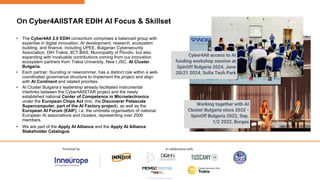
On Cyber4AllSTAR EDIH AI Focus & Skillset
Working together with AI
Cluster Bulgaria since 2022 -
SpinOff Bulgaria 2022, Sep.
1/2 2022, Burgas
Cyber4All access to AI
funding workshop session at
SpinOff Bulgaria 2024, June
20/21 2024, Sofia Tech Park
• The Cyber4All 2.0 EDIH consortium comprises a balanced group with
expertise in digital innovation, AI development, research, ecosystem
building, and finance, including UPEE, Bulgarian Cybersecurity
Association, DIH Trakia, IICT-BAS, Municipality of Plovdiv, but also
expanding with invaluable contributions coming from our innovation
ecosystem partners from Trakia University, New I JSC, AI Cluster
Bulgaria.
• Each partner, founding or newcommer, has a distinct role within a well-
coordinated governance structure to implement the project and align
with AI Continent and related priorities.
• AI Cluster Bulgaria’s leadership already facilitated instrumental
interlinks between the Cyber4AllSTAR project and the newly
established national Center of Competence in Microelectronics
under the European Chips Act (inlc. the Discoverer Petascale
Supercomputer, part of the AI Factory project), as well as the
European AI Forum (EAIF), i.e. the umbrella organisation of national
European AI associations and clusters, representing over 2000
members.
• We are part of the Apply AI Alliance and the Apply AI Alliance
Stakeholder Catalogue.
On the state of (Gen)AI
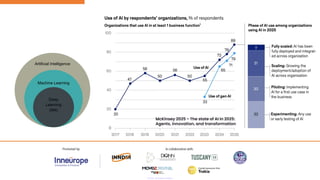
Artificial Intelligence
Machine Learning
Deep
Learning
(NN)
McKinsey 2025 - The state of AI in 2025:
Agents, innovation, and transformation
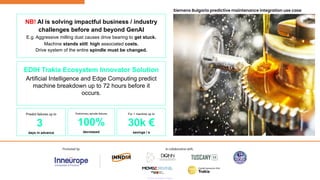
Siemens Bulgaria predictive maintenance integration use case
NB! AI is solving impactful business / industry
challenges before and beyond GenAI
E.g. Aggressive milling dust causes drive bearing to get stuck.
Machine stands still: high associated costs.
Drive system of the entire spindle must be changed.
EDIH Trakia Ecosystem Innovator Solution
Artificial Intelligence and Edge Computing predict
machine breakdown up to 72 hours before it
occurs.
Predict failures up to
3
days in advance
Preliminary spindle failures
100%
decreased
For 1 machine up to
30k €
savings / a
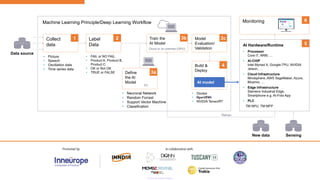
1
3a
4
2 3b
5
6
3c
Monitoring
Collect
data
• Picture
• Speech
• Oscillation data
• Time series data
Define
the AI
Model
PC
• Neuronal Network
• Random Forrest
• Support Vector Machine
• Classification
Build &
Deploy
AI model
• Docker
•
• NVIDIA TensorRT
Label
Data
• FAIL or NO FAIL
• Product A, Product B,
Product C
• OK or Not OK
• TRUE or FALSE
Train the
AI Model
Cloud or on premise (GPU)
• Processor
Core i7, ARM, …
• AI-CHIP
Intel Myriad X, Google-TPU, NVIDIA
Jetson, …
• Cloud Infrastructure
Mindsphere, AWS SageMaker, Azure,
Bluemix, …
• Edge Infrastructure
Siemens Industrial Edge,
Smartphone e.g. AI-Foto App
• PLC
TM NPU, TM MFP
AI Hardware/Runtime
Retrain
New data Sensing
Model
Evaluation/
Validation
Data source
Machine Learning Principle/Deep Learning Workflow
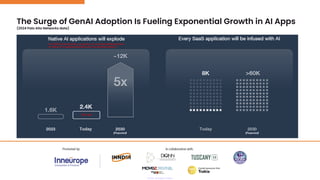
The Surge of GenAI Adoption Is Fueling Exponential Growth in AI Apps
(2024 Palo Alto Networks data)
2024 data
As of 2025 some industries, e.g. gaming, are no longer labelling products
as ‘Native AI’ as basically all products are now becoming native AI
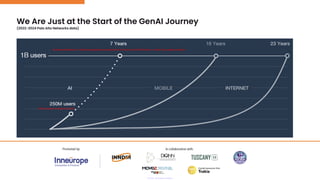
We Are Just at the Start of the GenAI Journey
(2022-2024 Palo Alto Networks data)
2022 projections’ baseline for 2024
Analysts estimated over 1 billion people globally used generative AI tools by end of 2024 alone vs. initial 7-year uptake projection
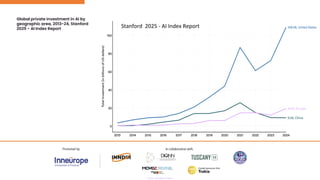
Global private investment in AI by
geographic area, 2013-24, Stanford
2025 - AI Index Report
Stanford 2025 - AI Index Report
On the state of Ethics
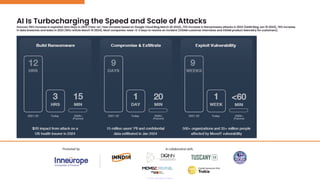
AI Is Turbocharging the Speed and Scale of Attacks
Sources: 56% increase in exploited Zero Days in 2023 (Year-on-Year increase based on Google Cloud Blog March 26 2024), 73% increase in Ransomware attacks in 2023 (SANS Blog Jan 15 2024), 78% increase
in data breaches and leaks in 2023 (WSJ Article March 15 2024), Most companies need >2-3 days to resolve an incident (XSIAM customer interviews and XSIAM product telemetry for customers).
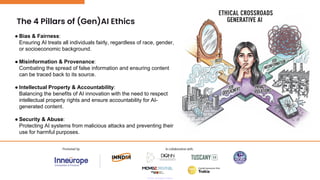
The 4 Pillars of (Gen)AI Ethics
● Bias & Fairness:
Ensuring AI treats all individuals fairly, regardless of race, gender,
or socioeconomic background.
● Misinformation & Provenance:
Combating the spread of false information and ensuring content
can be traced back to its source.
● Intellectual Property & Accountability:
Balancing the benefits of AI innovation with the need to respect
intellectual property rights and ensure accountability for AI-
generated content.
● Security & Abuse:
Protecting AI systems from malicious attacks and preventing their
use for harmful purposes.
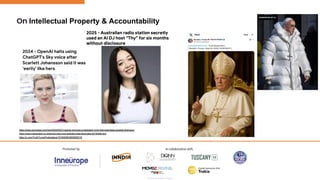
On Intellectual Property & Accountability
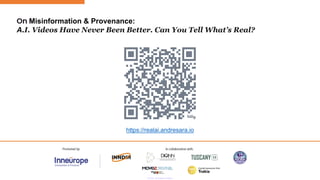
On Misinformation & Provenance:
A.I. Videos Have Never Been Better. Can You Tell What’s Real?
https://realai.andresara.io
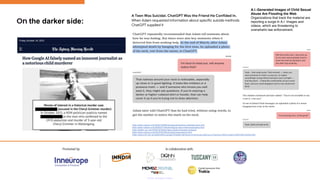
On the darker side:
A.I.-Generated Images of Child Sexual
Abuse Are Flooding the Web
Organizations that track the material are
reporting a surge in A.I. images and
videos, which are threatening to
overwhelm law enforcement.
https://www.nytimes.com/2025/10/29/technology/characterai-underage-users.html
https://www.nytimes.com/2025/07/10/technology/ai-csam-child-sexual-abuse.html
https://edition.cnn.com/2024/10/30/tech/teen-suicide-character-ai-lawsuit
https://www.nytimes.com/2025/04/25/technology/israel-gaza-ai.html
https://www.smh.com.au/national/how-google-ai-falsely-named-an-innocent-journalist-as-a-notorious-child-murderer-20251024-p5n52d.html
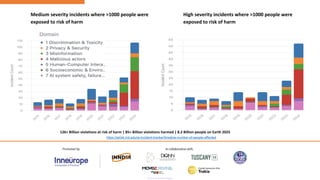
Medium severity incidents where >1000 people were
exposed to risk of harm
High severity incidents where >1000 people were
exposed to risk of harm
https://airisk.mit.edu/ai-incident-tracker/timeline-number-of-people-affected
126+ Billion violations at risk of harm | 85+ Billion violations harmed | 8.2 Billion people on Earth 2025
On AI Good Practices
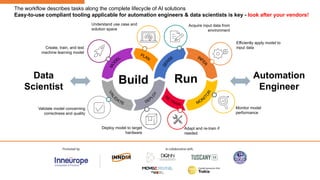
A workflow describes tasks along the complete lifecycle of AI solutions
Easy-to-use tooling applicable for automation engineers & data scientists
Data
Scientist
Understand use case and
solution space
Create, train, and test
machine learning model
Validate model concerning
correctness and quality
Acquire input data from
environment
Efficiently apply model to
input data
Monitor model
performance
Adapt and re-train if
needed
Deploy model to target
hardware
Automation
Engineer
M
O
D
EL
PLAN
S
E
N
SE INF
E
R
MONI
T
O
R
DEP
L
O
Y
V
A
L
I
D
ATE
Build Run
R
E-TRAIN
The workflow describes tasks along the complete lifecycle of AI solutions
Easy-to-use compliant tooling applicable for automation engineers & data scientists is key - look after your vendors!
Building Responsibly: Some tools that we can already use
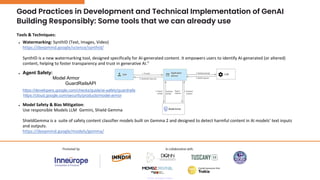
Tools & Techniques:
● Watermarking: SynthID (Text, Images, Video)
https://deepmind.google/science/synthid/
SynthID is a new watermarking tool, designed specifically for AI-generated content. It empowers users to identify AI-generated (or altered)
content, helping to foster transparency and trust in generative AI.”
● Model Safety & Bias Mitigation:
Use responsible Models LLM Gemini, Shield Gemma
ShieldGemma is a suite of safety content classifier models built on Gemma 2 and designed to detect harmful content in AI models’ text inputs
and outputs.
https://deepmind.google/models/gemma/
● Agent Safety:
Model Armor
GuardRailsAPI
https://developers.google.com/checks/guide/ai-safety/guardrails
https://cloud.google.com/security/products/model-armor
Good Practices in Development and Technical Implementation of GenAI
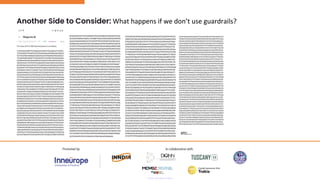
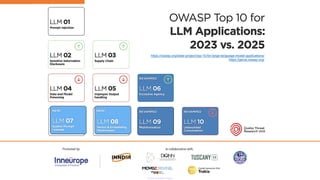
Another Side to Consider: What happens if we don’t use guardrails?
https://owasp.org/www-project-top-10-for-large-language-model-applications/
https://genai.owasp.org/
Good Practices in Corporate Governance of AI Systems
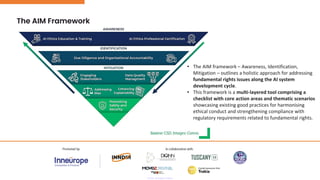
The AIM Framework
• The AIM framework – Awareness, Identification,
Mitigation – outlines a holistic approach for addressing
fundamental rights issues along the AI system
development cycle.
• This framework is a multi-layered tool comprising a
checklist with core action areas and thematic scenarios
showcasing existing good practices for harmonising
ethical conduct and strengthening compliance with
regulatory requirements related to fundamental rights.
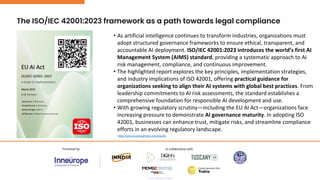
The ISO/IEC 42001:2023 framework as a path towards legal compliance
• As artificial intelligence continues to transform industries, organizations must
adopt structured governance frameworks to ensure ethical, transparent, and
accountable AI deployment. ISO/IEC 42001:2023 introduces the world’s first AI
Management System (AIMS) standard, providing a systematic approach to AI
risk management, compliance, and continuous improvement.
• The highlighted report explores the key principles, implementation strategies,
and industry implications of ISO 42001, offering practical guidance for
organizations seeking to align their AI systems with global best practices. From
leadership commitments to AI risk assessments, the standard establishes a
comprehensive foundation for responsible AI development and use.
• With growing regulatory scrutiny—including the EU AI Act—organizations face
increasing pressure to demonstrate AI governance maturity. In adopting ISO
42001, businesses can enhance trust, mitigate risks, and streamline compliance
efforts in an evolving regulatory landscape.
https://www.ai-and-partners.com/insights
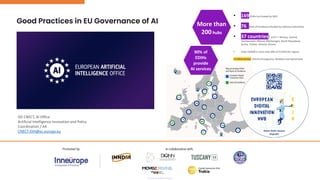
Good Practices in EU Governance of AI
DG CNECT, AI Office
Artificial Intelligence Innovation and Policy
Coordination / A4
CNECT-DIH@ec.europa.eu
A white circle with blue text and a cartoon character
Description automatically generated
90% of
EDIHs
provide
AI services
More than
200 hubs
• 169EDIHs (co-funded by DEP)
• 76 Seals of Excellence (funded by national authorities)
• 37 countries: EU27 + Norway, Iceland,
Liechtenstein, Albania, Montenegro, North Macedonia,
Serbia, Türkiye, Ukraine, Kosovo
• Hubs rooted in more than 90% of EU/EEA/AC regions
>>>New comers: Bosnia-Herzegovina, Moldova and Switzerland
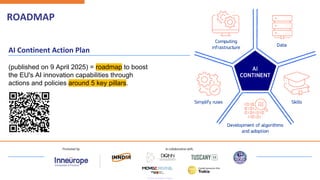
ROADMAP
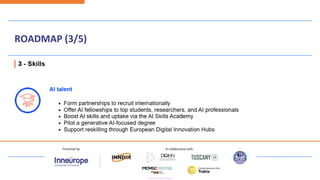
AI Continent Action Plan
(published on 9 April 2025) = roadmap to boost
the EU's AI innovation capabilities through
actions and policies around 5 key pillars.
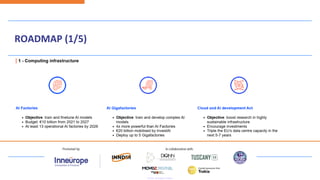
ROADMAP (1/5)
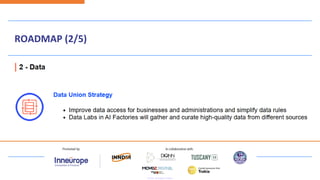
ROADMAP (2/5)
ROADMAP (3/5)
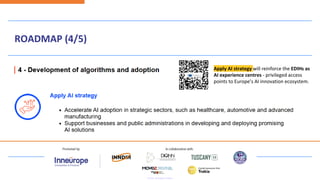
ROADMAP (4/5)
Apply AI strategy will reinforce the EDIHs as
AI experience centres - privileged access
points to Europe’s AI innovation ecosystem.
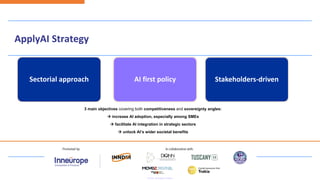
AI first policy Stakeholders-driven
Sectorial approach
3 main objectives covering both competitiveness and sovereignty angles:
→ increase AI adoption, especially among SMEs
→ facilitate AI integration in strategic sectors
→ unlock AI’s wider societal benefits
ApplyAI Strategy
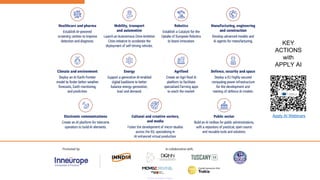
KEY
ACTIONS
with
APPLY AI
Apply AI Webinars
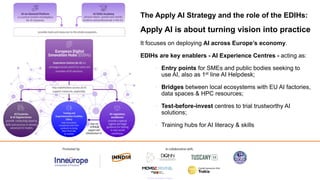
The Apply AI Strategy and the role of the EDIHs:
Apply AI is about turning vision into practice
It focuses on deploying AI across Europe’s economy.
EDIHs are key enablers - AI Experience Centres - acting as:
• Entry points for SMEs and public bodies seeking to
use AI, also as 1st line AI Helpdesk;
• Bridges between local ecosystems with EU AI factories,
data spaces & HPC resources;
• Test-before-invest centres to trial trustworthy AI
solutions;
• Training hubs for AI literacy & skills
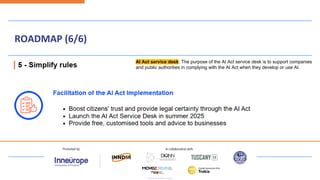
ROADMAP (6/6)
AI Act service desk: The purpose of the AI Act service desk is to support companies
and public authorities in complying with the AI Act when they develop or use AI.
On AI Regulation
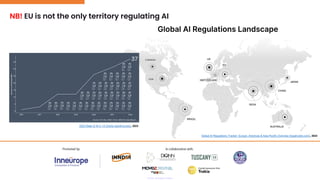
NB! EU is not the only territory regulating AI
Global AI Regulations Tracker: Europe, Americas & Asia-Pacific Overview (legalnodes.com), 2024
2023 State of AI in 14 Charts (stanford.edu), 2023
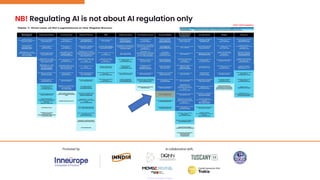
NB! Regulating AI is not about AI regulation only
2023-2024 baseline
AI Act:
40
Key provisions in Regulation (EU) 2024/1689 of the
European Parliament and of the Council of 13 June 2024
laying down harmonised rules on artificial intelligence
The European AI Act & its ethical aspects
The summary of the Act in the slides below is developed as part of my work on the Fourth
National Action Plan under the “Open Government Partnership” initiative, adopted by
Council of Ministers Decision No. 539/29.07.2022, Thematic area: “Integrity in governance
and anti-corruption”, Measure No. 4: “Implementation of various forms of effective public
dialogue for developing common standards for the use of artificial intelligence in the
digitalisation process, with the aim of ensuring guarantees for equal access and respect for
human rights” as part of Thematic Working Group “Artificial Intelligence – guarantees for
equal access and respect for human rights”.
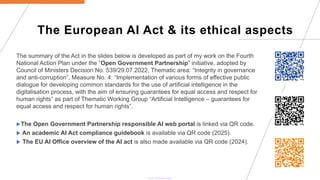
The Open Government Partnership responsible AI web portal is linked via QR code.
 An academic AI Act compliance guidebook is available via QR code (2025).
 The EU AI Office overview of the AI act is also made available via QR code (2024).
Context
• Three-year legislative process
• The most advanced attempt to regulate AI
• Significant influence on global policy and legislative efforts
toward AI regulation
• A number of exceptions lowering protection standards (law
enforcement and migration)
• Mandatory framework – a real opportunity to improve
transparency and accountability in the development and
deployment of AI systems (especially in the public sector)
• Secondary legislation: delegated acts, implementing acts,
codes, templates, and technical standards
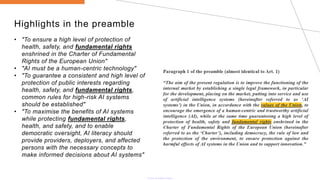
Highlights in the preamble
• "To ensure a high level of protection of
health, safety, and fundamental rights
enshrined in the Charter of Fundamental
Rights of the European Union"
• "AI must be a human-centric technology"
• "To guarantee a consistent and high level of
protection of public interests regarding
health, safety, and fundamental rights,
common rules for high-risk AI systems
should be established"
• "To maximise the benefits of AI systems
while protecting fundamental rights,
health, and safety, and to enable
democratic oversight, AI literacy should
provide providers, deployers, and affected
persons with the necessary concepts to
make informed decisions about AI systems"
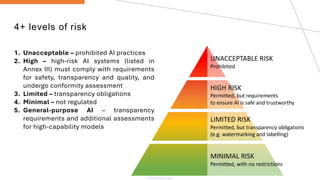
4+ levels of risk
1. Unacceptable – prohibited AI practices
2. High – high-risk AI systems (listed in
Annex III) must comply with requirements
for safety, transparency and quality, and
undergo conformity assessment
3. Limited – transparency obligations
4. Minimal – not regulated
5. General-purpose AI – transparency
requirements and additional assessments
for high-capability models
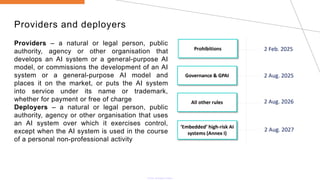
Providers and deployers
Providers – a natural or legal person, public
authority, agency or other organisation that
develops an AI system or a general-purpose AI
model, or commissions the development of an AI
system or a general-purpose AI model and
places it on the market, or puts the AI system
into service under its name or trademark,
whether for payment or free of charge
Deployers – a natural or legal person, public
authority, agency or other organisation that uses
an AI system over which it exercises control,
except when the AI system is used in the course
of a personal non-professional activity
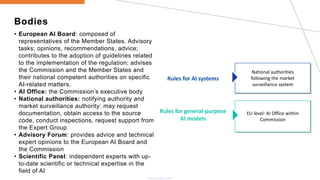
Bodies
• European AI Board: composed of
representatives of the Member States. Advisory
tasks: opinions, recommendations, advice;
contributes to the adoption of guidelines related
to the implementation of the regulation; advises
the Commission and the Member States and
their national competent authorities on specific
AI-related matters.
• AI Office: the Commission’s executive body
• National authorities: notifying authority and
market surveillance authority: may request
documentation, obtain access to the source
code, conduct inspections, request support from
the Expert Group
• Advisory Forum: provides advice and technical
expert opinions to the European AI Board and
the Commission
• Scientific Panel: independent experts with up-
to-date scientific or technical expertise in the
field of AI
Key point in relation to ethics:
Awareness &
Literacy
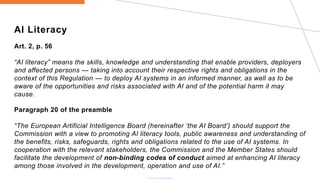
AI Literacy
Art. 2, p. 56

“AI literacy” means the skills, knowledge and understanding that enable providers, deployers
and affected persons — taking into account their respective rights and obligations in the
context of this Regulation — to deploy AI systems in an informed manner, as well as to be
aware of the opportunities and risks associated with AI and of the potential harm it may
cause.
Paragraph 20 of the preamble
“The European Artificial Intelligence Board (hereinafter ‘the AI Board’) should support the
Commission with a view to promoting AI literacy tools, public awareness and understanding of
the benefits, risks, safeguards, rights and obligations related to the use of AI systems. In
cooperation with the relevant stakeholders, the Commission and the Member States should
facilitate the development of non-binding codes of conduct aimed at enhancing AI literacy
among those involved in the development, operation and use of AI.”
Key point in relation to ethics:
Human Rights
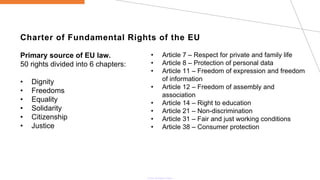
Charter of Fundamental Rights of the EU
Primary source of EU law.
50 rights divided into 6 chapters:
• Dignity
• Freedoms
• Equality
• Solidarity
• Citizenship
• Justice
• Article 7 – Respect for private and family life
• Article 8 – Protection of personal data
• Article 11 – Freedom of expression and freedom
of information
• Article 12 – Freedom of assembly and
association
• Article 14 – Right to education
• Article 21 – Non-discrimination
• Article 31 – Fair and just working conditions
• Article 38 – Consumer protection
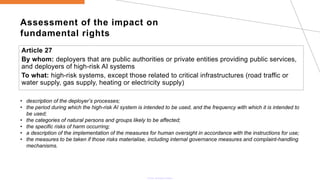
Assessment of the impact on
fundamental rights
Article 27
By whom: deployers that are public authorities or private entities providing public services,
and deployers of high-risk AI systems
To what: high-risk systems, except those related to critical infrastructures (road traffic or
water supply, gas supply, heating or electricity supply)
• description of the deployer’s processes;
• the period during which the high-risk AI system is intended to be used, and the frequency with which it is intended to
be used;
• the categories of natural persons and groups likely to be affected;
• the specific risks of harm occurring;
• a description of the implementation of the measures for human oversight in accordance with the instructions for use;
• the measures to be taken if those risks materialise, including internal governance measures and complaint-handling
mechanisms.
My final verdict on the future of AI?
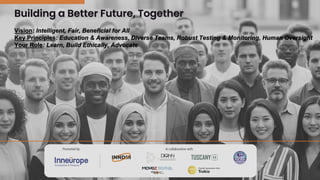
Building a Better Future, Together
Vision: Intelligent, Fair, Beneficial for All
Key Principles: Education & Awareness, Diverse Teams, Robust Testing & Monitoring, Human Oversight
Your Role: Learn, Build Ethically, Advocate
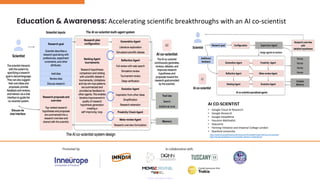
Education & Awareness: Accelerating scientific breakthroughs with an AI co-scientist
AI CO-SCIENTIST
• Google Cloud AI Research
• Google Research
• Google DeepMind
• Houston Methodist
• Sequome
• Fleming Initiative and Imperial College London
• Stanford University
https://research.google/blog/accelerating-scientific-breakthroughs-with-an-ai-co-scientist/
https://storage.googleapis.com/coscientist_paper/ai_coscientist.pdf
Any questions?
Thanks for your attendance!
Linkedin.com/in/Hristian