GROUND WATER
DEFINITION:
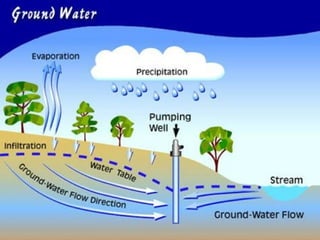
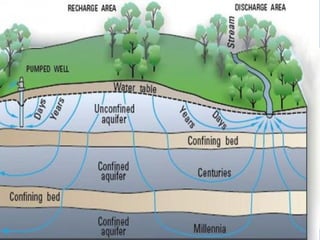
• Groundwater (or ground water)  is  the water present 
beneath Earth's  surface  in soil pore spaces  and  in 
the fractures of rock formations.
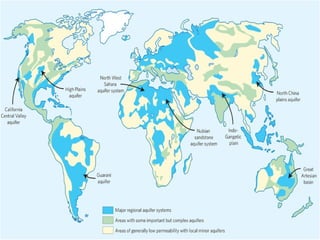
•   A  unit  of  rock  or  an  unconsolidated  deposit  is  called 
an aquifer when it can yield a usable quantity of water. 
• The depth at which soil pore spaces or fractures and voids in rock 
become completely saturated with water is called the water table.
USES:
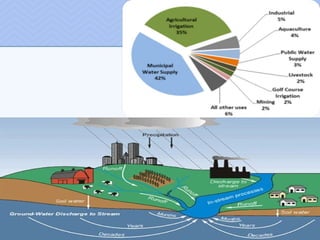
• Groundwater is also often withdrawn
for agricultural, municipal, and industrial use by
constructing and operating extraction wells.
• The study of the distribution and movement of
groundwater is hydrogeology, also called
GROUNDWATER HYDROLOGY.
• Groundwater is often cheaper, more convenient and
less vulnerable to pollution than surface water.
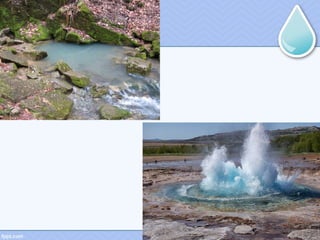
SPRINGS:
• A spring is the result of an aquifer being filled to the point
that the water overflows onto the land surface.
• They range in size from intermittent seeps, which flow only
after much rain, to huge pools flowing hundreds of millions of
gallons daily.
• Types of springs:
• Seepage or filtration spring. The term seep refers to springs
with small flow rates in which the source water has filtered
through permeable earth.
• Fracture springs, discharge from faults, joints, or fissures in
the earth, in which springs have followed a natural course of
voids or weaknesses in the bedrock.
CONE OF DEPRESSION:
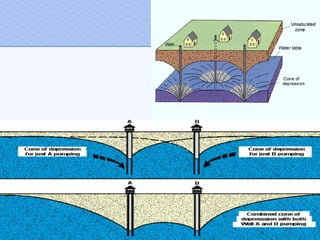
• A cone of depression occurs in 
an aquifer when groundwater is pumped from a well. 
In an unconfined aquifer (water table), this is an 
actual depression of the water levels. 
• In confined aquifers (artesian), the cone of depression 
is a reduction in the pressure head surrounding the 
pumped well.
DIFFERENCE:
• The size and shape (slope) of the cone of depression 
depends on many factors. The pumping rate in the 
well will affect the size of the cone.
•  Also, the type of aquifer material, such as whether 
the aquifer is , sand,silt, fractured rocksetc., also will 
affect how far the cone extends. 
• The amount of water in storage and the thickness of 
the aquifer also will determine the size and shape of 
the cone of depression.
• As a well is pumped, the cone of depression will
extend out and will continue to expand in a radial
fashion until a point of equilibrium occurs.
• This usually is when the amount of water released
from storage equals the rate of pumping. This also
can occur when recharge to the aquifer equals the
amount of water being pumped.

Ground water

  • 1.
  • 2.
    DEFINITION: • Groundwater (or ground water) is  the water present  beneath Earth's  surface  in soil pore spaces  and  in  the fractures of rock formations. •   A  unit  of  rock  or  an  unconsolidated  deposit  is  called  an aquifer when it can yield a usable quantity of water.  • The depth at which soil pore spaces or fractures and voids in rock  become completely saturated with water is called the water table.
  • 5.
    USES: • Groundwater isalso often withdrawn for agricultural, municipal, and industrial use by constructing and operating extraction wells. • The study of the distribution and movement of groundwater is hydrogeology, also called GROUNDWATER HYDROLOGY. • Groundwater is often cheaper, more convenient and less vulnerable to pollution than surface water.
  • 8.
    SPRINGS: • A springis the result of an aquifer being filled to the point that the water overflows onto the land surface. • They range in size from intermittent seeps, which flow only after much rain, to huge pools flowing hundreds of millions of gallons daily. • Types of springs: • Seepage or filtration spring. The term seep refers to springs with small flow rates in which the source water has filtered through permeable earth. • Fracture springs, discharge from faults, joints, or fissures in the earth, in which springs have followed a natural course of voids or weaknesses in the bedrock.
  • 10.
    CONE OF DEPRESSION: •A cone of depression occurs in  an aquifer when groundwater is pumped from a well.  In an unconfined aquifer (water table), this is an  actual depression of the water levels.  • In confined aquifers (artesian), the cone of depression  is a reduction in the pressure head surrounding the  pumped well.
  • 12.
  • 13.
    • As awell is pumped, the cone of depression will extend out and will continue to expand in a radial fashion until a point of equilibrium occurs. • This usually is when the amount of water released from storage equals the rate of pumping. This also can occur when recharge to the aquifer equals the amount of water being pumped.