Al-Azhar University-Gaza
Master Program of Water and Environmental
Science

November 2013
Properties of aquifer
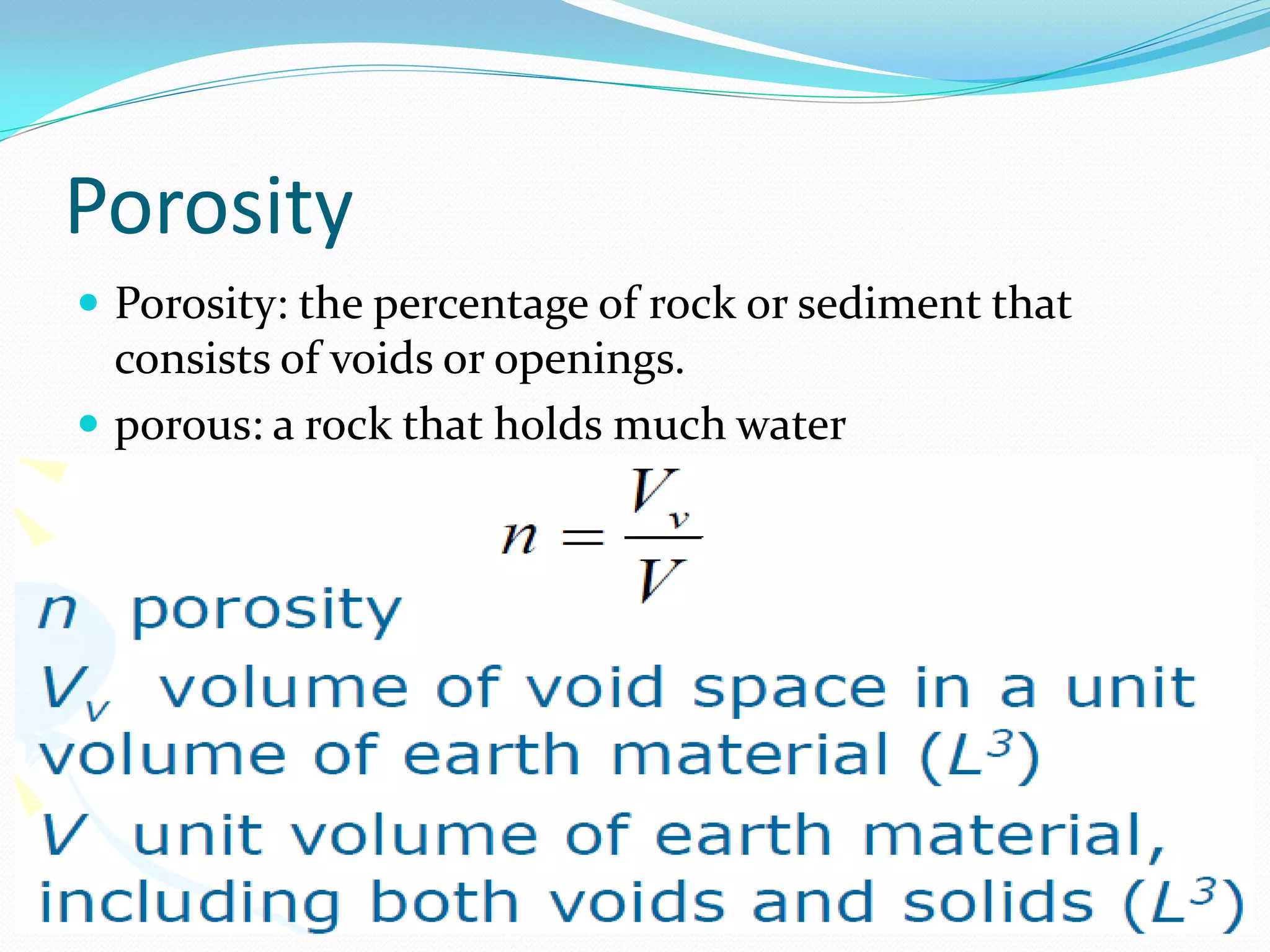
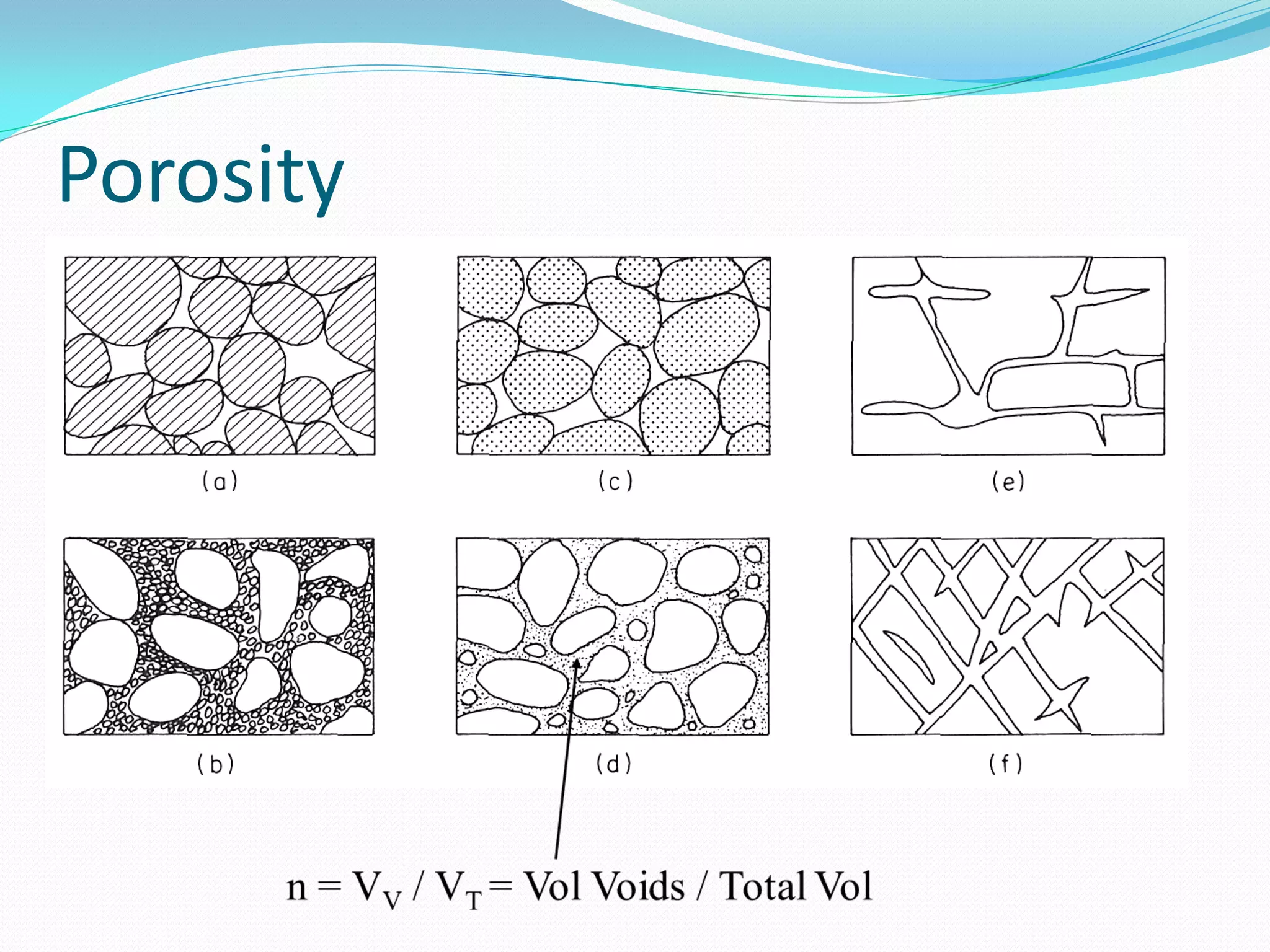
Porosity
 Porosity: the percentage of rock or sediment that

consists of voids or openings.
 porous: a rock that holds much water
Porosity
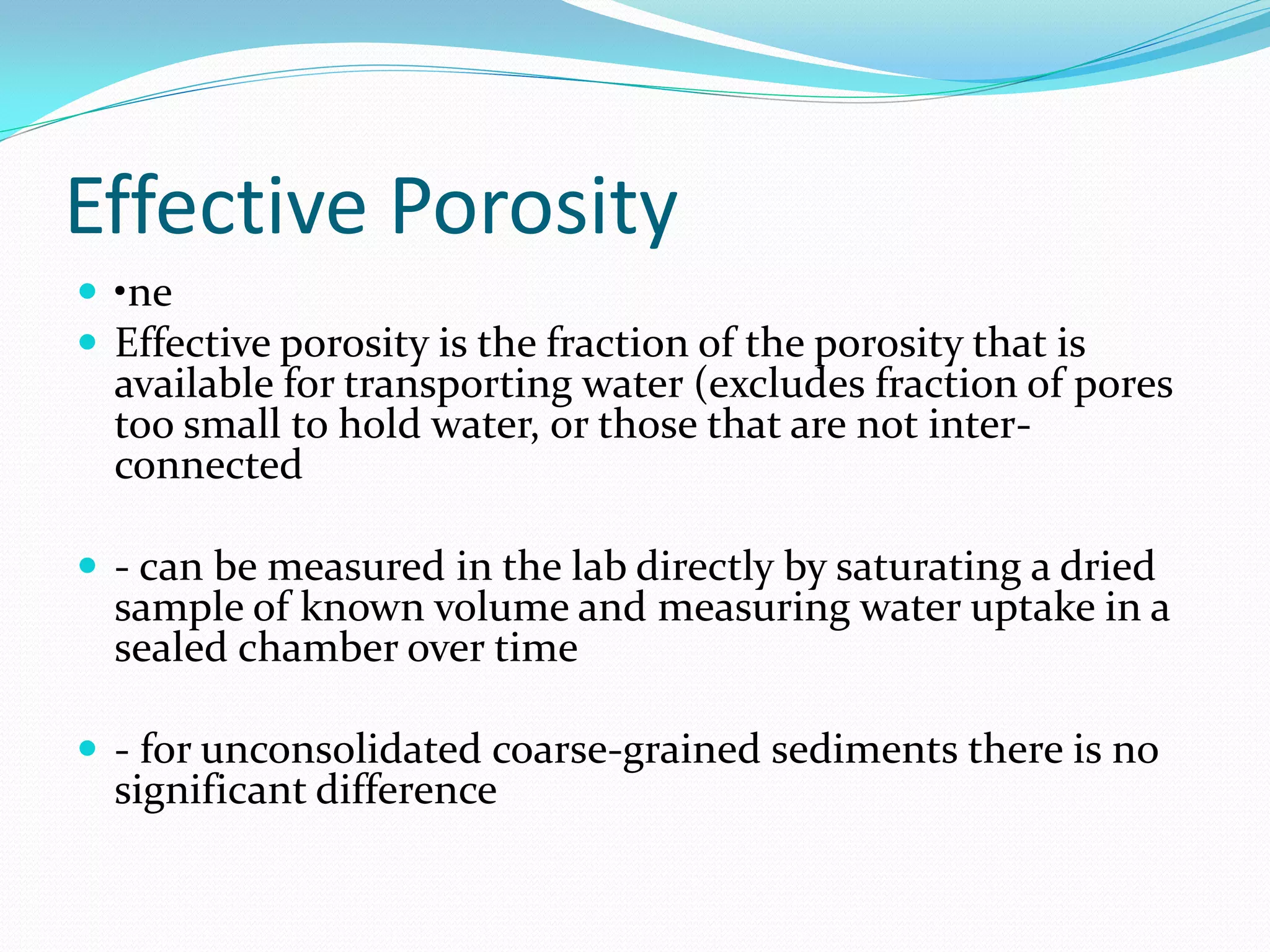
Effective Porosity
 •ne
 Effective porosity is the fraction of the porosity that is

available for transporting water (excludes fraction of pores
too small to hold water, or those that are not interconnected

 - can be measured in the lab directly by saturating a dried

sample of known volume and measuring water uptake in a
sealed chamber over time

 - for unconsolidated coarse-grained sediments there is no

significant difference
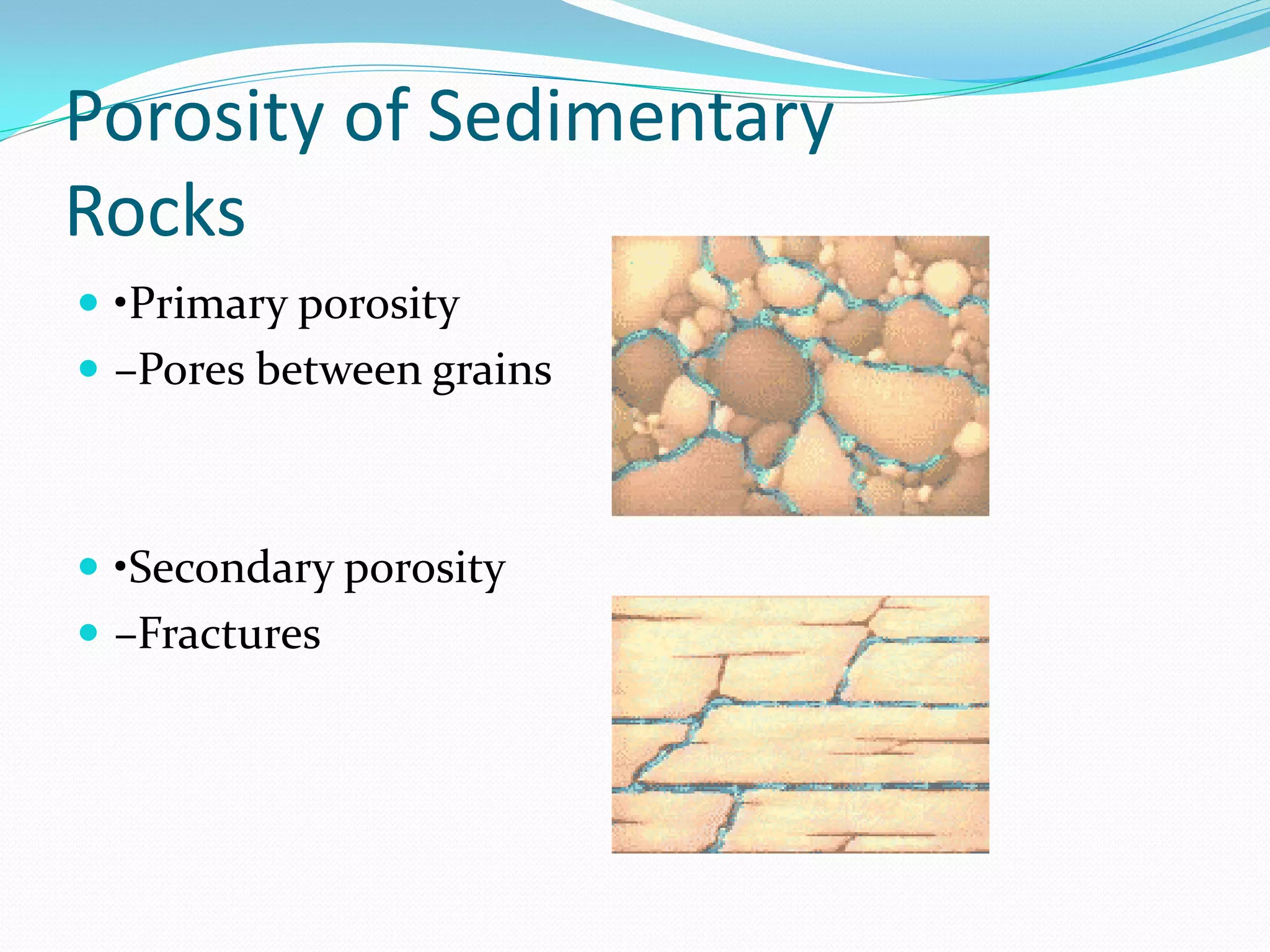
Porosity of Sedimentary
Rocks
 •Primary porosity
 –Pores between grains

 •Secondary porosity
 –Fractures
Permeability
 permeability: the capacity of a rock to transmit a fluid

such as water or petroleum through pores and
fractures
 permeable: a rock that allows water to flow easily
through it
 impermeable: a rock that does not allow water to flow
through it easily
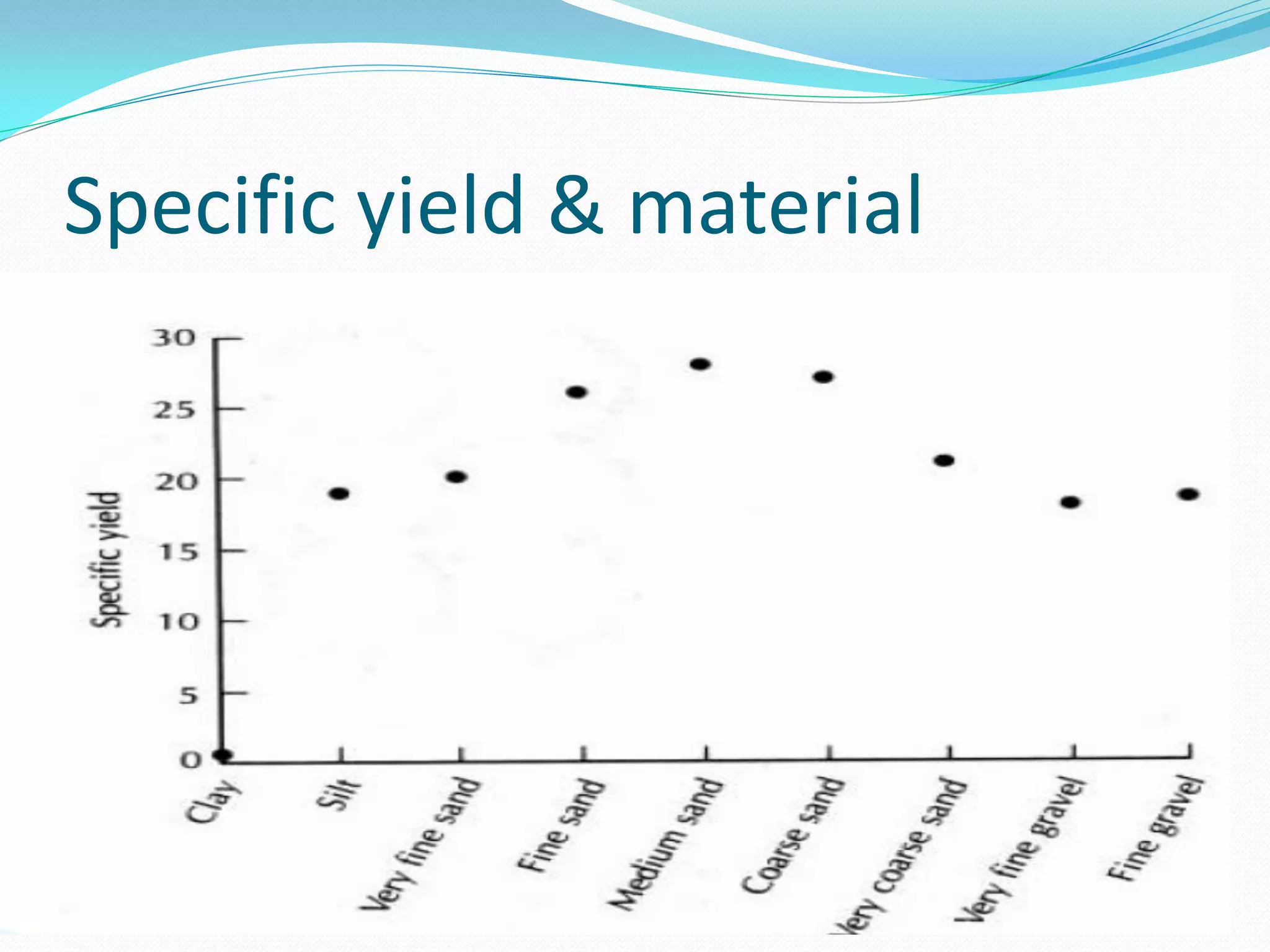
Specific Yield (Sy)
 •Specific Yield Sy the ratio of the volume of water that

drains from a saturated geomaterialowing to the
attraction of gravity to the total volume of the
geomaterial
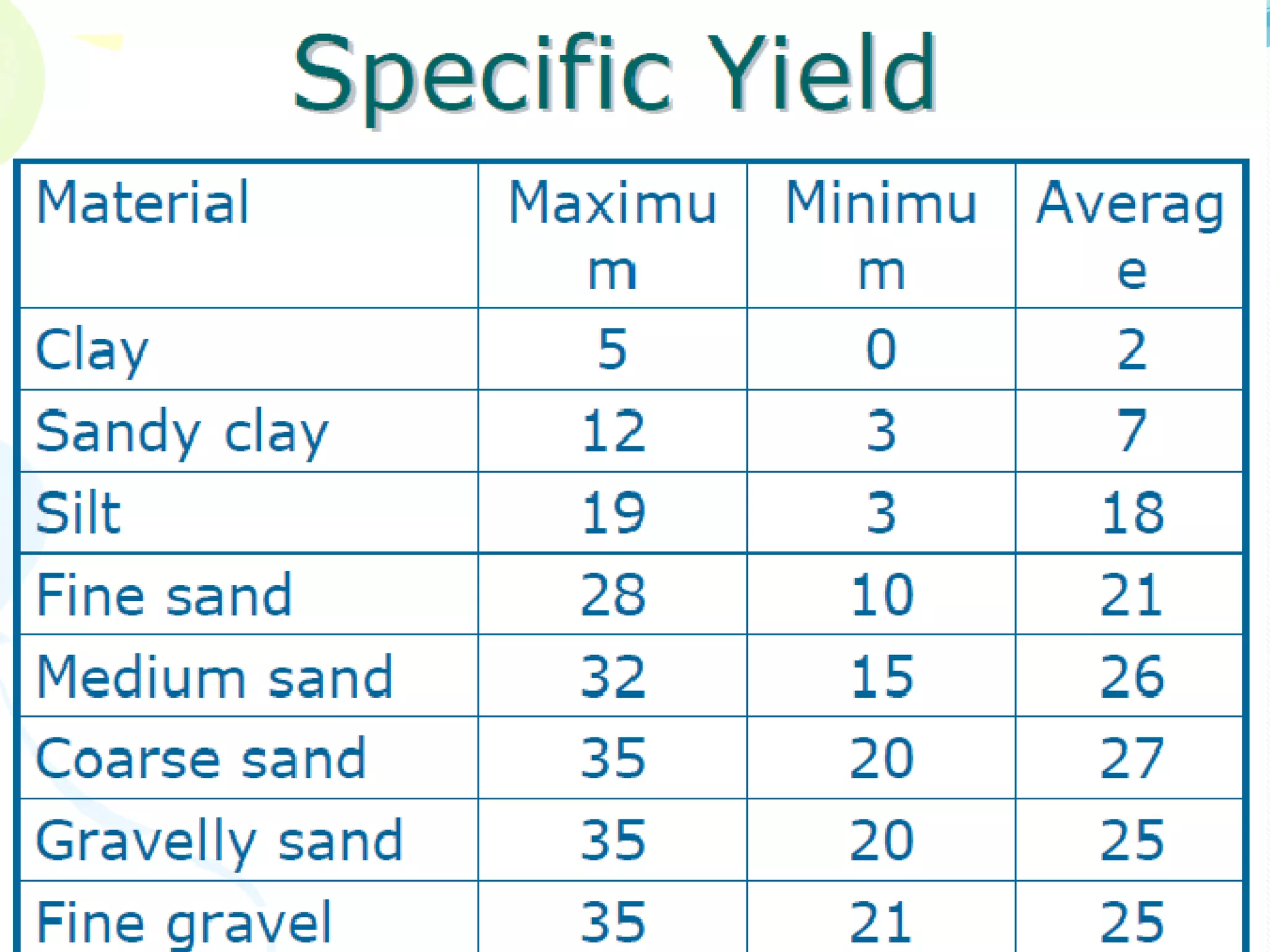
Specific yield & material
Specific Retention (Sr)
 •Specific retention Sr the ratio of the volume of water a

geomaterial can retain against gravity drainage to the
total volume of the geomaterial.
 n = Sy+ Sr
Hydraulic Conductivity
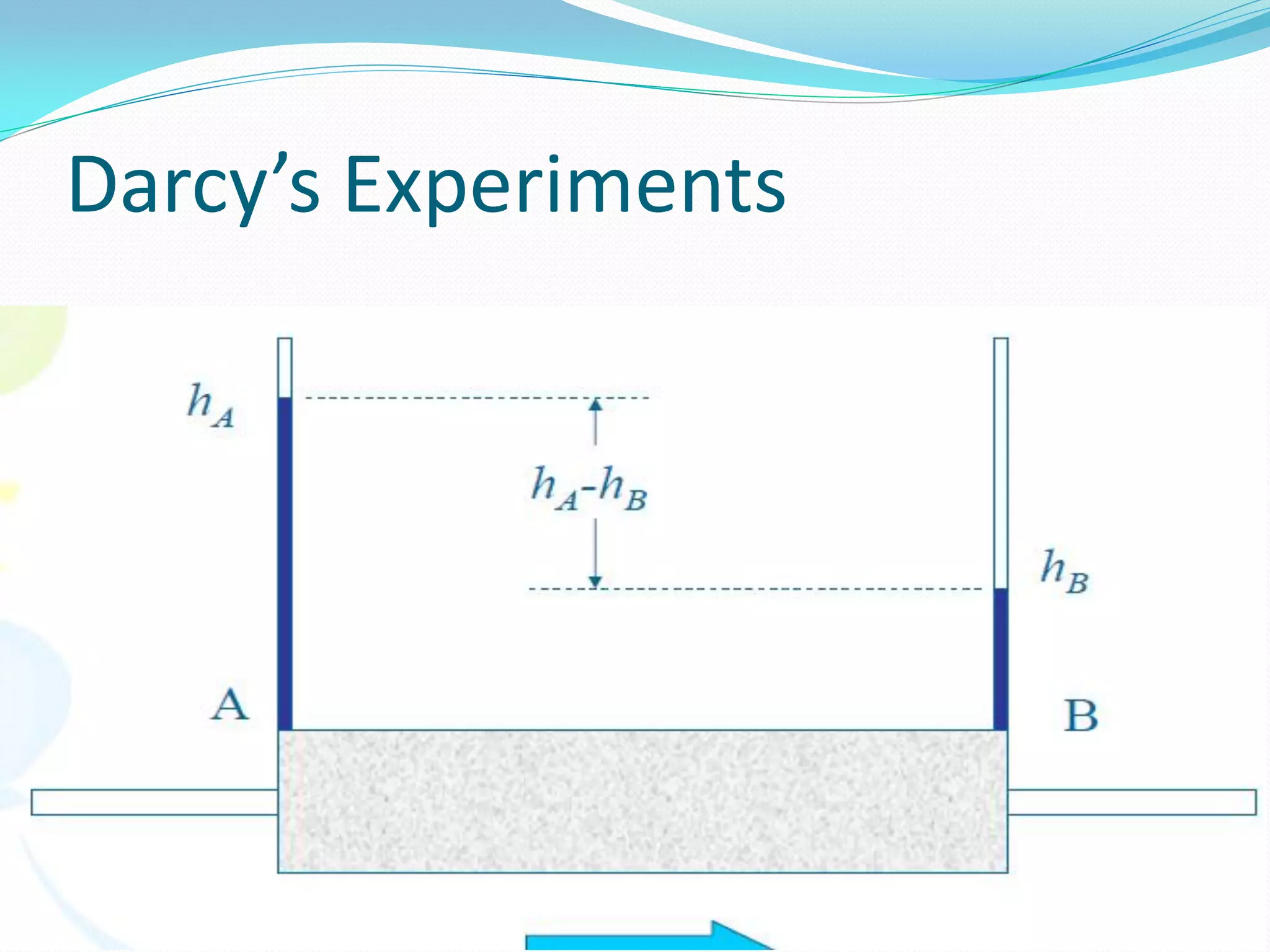
Darcy’s Experiments
Darcy’s Experiments
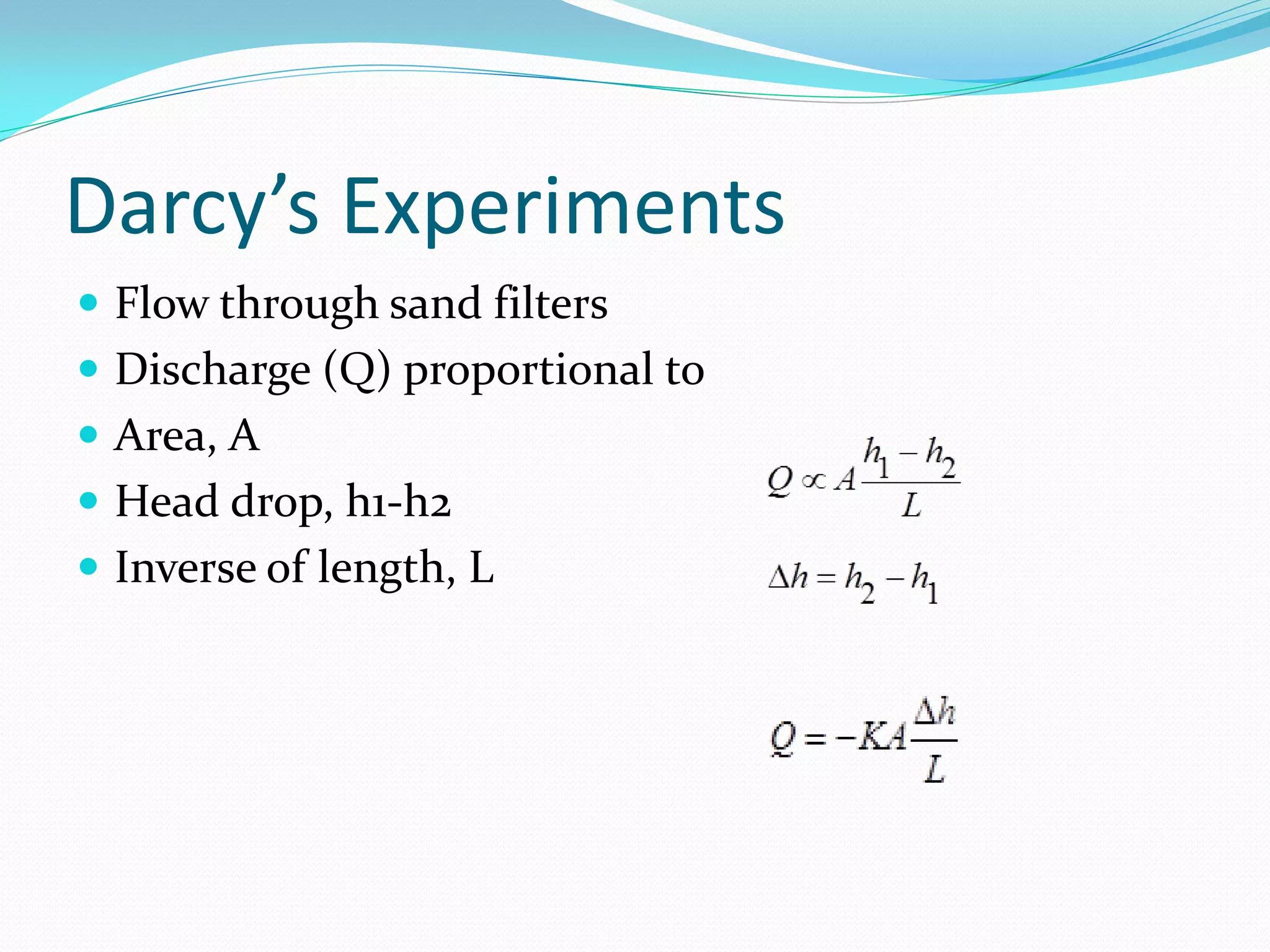
 Flow through sand filters
 Discharge (Q) proportional to
 Area, A
 Head drop, h1-h2
 Inverse of length, L
Hydraulic Conductivity
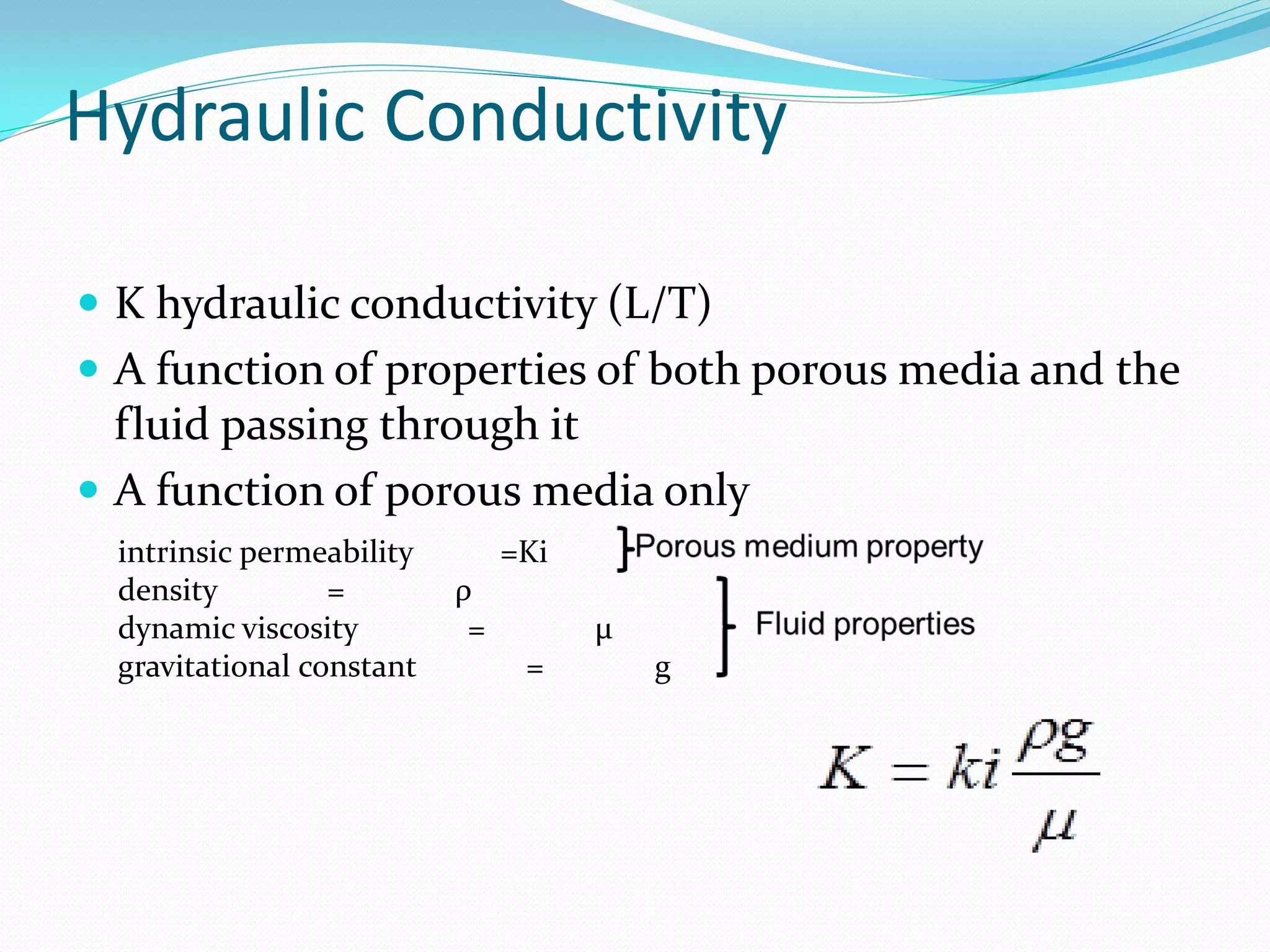
 K hydraulic conductivity (L/T)
 A function of properties of both porous media and the

fluid passing through it
 A function of porous media only
intrinsic permeability
density
=
dynamic viscosity
gravitational constant

=Ki
ρ
=

µ

=

g
Factors Affecting
Measurement of K
 Effective stress
 Hydraulic gradient

 Volume of Flow
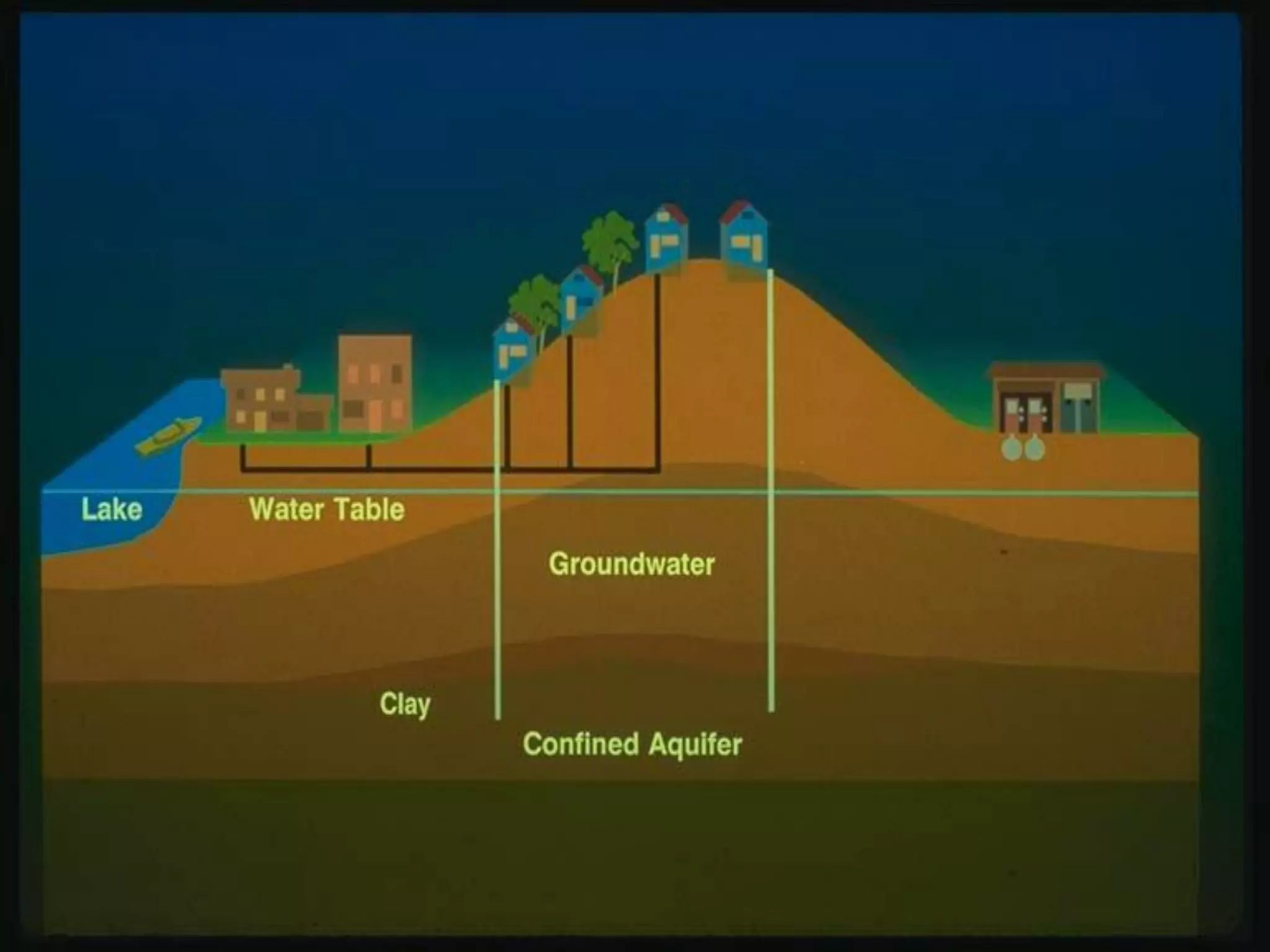
Ground water
 the water that lies beneath the ground surface, filling

the pore space between grains in bodies of sediment
and clastic sedimentary rock, and filling cracks and
crevices in all types of rock
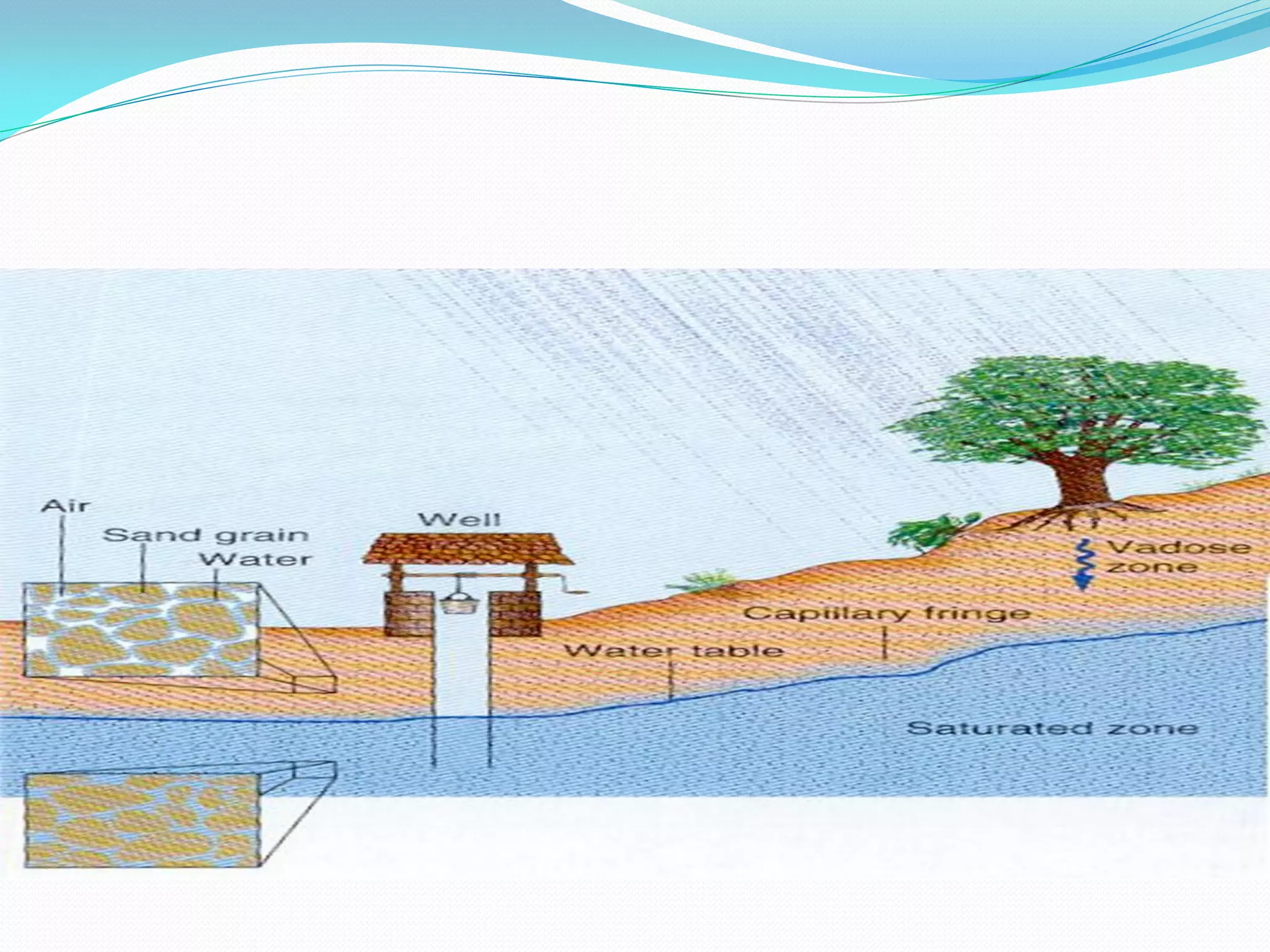
The Water table
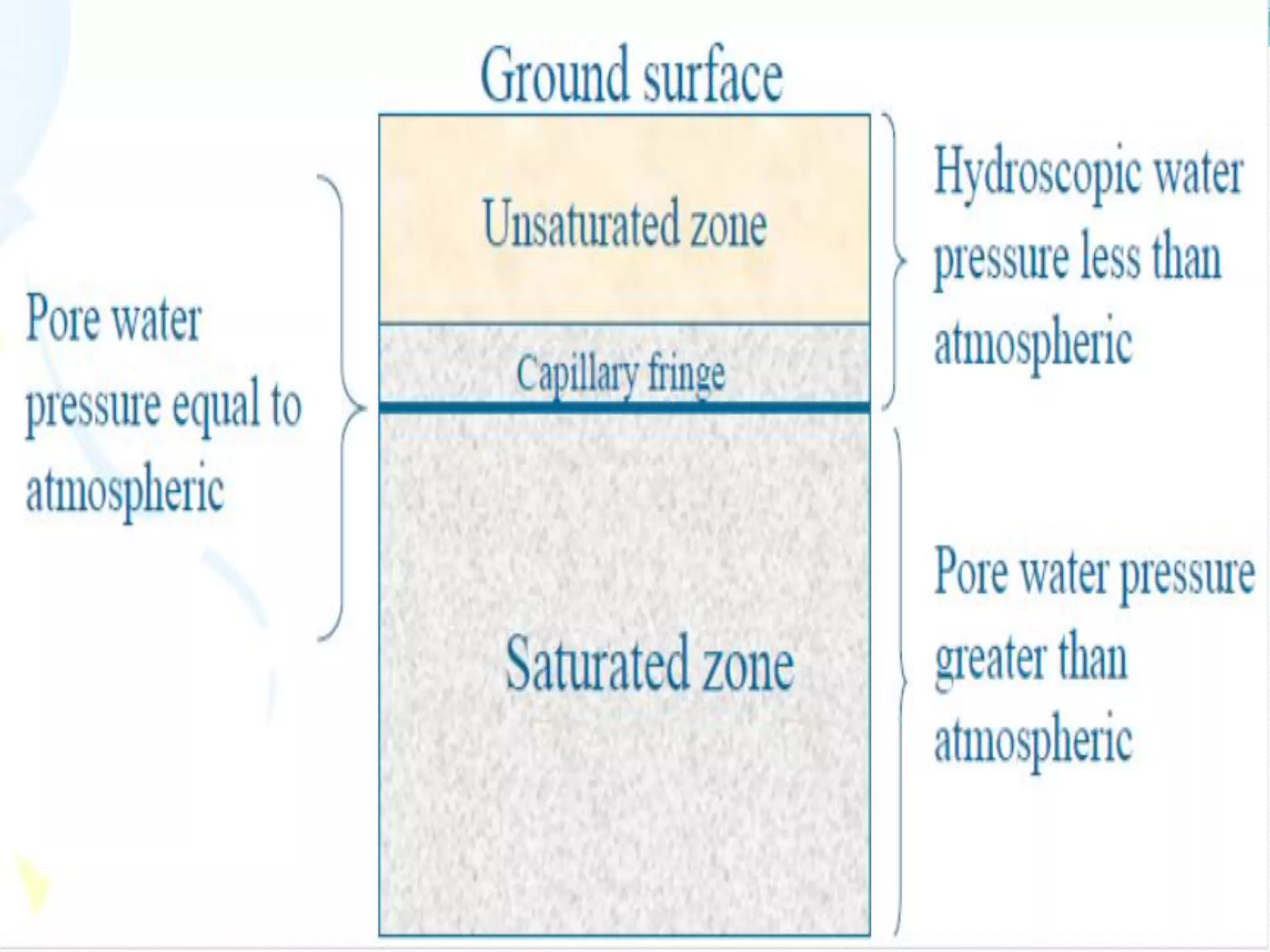
 water table: the upper surface of the zone of saturation

and pore water pressure is equal to atmospheric
pressure.

 saturated zone: the subsurface zone in which all rock

openings are filled with water
 vadose zone: a subsurface zone in which rock openings

are generally unsaturated and filled partly with air and
partly with water; above the saturated zone.
 capillary fringe: a transition zone with higher moisture

content at the base of the vadose zone just above the
water table
The Water table
 The following generalizations are valid:
 1. In the absence of flow the water table will be flat
 2. A sloping water table indicates flow
 3. Ground-water discharge occurs in low zones
 4. The water table has the same general shape as the

surface topography (but less relief change)
 5. Ground water generally flows from topographic
highs to lows
Aquifers
 Aquifer: A formation, that contains sufficient

saturated, permeable material to yield significant
quantities of water to wells and springs.
Types of Aquifers
 •Unconfined aquifer(Water-table aquifer)
 •Confined aquifer(Artesian aquifer)
 Semi confined aquifer.
1. Unconfined Aquifer
 •An aquifer that is close to the ground surface, with

continuous layers of materials of high intrinsic
permeability extending from the land surface to the
base of the aquifer.
 •Recharge from downward seepage through the
unsaturated zone, lateral ground water flow, or
upward seepage from underlying strata.
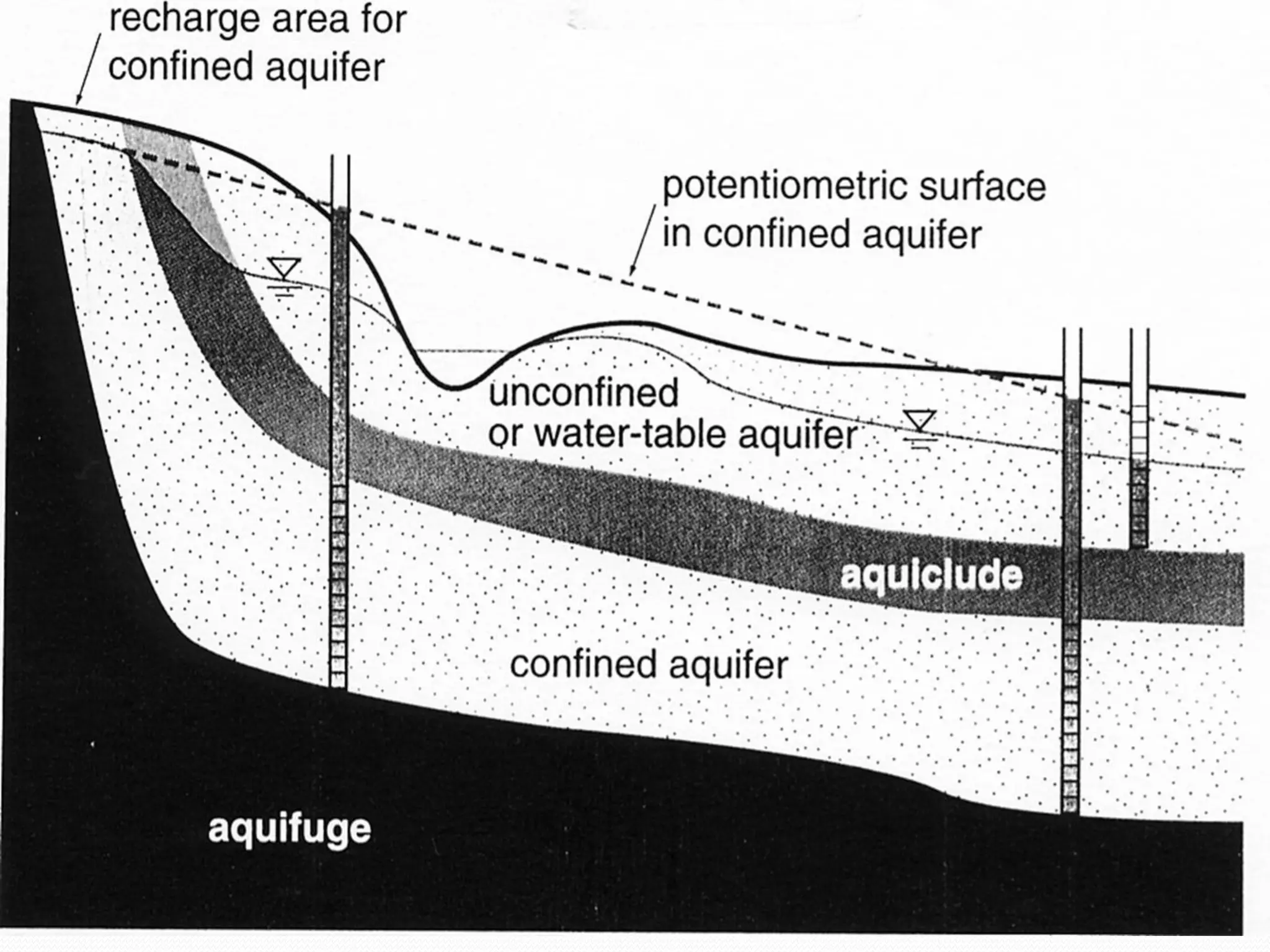
2.Confined Aquifer
 •An aquifer that are overlain by a confining layer.
 •Recharge occurs in recharge area, where the aquifer

crops out, or by slow downward leakage through a
leaky confining layer.
 •Potentiometric surfaceis the surface representative of
the level to which water will rise in a well cased to the
aquifer
3.Semi confined aquifer
 Are overlain by a semi confining layer.
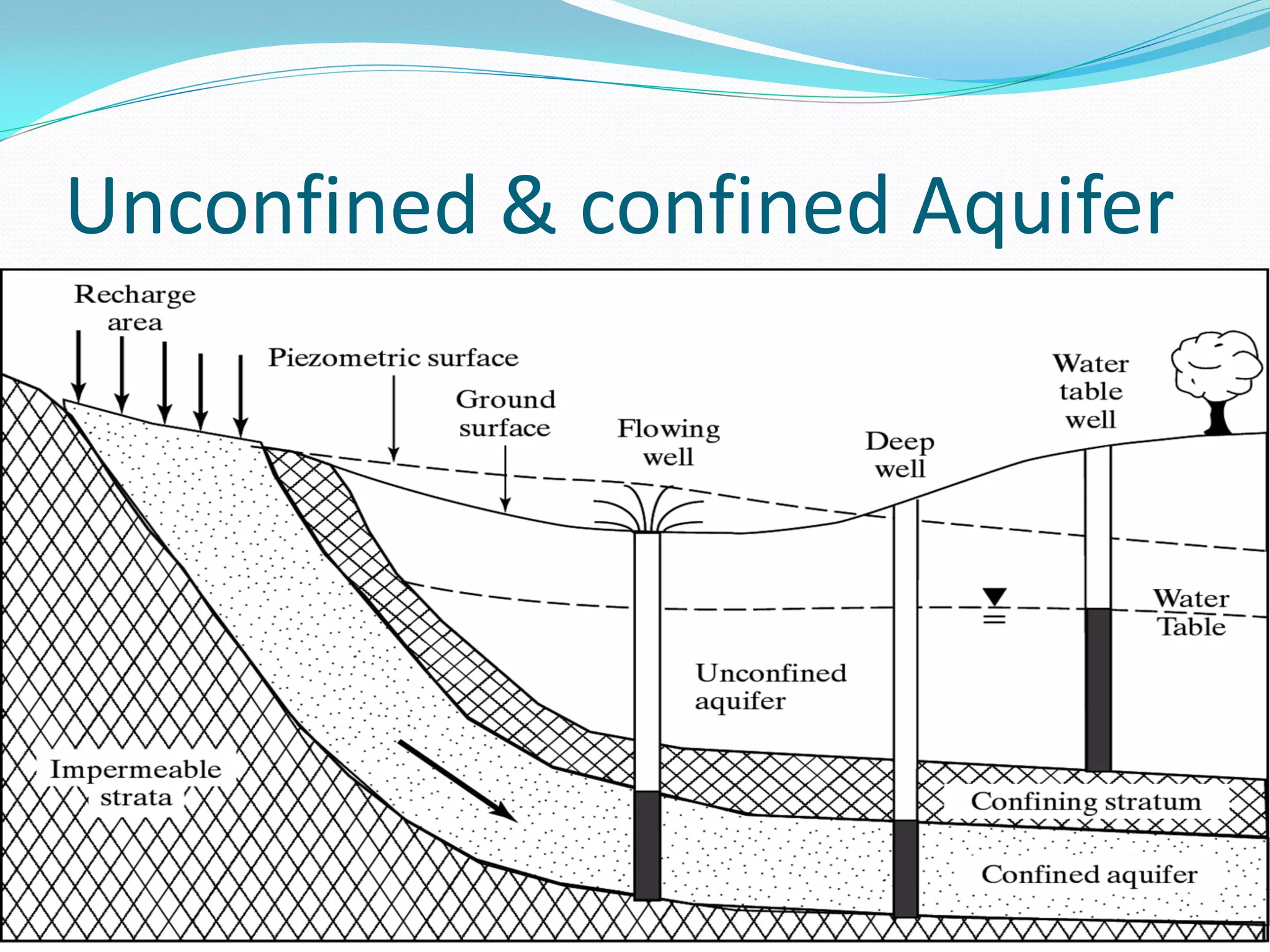
Unconfined & confined Aquifer
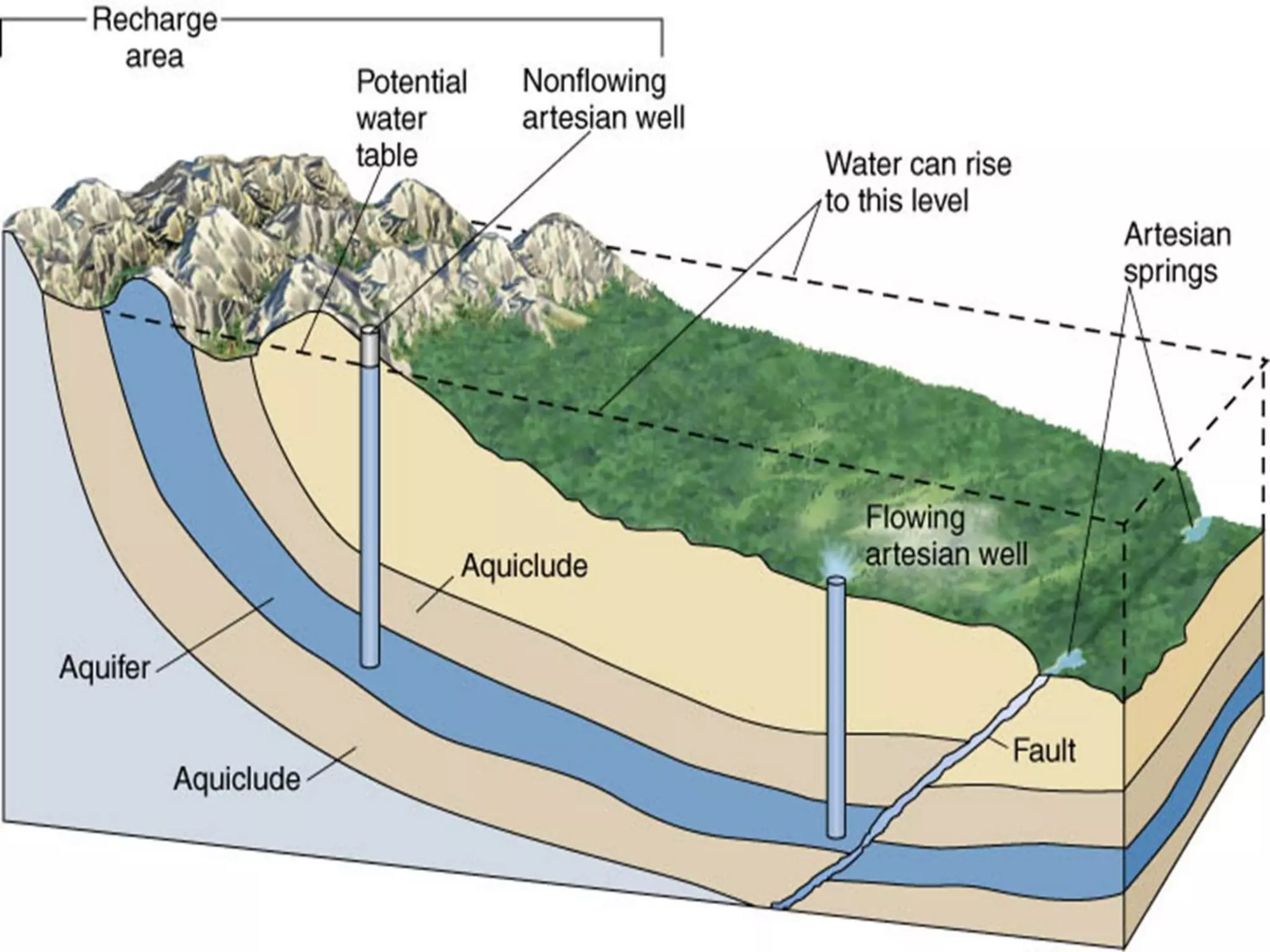
Artesian Wells
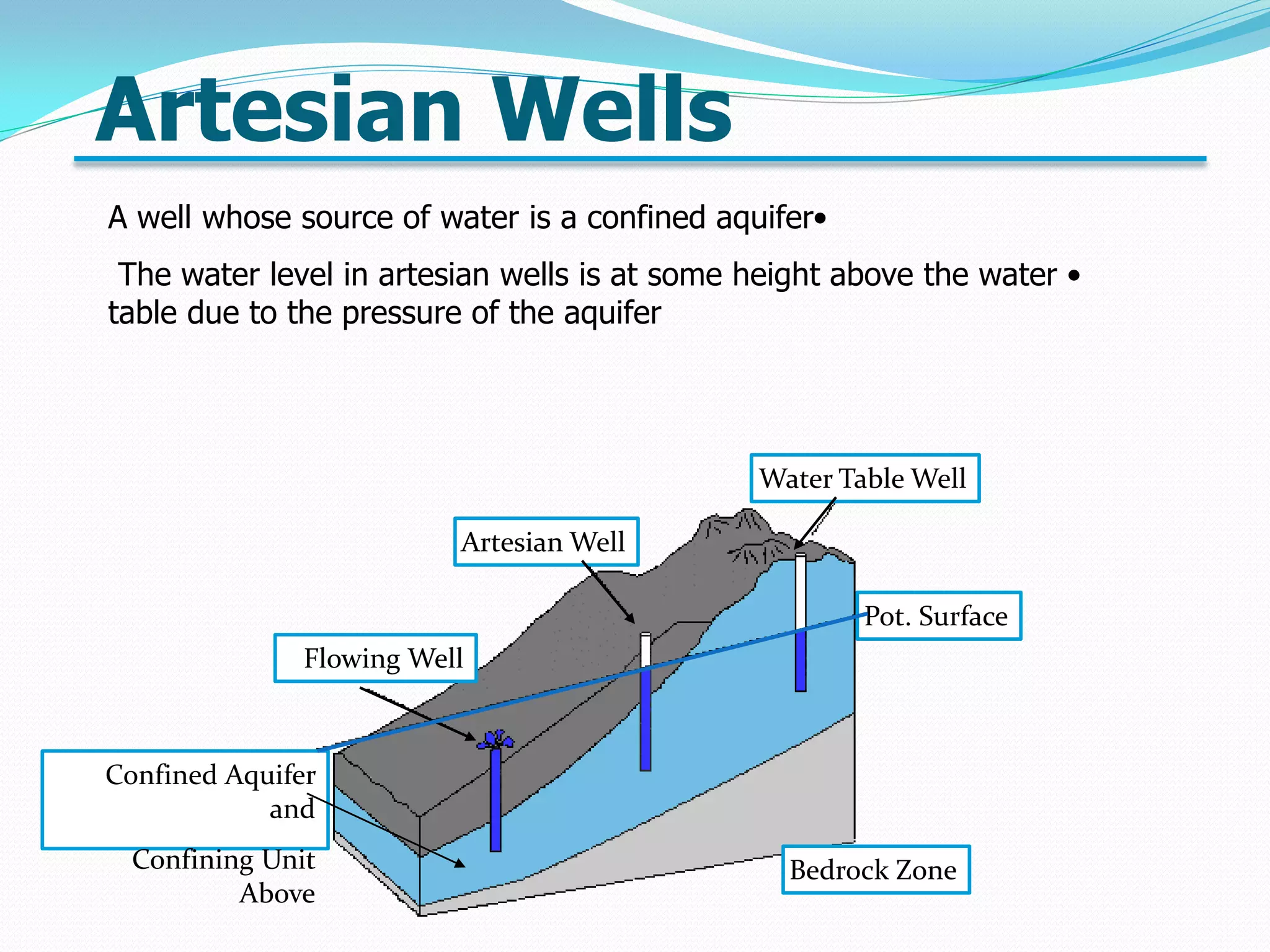
A well whose source of water is a confined aquifer•
The water level in artesian wells is at some height above the water •
table due to the pressure of the aquifer

Water Table Well
Artesian Well
Pot. Surface
Flowing Well

Confined Aquifer
and
Confining Unit
Above

Bedrock Zone
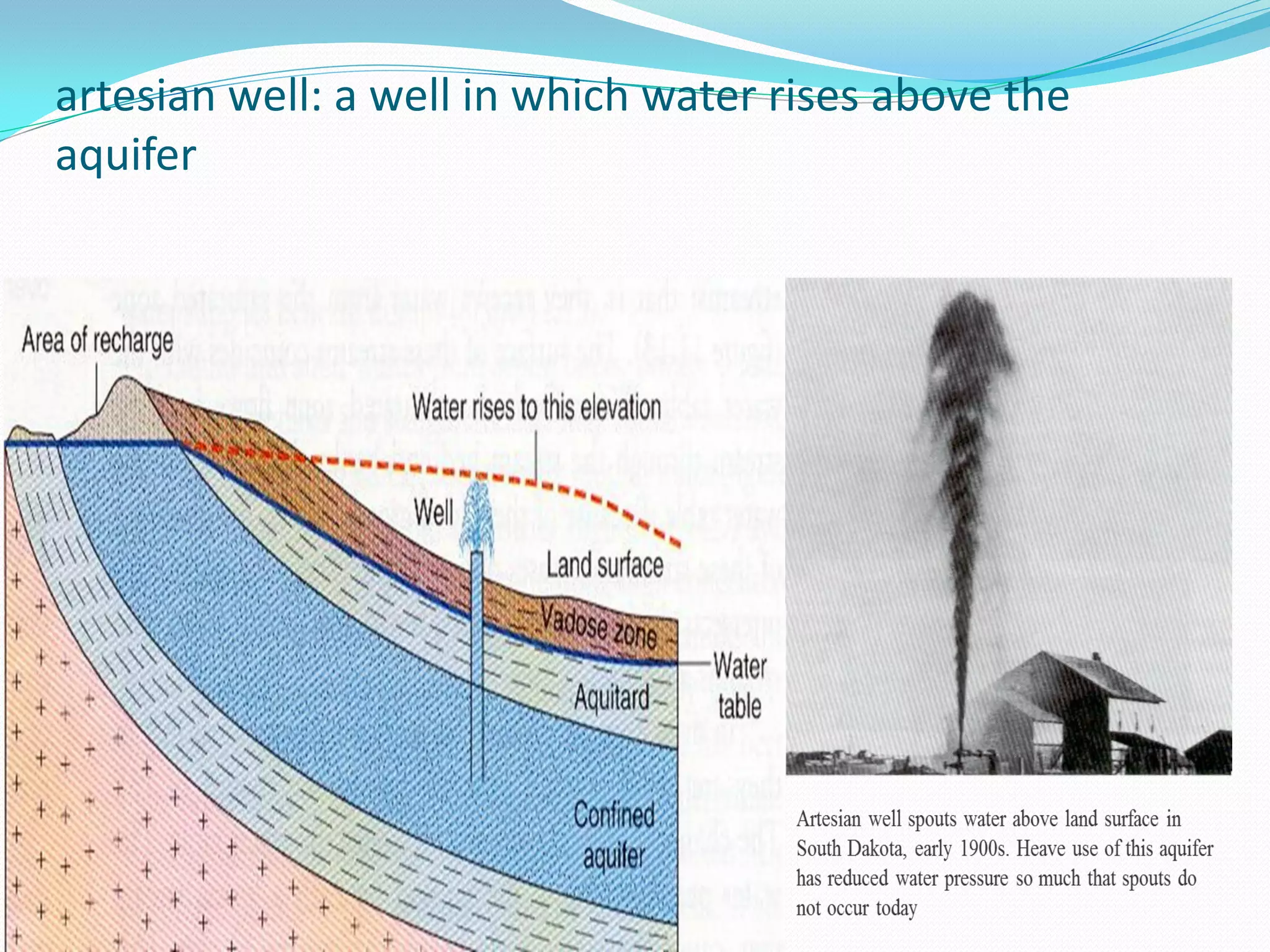
artesian well: a well in which water rises above the
aquifer
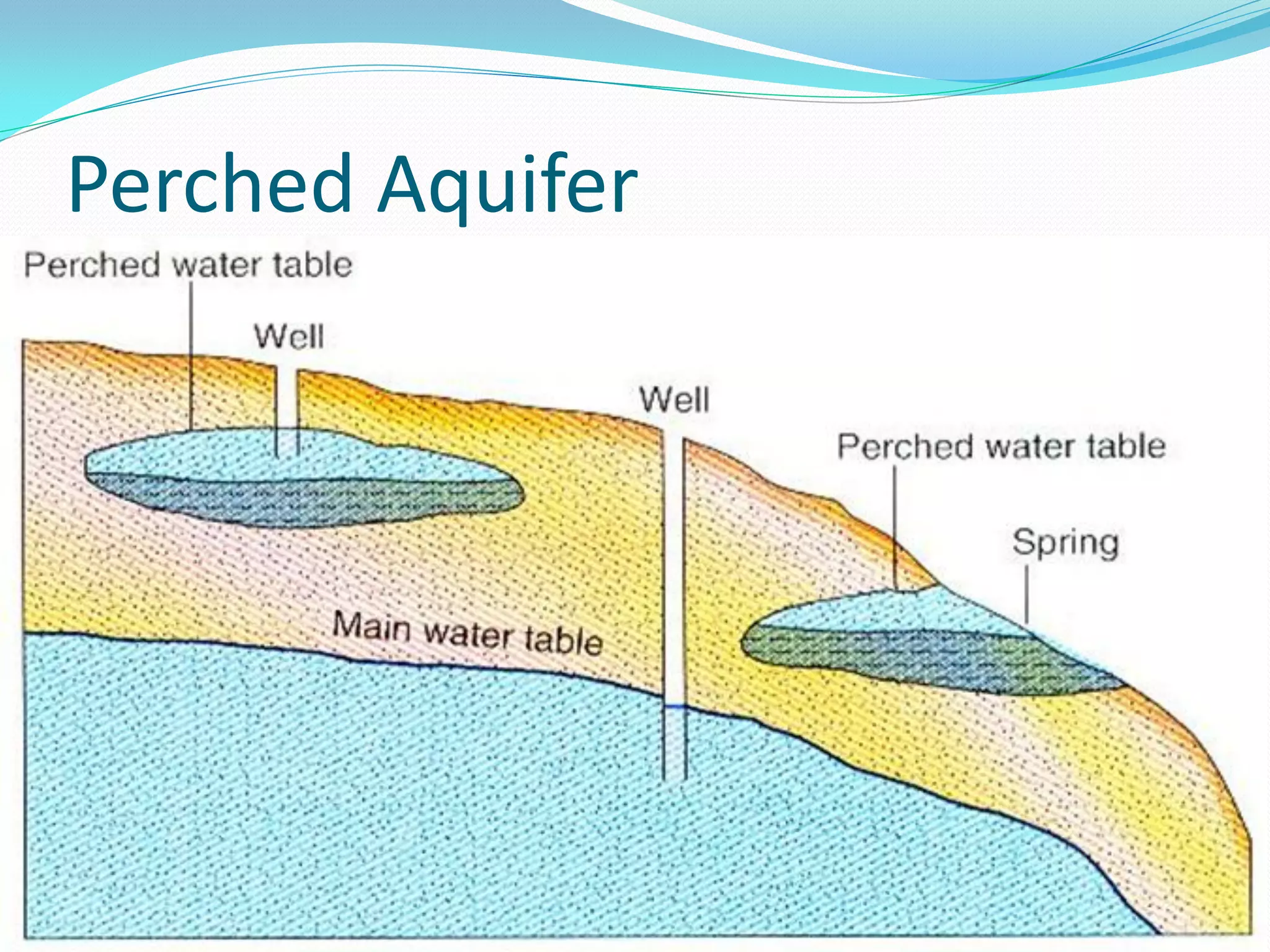
Perched Aquifer
 Perched Aquifer - aquifer in the vadose zone because

of a lens of impermeable material
 - common in glacial outwash (clay from ponds),
volcanic deposits .
 the top of a body of ground water separated from the
main water table beneath it by a zone that is not
saturated
Perched Aquifer
Confining layer
 - layer having low or no peremeability
 - whether a layer is considered “confining” or not will

depend on main aquifer material
 - usually confining layers have some permeability, just
very low
 permeability –less than about 10-2darcy.
Types of confining layers:
 Aquiclude - layer of low permeability that can store

and transmit groundwater slowly between aquifers
(now more commonly referred to as “leaky confining
layer”)
 Aquifuge - absolutely impermeable and contains no

water
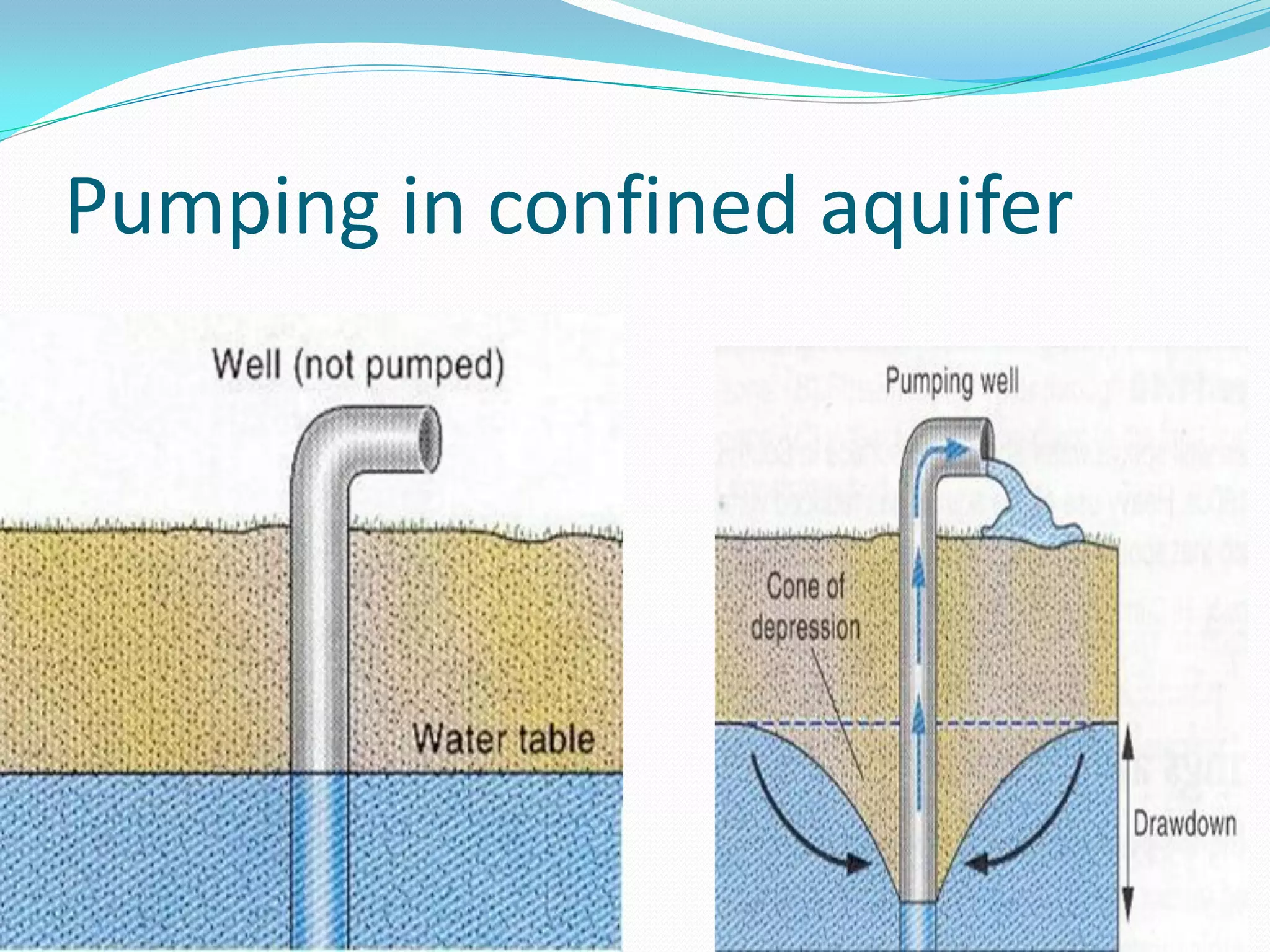
Pumping in confined aquifer
 Pumping lowering the aquifer surface in a cone of

depression.

 cone of depression: a depression of the water table

formed around a well when water is pumped out; it is
shaped like an inverted cone
Pumping in confined aquifer
Storativity
 Storativity (S) or Storage coefficient
 •The volume of water that a permeable unit will absorb

or expel from storage per unit surface area per unit
change in head.
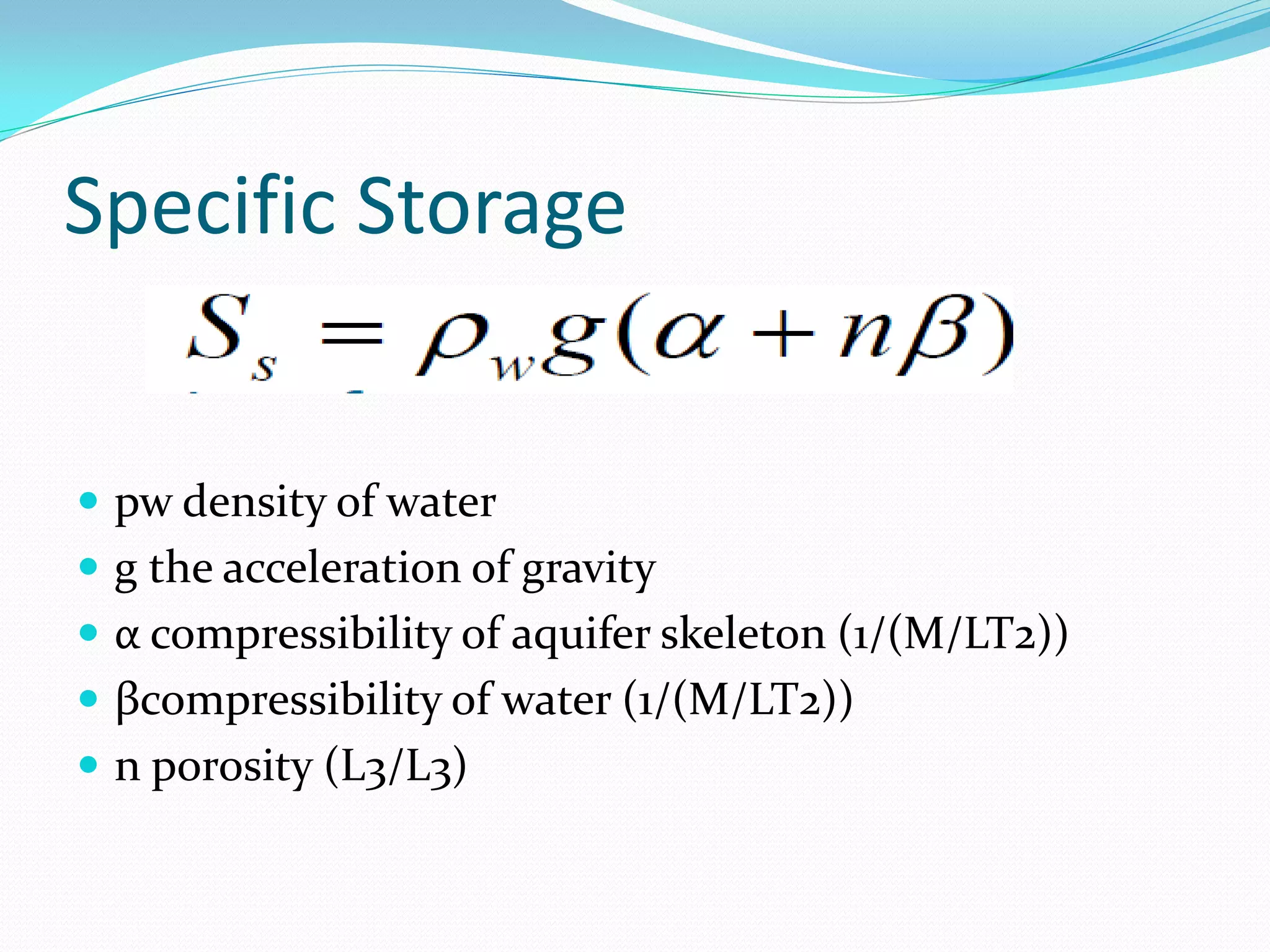
Specific Storage

 pw density of water
 g the acceleration of gravity
 α compressibility of aquifer skeleton (1/(M/LT2))
 βcompressibility of water (1/(M/LT2))
 n porosity (L3/L3)
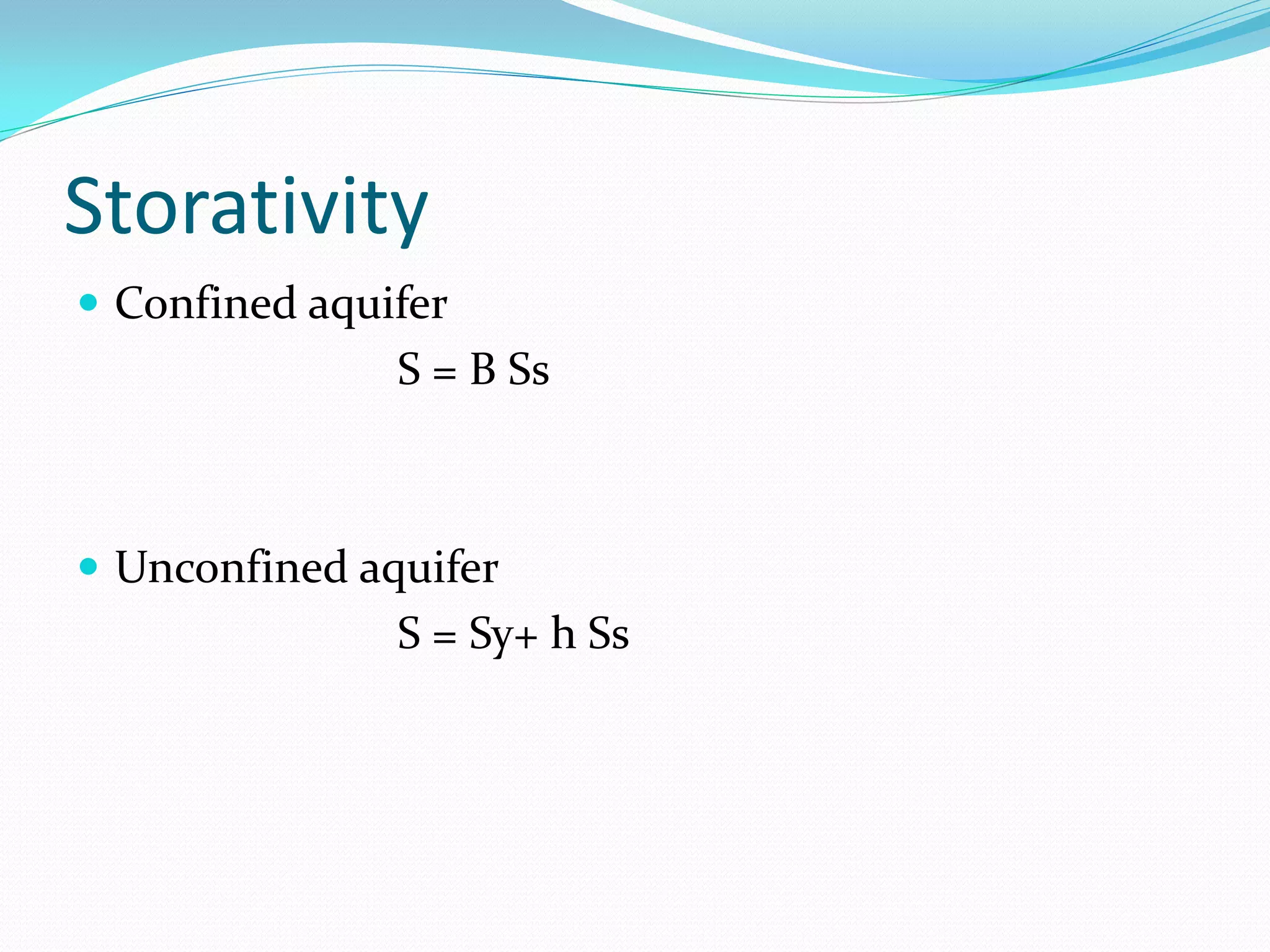
Storativity
 Confined aquifer

S = B Ss

 Unconfined aquifer

S = Sy+ h Ss
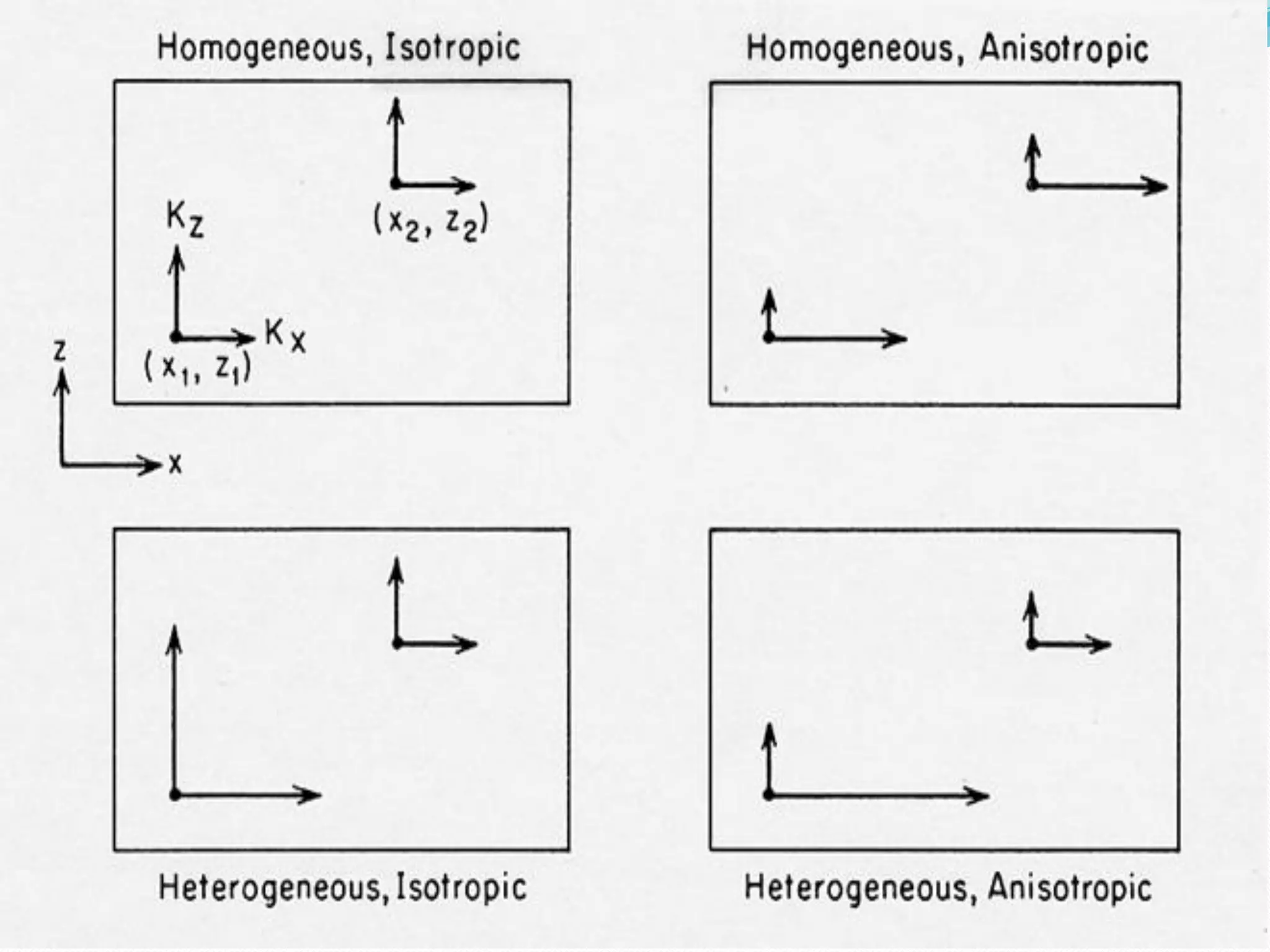
Homogenous unit
 Is one that has the same properties at all location.
 For a sank stone this would indicate that the graine

size ,porosity, thickness are variable in a small unit , so
the value of transmissivity and storativity of the unit
would be the same wherever present.
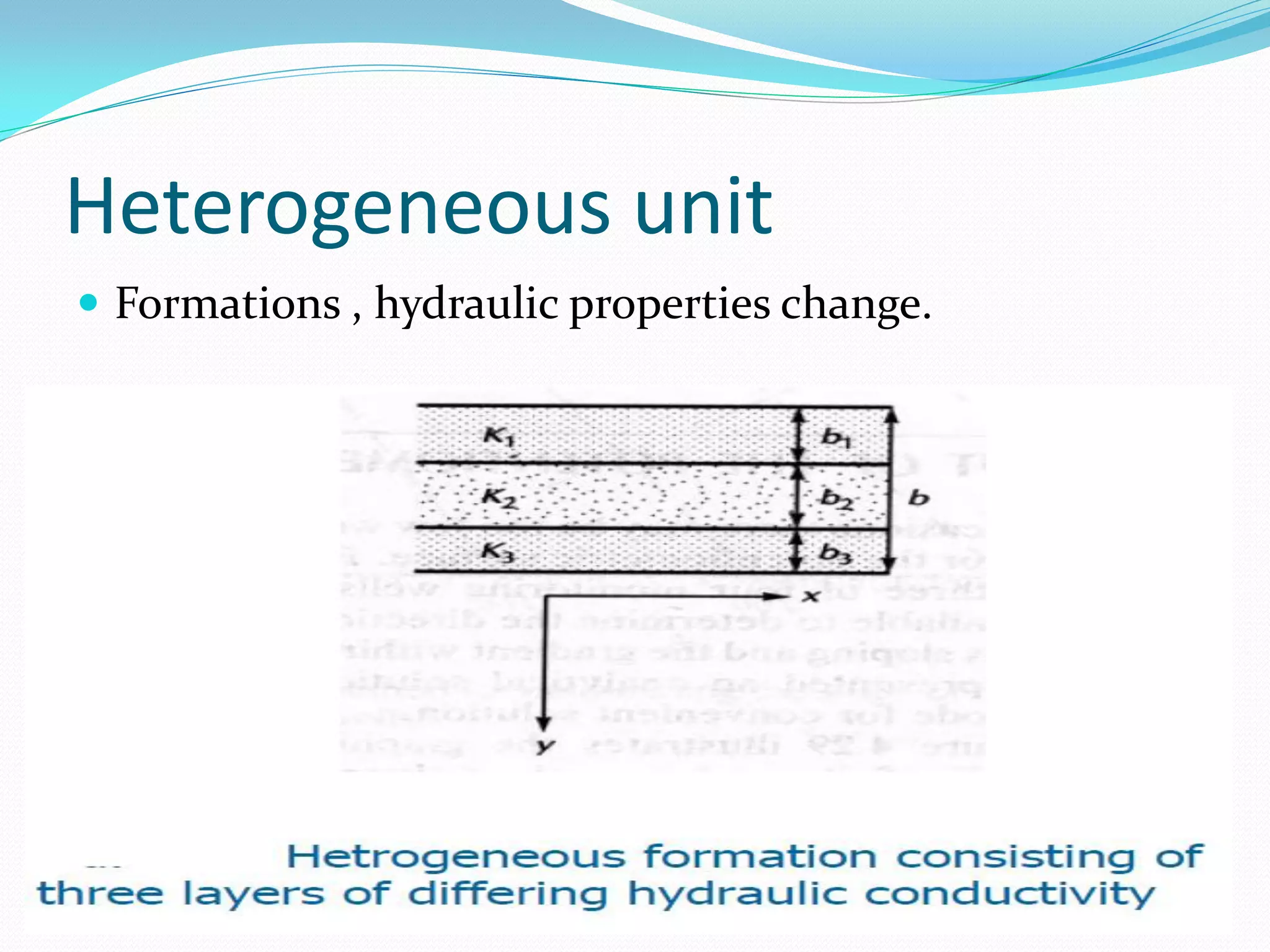
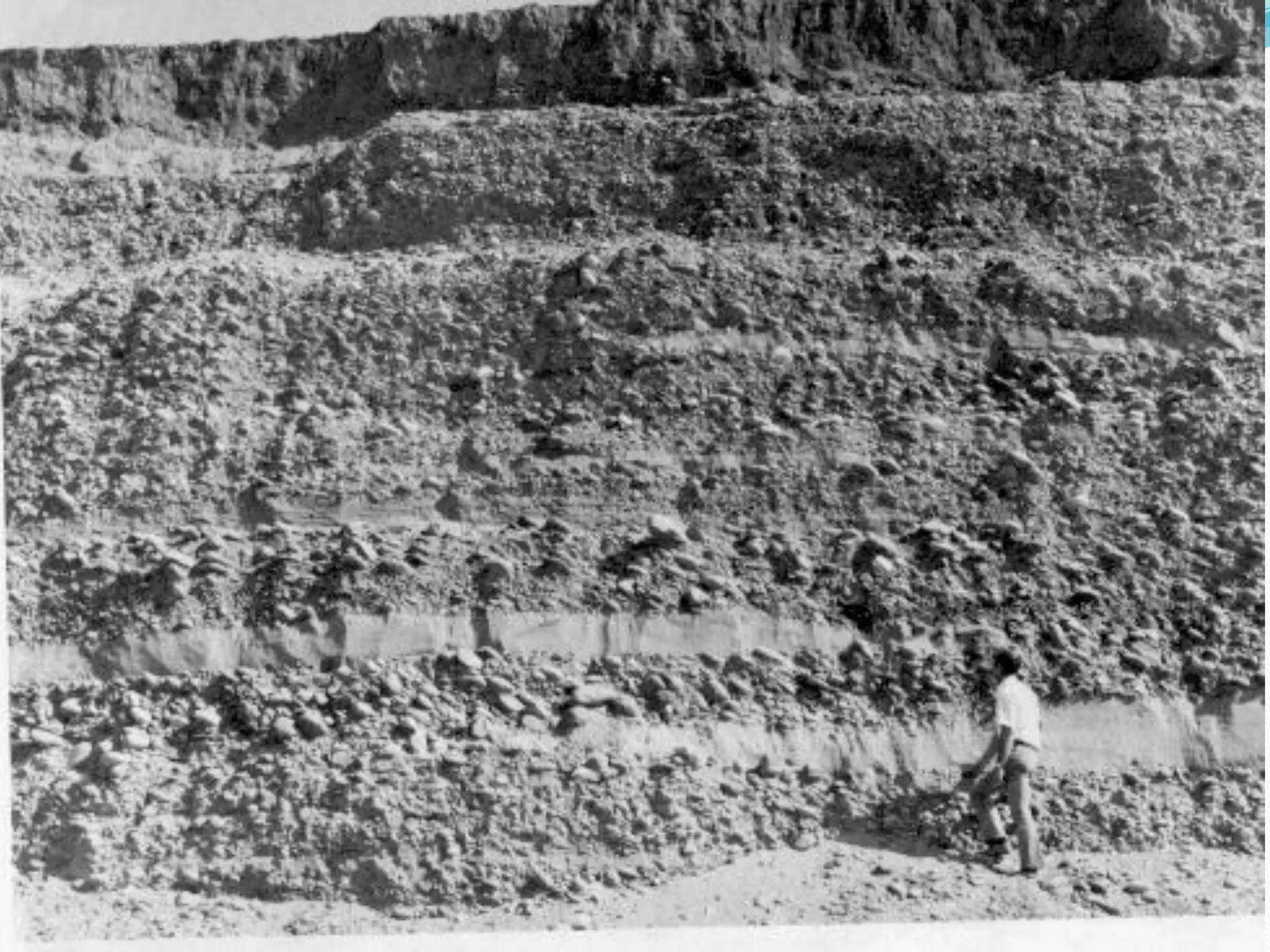
Heterogeneous unit
 Formations , hydraulic properties change.
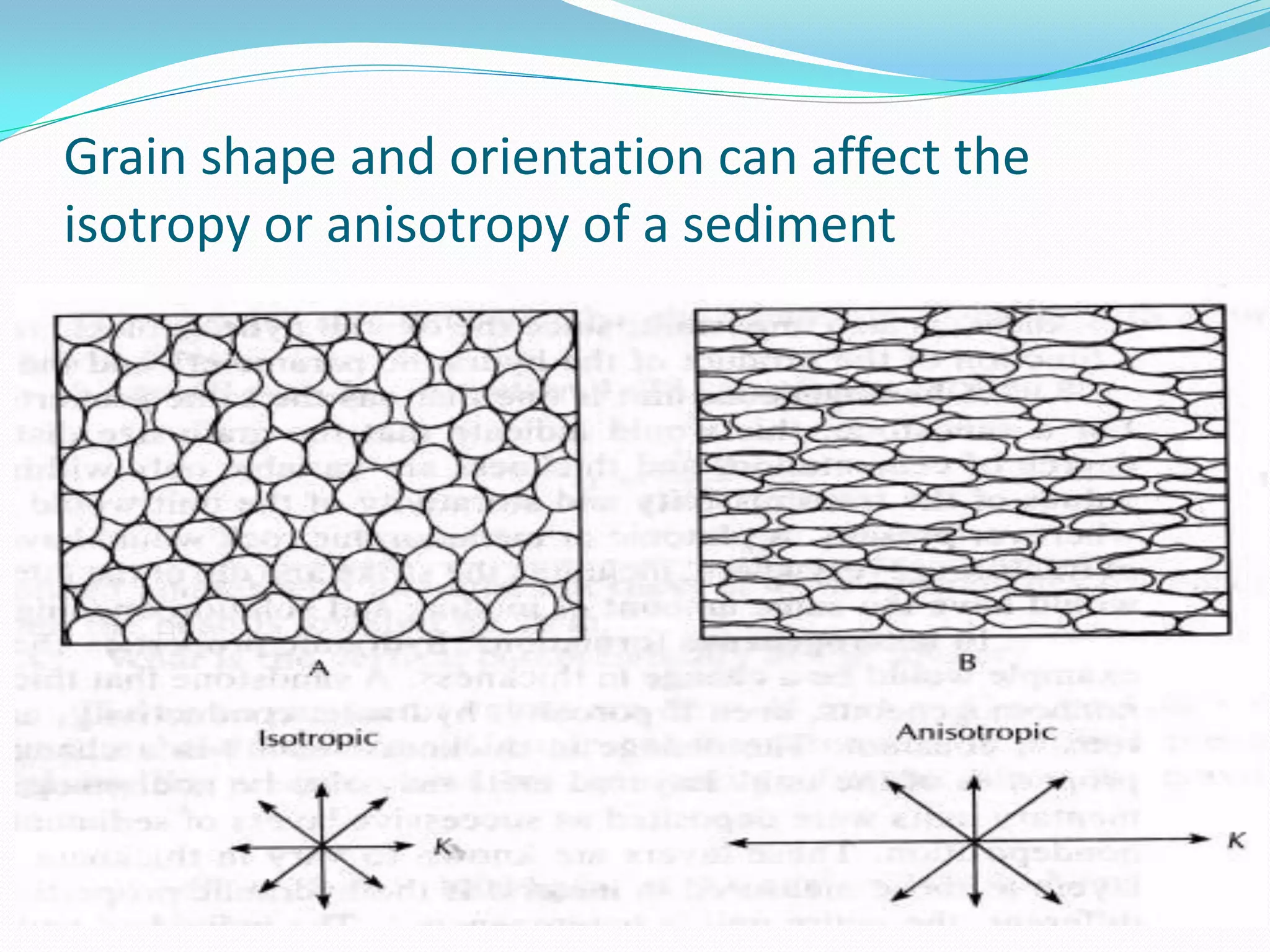
Isotropic & anisotropic
 If a porous medium has equal intrinsic permeability in

all directions it is said to be isotropic
 If the pattern of voids allows for a path of least

resistance (i.e. direction in which Ki is higher) the unit
is said to be anisotropic
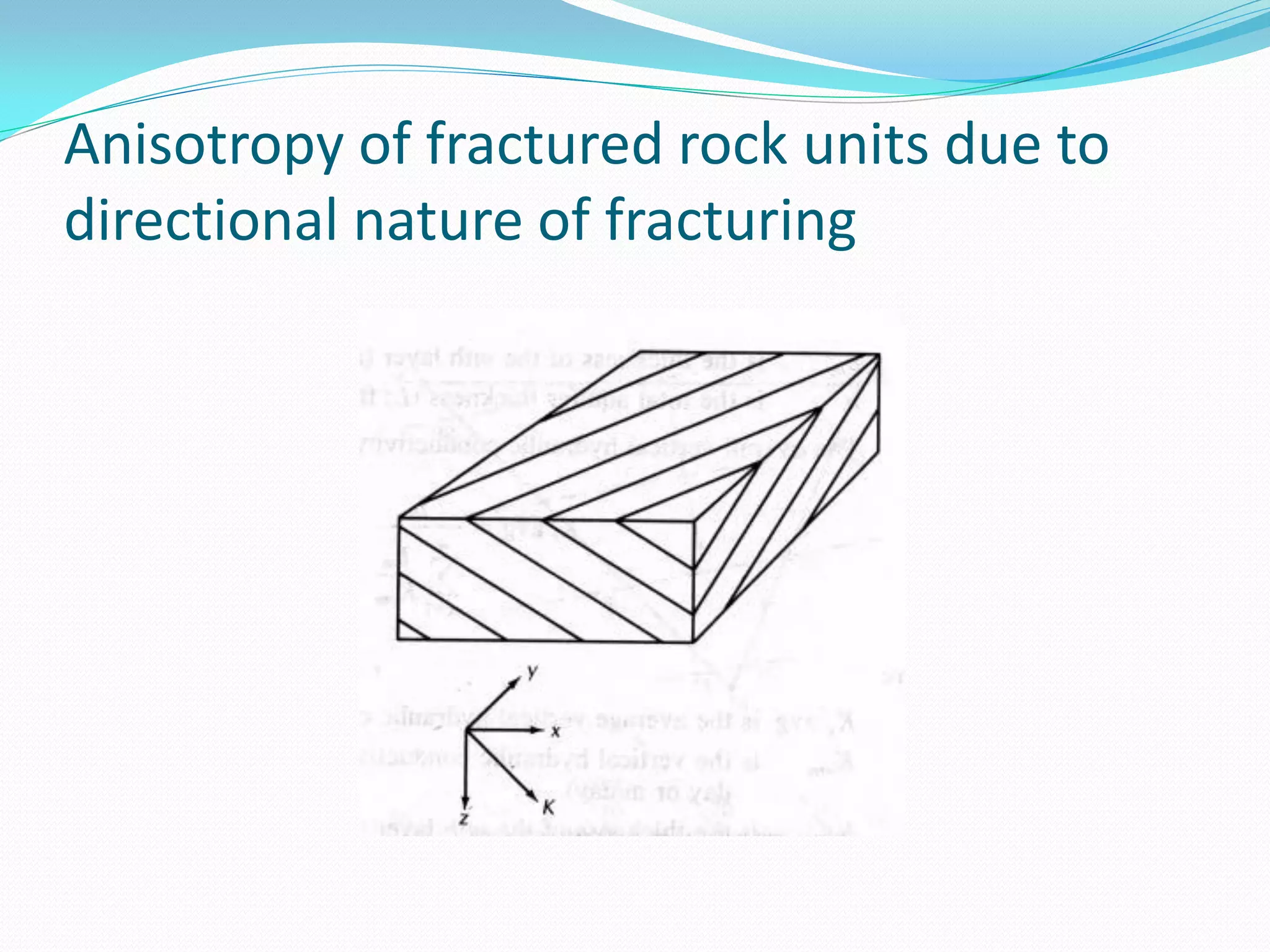
 - fractured rocks, basalts often highly anisotropic
 - sedimentary rocks may have many homogenous
units
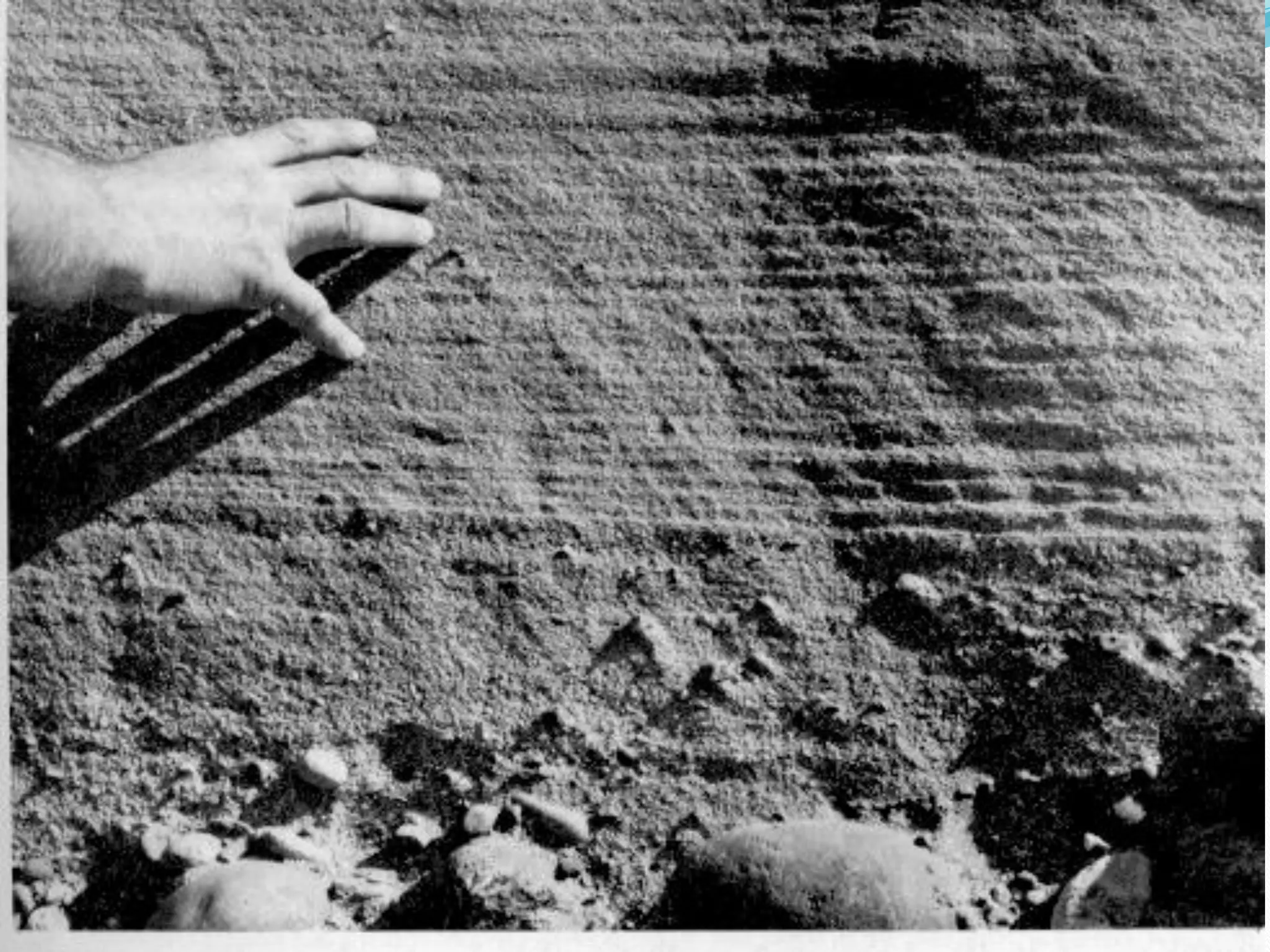
Grain shape and orientation can affect the
isotropy or anisotropy of a sediment
Anisotropy of fractured rock units due to
directional nature of fracturing
Chapter 3 Fetter Properties of Aquifers

Chapter 3 Fetter Properties of Aquifers

  • 1.
    Al-Azhar University-Gaza Master Programof Water and Environmental Science November 2013
  • 2.
  • 3.
    Porosity  Porosity: thepercentage of rock or sediment that consists of voids or openings.  porous: a rock that holds much water
  • 4.
  • 5.
    Effective Porosity  •ne Effective porosity is the fraction of the porosity that is available for transporting water (excludes fraction of pores too small to hold water, or those that are not interconnected  - can be measured in the lab directly by saturating a dried sample of known volume and measuring water uptake in a sealed chamber over time  - for unconsolidated coarse-grained sediments there is no significant difference
  • 6.
    Porosity of Sedimentary Rocks •Primary porosity  –Pores between grains  •Secondary porosity  –Fractures
  • 7.
    Permeability  permeability: thecapacity of a rock to transmit a fluid such as water or petroleum through pores and fractures  permeable: a rock that allows water to flow easily through it  impermeable: a rock that does not allow water to flow through it easily
  • 8.
    Specific Yield (Sy) •Specific Yield Sy the ratio of the volume of water that drains from a saturated geomaterialowing to the attraction of gravity to the total volume of the geomaterial
  • 10.
  • 11.
    Specific Retention (Sr) •Specific retention Sr the ratio of the volume of water a geomaterial can retain against gravity drainage to the total volume of the geomaterial.  n = Sy+ Sr
  • 12.
  • 13.
  • 14.
    Darcy’s Experiments  Flowthrough sand filters  Discharge (Q) proportional to  Area, A  Head drop, h1-h2  Inverse of length, L
  • 15.
    Hydraulic Conductivity  Khydraulic conductivity (L/T)  A function of properties of both porous media and the fluid passing through it  A function of porous media only intrinsic permeability density = dynamic viscosity gravitational constant =Ki ρ = µ = g
  • 16.
    Factors Affecting Measurement ofK  Effective stress  Hydraulic gradient  Volume of Flow
  • 17.
    Ground water  thewater that lies beneath the ground surface, filling the pore space between grains in bodies of sediment and clastic sedimentary rock, and filling cracks and crevices in all types of rock
  • 19.
    The Water table water table: the upper surface of the zone of saturation and pore water pressure is equal to atmospheric pressure.  saturated zone: the subsurface zone in which all rock openings are filled with water
  • 20.
     vadose zone:a subsurface zone in which rock openings are generally unsaturated and filled partly with air and partly with water; above the saturated zone.  capillary fringe: a transition zone with higher moisture content at the base of the vadose zone just above the water table
  • 23.
    The Water table The following generalizations are valid:  1. In the absence of flow the water table will be flat  2. A sloping water table indicates flow  3. Ground-water discharge occurs in low zones  4. The water table has the same general shape as the surface topography (but less relief change)  5. Ground water generally flows from topographic highs to lows
  • 24.
    Aquifers  Aquifer: Aformation, that contains sufficient saturated, permeable material to yield significant quantities of water to wells and springs.
  • 25.
    Types of Aquifers •Unconfined aquifer(Water-table aquifer)  •Confined aquifer(Artesian aquifer)  Semi confined aquifer.
  • 26.
    1. Unconfined Aquifer •An aquifer that is close to the ground surface, with continuous layers of materials of high intrinsic permeability extending from the land surface to the base of the aquifer.  •Recharge from downward seepage through the unsaturated zone, lateral ground water flow, or upward seepage from underlying strata.
  • 27.
    2.Confined Aquifer  •Anaquifer that are overlain by a confining layer.  •Recharge occurs in recharge area, where the aquifer crops out, or by slow downward leakage through a leaky confining layer.  •Potentiometric surfaceis the surface representative of the level to which water will rise in a well cased to the aquifer
  • 28.
    3.Semi confined aquifer Are overlain by a semi confining layer.
  • 29.
  • 30.
    Artesian Wells A wellwhose source of water is a confined aquifer• The water level in artesian wells is at some height above the water • table due to the pressure of the aquifer Water Table Well Artesian Well Pot. Surface Flowing Well Confined Aquifer and Confining Unit Above Bedrock Zone
  • 31.
    artesian well: awell in which water rises above the aquifer
  • 32.
    Perched Aquifer  PerchedAquifer - aquifer in the vadose zone because of a lens of impermeable material  - common in glacial outwash (clay from ponds), volcanic deposits .  the top of a body of ground water separated from the main water table beneath it by a zone that is not saturated
  • 33.
  • 34.
    Confining layer  -layer having low or no peremeability  - whether a layer is considered “confining” or not will depend on main aquifer material  - usually confining layers have some permeability, just very low  permeability –less than about 10-2darcy.
  • 35.
    Types of confininglayers:  Aquiclude - layer of low permeability that can store and transmit groundwater slowly between aquifers (now more commonly referred to as “leaky confining layer”)  Aquifuge - absolutely impermeable and contains no water
  • 38.
    Pumping in confinedaquifer  Pumping lowering the aquifer surface in a cone of depression.  cone of depression: a depression of the water table formed around a well when water is pumped out; it is shaped like an inverted cone
  • 39.
  • 41.
    Storativity  Storativity (S)or Storage coefficient  •The volume of water that a permeable unit will absorb or expel from storage per unit surface area per unit change in head.
  • 42.
    Specific Storage  pwdensity of water  g the acceleration of gravity  α compressibility of aquifer skeleton (1/(M/LT2))  βcompressibility of water (1/(M/LT2))  n porosity (L3/L3)
  • 43.
    Storativity  Confined aquifer S= B Ss  Unconfined aquifer S = Sy+ h Ss
  • 45.
    Homogenous unit  Isone that has the same properties at all location.  For a sank stone this would indicate that the graine size ,porosity, thickness are variable in a small unit , so the value of transmissivity and storativity of the unit would be the same wherever present.
  • 47.
    Heterogeneous unit  Formations, hydraulic properties change.
  • 49.
    Isotropic & anisotropic If a porous medium has equal intrinsic permeability in all directions it is said to be isotropic  If the pattern of voids allows for a path of least resistance (i.e. direction in which Ki is higher) the unit is said to be anisotropic  - fractured rocks, basalts often highly anisotropic  - sedimentary rocks may have many homogenous units
  • 50.
    Grain shape andorientation can affect the isotropy or anisotropy of a sediment
  • 51.
    Anisotropy of fracturedrock units due to directional nature of fracturing