1
The study of water, including rain, snow and water
on the earth’s surface, covering its properties,
distribution, utilisation, etc.
(Chambers Science and Technology Dictionary)
The study of water in all its forms, and from its
origins to all its destinations on the earth.
(Bras, 1990))
The science dealing with the waters of the earth,
their occurrence, distribution and circulation, their
chemical and physical properties, and their
interaction with the environment.
(Ward & Robinson, 1999)
HYDROLOGHYDROLOG
YY
2
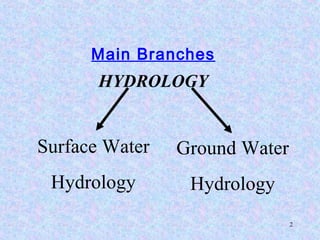
Main Branches
HYDROLOGY
Ground Water
Hydrology
Surface Water
Hydrology
3
• Water is one the most valuable natural resources
essential for human and animal life, industry and
agriculture.
• It is also used for power generation, navigation and
fisheries.
• Tremendous importance is given to the hydrology all over
the world in the development and management of water
resources for irrigation, water supply, flood control,
water-logging and salinity control, Hydro power and
navigation.
Scope of Hydrology
4
Engineering Hydrology
• It uses hydrologic principles in the solution of
engineering problems arising from human exploitation of
water resources of the earth.
• The engineering hydrologist, or water resources engineer,
is involved in the planning, analysis, design, construction
and operation of projects for the control, utilization and
management of water resources.
• Hydrologic calculations are estimates because mostly the
empirical and approximate nature of methods are used to
describe various hydrological processes.
5
Engineering Hydrology seeks to answer questions of the following types:
• What is the maximum probable flood at a proposed dam site?
• How does a catchment’s water yield vary from season to season and from year to
year?
• What is the relationship between a catchment’s surface water and groundwater
resources?
• What flood flows can be expected over a spillway, at a highway culvert, or in an
urban storm drainage system?
• What reservoir capacity is required to assure adequate water for irrigation or
municipal water supply in droughts condition?
• What hydrologic hardware (e.g. rain gauges, stream gauges etc) and software
(computer models) are needed for real-time flood forecasting?
Uses of Engineering Hydrology
6
Major Aspects of Hydrology
The main jobs of a hydrologist are collection and analysis of
data, and making prediction out of this data.
1. Collection of Data: The hydrologic data comprises:
Rainfall data, snowfall and snowmelt data, runoff data,
topographic maps, groundwater data.
2. Analysis of Data
Analysis of hydrologic data includes checking it for
consistency and homogeneity as well as finding its various
statistical parameters.
3. Prediction
Means to find design values and maximum possible events
(rainfall, floods, droughts). Various approaches used are:
Statistical, Physical, Deterministic
7
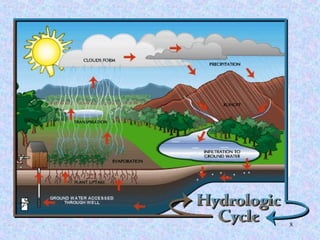
HYDROLOGIC CYCLE
• The hydrologic cycle describes the continues re-circulating
transport of the waters of the earth, linking atmosphere, land
and oceans.
• To explain it briefly, water evaporates from the ocean surface,
driven by energy from the Sun, and joins the atmosphere,
moving inland as clouds. Once inland, atmospheric conditions
act to condense and precipitate water onto the land surface,
where, driven by gravitational forces, it returns to the ocean
through river and streams.
• The process is quite complex, containing many sub-cycles.
• Engineering Hydrology takes a quantitative view of the
hydrologic cycle.
8
9
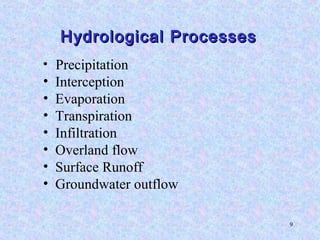
Hydrological ProcessesHydrological Processes
• Precipitation
• Interception
• Evaporation
• Transpiration
• Infiltration
• Overland flow
• Surface Runoff
• Groundwater outflow
10
11
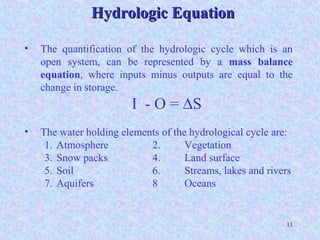
• The quantification of the hydrologic cycle which is an
open system, can be represented by a mass balance
equation, where inputs minus outputs are equal to the
change in storage.
I - O = ∆S
• The water holding elements of the hydrological cycle are:
1. Atmosphere 2. Vegetation
3. Snow packs 4. Land surface
5. Soil 6. Streams, lakes and rivers
7. Aquifers 8 Oceans
Hydrologic EquationHydrologic Equation
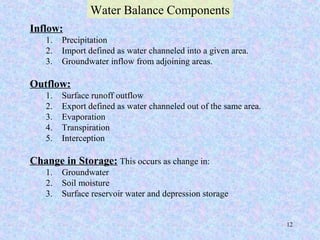
12
Inflow:
1. Precipitation
2. Import defined as water channeled into a given area.
3. Groundwater inflow from adjoining areas.
Outflow:
1. Surface runoff outflow
2. Export defined as water channeled out of the same area.
3. Evaporation
4. Transpiration
5. Interception
Change in Storage: This occurs as change in:
1. Groundwater
2. Soil moisture
3. Surface reservoir water and depression storage
Water Balance Components
13
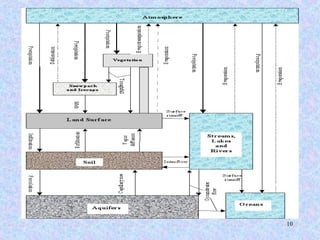
Global Hydrologic Cycle
• The global hydrologic cycle can be represented as a system
containing three subsystems:
the atmospheric water system,
the surface water system, and
the subsurface water system.
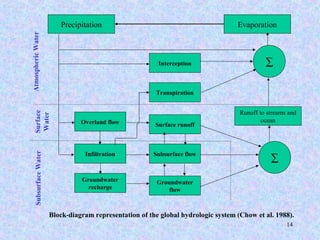
• Block-diagram (flow chart) representation of GHC is shown
in Figure#1.
14
Precipitation
Infiltration
Transpiration
Interception
Groundwater
recharge
Overland flow
Subsurface flow
Runoff to streams and
ocean
Surface runoff
Groundwater
flow
Evaporation
∑
∑
AtmosphericWaterSubsurfaceWaterSurface
Water
Block-diagram representation of the global hydrologic system (Chow et al. 1988).
15
Evapotranspiration
fromland
Evaporation
fromocean
Moisture overland
Precipitation
on land
100
61
39
424
Precipitation
on ocean
385
Groundwater
outflow
Surface outflow 38
1
Surface flow
Groundwaterflow
Infiltration
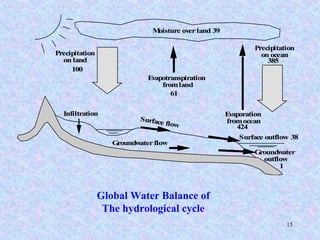
Global Water Balance of
The hydrological cycle
16
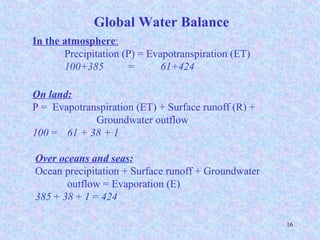
In the atmosphere:
Precipitation (P) = Evapotranspiration (ET)
100+385 = 61+424
On land:
P = Evapotranspiration (ET) + Surface runoff (R) +
Groundwater outflow
100 = 61 + 38 + 1
Over oceans and seas:
Ocean precipitation + Surface runoff + Groundwater
outflow = Evaporation (E)
385 + 38 + 1 = 424
Global Water Balance
17
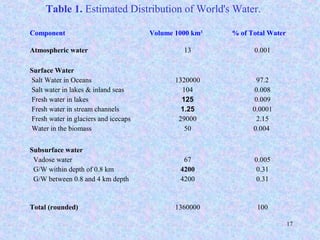
Table 1. Estimated Distribution of World's Water.
Component Volume 1000 km3
% of Total Water
Atmospheric water 13 0.001
Surface Water
Salt Water in Oceans
Salt water in lakes & inland seas
Fresh water in lakes
Fresh water in stream channels
Fresh water in glaciers and icecaps
Water in the biomass
1320000
104
125
1.25
29000
50
97.2
0.008
0.009
0.0001
2.15
0.004
Subsurface water
Vadose water
G/W within depth of 0.8 km
G/W between 0.8 and 4 km depth
67
4200
4200
0.005
0.31
0.31
Total (rounded) 1360000 100
18
Catchment and Basin
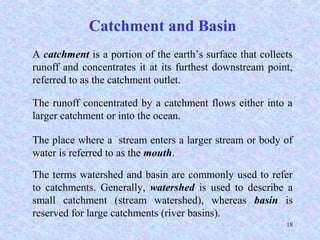
A catchment is a portion of the earth’s surface that collects
runoff and concentrates it at its furthest downstream point,
referred to as the catchment outlet.
The runoff concentrated by a catchment flows either into a
larger catchment or into the ocean.
The place where a stream enters a larger stream or body of
water is referred to as the mouth.
The terms watershed and basin are commonly used to refer
to catchments. Generally, watershed is used to describe a
small catchment (stream watershed), whereas basin is
reserved for large catchments (river basins).
19
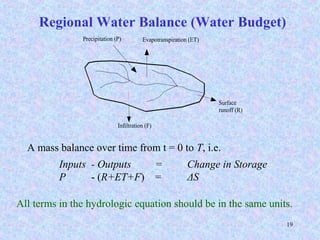
Regional Water Balance (Water Budget)
Precipitation (P) Evapotranspiration (ET)
Surface
runoff (R)
Infiltration (F)
A mass balance over time from t = 0 to T, i.e.
Inputs - Outputs = Change in Storage
P - (R+ET+F) = ΔS
All terms in the hydrologic equation should be in the same units.
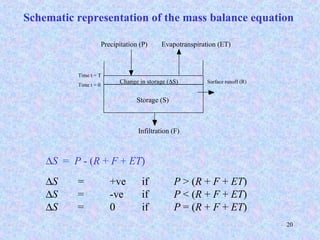
20
Infiltration (F)
Storage (S)
Time t = 0
Time t = T
Change in storage (∆S)
Precipitation (P) Evapotranspiration (ET)
Surface runoff (R)
Schematic representation of the mass balance equation
∆S = P - (R + F + ET)
∆S = +ve if P > (R + F + ET)
∆S = -ve if P < (R + F + ET)
∆S = 0 if P = (R + F + ET)
21
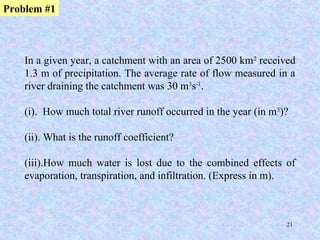
In a given year, a catchment with an area of 2500 km2
received
1.3 m of precipitation. The average rate of flow measured in a
river draining the catchment was 30 m3
s-1
.
(i). How much total river runoff occurred in the year (in m3
)?
(ii). What is the runoff coefficient?
(iii).How much water is lost due to the combined effects of
evaporation, transpiration, and infiltration. (Express in m).
Problem #1
22
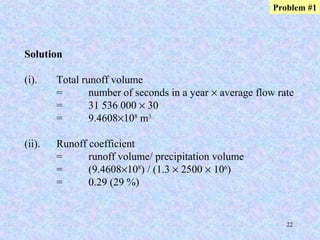
Solution
(i). Total runoff volume
= number of seconds in a year × average flow rate
= 31 536 000 × 30
= 9.4608×10⁸
m3
(ii). Runoff coefficient
= runoff volume/ precipitation volume
= (9.4608×10⁸
) / (1.3 × 2500 × 106
)
= 0.29 (29 %)
Problem #1
23
(iii). The water balance equation can be arranged to
produce:
ET+F= P - R - ΔS
where:
P = (1.3 × 2500×106
)
= 3.25×10⁹
m3
R = 9.4608×10⁸
m3
(from [i])
ΔS = 0 (i.e. no change in storage)
So,
ET + F = 3.25×10⁹
- 9.4608×108
= 2.30392×10⁹
m3
= (2.30392×10⁹
) / (2500×106
)
= 0.92 m
Problem #1
24
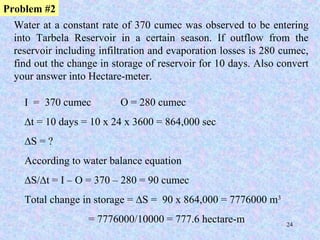
Water at a constant rate of 370 cumec was observed to be entering
into Tarbela Reservoir in a certain season. If outflow from the
reservoir including infiltration and evaporation losses is 280 cumec,
find out the change in storage of reservoir for 10 days. Also convert
your answer into Hectare-meter.
Problem #2
I = 370 cumec O = 280 cumec
∆t = 10 days = 10 x 24 x 3600 = 864,000 sec
∆S = ?
According to water balance equation
∆S/∆t = I – O = 370 – 280 = 90 cumec
Total change in storage = ∆S = 90 x 864,000 = 7776000 m3
= 7776000/10000 = 777.6 hectare-m
25
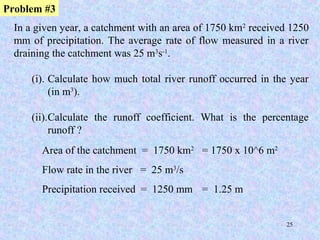
In a given year, a catchment with an area of 1750 km2
received 1250
mm of precipitation. The average rate of flow measured in a river
draining the catchment was 25 m3
s-1
.
(i). Calculate how much total river runoff occurred in the year
(in m3
).
(ii).Calculate the runoff coefficient. What is the percentage
runoff ?
Problem #3
Area of the catchment = 1750 km2
= 1750 x 10^6 m2
Flow rate in the river = 25 m3
/s
Precipitation received = 1250 mm = 1.25 m
26
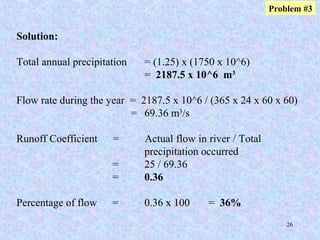
Solution:
Total annual precipitation = (1.25) x (1750 x 10^6)
= 2187.5 x 10^6 m3
Flow rate during the year = 2187.5 x 10^6 / (365 x 24 x 60 x 60)
= 69.36 m3
/s
Runoff Coefficient = Actual flow in river / Total
precipitation occurred
= 25 / 69.36
= 0.36
Percentage of flow = 0.36 x 100 = 36%
Problem #3

Lec.01.introduction to hydrology

  • 1.
    1 The study ofwater, including rain, snow and water on the earth’s surface, covering its properties, distribution, utilisation, etc. (Chambers Science and Technology Dictionary) The study of water in all its forms, and from its origins to all its destinations on the earth. (Bras, 1990)) The science dealing with the waters of the earth, their occurrence, distribution and circulation, their chemical and physical properties, and their interaction with the environment. (Ward & Robinson, 1999) HYDROLOGHYDROLOG YY
  • 2.
  • 3.
    3 • Water isone the most valuable natural resources essential for human and animal life, industry and agriculture. • It is also used for power generation, navigation and fisheries. • Tremendous importance is given to the hydrology all over the world in the development and management of water resources for irrigation, water supply, flood control, water-logging and salinity control, Hydro power and navigation. Scope of Hydrology
  • 4.
    4 Engineering Hydrology • Ituses hydrologic principles in the solution of engineering problems arising from human exploitation of water resources of the earth. • The engineering hydrologist, or water resources engineer, is involved in the planning, analysis, design, construction and operation of projects for the control, utilization and management of water resources. • Hydrologic calculations are estimates because mostly the empirical and approximate nature of methods are used to describe various hydrological processes.
  • 5.
    5 Engineering Hydrology seeksto answer questions of the following types: • What is the maximum probable flood at a proposed dam site? • How does a catchment’s water yield vary from season to season and from year to year? • What is the relationship between a catchment’s surface water and groundwater resources? • What flood flows can be expected over a spillway, at a highway culvert, or in an urban storm drainage system? • What reservoir capacity is required to assure adequate water for irrigation or municipal water supply in droughts condition? • What hydrologic hardware (e.g. rain gauges, stream gauges etc) and software (computer models) are needed for real-time flood forecasting? Uses of Engineering Hydrology
  • 6.
    6 Major Aspects ofHydrology The main jobs of a hydrologist are collection and analysis of data, and making prediction out of this data. 1. Collection of Data: The hydrologic data comprises: Rainfall data, snowfall and snowmelt data, runoff data, topographic maps, groundwater data. 2. Analysis of Data Analysis of hydrologic data includes checking it for consistency and homogeneity as well as finding its various statistical parameters. 3. Prediction Means to find design values and maximum possible events (rainfall, floods, droughts). Various approaches used are: Statistical, Physical, Deterministic
  • 7.
    7 HYDROLOGIC CYCLE • Thehydrologic cycle describes the continues re-circulating transport of the waters of the earth, linking atmosphere, land and oceans. • To explain it briefly, water evaporates from the ocean surface, driven by energy from the Sun, and joins the atmosphere, moving inland as clouds. Once inland, atmospheric conditions act to condense and precipitate water onto the land surface, where, driven by gravitational forces, it returns to the ocean through river and streams. • The process is quite complex, containing many sub-cycles. • Engineering Hydrology takes a quantitative view of the hydrologic cycle.
  • 8.
  • 9.
    9 Hydrological ProcessesHydrological Processes •Precipitation • Interception • Evaporation • Transpiration • Infiltration • Overland flow • Surface Runoff • Groundwater outflow
  • 10.
  • 11.
    11 • The quantificationof the hydrologic cycle which is an open system, can be represented by a mass balance equation, where inputs minus outputs are equal to the change in storage. I - O = ∆S • The water holding elements of the hydrological cycle are: 1. Atmosphere 2. Vegetation 3. Snow packs 4. Land surface 5. Soil 6. Streams, lakes and rivers 7. Aquifers 8 Oceans Hydrologic EquationHydrologic Equation
  • 12.
    12 Inflow: 1. Precipitation 2. Importdefined as water channeled into a given area. 3. Groundwater inflow from adjoining areas. Outflow: 1. Surface runoff outflow 2. Export defined as water channeled out of the same area. 3. Evaporation 4. Transpiration 5. Interception Change in Storage: This occurs as change in: 1. Groundwater 2. Soil moisture 3. Surface reservoir water and depression storage Water Balance Components
  • 13.
    13 Global Hydrologic Cycle •The global hydrologic cycle can be represented as a system containing three subsystems: the atmospheric water system, the surface water system, and the subsurface water system. • Block-diagram (flow chart) representation of GHC is shown in Figure#1.
  • 14.
    14 Precipitation Infiltration Transpiration Interception Groundwater recharge Overland flow Subsurface flow Runoffto streams and ocean Surface runoff Groundwater flow Evaporation ∑ ∑ AtmosphericWaterSubsurfaceWaterSurface Water Block-diagram representation of the global hydrologic system (Chow et al. 1988).
  • 15.
    15 Evapotranspiration fromland Evaporation fromocean Moisture overland Precipitation on land 100 61 39 424 Precipitation onocean 385 Groundwater outflow Surface outflow 38 1 Surface flow Groundwaterflow Infiltration Global Water Balance of The hydrological cycle
  • 16.
    16 In the atmosphere: Precipitation(P) = Evapotranspiration (ET) 100+385 = 61+424 On land: P = Evapotranspiration (ET) + Surface runoff (R) + Groundwater outflow 100 = 61 + 38 + 1 Over oceans and seas: Ocean precipitation + Surface runoff + Groundwater outflow = Evaporation (E) 385 + 38 + 1 = 424 Global Water Balance
  • 17.
    17 Table 1. EstimatedDistribution of World's Water. Component Volume 1000 km3 % of Total Water Atmospheric water 13 0.001 Surface Water Salt Water in Oceans Salt water in lakes & inland seas Fresh water in lakes Fresh water in stream channels Fresh water in glaciers and icecaps Water in the biomass 1320000 104 125 1.25 29000 50 97.2 0.008 0.009 0.0001 2.15 0.004 Subsurface water Vadose water G/W within depth of 0.8 km G/W between 0.8 and 4 km depth 67 4200 4200 0.005 0.31 0.31 Total (rounded) 1360000 100
  • 18.
    18 Catchment and Basin Acatchment is a portion of the earth’s surface that collects runoff and concentrates it at its furthest downstream point, referred to as the catchment outlet. The runoff concentrated by a catchment flows either into a larger catchment or into the ocean. The place where a stream enters a larger stream or body of water is referred to as the mouth. The terms watershed and basin are commonly used to refer to catchments. Generally, watershed is used to describe a small catchment (stream watershed), whereas basin is reserved for large catchments (river basins).
  • 19.
    19 Regional Water Balance(Water Budget) Precipitation (P) Evapotranspiration (ET) Surface runoff (R) Infiltration (F) A mass balance over time from t = 0 to T, i.e. Inputs - Outputs = Change in Storage P - (R+ET+F) = ΔS All terms in the hydrologic equation should be in the same units.
  • 20.
    20 Infiltration (F) Storage (S) Timet = 0 Time t = T Change in storage (∆S) Precipitation (P) Evapotranspiration (ET) Surface runoff (R) Schematic representation of the mass balance equation ∆S = P - (R + F + ET) ∆S = +ve if P > (R + F + ET) ∆S = -ve if P < (R + F + ET) ∆S = 0 if P = (R + F + ET)
  • 21.
    21 In a givenyear, a catchment with an area of 2500 km2 received 1.3 m of precipitation. The average rate of flow measured in a river draining the catchment was 30 m3 s-1 . (i). How much total river runoff occurred in the year (in m3 )? (ii). What is the runoff coefficient? (iii).How much water is lost due to the combined effects of evaporation, transpiration, and infiltration. (Express in m). Problem #1
  • 22.
    22 Solution (i). Total runoffvolume = number of seconds in a year × average flow rate = 31 536 000 × 30 = 9.4608×10⁸ m3 (ii). Runoff coefficient = runoff volume/ precipitation volume = (9.4608×10⁸ ) / (1.3 × 2500 × 106 ) = 0.29 (29 %) Problem #1
  • 23.
    23 (iii). The waterbalance equation can be arranged to produce: ET+F= P - R - ΔS where: P = (1.3 × 2500×106 ) = 3.25×10⁹ m3 R = 9.4608×10⁸ m3 (from [i]) ΔS = 0 (i.e. no change in storage) So, ET + F = 3.25×10⁹ - 9.4608×108 = 2.30392×10⁹ m3 = (2.30392×10⁹ ) / (2500×106 ) = 0.92 m Problem #1
  • 24.
    24 Water at aconstant rate of 370 cumec was observed to be entering into Tarbela Reservoir in a certain season. If outflow from the reservoir including infiltration and evaporation losses is 280 cumec, find out the change in storage of reservoir for 10 days. Also convert your answer into Hectare-meter. Problem #2 I = 370 cumec O = 280 cumec ∆t = 10 days = 10 x 24 x 3600 = 864,000 sec ∆S = ? According to water balance equation ∆S/∆t = I – O = 370 – 280 = 90 cumec Total change in storage = ∆S = 90 x 864,000 = 7776000 m3 = 7776000/10000 = 777.6 hectare-m
  • 25.
    25 In a givenyear, a catchment with an area of 1750 km2 received 1250 mm of precipitation. The average rate of flow measured in a river draining the catchment was 25 m3 s-1 . (i). Calculate how much total river runoff occurred in the year (in m3 ). (ii).Calculate the runoff coefficient. What is the percentage runoff ? Problem #3 Area of the catchment = 1750 km2 = 1750 x 10^6 m2 Flow rate in the river = 25 m3 /s Precipitation received = 1250 mm = 1.25 m
  • 26.
    26 Solution: Total annual precipitation= (1.25) x (1750 x 10^6) = 2187.5 x 10^6 m3 Flow rate during the year = 2187.5 x 10^6 / (365 x 24 x 60 x 60) = 69.36 m3 /s Runoff Coefficient = Actual flow in river / Total precipitation occurred = 25 / 69.36 = 0.36 Percentage of flow = 0.36 x 100 = 36% Problem #3