BY
Gowtham B AP/Civil
SREC,CBE-22
RUNOFF
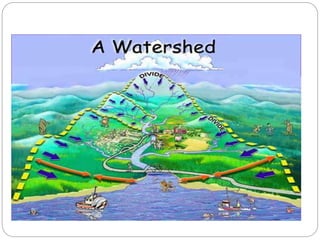
Watershed
A watershed describes an area of land that
contains a common set of streams that all drain
into a single larger body of water, such as a larger
river, a lake or an ocean. A watershed can cover
a small or large land area.
Basin
A river drainage basin is an area drained by a
river and all of its tributaries. A low-lying area on
the earth’s surface in which thick layers of
sediment have accumulated. Some basins are
bowl-shaped while others are elongated.
A river basin is made up of many different
watersheds. A watershed is a small version of a
river basin.
Catchment Area
catchment area is an extent or an area of land
where all surface water from rain, melting snow or
ice converges to a single point at a lower
elevation, usually the exit of the basin, where the
waters join another body of water, such as a river,
lake, reservoir, estuary, wetland, sea, or ocean.
Definition of Runoff
Runoff can be defined as the portion of the
precipitation that makes it’s way towards rivers
or oceans etc, as surface or subsurface flow.
Portion which is not absorbed by the deep
strata.
Runoff occurs only when the rate of
precipitation exceeds the rate at which water
may infiltrate into the soil.
Portions of Runoff
1. Surface runoff
2. Groundwater flow
3. Direct precipitation over the river stream.
Runoff Process
When rainfall occurs:
A part of rainfall/precipitation is intercepted by
vegetation.
Some part is stored in depressions on the ground
surface known as depression storage, which later
infiltrates or evaporates.
Some part of rainfall is absorbed by the soil, the
amount of which depends upon the soil moisture
condition at the time of percolation.
Now if the rain continues further;
 The water starts infiltrating/percolating to the
water table and if the rate of rainfall or the rate at
which the water is reaching the ground exceeds
the infiltration rate (f), resulting the surface
detention (D).
 This water flow overland and joins the rivers,
lakes, streams, oceans, etc., and is known as
surface runoff.
Factors Affecting Runoff
1. Precipitation characteristics,
2. Shape and size of the catchment,
3. Topography,
4. Geological characteristics,
5. Meteorological characteristics,
6. Character of the catchment surface,
7. Storage characteristics.
1. Precipitation characteristics
 It is the most important factor for runoff
 Runoff depends on the type of the storm and it’s
duration, which causes precipitation.
 Runoff depends on the intensity of rainfall.
 More the rainfall, more will be runoff.
 If the rainfall intensity is very less and it rains as
light showers then much of the water will be lost
in infiltration & evaporation resulting less runoff.
 If precipitation is in case of snow then less runoff.
2. Shape and size of the
catchment
 Runoff depends upon size, shape and location of
the catchment.
 Generally more rainfall on smaller area resulting
in greater runoff.
 Less runoff in larger catchments because due to
uniform rainfall over the entire area, thus only few
tributaries of the stream feed water to a main
stream during a particular storm.
Types of catchment
A. Fan shaped catchment
B. Fern leaf catchment
A. Fan shaped catchment
 All the tributaries are approximately of the same
size.
 Gives greater runoff because the peak flood from
the tributaries is likely to reach the main stream
approximately at the same time.
B. Fern leaf catchment
 The tributaries are generally of different lengths
and meet the main stream at the regular intervals.
 Such a narrow catchments the peak flood
intensity is reduced since discharges are likely to
be distributed over a long period of time.
3. Topography
 Runoff depends on surface smoothness and
slope.
 If slope is steep, flow will be quick and less
evaporation and absorption, resulting greater
runoff.
 If the catchment is in mountainous area and on
the windward side of the mountain, then more
rain fall resulting more runoff.
4. Geological characteristics
It is one of the important factor.
 It includes the type of surface soil, subsoil, type
of rock and their permeability characteristics.
 If soil and subsoil is porous, seepage will be more
resulting reduction of the peak flood.
 If the surface is rocky, then absorption will be nil
resulting more runoff.
 If rocks have fissures, are porous in nature, have
lava funnels water will be lost resulting less
runoff.
5. Meteorological
characteristics
Runoff may also be affected by temperature, wind
and humidity.
 If temperature is low and ground is saturated
then runoff will be greater.
 If temperature is high and greater wind velocity
give rise to greater evaporation loss and resulting
in less runoff.
6. Character of the Catchment
surface
Runoff depends upon the surface conditions like
drained, undrained, natural or cultivated.
 If the surface has no natural drainage then
absorption loss will be more.
 If more area of a catchment is cultivated resulting
less runoff.
 Vegetal cover reduces the runoff in smaller
storms.
 No vegetal cover reduction in bigger storm.
7. Storage characteristics
 The artificial storage such as dams, weirs, etc
and natural storage such as lakes, ponds, etc.,
tend to reduce the peak flow.
 They also give rise to greater evaporation losses.
Thankyou

Runoff

  • 1.
  • 2.
    Watershed A watershed describesan area of land that contains a common set of streams that all drain into a single larger body of water, such as a larger river, a lake or an ocean. A watershed can cover a small or large land area.
  • 4.
    Basin A river drainagebasin is an area drained by a river and all of its tributaries. A low-lying area on the earth’s surface in which thick layers of sediment have accumulated. Some basins are bowl-shaped while others are elongated. A river basin is made up of many different watersheds. A watershed is a small version of a river basin.
  • 5.
    Catchment Area catchment areais an extent or an area of land where all surface water from rain, melting snow or ice converges to a single point at a lower elevation, usually the exit of the basin, where the waters join another body of water, such as a river, lake, reservoir, estuary, wetland, sea, or ocean.
  • 6.
    Definition of Runoff Runoffcan be defined as the portion of the precipitation that makes it’s way towards rivers or oceans etc, as surface or subsurface flow. Portion which is not absorbed by the deep strata. Runoff occurs only when the rate of precipitation exceeds the rate at which water may infiltrate into the soil.
  • 7.
    Portions of Runoff 1.Surface runoff 2. Groundwater flow 3. Direct precipitation over the river stream.
  • 8.
    Runoff Process When rainfalloccurs: A part of rainfall/precipitation is intercepted by vegetation. Some part is stored in depressions on the ground surface known as depression storage, which later infiltrates or evaporates. Some part of rainfall is absorbed by the soil, the amount of which depends upon the soil moisture condition at the time of percolation.
  • 9.
    Now if therain continues further;  The water starts infiltrating/percolating to the water table and if the rate of rainfall or the rate at which the water is reaching the ground exceeds the infiltration rate (f), resulting the surface detention (D).  This water flow overland and joins the rivers, lakes, streams, oceans, etc., and is known as surface runoff.
  • 10.
    Factors Affecting Runoff 1.Precipitation characteristics, 2. Shape and size of the catchment, 3. Topography, 4. Geological characteristics, 5. Meteorological characteristics, 6. Character of the catchment surface, 7. Storage characteristics.
  • 11.
    1. Precipitation characteristics It is the most important factor for runoff  Runoff depends on the type of the storm and it’s duration, which causes precipitation.  Runoff depends on the intensity of rainfall.  More the rainfall, more will be runoff.  If the rainfall intensity is very less and it rains as light showers then much of the water will be lost in infiltration & evaporation resulting less runoff.  If precipitation is in case of snow then less runoff.
  • 12.
    2. Shape andsize of the catchment  Runoff depends upon size, shape and location of the catchment.  Generally more rainfall on smaller area resulting in greater runoff.  Less runoff in larger catchments because due to uniform rainfall over the entire area, thus only few tributaries of the stream feed water to a main stream during a particular storm.
  • 13.
    Types of catchment A.Fan shaped catchment B. Fern leaf catchment
  • 14.
    A. Fan shapedcatchment  All the tributaries are approximately of the same size.  Gives greater runoff because the peak flood from the tributaries is likely to reach the main stream approximately at the same time.
  • 16.
    B. Fern leafcatchment  The tributaries are generally of different lengths and meet the main stream at the regular intervals.  Such a narrow catchments the peak flood intensity is reduced since discharges are likely to be distributed over a long period of time.
  • 18.
    3. Topography  Runoffdepends on surface smoothness and slope.  If slope is steep, flow will be quick and less evaporation and absorption, resulting greater runoff.  If the catchment is in mountainous area and on the windward side of the mountain, then more rain fall resulting more runoff.
  • 19.
    4. Geological characteristics Itis one of the important factor.  It includes the type of surface soil, subsoil, type of rock and their permeability characteristics.  If soil and subsoil is porous, seepage will be more resulting reduction of the peak flood.  If the surface is rocky, then absorption will be nil resulting more runoff.  If rocks have fissures, are porous in nature, have lava funnels water will be lost resulting less runoff.
  • 20.
    5. Meteorological characteristics Runoff mayalso be affected by temperature, wind and humidity.  If temperature is low and ground is saturated then runoff will be greater.  If temperature is high and greater wind velocity give rise to greater evaporation loss and resulting in less runoff.
  • 21.
    6. Character ofthe Catchment surface Runoff depends upon the surface conditions like drained, undrained, natural or cultivated.  If the surface has no natural drainage then absorption loss will be more.  If more area of a catchment is cultivated resulting less runoff.  Vegetal cover reduces the runoff in smaller storms.  No vegetal cover reduction in bigger storm.
  • 22.
    7. Storage characteristics The artificial storage such as dams, weirs, etc and natural storage such as lakes, ponds, etc., tend to reduce the peak flow.  They also give rise to greater evaporation losses.
  • 23.