Raman Spectroscopy 
Prof. V. Krishnakumar 
Professor and Head 
Department of Physics 
Periyar University 
Salem – 636 011, India
What is Spectroscopy? 
• The study of how 'species' (i.e., 
atoms, molecules, solutions) react 
to light. Some studies depend on 
how much light an atom absorbs. 
The electromagnetic radiation 
absorbed, emitted or scattered by 
the molecule is analyzed. Typically, 
a beam of radiation from a source 
such as a laser is passed through a 
sample, and the radiation exiting 
the sample is measured. Some, like 
Raman, depend on a molecule's 
vibrations in reaction to the light.
Light Scattering Phenomenon 
• When radiation passes through a 
transparent medium, the species present 
in that medium scatter a fraction of the 
beam in all directions.
Raman Effect (or Raman 
Scattering) 
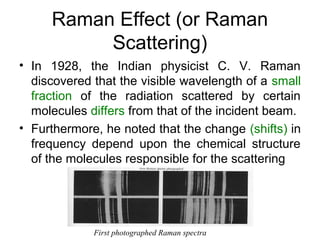
• In 1928, the Indian physicist C. V. Raman 
discovered that the visible wavelength of a small 
fraction of the radiation scattered by certain 
molecules differs from that of the incident beam. 
• Furthermore, he noted that the change (shifts) in 
frequency depend upon the chemical structure 
of the molecules responsible for the scattering 
First photographed Raman spectra
Why Raman? 
• In Raman spectroscopy, 
by varying the frequency 
of the radiation, a 
spectrum can be 
produced, showing the 
intensity of the exiting 
radiation for each 
frequency. This spectrum 
will show which 
frequencies of radiation 
have been absorbed by 
the molecule to raise it to 
higher vibrational energy 
states.
What Exactly Is Being Measured? 
METHANE 
When Light hits a 
sample, It is Excited, 
and is forced to vibrate 
and move. It is these 
vibrations which we are 
measuring.
First Report of Raman Observation 
Nature 121, 501-502 (31 March 1928) 
A New Type of Secondary Radiation 
C. V. RAMAN & K. S. KRISHNAN 
Abstract 
If we assume that the X-ray scattering of the ‘unmodified’ type observed by Prof. 
Compton corresponds to the normal or average state of the atoms and molecules, 
while the ‘modified’ scattering of altered wave-length corresponds to their 
fluctuations from that state, it would follow that we should expect also in the case of 
ordinary light two types of scattering, one determined by the normal optical 
properties of the atoms or molecules, and another representing the effect of their 
fluctuations from their normal state. It accordingly becomes necessary to test 
whether this is actually the case. The experiments we have made have confirmed 
this anticipation, and shown that in every case in which light is scattered by the 
molecules in dust-free liquids or gases, the diffuse radiation of the ordinary kind, 
having the same wave-length as the incident beam, is accompanied by a modified 
scattered radiation of degraded frequency.
First Report of Raman Observation 
Nature 121, 501-502 (31 March 1928) 
A New Type of Secondary Radiation 
C. V. RAMAN & K. S. KRISHNAN 
Continue 
The new type of light scattering discovered by us naturally requires very 
powerful illumination for its observation. In our experiments, a beam of 
sunlight was converged successively by a telescope objective of 18 cm. 
aperture and 230 cm. focal length, and by a second lens was placed the 
scattering material, which is either a liquid (carefully purified by repeated 
distillation in vacuo) or its dust-free vapour. To detect the presence of a 
modified scattered radiation, the method of complementary light-filters was 
used. A blue-violet filter, when coupled with a yellow-green filter and placed 
in the incident light, completely extinguished the track of the light through 
the liquid or vapour. The reappearance of the track when the yellow filter is 
transferred to a place between it and the observer's eye is proof of the 
existence of a modified scattered radiation. Spectroscopic confirmation is 
also available.
The Nobel Prize in Physics 
1930 
Professor Sir C.V. Raman 
1888-1970 
"for his work on the 
scattering of light 
and for the 
discovery of the 
effect named after 
him" 
http://nobelprize.org/nobel_prizes/physics/laureat 
es/1930/raman-lecture.pdf
Rayleigh Scattering and Raman 
Scattering 
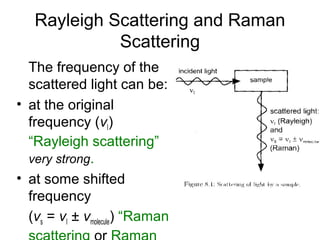
The frequency of the 
scattered light can be: 
• at the original 
frequency (νI) 
“Rayleigh scattering” 
very strong. 
• at some shifted 
frequency 
(νs = νI ± νmolecule) “Raman 
scattering or Raman
Stokes and Anti-Stokes 
Scattering 
• Raman shift can correspond either to 
rotational, vibrational or electronic 
frequencies. 
Δν = |νI – νs| 
• Radiation scattering to the lower 
frequency side (to the red side) of the 
Rayleigh line is called Stokes scattering. 
• Radiation scattering to the higher 
frequency side (to the blue side) of the 
Rayleigh line is called anti-Stokes
Stokes and Anti-Stokes 
Scattering
Stokes and Anti-Stokes 
Scattering
Number of bands in a Raman spectrum 
As for an IR spectrum, the number of bands in the 
Raman spectrum for an N-atom non-linear molecule is 
seldom 3N-6, because: 
polarizability change is zero or small for some 
vibrations; 
bands overlap; 
combination or overtone bands are present; 
Fermi resonances occur; 
some vibrations are highly degenerate; etc…
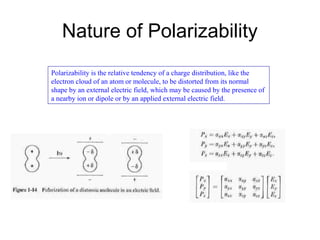
Nature of Polarizability 
Polarizability is the relative tendency of a charge distribution, like the 
electron cloud of an atom or molecule, to be distorted from its normal 
shape by an external electric field, which may be caused by the presence of 
a nearby ion or dipole or by an applied external electric field.
Raman Activity of Molecular 
Vibrations 
• In order to be Raman active, a molecular rotation 
or vibration must cause some change in a 
component of the molecular polarizability. The 
change can either be in the magnitude or the 
direction of the polarizability ellipsoid. 
• Polarizability ellipsoid is a three-dimensional body 
generated by plotting 1/√α from the center of 
gravity in all directions. 
• This rule must be contrasted with that for IR 
activity that requires change in the net dipole 
moment of the molecule.
Raman 
Activity of 
H2O 
Vibrations
Raman 
Activity of 
CO2 
Vibrations
Raman and Infrared are Complementary 
Techniques 
• Interestingly, although they are based on two 
distinct phenomena, the Raman scattering 
spectrum and infrared absorption spectrum for a 
given species often resemble one another quite 
closely in terms of observed frequencies. 
The infrared 
and Raman 
spectrum of 
styrene/buta-diene 
rubber.
Rule of Mutual Exclusion 
• If a molecule has a center of symmetry, 
then Raman active vibrations are infrared 
inactive, and vice versa. If there is no 
center of symmetry, then some (but not 
necessarily all) may be both Raman and 
infrared active.
Comparison between FT and 
• FT-Raman 
dispersive Raman 
• Fluorescence-free Raman 
spectra by 1064nm 
excitation 
• Simple measurement of 
bulk samples due to 
advantage of sample 
compartment 
• Quantification 
• Dispersive Raman 
• Better spatial resolution for 
microscopy applications (down 
to 1μm) 
• Higher sensitivity and shorter 
measurement times for non-fluorescing 
samples 
• Selection of different excitation 
lines (488-785nm)
Uses of Raman Spectroscopy 
Raman spectroscopy has become more widely used 
since the advent of FT-Raman systems and remote 
optical fibre sampling. Previous difficulties with 
laser safety, stability and precision have largely 
been overcome. 
Basically, Raman spectroscopy is complementary 
to IR spectroscopy, but the sampling is more 
convenient, since glass containers may be used 
and solids do not have to be mulled or pressed into 
discs.
Applications of Raman spectroscopy 
Qualitative tool for identifying molecules from their 
vibrations, especially in conjunction with infrared 
spectrometry. 
Quantitative Raman measurements 
a) not sensitive since Raman scattering is weak. But 
resonance Raman spectra offer higher sensitivity, 
e.g. fabric dyes studied at 30-50 ppb. 
b) beset by difficulties in measuring relative 
intensities of bands from different samples, due to 
sample alignment, collection efficiency, laser power. 
Overcome by using internal standard.
Raman vs IR spectroscopy 
RAMAN IR 
Sample preparation usually simpler 
Liquid/ Solid samples must be free 
from dust 
Biological materials usually fluoresce, 
masking scattering 
Spectral measurements on vibrations Halide optics must be used-made 
in the visible region-glass cells expensive, easily broken, 
may be used water soluble 
Depolarization studies are easily made IR spectrometers not usually 
(laser radiation almost totally linearly equipped with polarizers 
polarized)

Raman Spectroscopy

  • 1.
    Raman Spectroscopy Prof.V. Krishnakumar Professor and Head Department of Physics Periyar University Salem – 636 011, India
  • 2.
    What is Spectroscopy? • The study of how 'species' (i.e., atoms, molecules, solutions) react to light. Some studies depend on how much light an atom absorbs. The electromagnetic radiation absorbed, emitted or scattered by the molecule is analyzed. Typically, a beam of radiation from a source such as a laser is passed through a sample, and the radiation exiting the sample is measured. Some, like Raman, depend on a molecule's vibrations in reaction to the light.
  • 3.
    Light Scattering Phenomenon • When radiation passes through a transparent medium, the species present in that medium scatter a fraction of the beam in all directions.
  • 4.
    Raman Effect (orRaman Scattering) • In 1928, the Indian physicist C. V. Raman discovered that the visible wavelength of a small fraction of the radiation scattered by certain molecules differs from that of the incident beam. • Furthermore, he noted that the change (shifts) in frequency depend upon the chemical structure of the molecules responsible for the scattering First photographed Raman spectra
  • 5.
    Why Raman? •In Raman spectroscopy, by varying the frequency of the radiation, a spectrum can be produced, showing the intensity of the exiting radiation for each frequency. This spectrum will show which frequencies of radiation have been absorbed by the molecule to raise it to higher vibrational energy states.
  • 6.
    What Exactly IsBeing Measured? METHANE When Light hits a sample, It is Excited, and is forced to vibrate and move. It is these vibrations which we are measuring.
  • 7.
    First Report ofRaman Observation Nature 121, 501-502 (31 March 1928) A New Type of Secondary Radiation C. V. RAMAN & K. S. KRISHNAN Abstract If we assume that the X-ray scattering of the ‘unmodified’ type observed by Prof. Compton corresponds to the normal or average state of the atoms and molecules, while the ‘modified’ scattering of altered wave-length corresponds to their fluctuations from that state, it would follow that we should expect also in the case of ordinary light two types of scattering, one determined by the normal optical properties of the atoms or molecules, and another representing the effect of their fluctuations from their normal state. It accordingly becomes necessary to test whether this is actually the case. The experiments we have made have confirmed this anticipation, and shown that in every case in which light is scattered by the molecules in dust-free liquids or gases, the diffuse radiation of the ordinary kind, having the same wave-length as the incident beam, is accompanied by a modified scattered radiation of degraded frequency.
  • 8.
    First Report ofRaman Observation Nature 121, 501-502 (31 March 1928) A New Type of Secondary Radiation C. V. RAMAN & K. S. KRISHNAN Continue The new type of light scattering discovered by us naturally requires very powerful illumination for its observation. In our experiments, a beam of sunlight was converged successively by a telescope objective of 18 cm. aperture and 230 cm. focal length, and by a second lens was placed the scattering material, which is either a liquid (carefully purified by repeated distillation in vacuo) or its dust-free vapour. To detect the presence of a modified scattered radiation, the method of complementary light-filters was used. A blue-violet filter, when coupled with a yellow-green filter and placed in the incident light, completely extinguished the track of the light through the liquid or vapour. The reappearance of the track when the yellow filter is transferred to a place between it and the observer's eye is proof of the existence of a modified scattered radiation. Spectroscopic confirmation is also available.
  • 9.
    The Nobel Prizein Physics 1930 Professor Sir C.V. Raman 1888-1970 "for his work on the scattering of light and for the discovery of the effect named after him" http://nobelprize.org/nobel_prizes/physics/laureat es/1930/raman-lecture.pdf
  • 10.
    Rayleigh Scattering andRaman Scattering The frequency of the scattered light can be: • at the original frequency (νI) “Rayleigh scattering” very strong. • at some shifted frequency (νs = νI ± νmolecule) “Raman scattering or Raman
  • 11.
    Stokes and Anti-Stokes Scattering • Raman shift can correspond either to rotational, vibrational or electronic frequencies. Δν = |νI – νs| • Radiation scattering to the lower frequency side (to the red side) of the Rayleigh line is called Stokes scattering. • Radiation scattering to the higher frequency side (to the blue side) of the Rayleigh line is called anti-Stokes
  • 12.
  • 13.
  • 14.
    Number of bandsin a Raman spectrum As for an IR spectrum, the number of bands in the Raman spectrum for an N-atom non-linear molecule is seldom 3N-6, because: polarizability change is zero or small for some vibrations; bands overlap; combination or overtone bands are present; Fermi resonances occur; some vibrations are highly degenerate; etc…
  • 15.
    Nature of Polarizability Polarizability is the relative tendency of a charge distribution, like the electron cloud of an atom or molecule, to be distorted from its normal shape by an external electric field, which may be caused by the presence of a nearby ion or dipole or by an applied external electric field.
  • 16.
    Raman Activity ofMolecular Vibrations • In order to be Raman active, a molecular rotation or vibration must cause some change in a component of the molecular polarizability. The change can either be in the magnitude or the direction of the polarizability ellipsoid. • Polarizability ellipsoid is a three-dimensional body generated by plotting 1/√α from the center of gravity in all directions. • This rule must be contrasted with that for IR activity that requires change in the net dipole moment of the molecule.
  • 17.
    Raman Activity of H2O Vibrations
  • 18.
    Raman Activity of CO2 Vibrations
  • 19.
    Raman and Infraredare Complementary Techniques • Interestingly, although they are based on two distinct phenomena, the Raman scattering spectrum and infrared absorption spectrum for a given species often resemble one another quite closely in terms of observed frequencies. The infrared and Raman spectrum of styrene/buta-diene rubber.
  • 20.
    Rule of MutualExclusion • If a molecule has a center of symmetry, then Raman active vibrations are infrared inactive, and vice versa. If there is no center of symmetry, then some (but not necessarily all) may be both Raman and infrared active.
  • 22.
    Comparison between FTand • FT-Raman dispersive Raman • Fluorescence-free Raman spectra by 1064nm excitation • Simple measurement of bulk samples due to advantage of sample compartment • Quantification • Dispersive Raman • Better spatial resolution for microscopy applications (down to 1μm) • Higher sensitivity and shorter measurement times for non-fluorescing samples • Selection of different excitation lines (488-785nm)
  • 23.
    Uses of RamanSpectroscopy Raman spectroscopy has become more widely used since the advent of FT-Raman systems and remote optical fibre sampling. Previous difficulties with laser safety, stability and precision have largely been overcome. Basically, Raman spectroscopy is complementary to IR spectroscopy, but the sampling is more convenient, since glass containers may be used and solids do not have to be mulled or pressed into discs.
  • 24.
    Applications of Ramanspectroscopy Qualitative tool for identifying molecules from their vibrations, especially in conjunction with infrared spectrometry. Quantitative Raman measurements a) not sensitive since Raman scattering is weak. But resonance Raman spectra offer higher sensitivity, e.g. fabric dyes studied at 30-50 ppb. b) beset by difficulties in measuring relative intensities of bands from different samples, due to sample alignment, collection efficiency, laser power. Overcome by using internal standard.
  • 25.
    Raman vs IRspectroscopy RAMAN IR Sample preparation usually simpler Liquid/ Solid samples must be free from dust Biological materials usually fluoresce, masking scattering Spectral measurements on vibrations Halide optics must be used-made in the visible region-glass cells expensive, easily broken, may be used water soluble Depolarization studies are easily made IR spectrometers not usually (laser radiation almost totally linearly equipped with polarizers polarized)