
By-
Manish Sahu
M.Sc. Chemistry (Final)
Sp.- Physical Chemistry
 INTRODUCTION
 DEFINITION
 METALS AND THEIR TOXICITY
 TYPES OF TOXICOLOGY
 TOXICITY OF METALS
 EXAMPLES OF METAL TOXICITY
 CONCLUSION
 REFERENCE
• INTRODUCTION
Pollution is the introduction of contaminants
into the natural environment that cause adverse
change.
Toxic heavy metals in air, soil, and water are
global problems that are a growing threat to the
environment.
• DEFINITION
Heavy - metal pollution an environment
pollution by metals with a high relative atomic
mass, such as lead and mercury.
These metals derive from a number of source,
including lead in petrol, industrial effluents and
leaching of metal ions from the soil into lakes
and rivers by acid rain.
• METALS AND THEIR TOXICITY
The power of toxicity varies from metal to
metal.
A branch of science which deals with the study
of adverse and harmful effects of chemical
agents on any biological system.
• TYPES OF TOXICOLOGY
Divided into five categories :-
1. Clinical toxicology
2. Industrial toxicology
3. Forensic toxicology
4. Environment toxicology
5. Economic toxicology
• TOXICITY OF METALS
Toxicity of a metal depends on the inherent
capacity of a metal to affect adversely any
biological activity.
Toxic metal changes the biological structure and
system of the living organism and also cause
deformity in the body or finally even death.
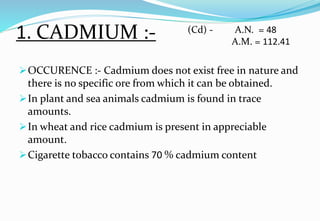
1. CADMIUM :-
OCCURENCE :- Cadmium does not exist free in nature and
there is no specific ore from which it can be obtained.
In plant and sea animals cadmium is found in trace
amounts.
In wheat and rice cadmium is present in appreciable
amount.
Cigarette tobacco contains 70 % cadmium content
(Cd) - A.N. = 48
A.M. = 112.41
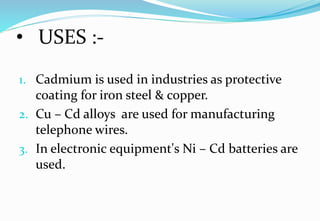
• USES :-
1. Cadmium is used in industries as protective
coating for iron steel & copper.
2. Cu – Cd alloys are used for manufacturing
telephone wires.
3. In electronic equipment's Ni – Cd batteries are
used.
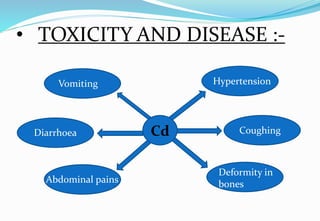
• TOXICITY AND DISEASE :-
Cd
Vomiting
Diarrhoea
Abdominal pains
Hypertension
Coughing
Deformity in
bones
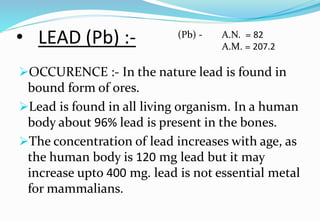
• LEAD (Pb) :-
OCCURENCE :- In the nature lead is found in
bound form of ores.
Lead is found in all living organism. In a human
body about 96% lead is present in the bones.
The concentration of lead increases with age, as
the human body is 120 mg lead but it may
increase upto 400 mg. lead is not essential metal
for mammalians.
(Pb) - A.N. = 82
A.M. = 207.2
• USES :-
Lead is usually deposit in bones and some soft
tissues. It is also retained by animals in liver,
kidney, muscles etc.
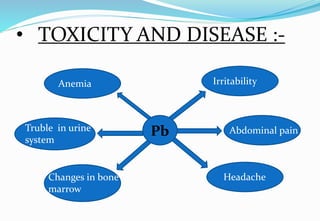
• TOXICITY AND DISEASE :-
Pb
Anemia
Truble in urine
system
Changes in bone
marrow
Irritability
Abdominal pain
Headache
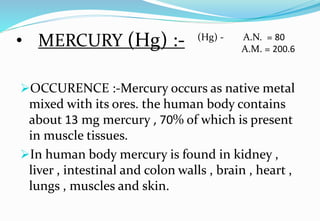
• MERCURY (Hg) :-
OCCURENCE :-Mercury occurs as native metal
mixed with its ores. the human body contains
about 13 mg mercury , 70% of which is present
in muscle tissues.
In human body mercury is found in kidney ,
liver , intestinal and colon walls , brain , heart ,
lungs , muscles and skin.
(Hg) - A.N. = 80
A.M. = 200.6
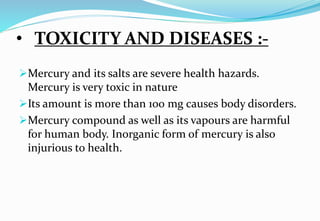
• TOXICITY AND DISEASES :-
Mercury and its salts are severe health hazards.
Mercury is very toxic in nature
Its amount is more than 100 mg causes body disorders.
Mercury compound as well as its vapours are harmful
for human body. Inorganic form of mercury is also
injurious to health.
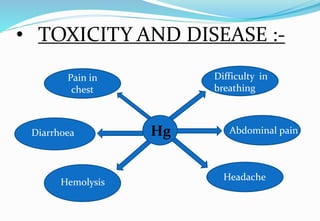
• TOXICITY AND DISEASE :-
Pain in
chest
HgDiarrhoea
Hemolysis
Difficulty in
breathing
Abdominal pain
Headache
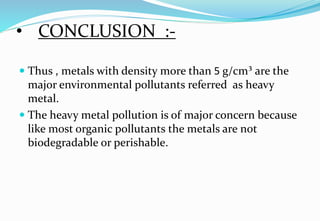
• CONCLUSION :-
 Thus , metals with density more than 5 g/cm³ are the
major environmental pollutants referred as heavy
metal.
 The heavy metal pollution is of major concern because
like most organic pollutants the metals are not
biodegradable or perishable.
Heavy Metal Pollution

Heavy Metal Pollution

  • 1.
    By- Manish Sahu M.Sc. Chemistry(Final) Sp.- Physical Chemistry
  • 2.
     INTRODUCTION  DEFINITION METALS AND THEIR TOXICITY  TYPES OF TOXICOLOGY  TOXICITY OF METALS  EXAMPLES OF METAL TOXICITY  CONCLUSION  REFERENCE
  • 3.
    • INTRODUCTION Pollution isthe introduction of contaminants into the natural environment that cause adverse change. Toxic heavy metals in air, soil, and water are global problems that are a growing threat to the environment.
  • 4.
    • DEFINITION Heavy -metal pollution an environment pollution by metals with a high relative atomic mass, such as lead and mercury. These metals derive from a number of source, including lead in petrol, industrial effluents and leaching of metal ions from the soil into lakes and rivers by acid rain.
  • 5.
    • METALS ANDTHEIR TOXICITY The power of toxicity varies from metal to metal. A branch of science which deals with the study of adverse and harmful effects of chemical agents on any biological system.
  • 6.
    • TYPES OFTOXICOLOGY Divided into five categories :- 1. Clinical toxicology 2. Industrial toxicology 3. Forensic toxicology 4. Environment toxicology 5. Economic toxicology
  • 7.
    • TOXICITY OFMETALS Toxicity of a metal depends on the inherent capacity of a metal to affect adversely any biological activity. Toxic metal changes the biological structure and system of the living organism and also cause deformity in the body or finally even death.
  • 8.
    1. CADMIUM :- OCCURENCE:- Cadmium does not exist free in nature and there is no specific ore from which it can be obtained. In plant and sea animals cadmium is found in trace amounts. In wheat and rice cadmium is present in appreciable amount. Cigarette tobacco contains 70 % cadmium content (Cd) - A.N. = 48 A.M. = 112.41
  • 9.
    • USES :- 1.Cadmium is used in industries as protective coating for iron steel & copper. 2. Cu – Cd alloys are used for manufacturing telephone wires. 3. In electronic equipment's Ni – Cd batteries are used.
  • 10.
    • TOXICITY ANDDISEASE :- Cd Vomiting Diarrhoea Abdominal pains Hypertension Coughing Deformity in bones
  • 11.
    • LEAD (Pb):- OCCURENCE :- In the nature lead is found in bound form of ores. Lead is found in all living organism. In a human body about 96% lead is present in the bones. The concentration of lead increases with age, as the human body is 120 mg lead but it may increase upto 400 mg. lead is not essential metal for mammalians. (Pb) - A.N. = 82 A.M. = 207.2
  • 12.
    • USES :- Leadis usually deposit in bones and some soft tissues. It is also retained by animals in liver, kidney, muscles etc.
  • 13.
    • TOXICITY ANDDISEASE :- Pb Anemia Truble in urine system Changes in bone marrow Irritability Abdominal pain Headache
  • 14.
    • MERCURY (Hg):- OCCURENCE :-Mercury occurs as native metal mixed with its ores. the human body contains about 13 mg mercury , 70% of which is present in muscle tissues. In human body mercury is found in kidney , liver , intestinal and colon walls , brain , heart , lungs , muscles and skin. (Hg) - A.N. = 80 A.M. = 200.6
  • 15.
    • TOXICITY ANDDISEASES :- Mercury and its salts are severe health hazards. Mercury is very toxic in nature Its amount is more than 100 mg causes body disorders. Mercury compound as well as its vapours are harmful for human body. Inorganic form of mercury is also injurious to health.
  • 16.
    • TOXICITY ANDDISEASE :- Pain in chest HgDiarrhoea Hemolysis Difficulty in breathing Abdominal pain Headache
  • 17.
    • CONCLUSION :- Thus , metals with density more than 5 g/cm³ are the major environmental pollutants referred as heavy metal.  The heavy metal pollution is of major concern because like most organic pollutants the metals are not biodegradable or perishable.