By-
Manish Sahu
M.Sc. Chemistry (Final)
Sp.- Physical Chemistry
CONTENTS :-
 INTRODUTION
 HISTORY
 SCHRODINGER WAVE EQUATION
 SCHRODINGER WAVE MODEL SYSTEM
 DERIVATION OF A PARTICLE IN ONE
DIMENSIONAL BOX
 ENERGY WAVE FUNCTION
 NORMALIZED WAVE FUNCTION
 GRAPH MODEL OF WAVE FUNCTION
 CONCLUSION
 REFERENCE
In quantum mechanics the analogue of
Newton’s law in Schrodinger wave equation for
a quantum system. The Schrodinger equation is
our fundamental equation of quantum
mechanics.
The particle in a box problem is a common
application of a quantum mechanical model to
a simplified system.
 ERWIN SCHRODINGER derived Schrodinger
equation in 1925 and published the
Schrodinger equation in 1926.
 ERWIN SCHRODINGER awarded the nobel
prize in physics in 1933.
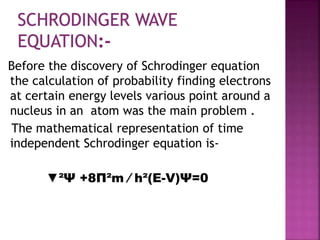
Before the discovery of Schrodinger equation
the calculation of probability finding electrons
at certain energy levels various point around a
nucleus in an atom was the main problem .
The mathematical representation of time
independent Schrodinger equation is-
▼²Ψ +8Π²m ⁄ h²(E-V)Ψ=0
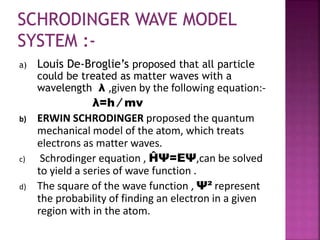
a) Louis De-Broglie’s proposed that all particle
could be treated as matter waves with a
wavelength λ ,given by the following equation:-
λ=h ⁄ mv
b) ERWIN SCHRODINGER proposed the quantum
mechanical model of the atom, which treats
electrons as matter waves.
c) Schrodinger equation , ĤΨ=ΕΨ,can be solved
to yield a series of wave function .
d) The square of the wave function , Ψ² represent
the probability of finding an electron in a given
region with in the atom.
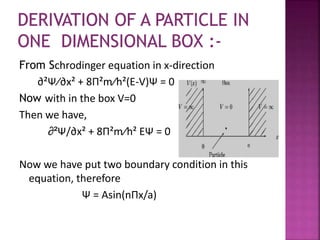
From Schrodinger equation in x-direction
∂²Ψ⁄∂x² + 8Π²m⁄h²(E-V)Ψ = 0
Now with in the box V=0
Then we have,
∂²Ψ/∂x² + 8Π²m⁄h² EΨ = 0
Now we have put two boundary condition in this
equation, therefore
Ψ = Asin(nΠx/a)
 E is a energy wave function and their value
are:-
[ E =n²h²/8ma² ]
This equation shows it is energy of the particle
in one- dimensional box in other words
energy depends upon the quantum number
‘n’ which have any integral value the energy
level of its particle in a box are quantized.
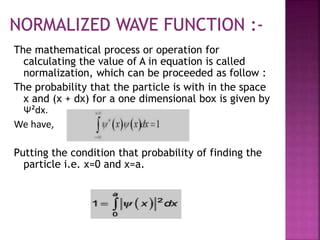
The mathematical process or operation for
calculating the value of A in equation is called
normalization, which can be proceeded as follow :
The probability that the particle is with in the space
x and (x + dx) for a one dimensional box is given by
Ψ²dx.
We have,
Putting the condition that probability of finding the
particle i.e. x=0 and x=a.
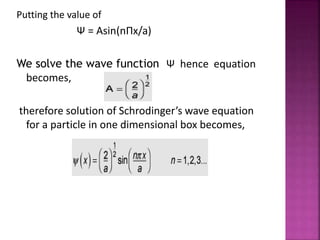
Putting the value of
Ψ = Asin(nΠx/a)
We solve the wave function Ψ hence equation
becomes,
therefore solution of Schrodinger’s wave equation
for a particle in one dimensional box becomes,
The graphs of the wave functions and the
probability densities are shown in fig :-
The particle will have only certain discrete
value for energy. So , in the box there is an
infinite sequence of discrete energy level .
Energy level of it’s particle in a box are
quantized.
 “Advanced physical chemistry”
~ “Dr. J. N. Gurtu” and “A. Gurtu”
 “Quantum Chemistry”
~ “B.K. Sen”
 “Quantum Chemistry”
~ “Donald MC Quarrie”
This is to certify that this project report on
“Particle in a one-dimensional box ” has
been carried out by Archana Dewangan a
student of KALYAN P.G. COLLEGE BHILAI
NAGAR. She has submitted the report during
the academic session 2018-2019 towards
partial fulfillment as per requirement of
DURG UNIVERSITY , Durg.
She has carried out the project under my
guidance and this is her original work.
I would like to express my profound sense of respect
and heartfelt gratitude to our lecturer DEEPA MAM
under whose able guidance and support. I have
completed my project on the given topic “(Particle in
one-dimensional box)”. I am thankful to her for
providing me this opportunity to work on this project.
It was his able guidance and constant encouragement
that has made this project work in successful way.
I also express my heartfelt thanks to our
respected sir Dr. Y. R. Katre sir H.O.D. of chemistry
department for this cooperation and providing
facilities available in the college, which helped me in
presenting the project in a nice form.

One dimensional box

  • 1.
    By- Manish Sahu M.Sc. Chemistry(Final) Sp.- Physical Chemistry
  • 2.
    CONTENTS :-  INTRODUTION HISTORY  SCHRODINGER WAVE EQUATION  SCHRODINGER WAVE MODEL SYSTEM  DERIVATION OF A PARTICLE IN ONE DIMENSIONAL BOX  ENERGY WAVE FUNCTION  NORMALIZED WAVE FUNCTION  GRAPH MODEL OF WAVE FUNCTION  CONCLUSION  REFERENCE
  • 3.
    In quantum mechanicsthe analogue of Newton’s law in Schrodinger wave equation for a quantum system. The Schrodinger equation is our fundamental equation of quantum mechanics. The particle in a box problem is a common application of a quantum mechanical model to a simplified system.
  • 4.
     ERWIN SCHRODINGERderived Schrodinger equation in 1925 and published the Schrodinger equation in 1926.  ERWIN SCHRODINGER awarded the nobel prize in physics in 1933.
  • 5.
    Before the discoveryof Schrodinger equation the calculation of probability finding electrons at certain energy levels various point around a nucleus in an atom was the main problem . The mathematical representation of time independent Schrodinger equation is- ▼²Ψ +8Π²m ⁄ h²(E-V)Ψ=0
  • 6.
    a) Louis De-Broglie’sproposed that all particle could be treated as matter waves with a wavelength λ ,given by the following equation:- λ=h ⁄ mv b) ERWIN SCHRODINGER proposed the quantum mechanical model of the atom, which treats electrons as matter waves. c) Schrodinger equation , ĤΨ=ΕΨ,can be solved to yield a series of wave function . d) The square of the wave function , Ψ² represent the probability of finding an electron in a given region with in the atom.
  • 7.
    From Schrodinger equationin x-direction ∂²Ψ⁄∂x² + 8Π²m⁄h²(E-V)Ψ = 0 Now with in the box V=0 Then we have, ∂²Ψ/∂x² + 8Π²m⁄h² EΨ = 0 Now we have put two boundary condition in this equation, therefore Ψ = Asin(nΠx/a)
  • 8.
     E isa energy wave function and their value are:- [ E =n²h²/8ma² ] This equation shows it is energy of the particle in one- dimensional box in other words energy depends upon the quantum number ‘n’ which have any integral value the energy level of its particle in a box are quantized.
  • 9.
    The mathematical processor operation for calculating the value of A in equation is called normalization, which can be proceeded as follow : The probability that the particle is with in the space x and (x + dx) for a one dimensional box is given by Ψ²dx. We have, Putting the condition that probability of finding the particle i.e. x=0 and x=a.
  • 10.
    Putting the valueof Ψ = Asin(nΠx/a) We solve the wave function Ψ hence equation becomes, therefore solution of Schrodinger’s wave equation for a particle in one dimensional box becomes,
  • 11.
    The graphs ofthe wave functions and the probability densities are shown in fig :-
  • 12.
    The particle willhave only certain discrete value for energy. So , in the box there is an infinite sequence of discrete energy level . Energy level of it’s particle in a box are quantized.
  • 13.
     “Advanced physicalchemistry” ~ “Dr. J. N. Gurtu” and “A. Gurtu”  “Quantum Chemistry” ~ “B.K. Sen”  “Quantum Chemistry” ~ “Donald MC Quarrie”
  • 15.
    This is tocertify that this project report on “Particle in a one-dimensional box ” has been carried out by Archana Dewangan a student of KALYAN P.G. COLLEGE BHILAI NAGAR. She has submitted the report during the academic session 2018-2019 towards partial fulfillment as per requirement of DURG UNIVERSITY , Durg. She has carried out the project under my guidance and this is her original work.
  • 16.
    I would liketo express my profound sense of respect and heartfelt gratitude to our lecturer DEEPA MAM under whose able guidance and support. I have completed my project on the given topic “(Particle in one-dimensional box)”. I am thankful to her for providing me this opportunity to work on this project. It was his able guidance and constant encouragement that has made this project work in successful way. I also express my heartfelt thanks to our respected sir Dr. Y. R. Katre sir H.O.D. of chemistry department for this cooperation and providing facilities available in the college, which helped me in presenting the project in a nice form.