GATTERMANN –
KOCH REACTION
By-
Manish Sahu
M.Sc. Chemistry (Final)
Sp.- Physical Chemistry
 Introduction
 Definition
 History
 Formylation
 Gattermann -Koch Formylation
 Mechanism
 Uses
 Conclusion
 Reference
The Gattermann-Koch reaction is a chemical reaction in
which aromatic compounds are formylated by a
mixture of CO and HCl in the presence of Anhydrous
AlCl3 .
This reaction is known as Gattermann-Koch
reaction .
A synthesis of an aldehyde from
an aromatic Hydrocarbon , Hydrogen , Carbon
monoxide , Hydrogen chloride , in the presence of
the catalyst Anhydrous Aluminium chloride .
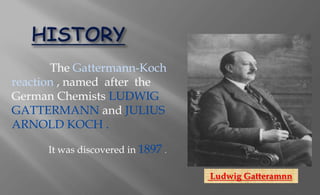
The Gattermann-Koch
reaction , named after the
German Chemists LUDWIG
GATTERMANN and JULIUS
ARNOLD KOCH .
It was discovered in 1897 .
Ludwig Gatteramnn
Substitution of formyl group that
is , aldehyde group ( - CHO ) into aromatic
ring is known as formylaton .
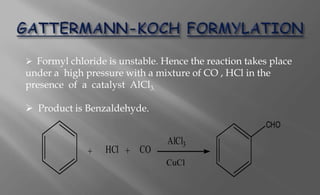
 Formyl chloride is unstable. Hence the reaction takes place
under a high pressure with a mixture of CO , HCl in the
presence of a catalyst AlCl3.
 Product is Benzaldehyde.
+ HCl + CO
AlCl3
CHO
CuCl
The CO and HCl reacts to form an unstable formyl
chloride.
CO + HCl + AlCl3 → [ HC+ = O ↔ HC ≡ O+ ] AlCl-
4
The Mechanism of this reaction, the formyl
cation ( HC+ = O ) is the active electrophlic species .
The function of cuprous chloride is to co-ordinate
with CO to provide its higher local concentration .
Unlike the Gattermann reaction , this reaction
is not applicable to phenol and phenolic ether
substrates .
 It is the method of synthesizing aromatic aldehyde
by the action of a mixture of CO and HCl on aromatic
hydrocarbon .
 Use aluminium chloride as catalyst some time
Aluminium Bromide using a small amount of
monochloride of copper .
In Gattermann - Koch reaction , formylation of
benzene take place to form benzaldehyde . In this reaction ,
benzene is reacted with CO and HCl in presence of anhydrous
AlCl3. AlCl3 abstracts Cl- ion and initiates H+ ion , which
attack on carbon atom in CO. Due to this carbon aquires
positive charge , hence attack on benzene ring to form
arenium ion , which loses proton to form benzaldehyde .
 Advanced Organic Chemistry By :-
“Dr. Jagdamba Singh”
“Dr. L. D. S. Yadav”
 Advanced Organic Chemistry By :-
“S. K. Gosh”
Gattermann koch

Gattermann koch

  • 1.
    GATTERMANN – KOCH REACTION By- ManishSahu M.Sc. Chemistry (Final) Sp.- Physical Chemistry
  • 2.
     Introduction  Definition History  Formylation  Gattermann -Koch Formylation  Mechanism  Uses  Conclusion  Reference
  • 3.
    The Gattermann-Koch reactionis a chemical reaction in which aromatic compounds are formylated by a mixture of CO and HCl in the presence of Anhydrous AlCl3 . This reaction is known as Gattermann-Koch reaction .
  • 4.
    A synthesis ofan aldehyde from an aromatic Hydrocarbon , Hydrogen , Carbon monoxide , Hydrogen chloride , in the presence of the catalyst Anhydrous Aluminium chloride .
  • 5.
    The Gattermann-Koch reaction ,named after the German Chemists LUDWIG GATTERMANN and JULIUS ARNOLD KOCH . It was discovered in 1897 . Ludwig Gatteramnn
  • 6.
    Substitution of formylgroup that is , aldehyde group ( - CHO ) into aromatic ring is known as formylaton .
  • 7.
     Formyl chlorideis unstable. Hence the reaction takes place under a high pressure with a mixture of CO , HCl in the presence of a catalyst AlCl3.  Product is Benzaldehyde. + HCl + CO AlCl3 CHO CuCl
  • 8.
    The CO andHCl reacts to form an unstable formyl chloride. CO + HCl + AlCl3 → [ HC+ = O ↔ HC ≡ O+ ] AlCl- 4
  • 9.
    The Mechanism ofthis reaction, the formyl cation ( HC+ = O ) is the active electrophlic species . The function of cuprous chloride is to co-ordinate with CO to provide its higher local concentration . Unlike the Gattermann reaction , this reaction is not applicable to phenol and phenolic ether substrates .
  • 10.
     It isthe method of synthesizing aromatic aldehyde by the action of a mixture of CO and HCl on aromatic hydrocarbon .  Use aluminium chloride as catalyst some time Aluminium Bromide using a small amount of monochloride of copper .
  • 11.
    In Gattermann -Koch reaction , formylation of benzene take place to form benzaldehyde . In this reaction , benzene is reacted with CO and HCl in presence of anhydrous AlCl3. AlCl3 abstracts Cl- ion and initiates H+ ion , which attack on carbon atom in CO. Due to this carbon aquires positive charge , hence attack on benzene ring to form arenium ion , which loses proton to form benzaldehyde .
  • 12.
     Advanced OrganicChemistry By :- “Dr. Jagdamba Singh” “Dr. L. D. S. Yadav”  Advanced Organic Chemistry By :- “S. K. Gosh”