X- RAY DIFFRACTION
SUBMITTED BY :
K.G. NITHYA LAKSHMI
&
K. VYTHEESWARI
M.Pharm
Pharmaceutical Analysis
RVS College of Pharmaceutical Science,
Sulur, Coimbatore.
CONTENT
 DEFINITION
 ORIGIN OF X-RAY
 BASIC ASPECT OF X-RAY
 X-RAY CRYSTOLLOGRPHY
 ROTATING CRYSTAL METHOD
 SINGLE CRYSTAL DIFFRACTION
 POWDER DIFFRACTION
 STRUCTURAL ELUCIDATION
 APPLICATION
 REFERANCE
DEFINITION
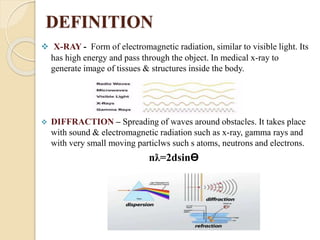
 X-RAY - Form of electromagnetic radiation, similar to visible light. Its
has high energy and pass through the object. In medical x-ray to
generate image of tissues & structures inside the body.
 DIFFRACTION – Spreading of waves around obstacles. It takes place
with sound & electromagnetic radiation such as x-ray, gamma rays and
with very small moving particlws such s atoms, neutrons and electrons.
nƛ=2dsinƟ
X-RAY DIFFRACTION METHOD
 X-ray diffraction is a non-destructive solid technique for delineating
crystalline materials.
 It gives information on phases, structures, favored crystal
orientations (texture), and different structural parameters, such as
strain, crystallinity, medium grain size, and cry
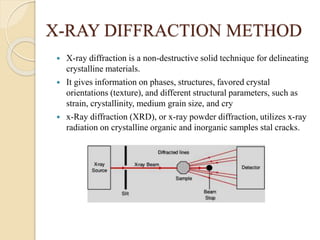
 x-Ray diffraction (XRD), or x-ray powder diffraction, utilizes x-ray
radiation on crystalline organic and inorganic samples stal cracks.
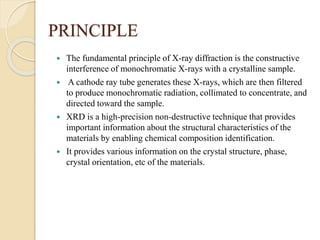
PRINCIPLE
 The fundamental principle of X-ray diffraction is the constructive
interference of monochromatic X-rays with a crystalline sample.
 A cathode ray tube generates these X-rays, which are then filtered
to produce monochromatic radiation, collimated to concentrate, and
directed toward the sample.
 XRD is a high-precision non-destructive technique that provides
important information about the structural characteristics of the
materials by enabling chemical composition identification.
 It provides various information on the crystal structure, phase,
crystal orientation, etc of the materials.
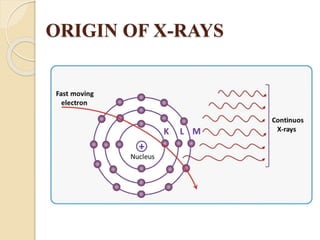
ORIGIN OF X-RAYS
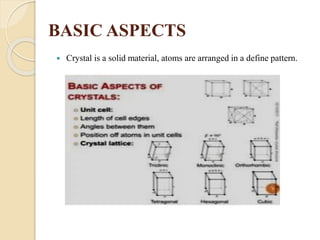
BASIC ASPECTS
 Crystal is a solid material, atoms are arranged in a define pattern.
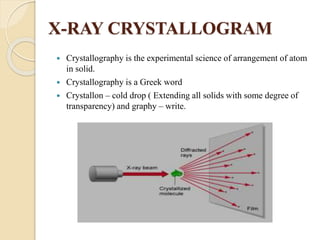
X-RAY CRYSTALLOGRAM
 Crystallography is the experimental science of arrangement of atom
in solid.
 Crystallography is a Greek word
 Crystallon – cold drop ( Extending all solids with some degree of
transparency) and graphy – write.
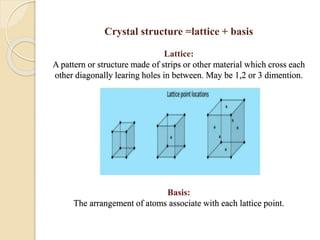
Crystal structure =lattice + basis
Lattice:
A pattern or structure made of strips or other material which cross each
other diagonally learing holes in between. May be 1,2 or 3 dimention.
Example:
Basis:
The arrangement of atoms associate with each lattice point.
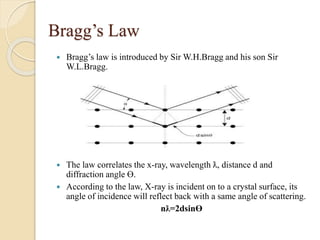
Bragg’s Law
 Bragg’s law is introduced by Sir W.H.Bragg and his son Sir
W.L.Bragg.
 The law correlates the x-ray, wavelength ƛ, distance d and
diffraction angle Ɵ.
 According to the law, X-ray is incident on to a crystal surface, its
angle of incidence will reflect back with a same angle of scattering.
nƛ=2dsinƟ
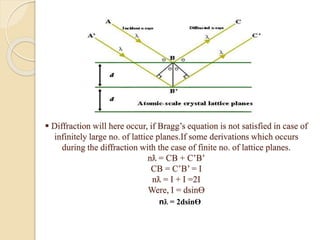
 Diffraction will here occur, if Bragg’s equation is not satisfied in case of
infinitely large no. of lattice planes.If some derivations which occurs
during the diffraction with the case of finite no. of lattice planes.
nƛ = CB + C’B’
CB = C’B’ = I
nƛ = I + I =2I
Were, I = dsinƟ
nƛ = 2dsinƟ
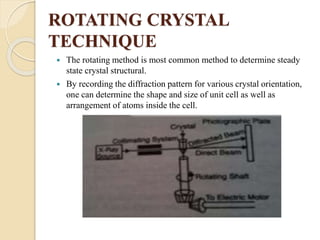
ROTATING CRYSTAL
TECHNIQUE
 The rotating method is most common method to determine steady
state crystal structural.
 By recording the diffraction pattern for various crystal orientation,
one can determine the shape and size of unit cell as well as
arrangement of atoms inside the cell.
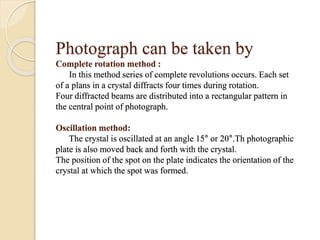
Photograph can be taken by
Complete rotation method :
In this method series of complete revolutions occurs. Each set
of a plans in a crystal diffracts four times during rotation.
Four diffracted beams are distributed into a rectangular pattern in
the central point of photograph.
Oscillation method:
The crystal is oscillated at an angle 15° or 20°.Th photographic
plate is also moved back and forth with the crystal.
The position of the spot on the plate indicates the orientation of the
crystal at which the spot was formed.
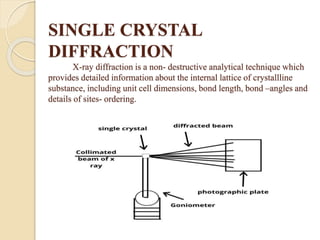
SINGLE CRYSTAL
DIFFRACTION
X-ray diffraction is a non- destructive analytical technique which
provides detailed information about the internal lattice of crystallline
substance, including unit cell dimensions, bond length, bond –angles and
details of sites- ordering.
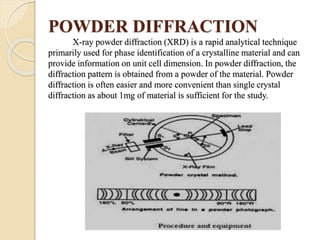
POWDER DIFFRACTION
X-ray powder diffraction (XRD) is a rapid analytical technique
primarily used for phase identification of a crystalline material and can
provide information on unit cell dimension. In powder diffraction, the
diffraction pattern is obtained from a powder of the material. Powder
diffraction is often easier and more convenient than single crystal
diffraction as about 1mg of material is sufficient for the study.
STRUCTURAL ELUCIDATION
 The following are common methods determining the chemical
structure(structure elucidation)
1. X-ray diffraction – crystal are available
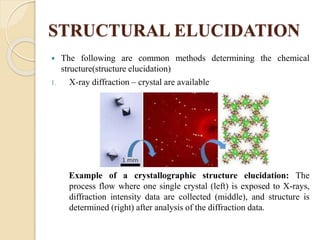
Example of a crystallographic structure elucidation: The
process flow where one single crystal (left) is exposed to X-rays,
diffraction intensity data are collected (middle), and structure is
determined (right) after analysis of the diffraction data.
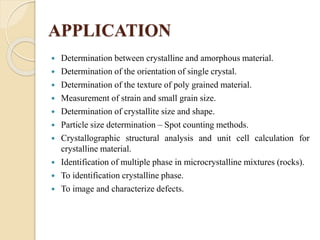
APPLICATION
 Determination between crystalline and amorphous material.
 Determination of the orientation of single crystal.
 Determination of the texture of poly grained material.
 Measurement of strain and small grain size.
 Determination of crystallite size and shape.
 Particle size determination – Spot counting methods.
 Crystallographic structural analysis and unit cell calculation for
crystalline material.
 Identification of multiple phase in microcrystalline mixtures (rocks).
 To identification crystalline phase.
 To image and characterize defects.
REFERANCE
1. X-Ray Diffraction -XRD is the principal technique used to
investigate crystal structures in composite materials in a
nondestructive way: as known, different crystal phases can lead to
different material properties. From: Nanofiber Composites for
Biomedical Applications, 2017.
2. X-ray diffraction Physics lso known as: X-ray diffraction analysis
Written and fact-checked by The Editors of Encyclopaedia
Britannica Last Updated: Article History Listen to article1 minute.
3. X-ray crystallography This article may be too long to read and
navigate comfortably. Please consider splitting content into sub-
articles, condensing it, or adding subheadings. Please discuss this
issue on the article's talk page. (February 2023).
THANK YOU

X – RAY DIFFRACTION

  • 1.
    X- RAY DIFFRACTION SUBMITTEDBY : K.G. NITHYA LAKSHMI & K. VYTHEESWARI M.Pharm Pharmaceutical Analysis RVS College of Pharmaceutical Science, Sulur, Coimbatore.
  • 2.
    CONTENT  DEFINITION  ORIGINOF X-RAY  BASIC ASPECT OF X-RAY  X-RAY CRYSTOLLOGRPHY  ROTATING CRYSTAL METHOD  SINGLE CRYSTAL DIFFRACTION  POWDER DIFFRACTION  STRUCTURAL ELUCIDATION  APPLICATION  REFERANCE
  • 3.
    DEFINITION  X-RAY -Form of electromagnetic radiation, similar to visible light. Its has high energy and pass through the object. In medical x-ray to generate image of tissues & structures inside the body.  DIFFRACTION – Spreading of waves around obstacles. It takes place with sound & electromagnetic radiation such as x-ray, gamma rays and with very small moving particlws such s atoms, neutrons and electrons. nƛ=2dsinƟ
  • 4.
    X-RAY DIFFRACTION METHOD X-ray diffraction is a non-destructive solid technique for delineating crystalline materials.  It gives information on phases, structures, favored crystal orientations (texture), and different structural parameters, such as strain, crystallinity, medium grain size, and cry  x-Ray diffraction (XRD), or x-ray powder diffraction, utilizes x-ray radiation on crystalline organic and inorganic samples stal cracks.
  • 5.
    PRINCIPLE  The fundamentalprinciple of X-ray diffraction is the constructive interference of monochromatic X-rays with a crystalline sample.  A cathode ray tube generates these X-rays, which are then filtered to produce monochromatic radiation, collimated to concentrate, and directed toward the sample.  XRD is a high-precision non-destructive technique that provides important information about the structural characteristics of the materials by enabling chemical composition identification.  It provides various information on the crystal structure, phase, crystal orientation, etc of the materials.
  • 6.
  • 7.
    BASIC ASPECTS  Crystalis a solid material, atoms are arranged in a define pattern.
  • 8.
    X-RAY CRYSTALLOGRAM  Crystallographyis the experimental science of arrangement of atom in solid.  Crystallography is a Greek word  Crystallon – cold drop ( Extending all solids with some degree of transparency) and graphy – write.
  • 9.
    Crystal structure =lattice+ basis Lattice: A pattern or structure made of strips or other material which cross each other diagonally learing holes in between. May be 1,2 or 3 dimention. Example: Basis: The arrangement of atoms associate with each lattice point.
  • 10.
    Bragg’s Law  Bragg’slaw is introduced by Sir W.H.Bragg and his son Sir W.L.Bragg.  The law correlates the x-ray, wavelength ƛ, distance d and diffraction angle Ɵ.  According to the law, X-ray is incident on to a crystal surface, its angle of incidence will reflect back with a same angle of scattering. nƛ=2dsinƟ
  • 11.
     Diffraction willhere occur, if Bragg’s equation is not satisfied in case of infinitely large no. of lattice planes.If some derivations which occurs during the diffraction with the case of finite no. of lattice planes. nƛ = CB + C’B’ CB = C’B’ = I nƛ = I + I =2I Were, I = dsinƟ nƛ = 2dsinƟ
  • 12.
    ROTATING CRYSTAL TECHNIQUE  Therotating method is most common method to determine steady state crystal structural.  By recording the diffraction pattern for various crystal orientation, one can determine the shape and size of unit cell as well as arrangement of atoms inside the cell.
  • 13.
    Photograph can betaken by Complete rotation method : In this method series of complete revolutions occurs. Each set of a plans in a crystal diffracts four times during rotation. Four diffracted beams are distributed into a rectangular pattern in the central point of photograph. Oscillation method: The crystal is oscillated at an angle 15° or 20°.Th photographic plate is also moved back and forth with the crystal. The position of the spot on the plate indicates the orientation of the crystal at which the spot was formed.
  • 14.
    SINGLE CRYSTAL DIFFRACTION X-ray diffractionis a non- destructive analytical technique which provides detailed information about the internal lattice of crystallline substance, including unit cell dimensions, bond length, bond –angles and details of sites- ordering.
  • 15.
    POWDER DIFFRACTION X-ray powderdiffraction (XRD) is a rapid analytical technique primarily used for phase identification of a crystalline material and can provide information on unit cell dimension. In powder diffraction, the diffraction pattern is obtained from a powder of the material. Powder diffraction is often easier and more convenient than single crystal diffraction as about 1mg of material is sufficient for the study.
  • 16.
    STRUCTURAL ELUCIDATION  Thefollowing are common methods determining the chemical structure(structure elucidation) 1. X-ray diffraction – crystal are available Example of a crystallographic structure elucidation: The process flow where one single crystal (left) is exposed to X-rays, diffraction intensity data are collected (middle), and structure is determined (right) after analysis of the diffraction data.
  • 17.
    APPLICATION  Determination betweencrystalline and amorphous material.  Determination of the orientation of single crystal.  Determination of the texture of poly grained material.  Measurement of strain and small grain size.  Determination of crystallite size and shape.  Particle size determination – Spot counting methods.  Crystallographic structural analysis and unit cell calculation for crystalline material.  Identification of multiple phase in microcrystalline mixtures (rocks).  To identification crystalline phase.  To image and characterize defects.
  • 18.
    REFERANCE 1. X-Ray Diffraction-XRD is the principal technique used to investigate crystal structures in composite materials in a nondestructive way: as known, different crystal phases can lead to different material properties. From: Nanofiber Composites for Biomedical Applications, 2017. 2. X-ray diffraction Physics lso known as: X-ray diffraction analysis Written and fact-checked by The Editors of Encyclopaedia Britannica Last Updated: Article History Listen to article1 minute. 3. X-ray crystallography This article may be too long to read and navigate comfortably. Please consider splitting content into sub- articles, condensing it, or adding subheadings. Please discuss this issue on the article's talk page. (February 2023).
  • 19.