By-
Manish Sahu
M.Sc. Chemistry (Final)
Sp.- Physical Chemistry
UV SPECTROSCOPY
SYNOPSIS
 Introduction
 History
 Principle
 Instrumentation
 Beer-Lambert Law
 Application
 Conclusion
 Reference
INTRODUCTION
 The electronic spectra ( Ultraviolet and
Visible ) of compound are associated with
measurement of energy absorbed when
electrons are promoted to higher energy
levels .
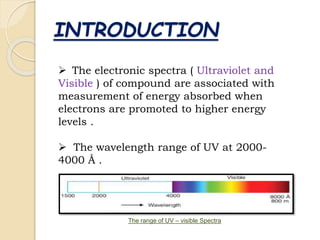
 The wavelength range of UV at 2000-
4000 Å .
The range of UV – visible Spectra
HISTORY
 “Ultraviolet” means “Beyond violet” ( from
Latin ultra “beyond” ) , violet being the colour
of the highest frequencies of visible light.
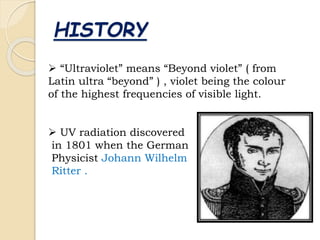
 UV radiation discovered
in 1801 when the German
Physicist Johann Wilhelm
Ritter .
PRINCIPLE
 UV absorption spectra arise from transition of
electron with in a molecule from a lower level to
high level .
 A molecule absorb ultraviolet radiation of
frequency (ʋ) the electron in that molecule
undergo transition from lower to high energy level.
The energy can be calculated by :
Etotal = Eelectranic + Evibrational + Erotational
INSTRUMENTATION
A spectrophotometer is a
device which detects the percentage
transmittance of light radiation when
light of certain intensity and frequency
range is passed through the sample .
Thus, the instrument compress the
intensity of the light with that of the
incident light .
BEER-LAMBERT LAW
 According to the Beer-Lambert law the
absorbance is proportional to the concentration of
the substance in solution and as a result UV –
Visible spectroscopy can also be used to measure
the concentration of a sample .
 The Beer - Lambert law can be expressed in from
of the following equation ;
A = εcl
Where;
A= Absorbance
l = Optical path length
c = Concentration of solution ( mol dm-3
)
ε = Molar extinction
APPLICATION
Ultraviolet Spectrophotometric methods find
extensive use in the identification of various hydrocarbons ,
vitamins, steroid, heterocyclic, and conjugated aliphatics.
 Quantitative Analysis:-
UV absorption spectroscopy can
characterise those types of compound which
absorb UV Radiation. These compounds contain
either unbounded electron ( n – electron ) or the
conjugated double bond system ( π – electron ) such
as aromatic compound .
 Identification of an Unknown Compound :-
An unknown compound
can be identified by comparing its spectrum with the
known spectra UV absorption method is less useful
then IR and NMR method .
 Detection of Functional Group :-
UV technique is
applied to detect presence or absence of the
chromospheres .
CONCLUSION
We can conclude that UV
spectroscopy is best method which routinely
used in analytical chemistry for the
quantitative determination of different
analytes , such as transition metal ions, highly
conjugated organic compound and biological .
REFERENCE
 “Spectroscopy” By :-
“H. Kaur”
(Page No. 314-315)
 “Elementry Organic Chemistry” By :-
“Y. R. Sharma”
(Page No. 11-17)
Uv spectroscopy

Uv spectroscopy

  • 1.
    By- Manish Sahu M.Sc. Chemistry(Final) Sp.- Physical Chemistry UV SPECTROSCOPY
  • 2.
    SYNOPSIS  Introduction  History Principle  Instrumentation  Beer-Lambert Law  Application  Conclusion  Reference
  • 3.
    INTRODUCTION  The electronicspectra ( Ultraviolet and Visible ) of compound are associated with measurement of energy absorbed when electrons are promoted to higher energy levels .  The wavelength range of UV at 2000- 4000 Å . The range of UV – visible Spectra
  • 4.
    HISTORY  “Ultraviolet” means“Beyond violet” ( from Latin ultra “beyond” ) , violet being the colour of the highest frequencies of visible light.  UV radiation discovered in 1801 when the German Physicist Johann Wilhelm Ritter .
  • 5.
    PRINCIPLE  UV absorptionspectra arise from transition of electron with in a molecule from a lower level to high level .  A molecule absorb ultraviolet radiation of frequency (ʋ) the electron in that molecule undergo transition from lower to high energy level. The energy can be calculated by : Etotal = Eelectranic + Evibrational + Erotational
  • 6.
    INSTRUMENTATION A spectrophotometer isa device which detects the percentage transmittance of light radiation when light of certain intensity and frequency range is passed through the sample . Thus, the instrument compress the intensity of the light with that of the incident light .
  • 8.
    BEER-LAMBERT LAW  Accordingto the Beer-Lambert law the absorbance is proportional to the concentration of the substance in solution and as a result UV – Visible spectroscopy can also be used to measure the concentration of a sample .  The Beer - Lambert law can be expressed in from of the following equation ; A = εcl Where; A= Absorbance l = Optical path length c = Concentration of solution ( mol dm-3 ) ε = Molar extinction
  • 9.
    APPLICATION Ultraviolet Spectrophotometric methodsfind extensive use in the identification of various hydrocarbons , vitamins, steroid, heterocyclic, and conjugated aliphatics.  Quantitative Analysis:- UV absorption spectroscopy can characterise those types of compound which absorb UV Radiation. These compounds contain either unbounded electron ( n – electron ) or the conjugated double bond system ( π – electron ) such as aromatic compound .
  • 10.
     Identification ofan Unknown Compound :- An unknown compound can be identified by comparing its spectrum with the known spectra UV absorption method is less useful then IR and NMR method .  Detection of Functional Group :- UV technique is applied to detect presence or absence of the chromospheres .
  • 11.
    CONCLUSION We can concludethat UV spectroscopy is best method which routinely used in analytical chemistry for the quantitative determination of different analytes , such as transition metal ions, highly conjugated organic compound and biological .
  • 12.
    REFERENCE  “Spectroscopy” By:- “H. Kaur” (Page No. 314-315)  “Elementry Organic Chemistry” By :- “Y. R. Sharma” (Page No. 11-17)