
Waves & Energy
         Powerpoint Templates
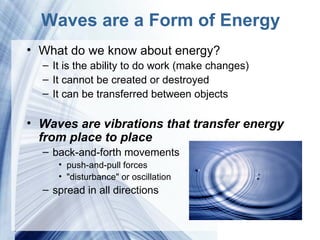
Waves are a Form of Energy
• What do we know about energy?
  – It is the ability to do work (make changes)
  – It cannot be created or destroyed
  – It can be transferred between objects

• Waves are vibrations that transfer energy
  from place to place
  – back-and-forth movements
     • push-and-pull forces
     • "disturbance" or oscillation
  – spread in all directions


                     Powerpoint Templates
Mechanical vs. Electromagnetic
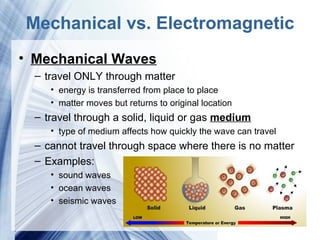
• Mechanical Waves
  – travel ONLY through matter
     • energy is transferred from place to place
     • matter moves but returns to original location
  – travel through a solid, liquid or gas medium
     • type of medium affects how quickly the wave can travel
  – cannot travel through space where there is no matter
  – Examples:
     • sound waves
     • ocean waves
     • seismic waves

                       Powerpoint Templates
Mechanical vs. Electromagnetic
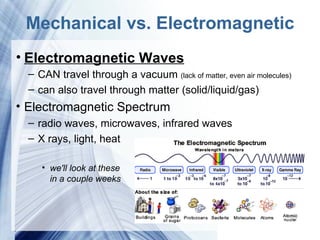
• Electromagnetic Waves
  – CAN travel through a vacuum (lack of matter, even air molecules)
  – can also travel through matter (solid/liquid/gas)
• Electromagnetic Spectrum
  – radio waves, microwaves, infrared waves
  – X rays, light, heat

     • we'll look at these
       in a couple weeks


                         Powerpoint Templates
Anatomy of a Wave

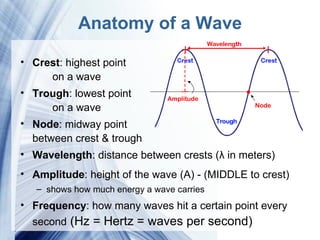
• Crest: highest point
     on a wave
• Trough: lowest point          Amplitude
     on a wave                                  Node


• Node: midway point
  between crest & trough
• Wavelength: distance between crests (λ in meters)
• Amplitude: height of the wave (A) - (MIDDLE to crest)
   – shows how much energy a wave carries
• Frequency: how many waves hit a certain point every
  second (Hz = Hertz = waves per second)
                 Powerpoint Templates
Transverse Waves
• A transverse wave has vibrations (oscillations)
  perpendicular to the direction the wave travels
  – propagation (direction wave travels) is to the right
  – oscillation is up and down
• May be mechanical or electromagnetic
   – Examples: ocean waves, X-rays or light


 If the graph show
 here represented
 1 second of time,
 what would the
                                              Oscillation
 frequency be?
 Answer: 2.5 Hz
                       Powerpoint Templates
Longitudinal Waves
• A longitudinal wave oscillates parallel to the
  direction the wave travels
   – propagation is to the right
   – oscillation is left and right
• All longitudinal waves are mechanical
   – Examples: sound waves, seismic waves
• Also called compressional waves
 If the graph show
 here represented
 1 second of time,
 what would the
 frequency be?
 Answer: 3 Hz
                       Powerpoint Templates   Oscillation
Longitudinal Waves
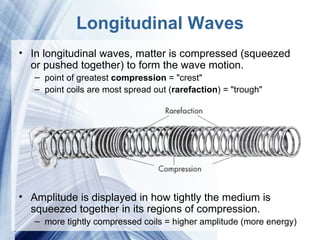
• In longitudinal waves, matter is compressed (squeezed
  or pushed together) to form the wave motion.
   – point of greatest compression = "crest"
   – point coils are most spread out (rarefaction) = "trough"


• Amplitude is displayed in how tightly the medium is
  squeezed together in its regions of compression.
   – more tightly compressed coils Templatesamplitude (more energy)
                       Powerpoint = higher
Sound Waves
• When you hear a sound, it is caused by air
  molecules being compressed in waves.


                 Powerpoint Templates
Transverse & Longitudinal
         Waves


                           Rarefaction


                                         Comparison
        Powerpoint Templates
Powerpoint Templates
Wavelength & Frequency

• Wavelength, frequency and wave speed can be
  described mathematically by the following
  equation:
   wave speed (v) = frequency (f) x wavelength (λ)

       f = v
           λ


                  Powerpoint Templates
A, f & λ Relationships

• Beads on a String Demo


    f= v
       λ


• As frequency increases, the wavelength decreases.
   – f and λ are inversely proportional


                         Powerpoint Templates
Practice Problem
• A marine weather station detects waves which are 9.28 meters
  apart and 1.65 meters high and travel a distance of 50 meters in
  21.8 seconds. Determine the speed, amplitude and frequency of
  these waves.
                     Speed
                        Speed (v) = distance/time = 50m ÷ 21.8s = 2.3m/s

                     Amplitude
                        Amplitude (A) = ½ wave height = .5 x 1.65m = .825m

                     Frequency
                        Frequency (f) = v/λ = 2.3m/s ÷ 9.28m = .25 Hz


                         Powerpoint Templates
Frequency & Period

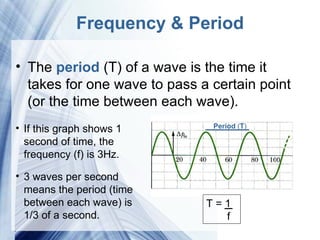
• The period (T) of a wave is the time it
  takes for one wave to pass a certain point
  (or the time between each wave).
• If this graph shows 1                      Period (T)

  second of time, the
  frequency (f) is 3Hz.

• 3 waves per second
  means the period (time
  between each wave) is                      T=1
  1/3 of a second.                             f
                      Powerpoint Templates
Practice Problem
• Strong winds can apply a significant enough force to tall
  skyscrapers to set them into a back-and-forth motion. The
  amplitudes of these motions are greater at the higher floors and
  barely observable for the lower floors. It is said that one can even
  observe the swaying motion of the Sears Tower in Chicago on a
  windy day.
   – As the Sears Tower vibrates back and forth, it makes about 8.6
      vibrations in 60 seconds. Determine the frequency and the
      period of vibration of the Sears Tower.
  f = waves per second = ?/s
                                     T=1
                                       f
  f = 8.6/60s = .143 = .14 Hz


  period = 1/f = 1 = 6.98s (about 7 seconds)
                .14
                          Powerpoint Templates

Waves and Energy

  • 1.
    Waves & Energy Powerpoint Templates
  • 2.
    Waves are aForm of Energy • What do we know about energy? – It is the ability to do work (make changes) – It cannot be created or destroyed – It can be transferred between objects • Waves are vibrations that transfer energy from place to place – back-and-forth movements • push-and-pull forces • "disturbance" or oscillation – spread in all directions Powerpoint Templates
  • 3.
    Mechanical vs. Electromagnetic •Mechanical Waves – travel ONLY through matter • energy is transferred from place to place • matter moves but returns to original location – travel through a solid, liquid or gas medium • type of medium affects how quickly the wave can travel – cannot travel through space where there is no matter – Examples: • sound waves • ocean waves • seismic waves Powerpoint Templates
  • 4.
    Mechanical vs. Electromagnetic •Electromagnetic Waves – CAN travel through a vacuum (lack of matter, even air molecules) – can also travel through matter (solid/liquid/gas) • Electromagnetic Spectrum – radio waves, microwaves, infrared waves – X rays, light, heat • we'll look at these in a couple weeks Powerpoint Templates
  • 5.
    Anatomy of aWave • Crest: highest point on a wave • Trough: lowest point Amplitude on a wave Node • Node: midway point between crest & trough • Wavelength: distance between crests (λ in meters) • Amplitude: height of the wave (A) - (MIDDLE to crest) – shows how much energy a wave carries • Frequency: how many waves hit a certain point every second (Hz = Hertz = waves per second) Powerpoint Templates
  • 6.
    Transverse Waves • Atransverse wave has vibrations (oscillations) perpendicular to the direction the wave travels – propagation (direction wave travels) is to the right – oscillation is up and down • May be mechanical or electromagnetic – Examples: ocean waves, X-rays or light If the graph show here represented 1 second of time, what would the Oscillation frequency be? Answer: 2.5 Hz Powerpoint Templates
  • 7.
    Longitudinal Waves • Alongitudinal wave oscillates parallel to the direction the wave travels – propagation is to the right – oscillation is left and right • All longitudinal waves are mechanical – Examples: sound waves, seismic waves • Also called compressional waves If the graph show here represented 1 second of time, what would the frequency be? Answer: 3 Hz Powerpoint Templates Oscillation
  • 8.
    Longitudinal Waves • Inlongitudinal waves, matter is compressed (squeezed or pushed together) to form the wave motion. – point of greatest compression = "crest" – point coils are most spread out (rarefaction) = "trough" • Amplitude is displayed in how tightly the medium is squeezed together in its regions of compression. – more tightly compressed coils Templatesamplitude (more energy) Powerpoint = higher
  • 9.
    Sound Waves • Whenyou hear a sound, it is caused by air molecules being compressed in waves. Powerpoint Templates
  • 10.
    Transverse & Longitudinal Waves Rarefaction Comparison Powerpoint Templates
  • 11.
  • 12.
    Wavelength & Frequency •Wavelength, frequency and wave speed can be described mathematically by the following equation: wave speed (v) = frequency (f) x wavelength (λ) f = v λ Powerpoint Templates
  • 13.
    A, f &λ Relationships • Beads on a String Demo f= v λ • As frequency increases, the wavelength decreases. – f and λ are inversely proportional Powerpoint Templates
  • 14.
    Practice Problem • Amarine weather station detects waves which are 9.28 meters apart and 1.65 meters high and travel a distance of 50 meters in 21.8 seconds. Determine the speed, amplitude and frequency of these waves. Speed Speed (v) = distance/time = 50m ÷ 21.8s = 2.3m/s Amplitude Amplitude (A) = ½ wave height = .5 x 1.65m = .825m Frequency Frequency (f) = v/λ = 2.3m/s ÷ 9.28m = .25 Hz Powerpoint Templates
  • 15.
    Frequency & Period •The period (T) of a wave is the time it takes for one wave to pass a certain point (or the time between each wave). • If this graph shows 1 Period (T) second of time, the frequency (f) is 3Hz. • 3 waves per second means the period (time between each wave) is T=1 1/3 of a second. f Powerpoint Templates
  • 16.
    Practice Problem • Strongwinds can apply a significant enough force to tall skyscrapers to set them into a back-and-forth motion. The amplitudes of these motions are greater at the higher floors and barely observable for the lower floors. It is said that one can even observe the swaying motion of the Sears Tower in Chicago on a windy day. – As the Sears Tower vibrates back and forth, it makes about 8.6 vibrations in 60 seconds. Determine the frequency and the period of vibration of the Sears Tower. f = waves per second = ?/s T=1 f f = 8.6/60s = .143 = .14 Hz period = 1/f = 1 = 6.98s (about 7 seconds) .14 Powerpoint Templates

Editor's Notes

  • #4 vacuum = lack of matter (even air molecules)
  • #6 Suppose you were wading in the ocean at a beach. The amplitude of the waves would basically tell you how high the waves are. People riding surfboards would be happy if the waves had a large amplitude, because that would mean that the waves were high. People wanting a leisurely swim in the ocean would be more happy with small amplitude waves. The wavelength indicates how far apart the wave crests are. Frequency, on the other hand, indicates how many waves will hit you each second if you simply stand there and do not move. It should make sense to you that frequency and wavelength are related in some way. After all, if the wave crests are far apart, not very many of them will hit you in a second. If the wave crests are close together, then several of them can hit you each second. Thus, when wavelength is large, frequency is small, and when wavelength is small, frequency is large. In other words, wavelength and frequency are inversely proportional to one another. When one gets large, the other becomes small.
  • #7 right angle = perpendicular = 90 degree angle If the graph show here represented 1 second of time, what would the frequency (waves per second) be? Answer: 2.5 Hz
  • #8 A.K.A. compressional wave
  • #9 A.K.A. compressional wave
  • #15 Period - 1/T, so what is the period? 4 seconds (between waves)
  • #16 if 100 = 1 second, the frequency would be 3Hz. 3 waves per second means the period (time between each wave) is 1/3 of a second