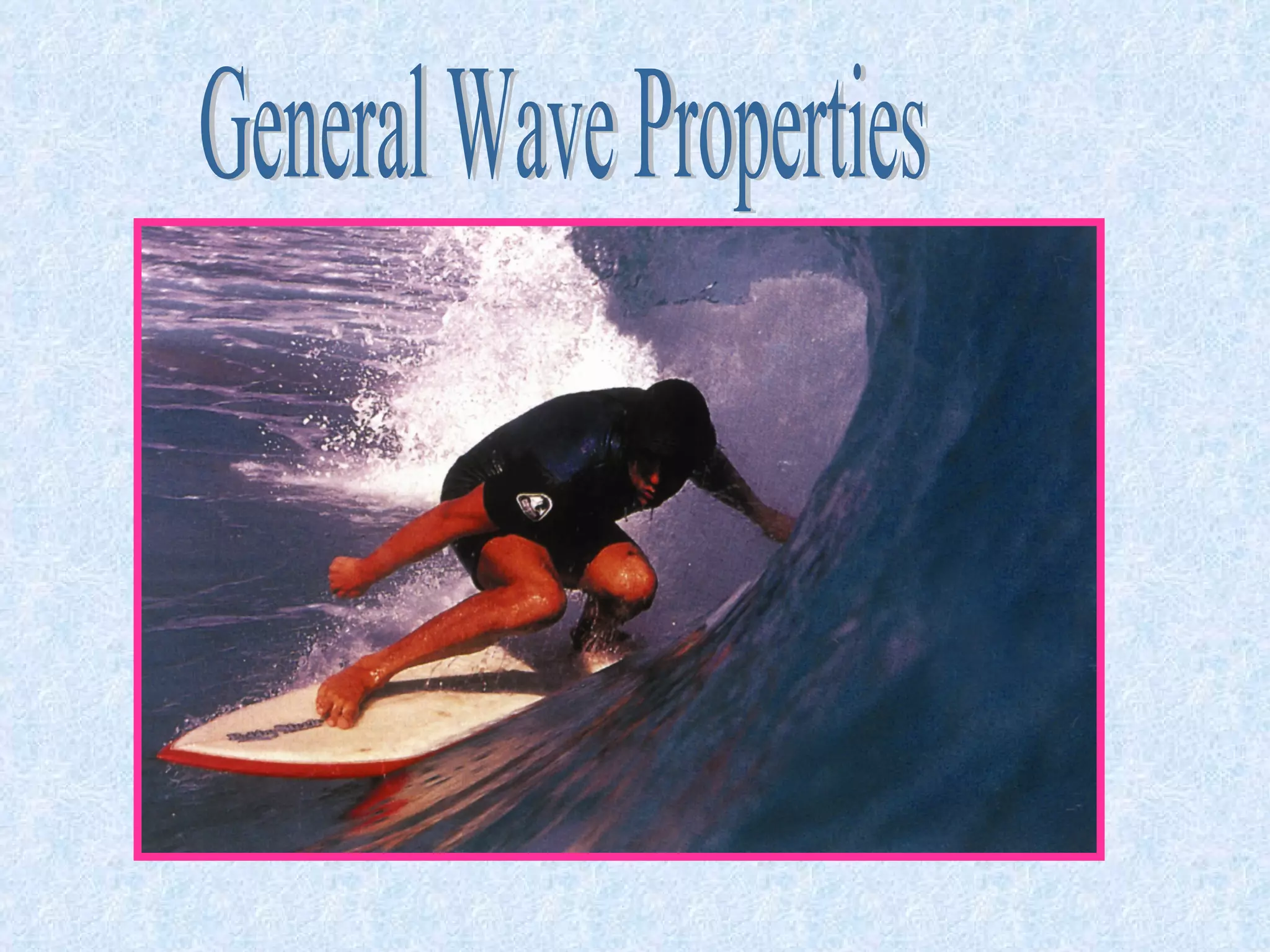
General Wave Properties
Before we move on, We have… Representing the video clips available Representing the applets available Representing the websites available
General Waves Properties                                            Pupils should be able to explain wave motion and give some examples of waves. compare transverse and longitudinal waves, and give examples of each. explain certain terms we use to describe a waves. describe wave front and wave energy.   define speed, frequency, wavelength, period and amplitude. recall and apply the relationship velocity = frequency    wavelength and solve related problems. Lesson objectives
Lesson Trigger W aves are  disturbances  that travel away from its source  of origin, the centre of disturbance. It is one way by which energy can be transmitted from one place to another. Waves, Waves, Waves Sound waves carry sound energy from the source  (for e.g., loudspeaker) to the receiver (ear). Example : Go to Exp9b.mpg                                                                                         What are waves? What can waves do? hyperlink
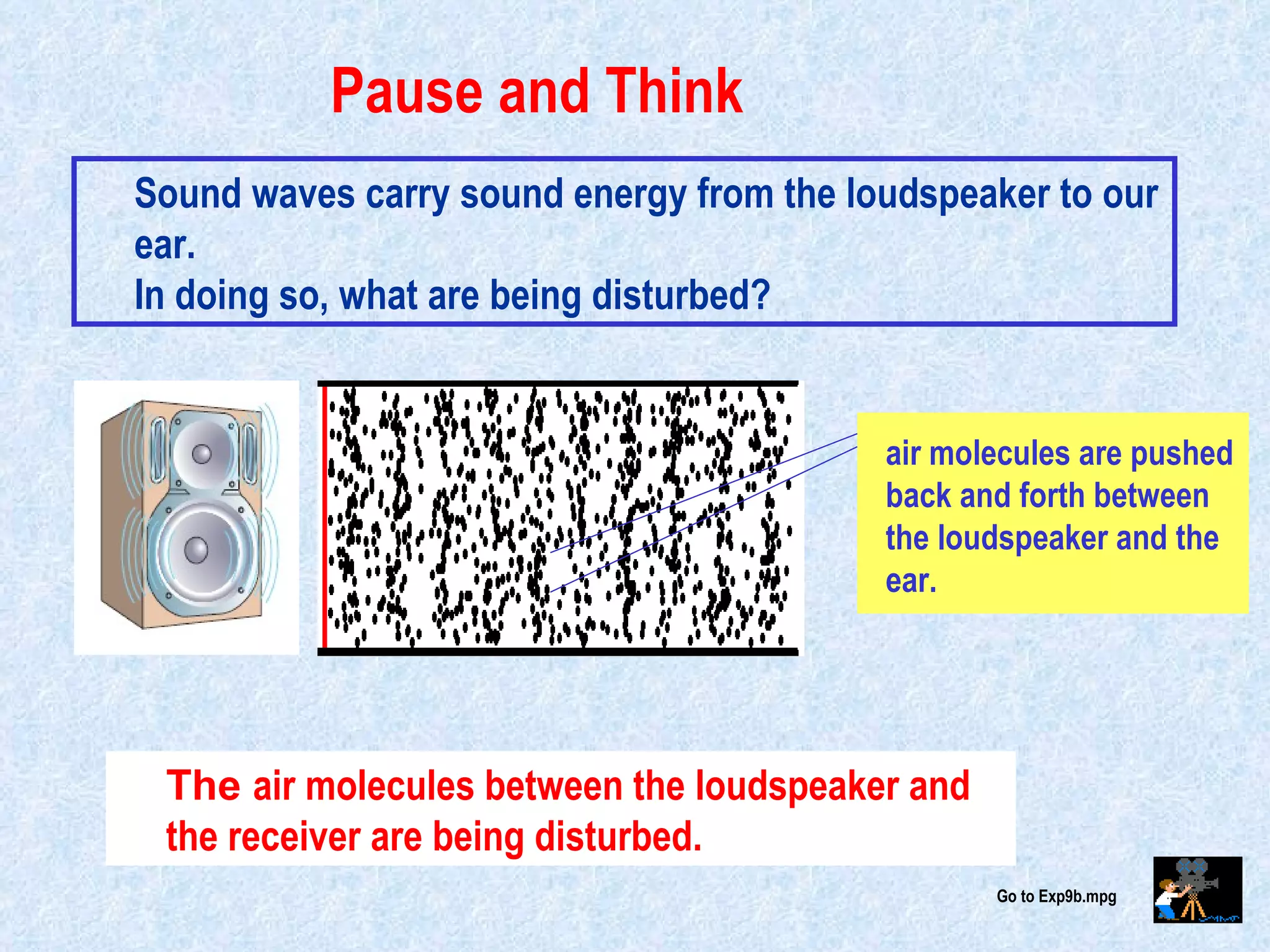
Sound waves carry sound energy from the loudspeaker to our ear. In doing so, what are being disturbed?  Pause and Think The  air molecules between the loudspeaker and the receiver are being disturbed. Go to Exp9b.mpg                                                                                         air molecules are pushed back and forth between the loudspeaker and the ear.
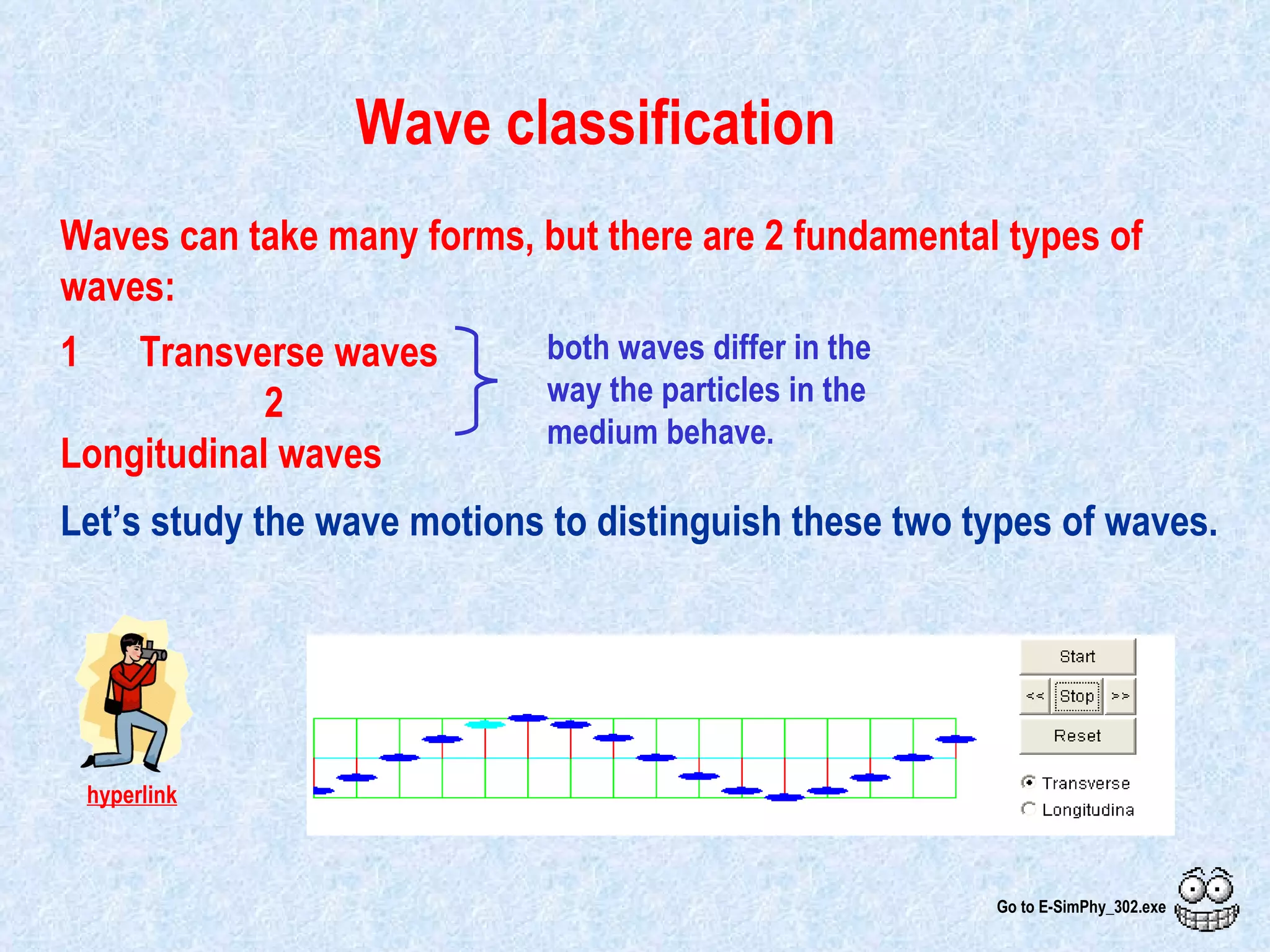
Waves can take many forms, but there are 2 fundamental types of waves:  Let’s study the wave motions to distinguish these two types of waves. Wave classification 1  Transverse waves    2  Longitudinal waves Go to E-SimPhy_302.exe                                                                                         both waves differ in the way the particles in the medium behave. hyperlink
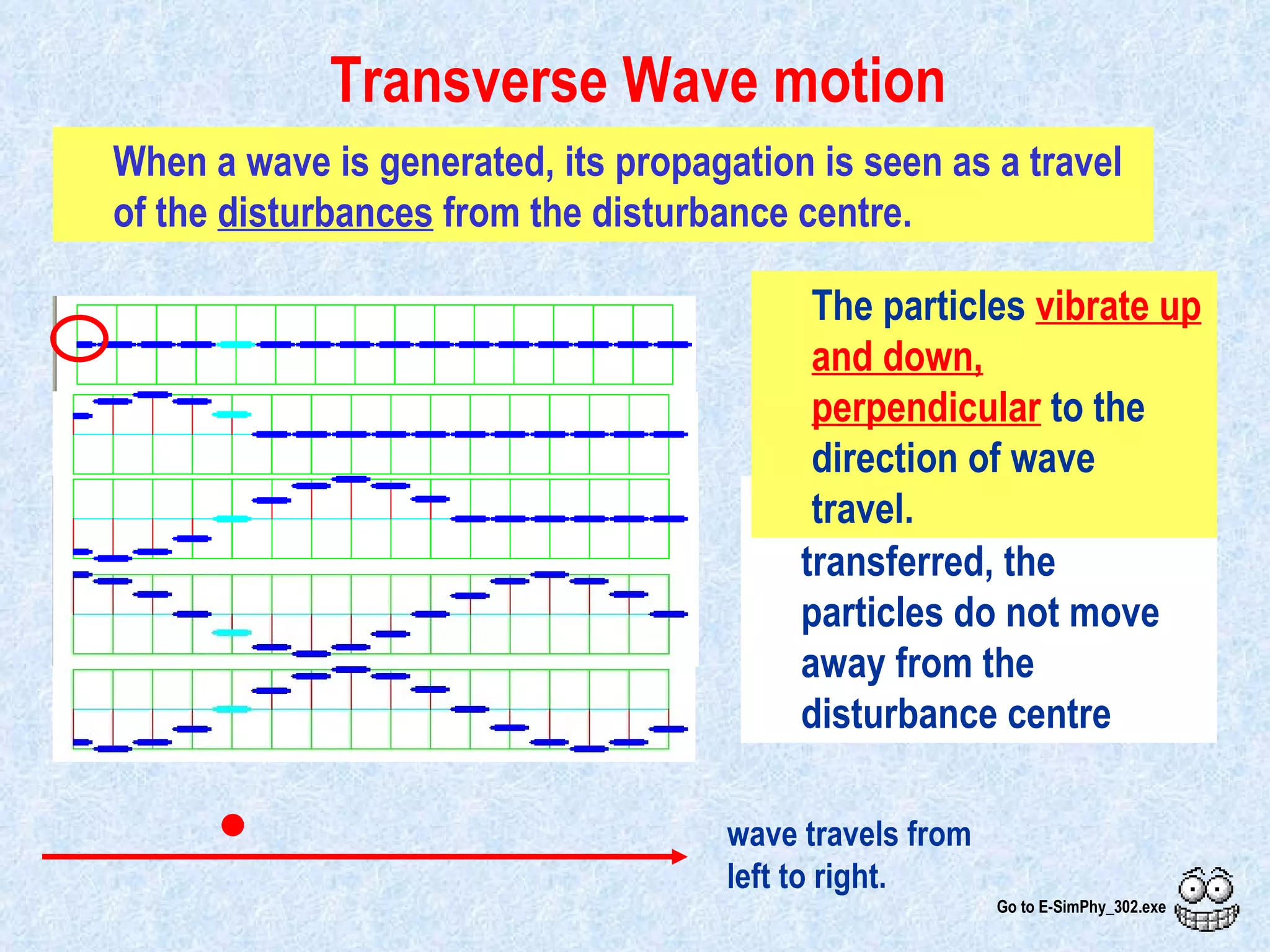
Such wave motion produces  transverse  waves. Are the air particles being moved away from the disturbance centre ? No, only wave energy is transferred, the particles do not move away from the disturbance centre Transverse Wave motion Where is the disturbance centre? When a wave is generated, its propagation is seen as a travel of the  disturbances  from the disturbance centre. How do the particles in the medium respond? The particles  vibrate up and down, perpendicular  to the direction of wave travel. Go to E-SimPhy_302.exe wave travels from left to right.
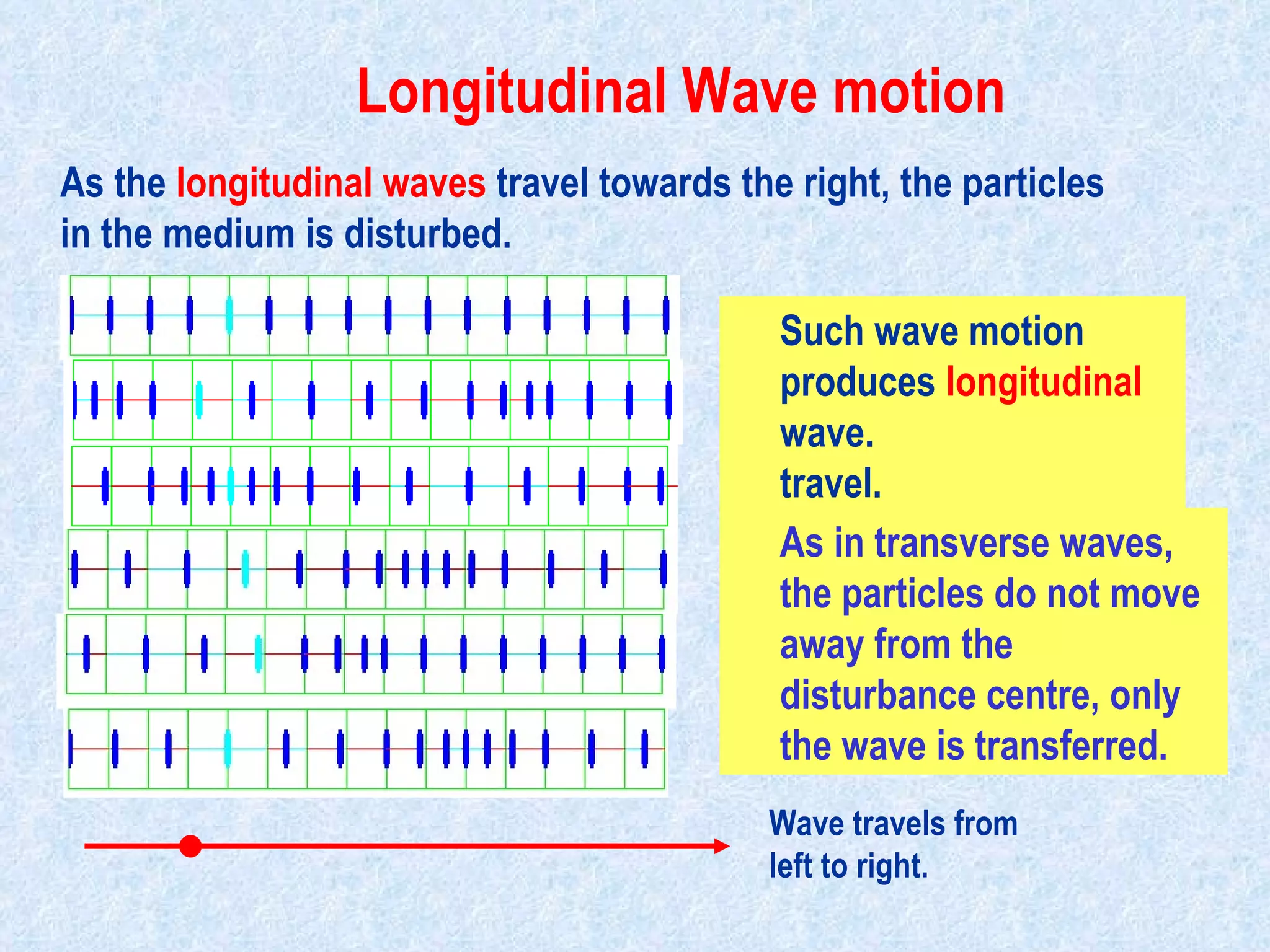
Are the air particles in the medium transferred away from the disturbance centre? As in transverse waves, the particles do not move away from the disturbance centre, only the wave is transferred. How do the particles in the medium respond? The particles  vibrate to and fro, parallel  to the direction of wave travel. Such wave motion produces  longitudinal  wave. As the  longitudinal waves  travel towards the right, the particles in the medium is disturbed.  Longitudinal Wave motion                                                                                         Wave travels from left to right.
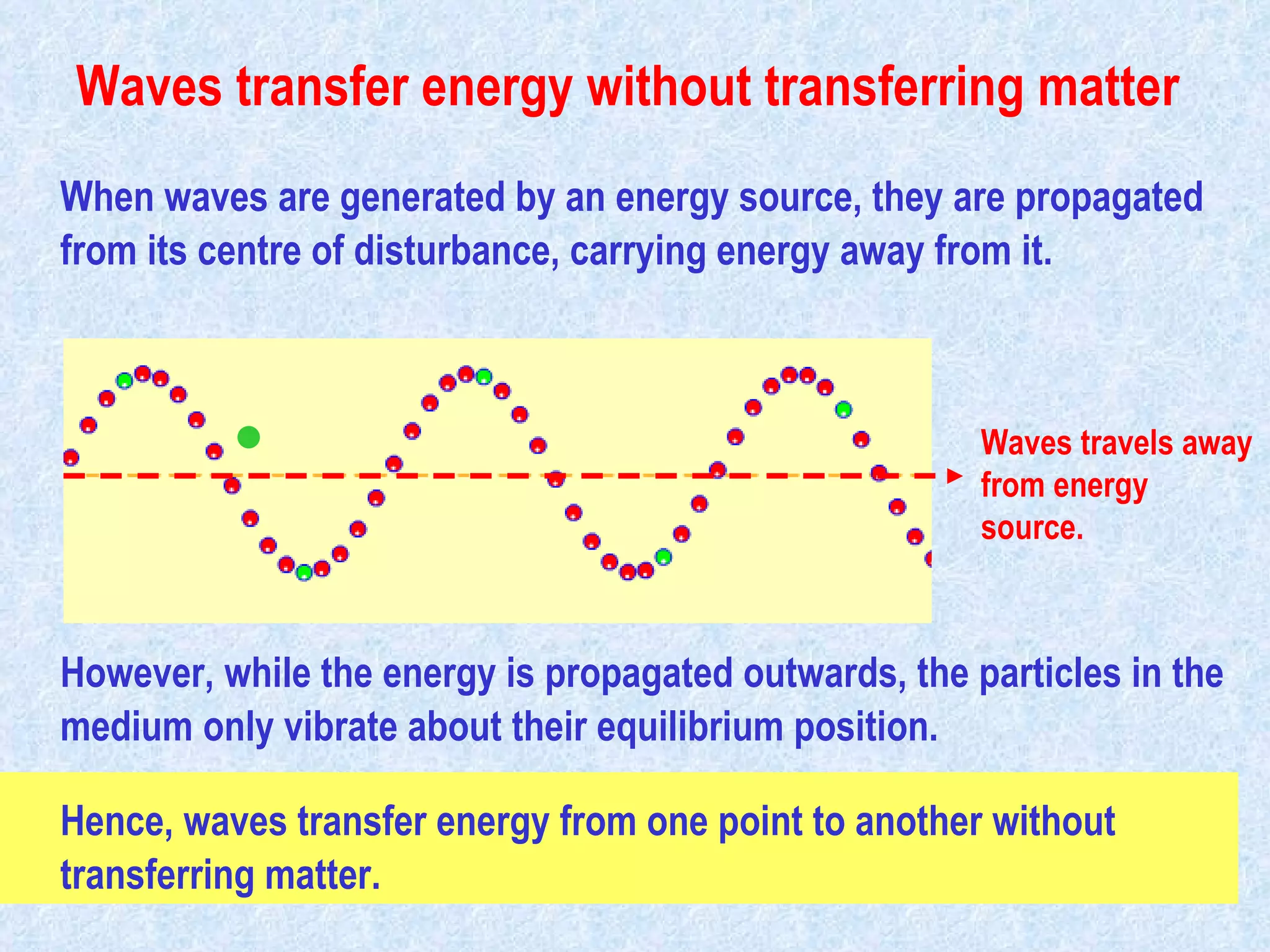
Waves transfer energy without transferring matter When waves are generated by an energy source, they are propagated from its centre of disturbance, carrying energy away from it.  Waves travels away from energy source. However, while the energy is propagated outwards, the particles in the medium only vibrate about their equilibrium position. Hence, waves transfer energy from one point to another without transferring matter.                                                                                         
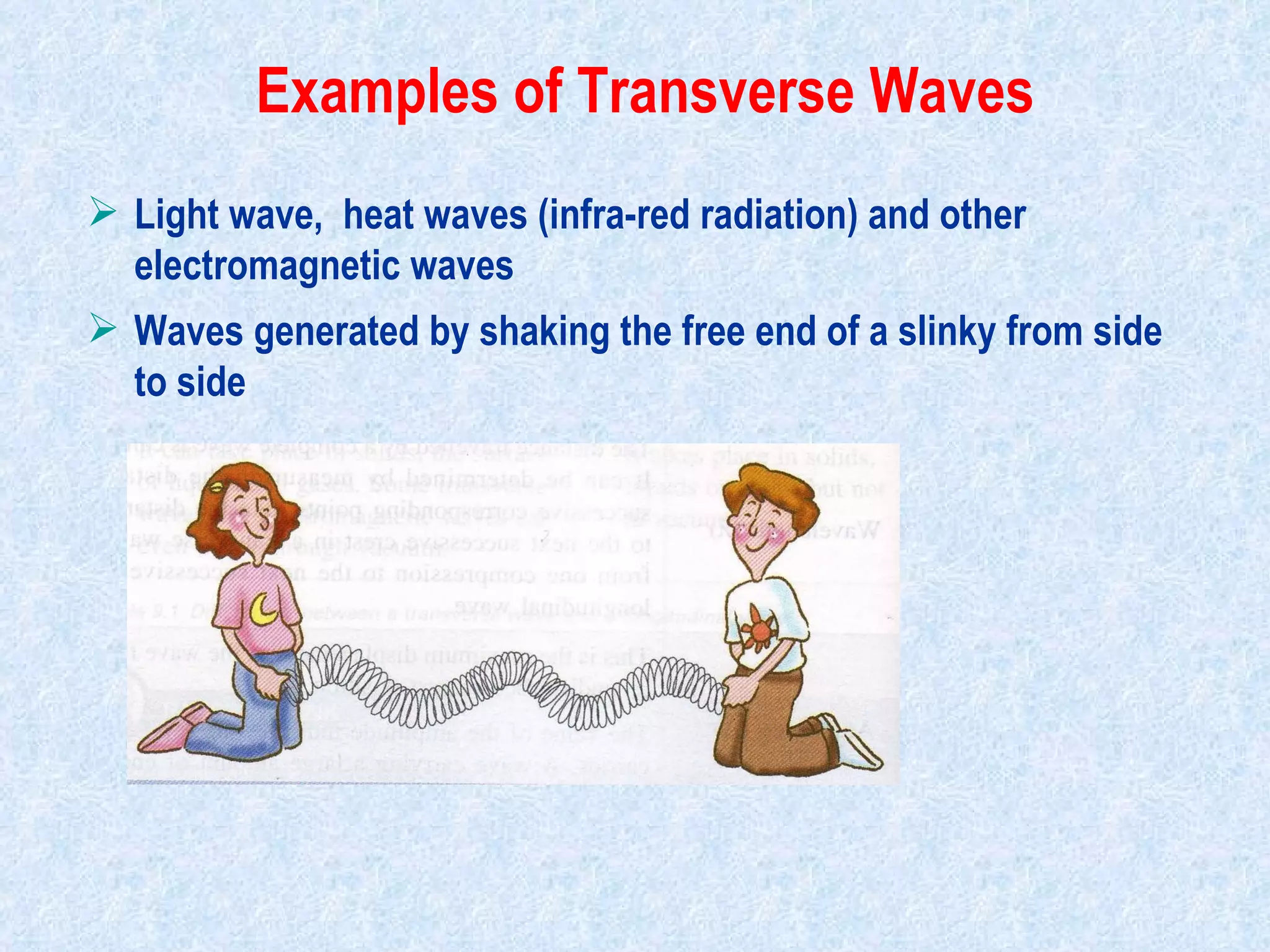
Light wave,  heat waves (infra-red radiation) and other electromagnetic waves Waves generated by shaking the free end of a slinky from side to side   Examples of Transverse Waves                                                                                        
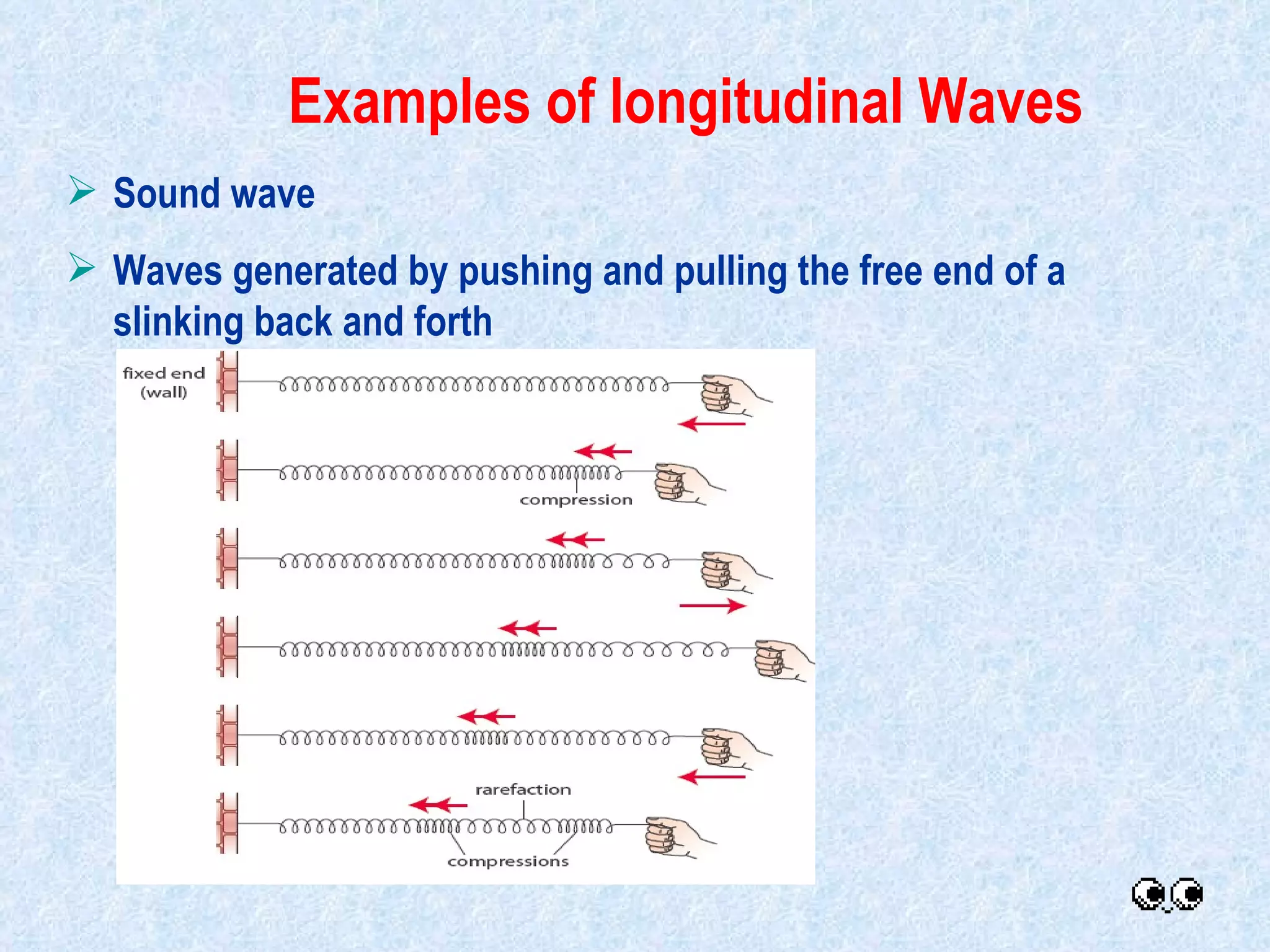
S ound wave  Waves generated by pushing and pulling the free end of a    slinking back and forth   Examples of longitudinal Waves                                                                                        
Lesson closure   At the end of the lesson, reflect on what you have been introduced to:  state 3 new learning points. two things that struck you most. one question you would like to raise with your  teacher on waves. Waves, Waves, Waves                                                                                        
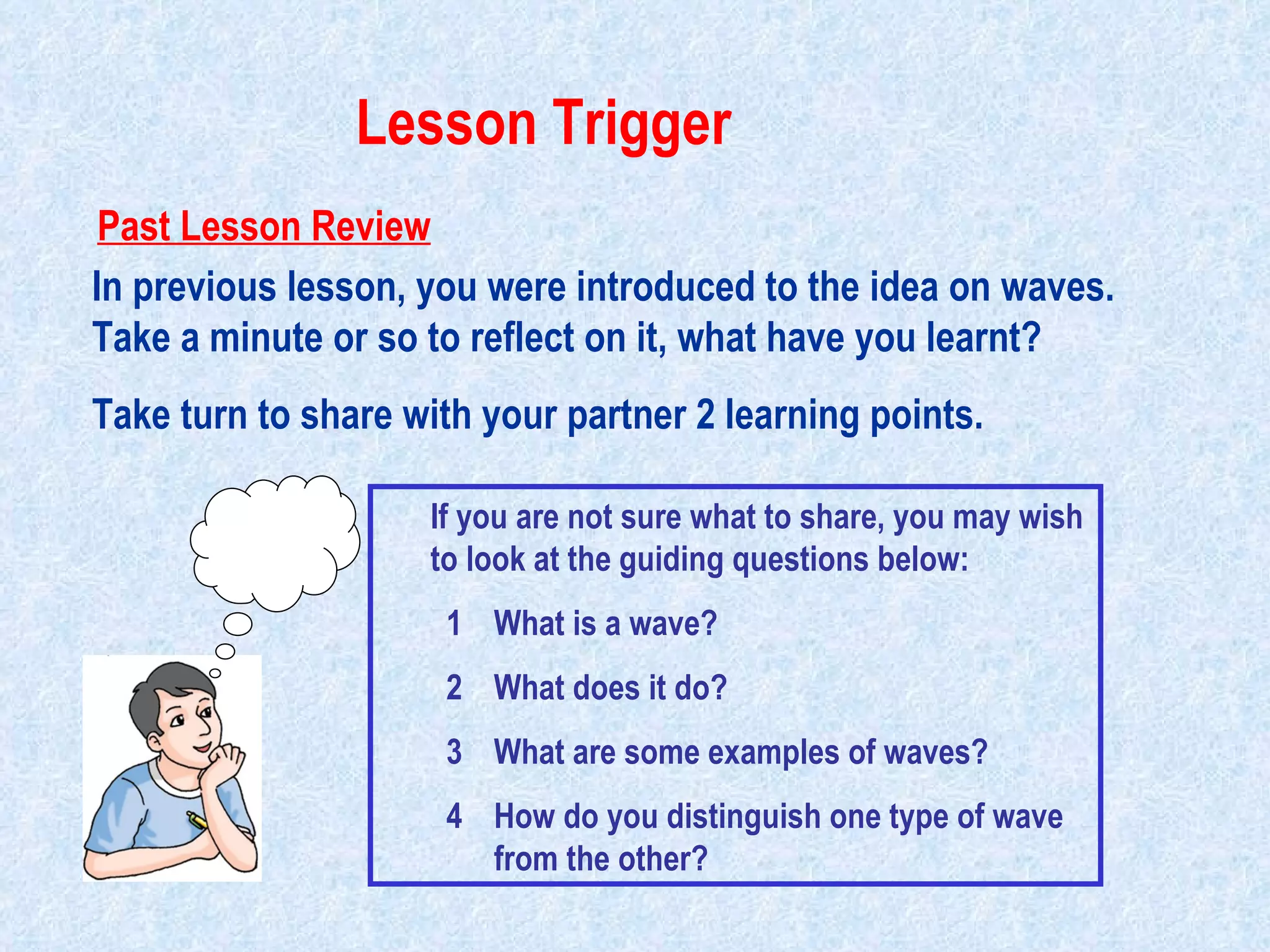
In previous lesson, you were introduced to the idea on waves. Take a minute or so to reflect on it, what have you learnt?  Take turn to share with your partner 2 learning points. If you are not sure what to share, you may wish to look at the guiding questions below: What is a wave? What does it do? What are some examples of waves? How do you distinguish one type of wave from the other? Past Lesson Review Lesson Trigger                                                                                        
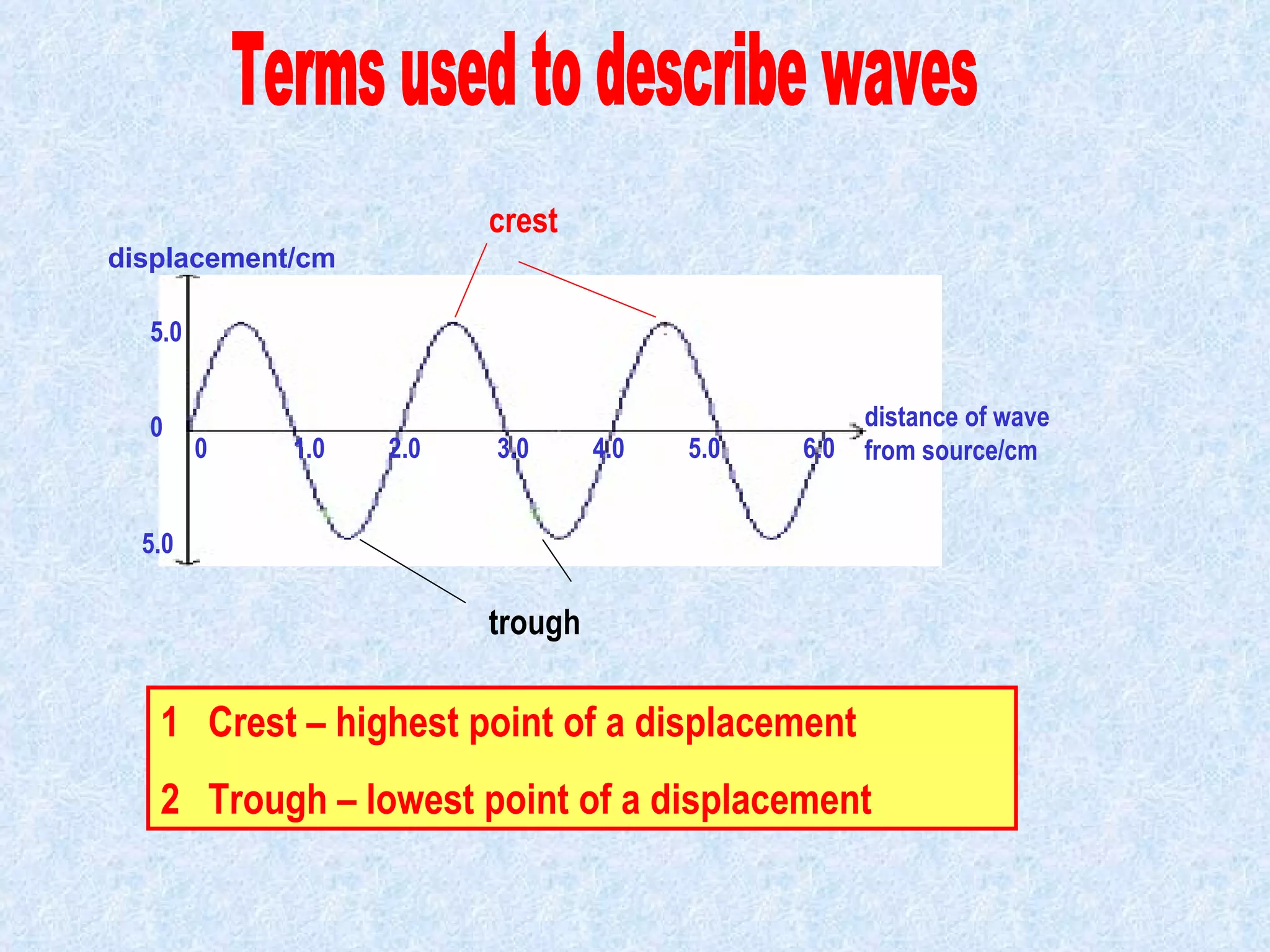
distance of wave from source/cm 0   1.0  2.0  3.0  4.0  5.0  6.0 displacement/cm 5.0 5.0 0 Terms used to describe waves crest  trough  Crest – highest point of a displacement Trough – lowest point of a displacement
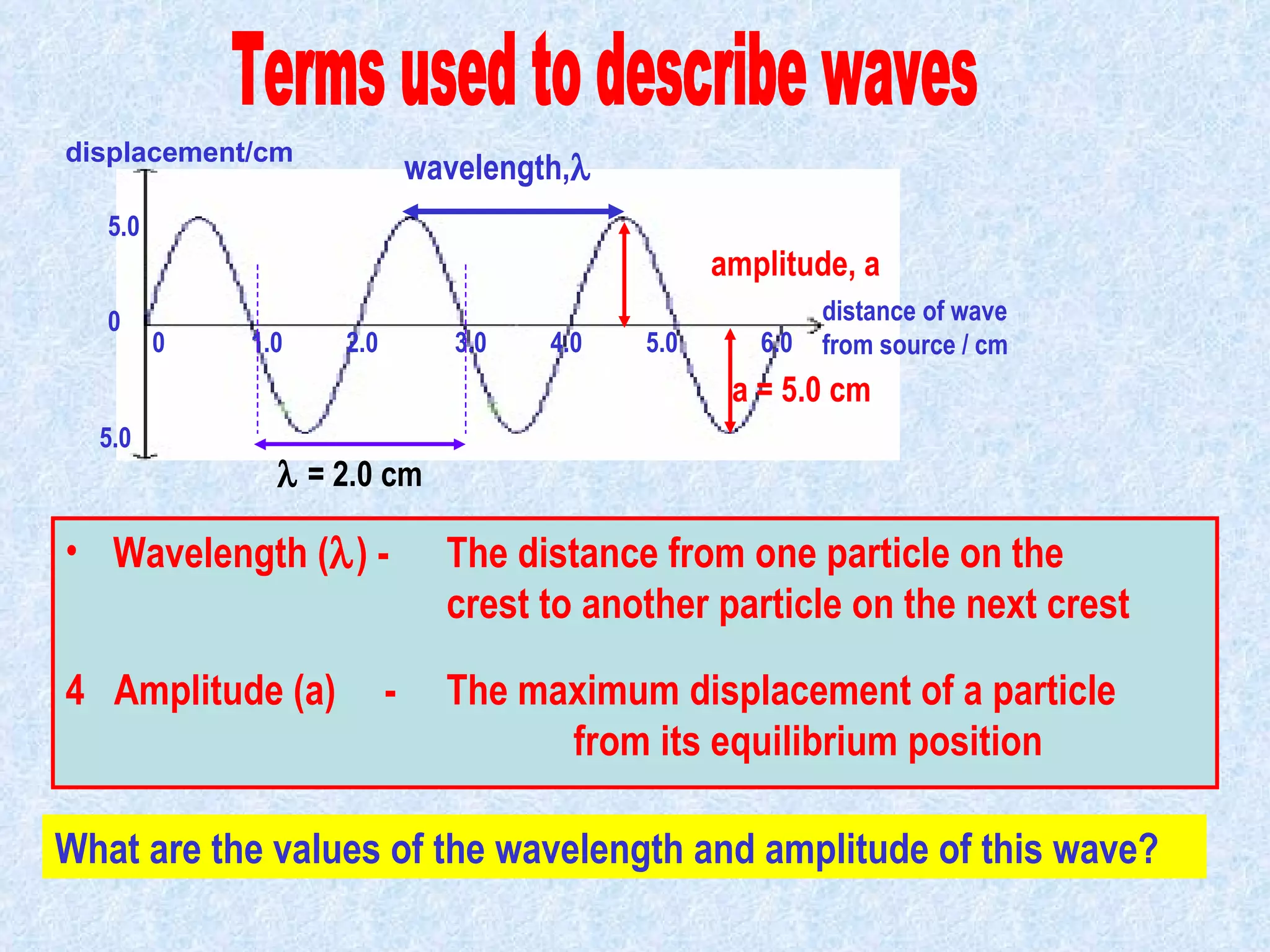
distance of wave from source / cm 0   1.0  2.0  3.0  4.0  5.0  6.0 displacement/cm 5.0 5.0 0 What are the values of the wavelength and amplitude of this wave? Wavelength (  ) -  The distance from one particle on the  crest to another particle on the next crest Terms used to describe waves 4  Amplitude (a)  -  The maximum displacement of a particle  from its equilibrium position    = 2.0 cm a = 5.0 cm amplitude, a wavelength, 
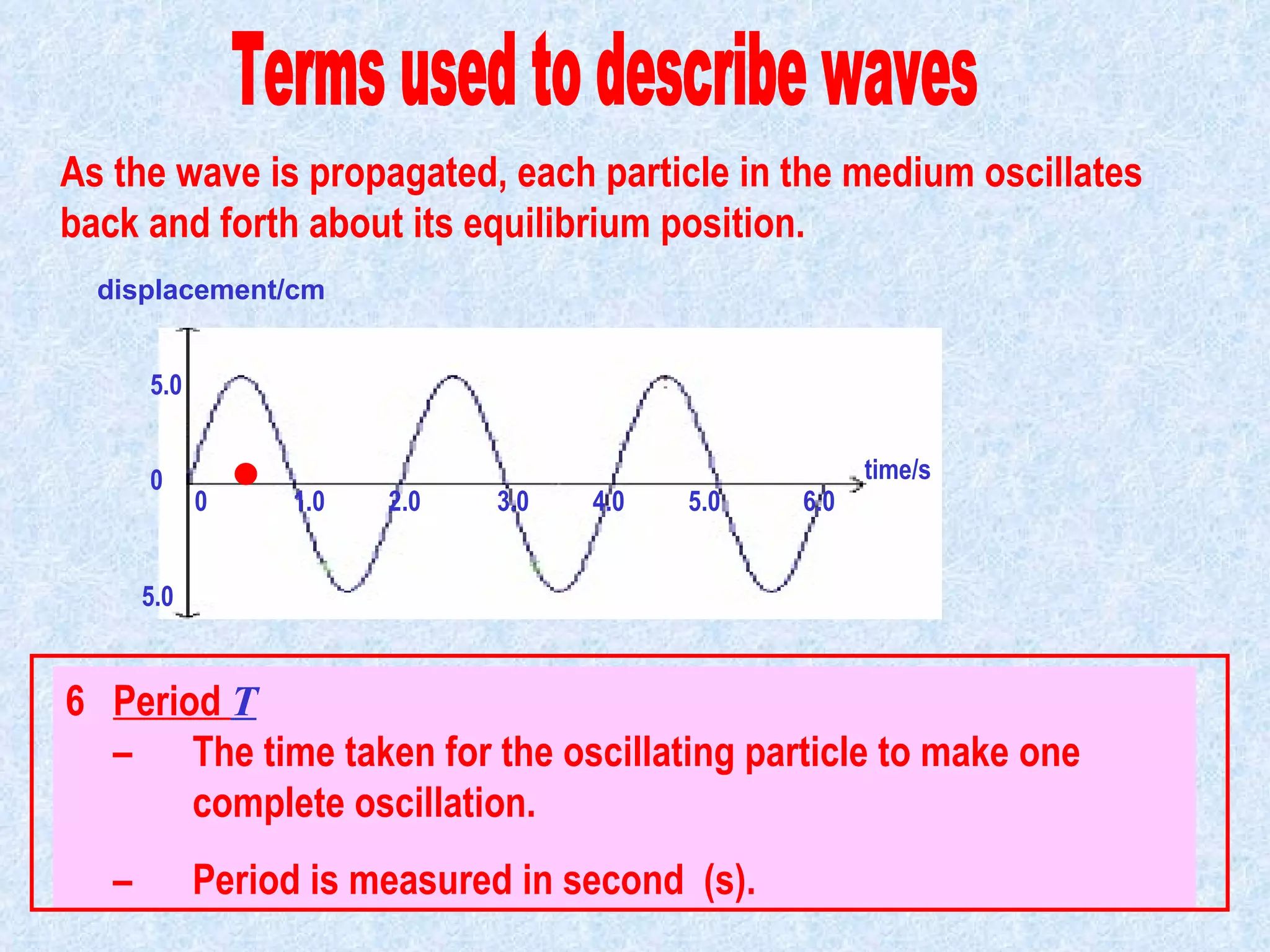
5 Frequency   f       –  the number of complete oscillations made by an  oscillating particle in one second. –  Frequency unit : hertz (Hz). 1 Hz = 1 oscillation per sec  6 Period  T     –  The time taken for the oscillating particle to make one  complete oscillation. –  Period is measured in second  (s). As the wave is propagated, each particle in the medium oscillates back and forth about its equilibrium position. time/s 0   1.0  2.0  3.0  4.0  5.0  6.0 displacement/cm 5.0 5.0 0 Terms used to describe waves                                           
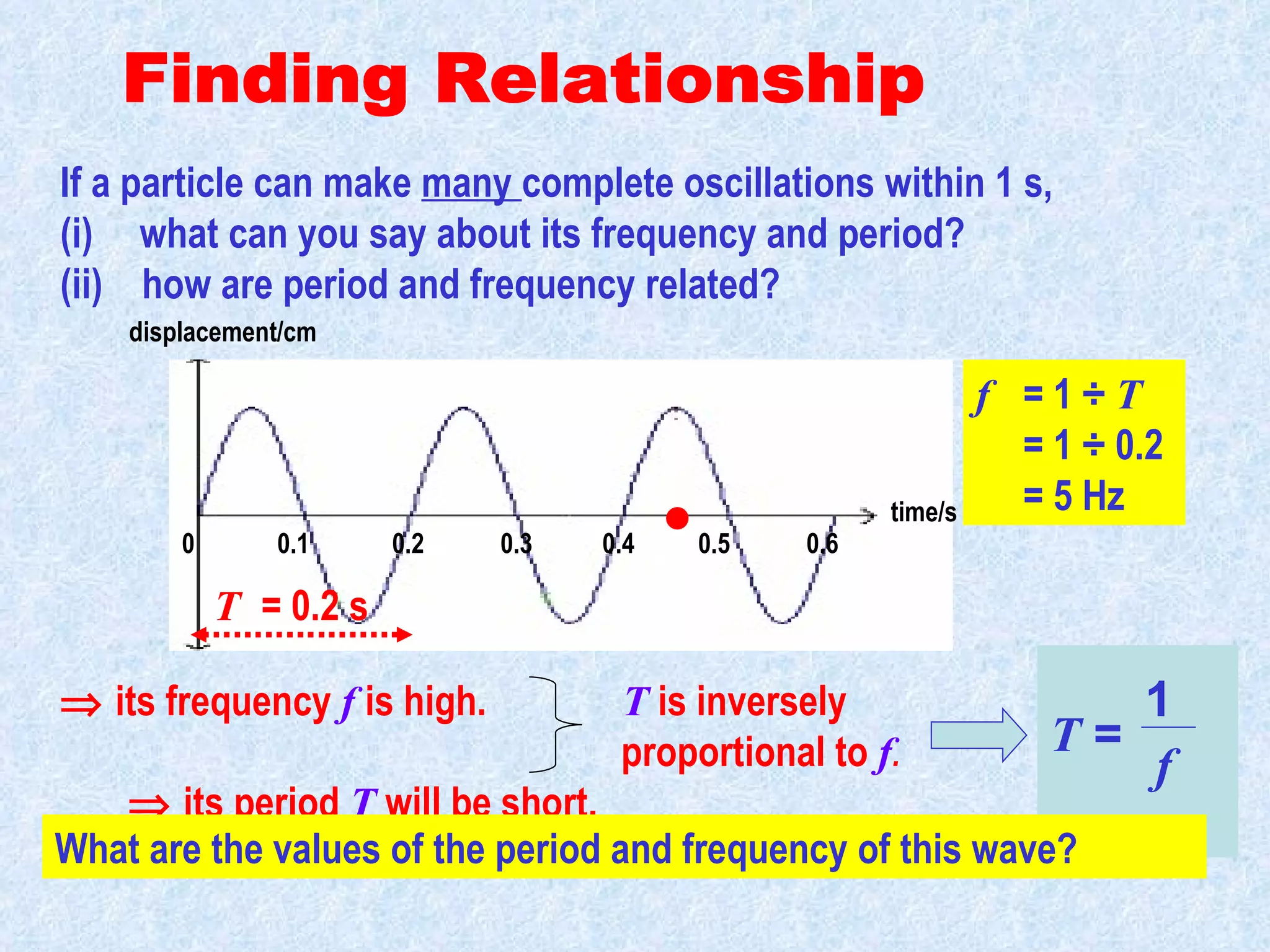
If a particle can make  many  complete oscillations within 1 s,  (i) what can you say about its frequency and period?  (ii)  how are period and frequency related?  Finding Relationship  T  is inversely proportional to  f .    its frequency  f  is high.    its period  T  will be short. time/s displacement/cm 0  0.1  0.2  0.3  0.4  0.5  0.6 What are the values of the period and frequency of this wave? f = 1 ÷  T   = 1 ÷ 0.2 = 5 Hz T  = 1 f T = 0.2 s
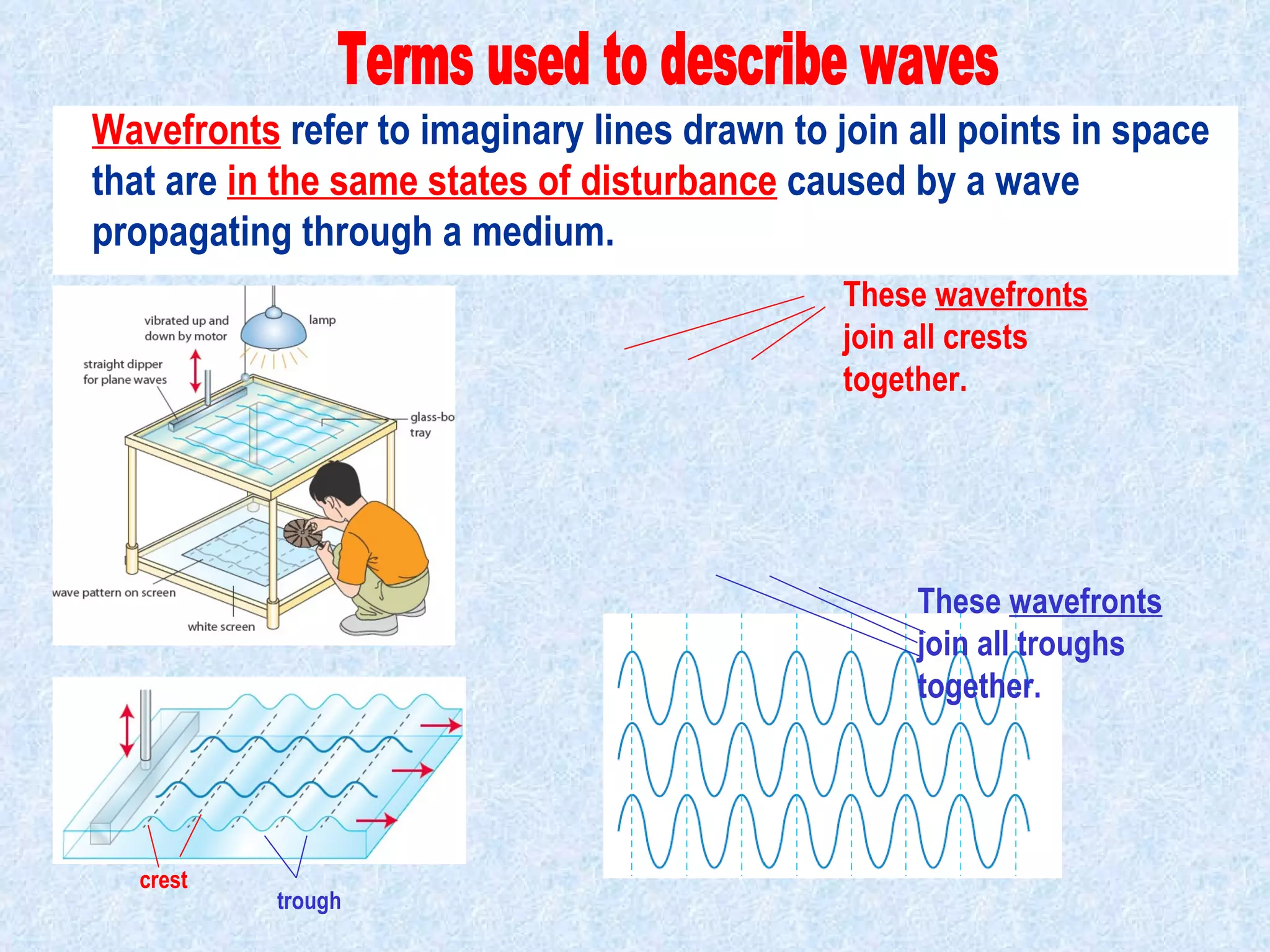
When a ripple tank is used to study wave motion, we can see crests and troughs from the side of a ripple tank. Terms used to describe waves These  wavefronts  join all crests together. These  wavefronts  join all troughs together.                                            crest trough Wavefronts  refer to imaginary lines drawn to join all points in space that are  in the same states of disturbance  caused by a wave propagating through a medium.
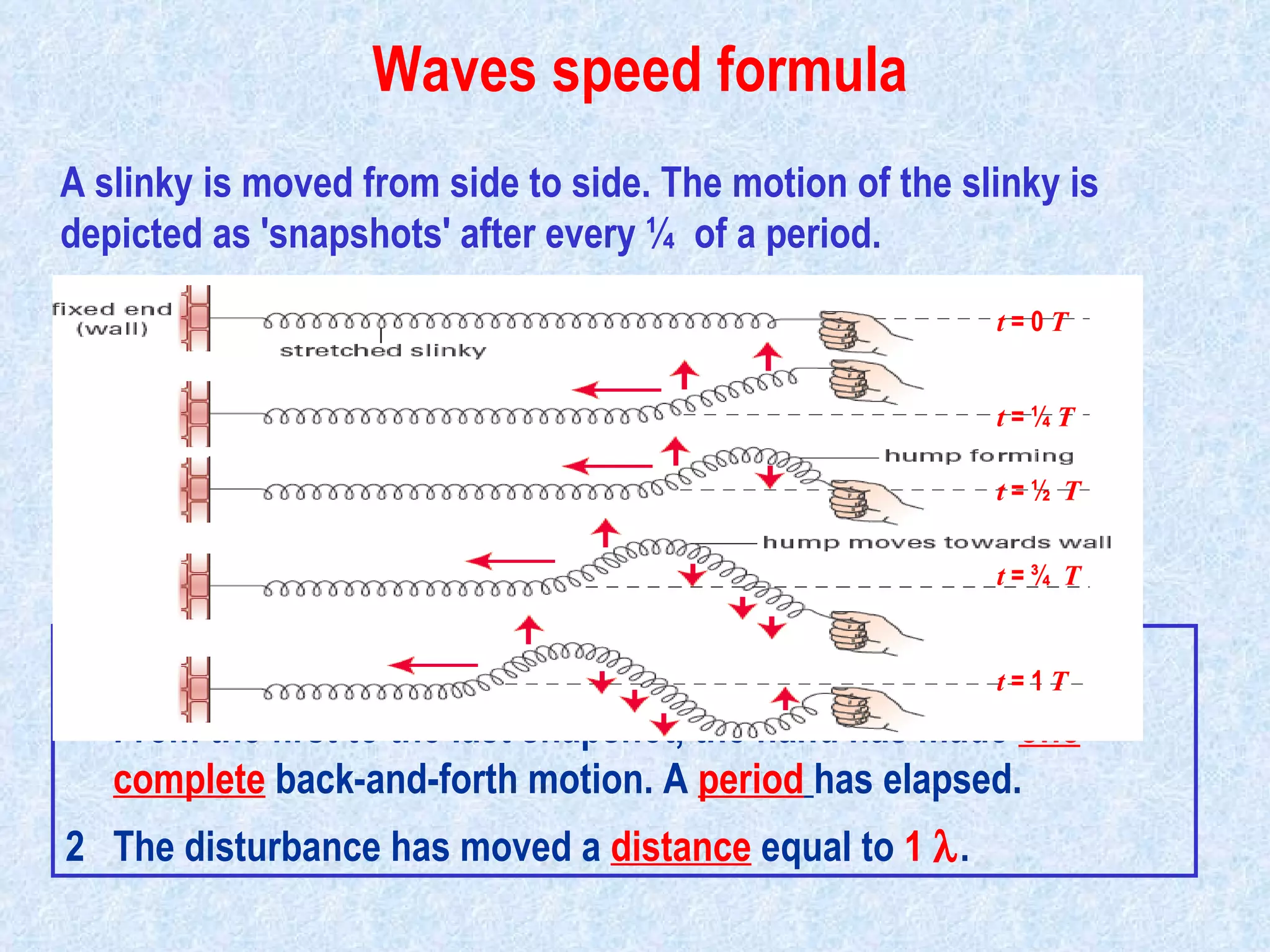
A slinky is moved from side to side.   The motion of the slinky is depicted as 'snapshots' after every ¼  of a period. Observations From the first to the last snapshot, the hand has made  one complete  back-and-forth motion. A  period   has elapsed. 2 The disturbance has moved a  distance  equal to  1   .  Waves speed formula  t  = 0  T   t  = ¼  T t  = ½  T t  = ¾  T t  = 1  T
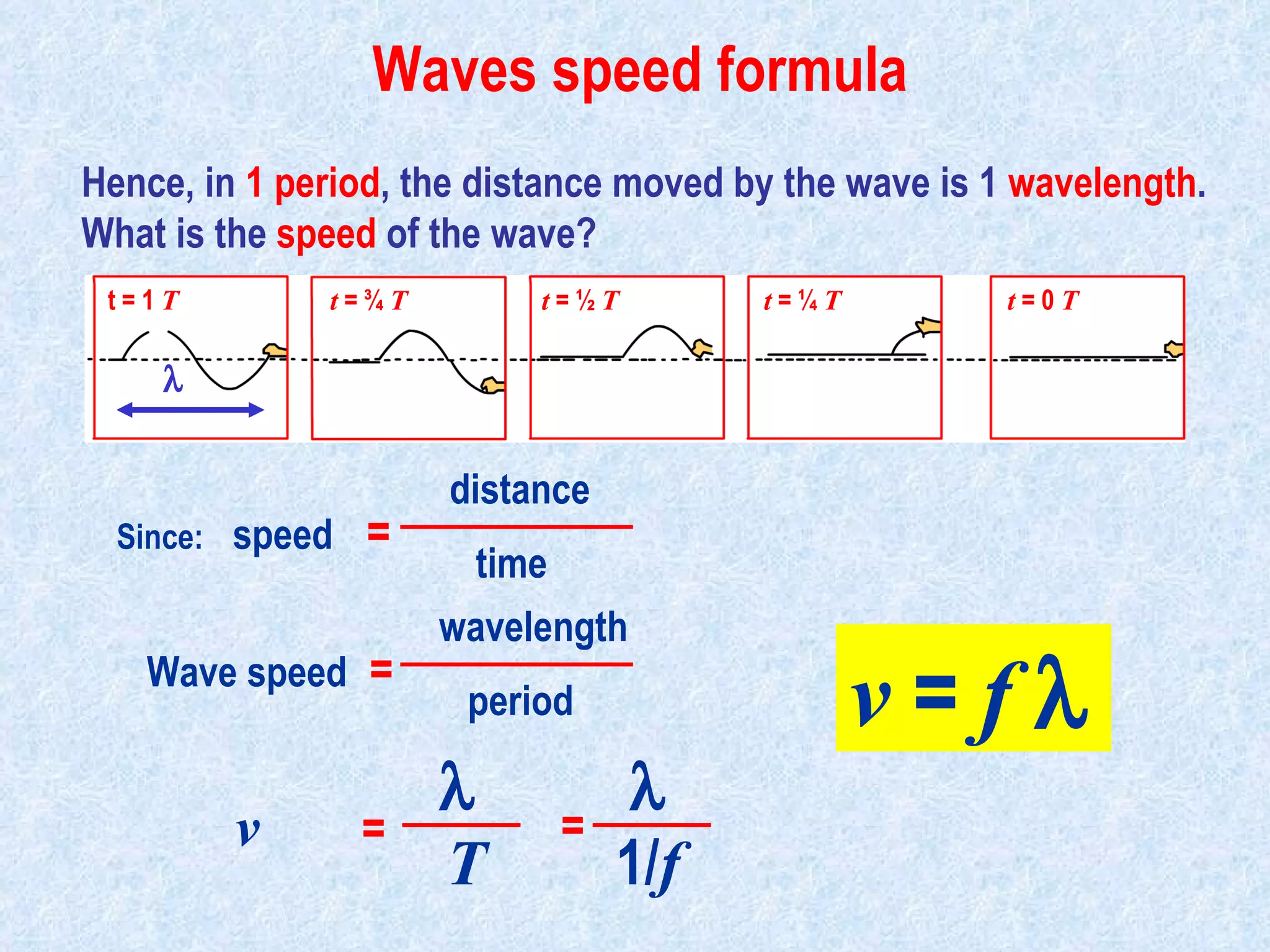
Hence, in  1 period , the distance moved by the wave is 1  wavelength . What is the  speed  of the wave? v  =  f    Waves speed formula t  = 0  T   t  = ¼  T   t  = ½  T   t  = ¾  T t = 1  T                                            Since:   speed   =  distance time   Wave speed   =  wavelength period  v   =   T  1/ f =
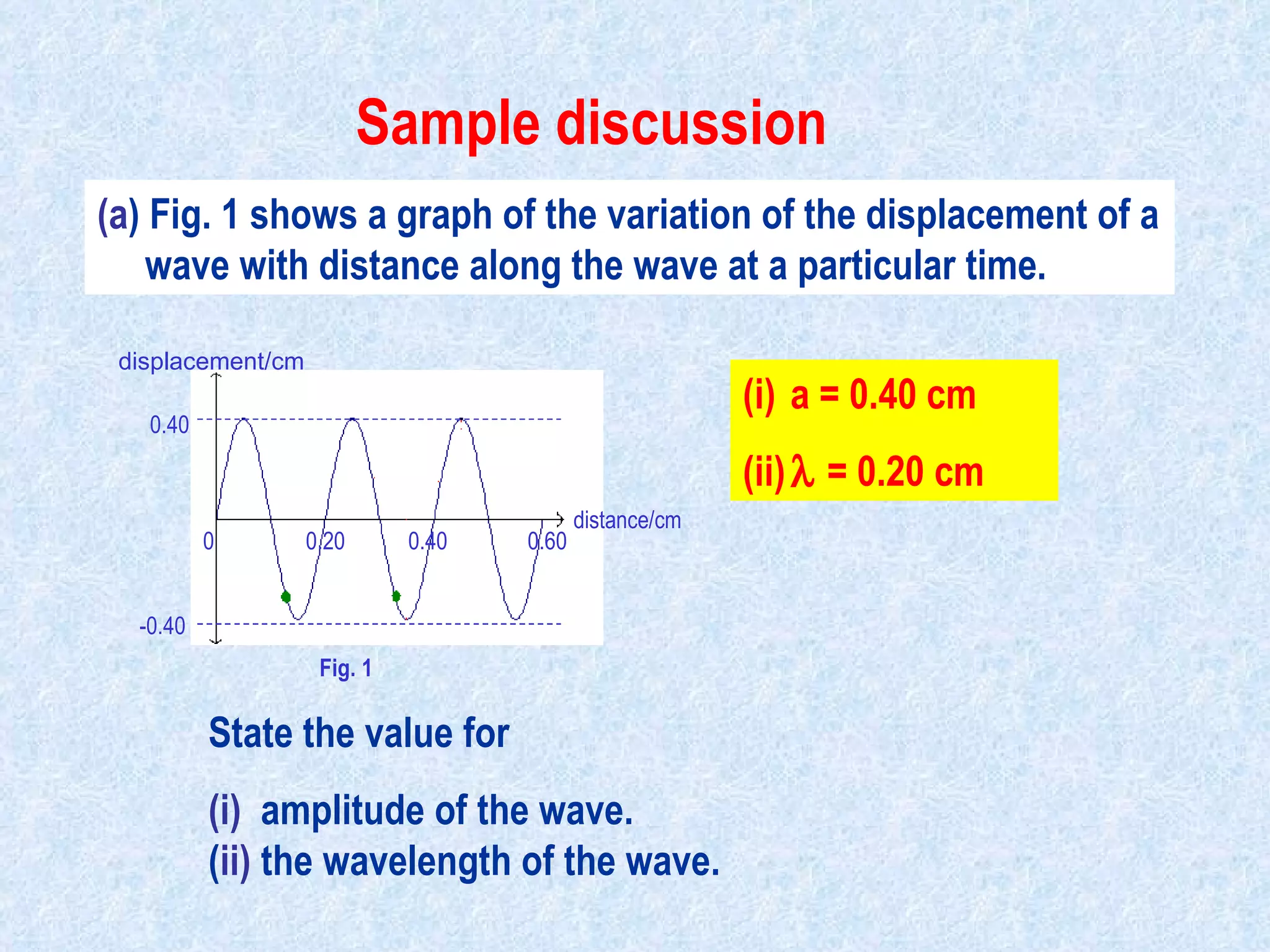
State the value for  (i)   amplitude of the wave.  ( ii)  the wavelength of the wave. (a ) Fig. 1 shows a graph of the variation of the displacement of a wave with distance along the wave at a particular time.   (i)  a = 0.40 cm (ii)   = 0.20 cm Sample discussion                                            distance/cm 0  0.20  0.40  0.60 displacement/cm 0.40 -0.40 Fig. 1
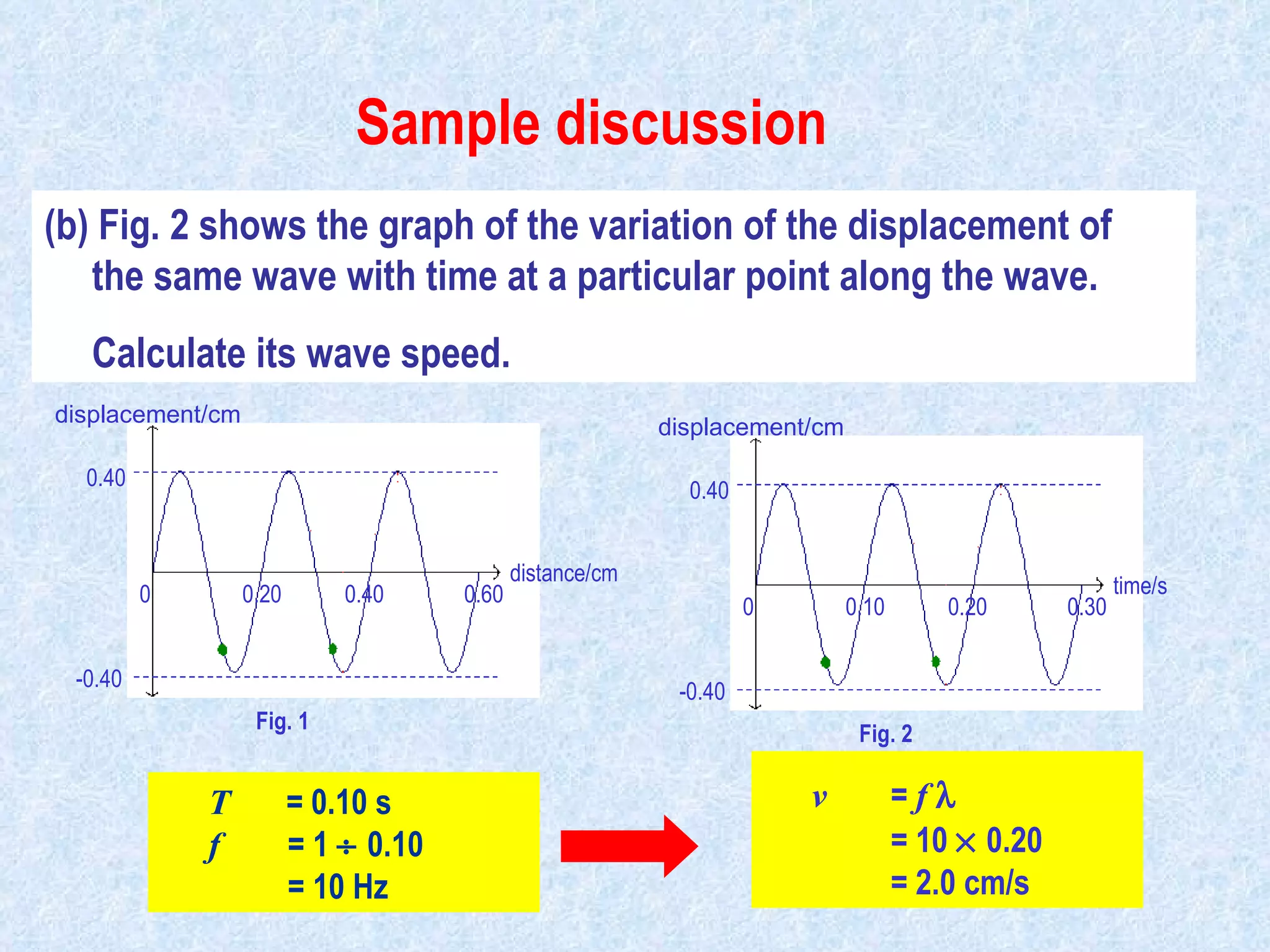
(b) Fig. 2 shows the graph of the variation of the displacement of  the same wave with time at a particular point along the wave.  Calculate its wave speed. T   = 0.10 s    f   = 1    0.10  = 10 Hz Sample discussion                                            distance/cm 0  0.20  0.40  0.60 displacement/cm 0.40 -0.40 Fig. 1 time/s 0  0.10  0.20  0.30 displacement/cm 0.40 -0.40 Fig. 2 v   =  f      = 10    0.20 = 2.0 cm/s
Summary By the end of this lesson pupils are able to: Describe what is meant by wave motion. Understand that waves transfer energy without transferring matter. Define speed, frequency, wavelength, period and amplitude. State what is meant by the term wavefront. Solve problems using the relationship velocity = frequency    wavelength. Compare transverse and longitudinal waves and give examples of each.

Phy exppp chap11

  • 1.
  • 2.
    Before we moveon, We have… Representing the video clips available Representing the applets available Representing the websites available
  • 3.
    General Waves Properties                                         Pupils should be able to explain wave motion and give some examples of waves. compare transverse and longitudinal waves, and give examples of each. explain certain terms we use to describe a waves. describe wave front and wave energy. define speed, frequency, wavelength, period and amplitude. recall and apply the relationship velocity = frequency  wavelength and solve related problems. Lesson objectives
  • 4.
    Lesson Trigger Waves are disturbances that travel away from its source of origin, the centre of disturbance. It is one way by which energy can be transmitted from one place to another. Waves, Waves, Waves Sound waves carry sound energy from the source (for e.g., loudspeaker) to the receiver (ear). Example : Go to Exp9b.mpg                                                                                   What are waves? What can waves do? hyperlink
  • 5.
    Sound waves carrysound energy from the loudspeaker to our ear. In doing so, what are being disturbed? Pause and Think The air molecules between the loudspeaker and the receiver are being disturbed. Go to Exp9b.mpg                                                                                   air molecules are pushed back and forth between the loudspeaker and the ear.
  • 6.
    Waves can takemany forms, but there are 2 fundamental types of waves: Let’s study the wave motions to distinguish these two types of waves. Wave classification 1 Transverse waves 2 Longitudinal waves Go to E-SimPhy_302.exe                                                                                   both waves differ in the way the particles in the medium behave. hyperlink
  • 7.
    Such wave motionproduces transverse waves. Are the air particles being moved away from the disturbance centre ? No, only wave energy is transferred, the particles do not move away from the disturbance centre Transverse Wave motion Where is the disturbance centre? When a wave is generated, its propagation is seen as a travel of the disturbances from the disturbance centre. How do the particles in the medium respond? The particles vibrate up and down, perpendicular to the direction of wave travel. Go to E-SimPhy_302.exe wave travels from left to right.
  • 8.
    Are the airparticles in the medium transferred away from the disturbance centre? As in transverse waves, the particles do not move away from the disturbance centre, only the wave is transferred. How do the particles in the medium respond? The particles vibrate to and fro, parallel to the direction of wave travel. Such wave motion produces longitudinal wave. As the longitudinal waves travel towards the right, the particles in the medium is disturbed. Longitudinal Wave motion                                                                                   Wave travels from left to right.
  • 9.
    Waves transfer energywithout transferring matter When waves are generated by an energy source, they are propagated from its centre of disturbance, carrying energy away from it. Waves travels away from energy source. However, while the energy is propagated outwards, the particles in the medium only vibrate about their equilibrium position. Hence, waves transfer energy from one point to another without transferring matter.                                                                                  
  • 10.
    Light wave, heat waves (infra-red radiation) and other electromagnetic waves Waves generated by shaking the free end of a slinky from side to side Examples of Transverse Waves                                                                                  
  • 11.
    S ound wave Waves generated by pushing and pulling the free end of a slinking back and forth Examples of longitudinal Waves                                                                                  
  • 12.
    Lesson closure At the end of the lesson, reflect on what you have been introduced to: state 3 new learning points. two things that struck you most. one question you would like to raise with your teacher on waves. Waves, Waves, Waves                                                                                  
  • 13.
    In previous lesson,you were introduced to the idea on waves. Take a minute or so to reflect on it, what have you learnt? Take turn to share with your partner 2 learning points. If you are not sure what to share, you may wish to look at the guiding questions below: What is a wave? What does it do? What are some examples of waves? How do you distinguish one type of wave from the other? Past Lesson Review Lesson Trigger                                                                                  
  • 14.
    distance of wavefrom source/cm 0 1.0 2.0 3.0 4.0 5.0 6.0 displacement/cm 5.0 5.0 0 Terms used to describe waves crest trough Crest – highest point of a displacement Trough – lowest point of a displacement
  • 15.
    distance of wavefrom source / cm 0 1.0 2.0 3.0 4.0 5.0 6.0 displacement/cm 5.0 5.0 0 What are the values of the wavelength and amplitude of this wave? Wavelength (  ) - The distance from one particle on the crest to another particle on the next crest Terms used to describe waves 4 Amplitude (a) - The maximum displacement of a particle from its equilibrium position  = 2.0 cm a = 5.0 cm amplitude, a wavelength, 
  • 16.
    5 Frequency f – the number of complete oscillations made by an oscillating particle in one second. – Frequency unit : hertz (Hz). 1 Hz = 1 oscillation per sec 6 Period T – The time taken for the oscillating particle to make one complete oscillation. – Period is measured in second (s). As the wave is propagated, each particle in the medium oscillates back and forth about its equilibrium position. time/s 0 1.0 2.0 3.0 4.0 5.0 6.0 displacement/cm 5.0 5.0 0 Terms used to describe waves                                        
  • 17.
    If a particlecan make many complete oscillations within 1 s, (i) what can you say about its frequency and period? (ii) how are period and frequency related? Finding Relationship T is inversely proportional to f .  its frequency f is high.  its period T will be short. time/s displacement/cm 0 0.1 0.2 0.3 0.4 0.5 0.6 What are the values of the period and frequency of this wave? f = 1 ÷ T = 1 ÷ 0.2 = 5 Hz T = 1 f T = 0.2 s
  • 18.
    When a rippletank is used to study wave motion, we can see crests and troughs from the side of a ripple tank. Terms used to describe waves These wavefronts join all crests together. These wavefronts join all troughs together.                                         crest trough Wavefronts refer to imaginary lines drawn to join all points in space that are in the same states of disturbance caused by a wave propagating through a medium.
  • 19.
    A slinky ismoved from side to side. The motion of the slinky is depicted as 'snapshots' after every ¼ of a period. Observations From the first to the last snapshot, the hand has made one complete back-and-forth motion. A period has elapsed. 2 The disturbance has moved a distance equal to 1  . Waves speed formula  t = 0 T t = ¼ T t = ½ T t = ¾ T t = 1 T
  • 20.
    Hence, in 1 period , the distance moved by the wave is 1 wavelength . What is the speed of the wave? v = f  Waves speed formula t = 0 T t = ¼ T t = ½ T t = ¾ T t = 1 T                                         Since: speed = distance time Wave speed = wavelength period  v =  T  1/ f =
  • 21.
    State the valuefor (i) amplitude of the wave. ( ii) the wavelength of the wave. (a ) Fig. 1 shows a graph of the variation of the displacement of a wave with distance along the wave at a particular time. (i) a = 0.40 cm (ii)  = 0.20 cm Sample discussion                                         distance/cm 0 0.20 0.40 0.60 displacement/cm 0.40 -0.40 Fig. 1
  • 22.
    (b) Fig. 2shows the graph of the variation of the displacement of the same wave with time at a particular point along the wave. Calculate its wave speed. T = 0.10 s f = 1  0.10 = 10 Hz Sample discussion                                         distance/cm 0 0.20 0.40 0.60 displacement/cm 0.40 -0.40 Fig. 1 time/s 0 0.10 0.20 0.30 displacement/cm 0.40 -0.40 Fig. 2 v = f  = 10  0.20 = 2.0 cm/s
  • 23.
    Summary By theend of this lesson pupils are able to: Describe what is meant by wave motion. Understand that waves transfer energy without transferring matter. Define speed, frequency, wavelength, period and amplitude. State what is meant by the term wavefront. Solve problems using the relationship velocity = frequency  wavelength. Compare transverse and longitudinal waves and give examples of each.