Grade 8 Science Forces and Their Effects http://commons.wikimedia.org/wiki/File:Jal.747.newcolours.arp.750pix.jpg
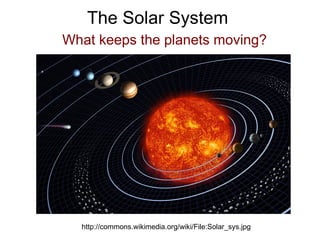
The Solar System What keeps the planets moving? http://commons.wikimedia.org/wiki/File:Solar_sys.jpg
Forces A force is a push or a pull.
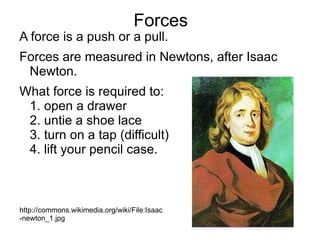
Forces are measured in Newtons, after Isaac Newton.
What force is required to: 1. open a drawer 2. untie a shoe lace 3. turn on a tap (difficult) 4. lift your pencil case. http://commons.wikimedia.org/wiki/File:Isaac-newton_1.jpg
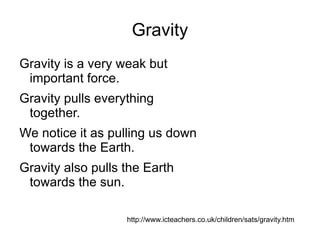
Gravity Gravity is a very weak but important force.
Gravity pulls everything together.
We notice it as pulling us down towards the Earth.
Gravity also pulls the Earth towards the sun. http://www.icteachers.co.uk/children/sats/gravity.htm
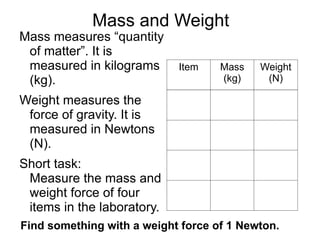
Mass and Weight Mass measures “quantity of matter”. It is measured in kilograms (kg).
Weight measures the force of gravity. It is measured in Newtons (N).
Short task:  Measure the mass and weight force of four items in the laboratory.  Item Mass (kg) Weight (N) Find something with a weight force of 1 Newton.
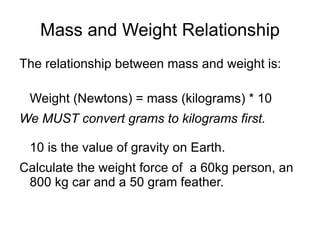
Mass and Weight Relationship The relationship between mass and weight is:
Weight (Newtons) = mass (kilograms) * 10
We MUST convert grams to kilograms first. 10 is the value of gravity on Earth.
Calculate the weight force of  a 60kg person, an 800 kg car and a 50 gram feather.
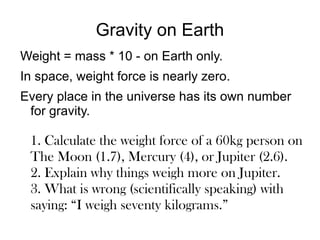
Gravity on Earth Weight = mass * 10 - on Earth only.
In space, weight force is nearly zero.
Every place in the universe has its own number for gravity. 1. Calculate the weight force of a 60kg person on The Moon (1.7), Mercury (4), or Jupiter (2.6). 2. Explain why things weigh more on Jupiter. 3. What is wrong (scientifically speaking) with saying: “I weigh seventy kilograms.”
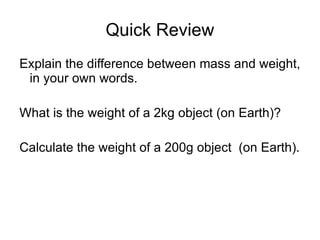
Quick Review Explain the difference between mass and weight, in your own words.
What is the weight of a 2kg object (on Earth)?
Calculate the weight of a 200g object  (on Earth).
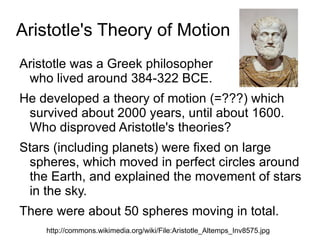
Aristotle's Theory of Motion Aristotle was a Greek philosopher  who lived around 384-322 BCE.
He developed a theory of motion (=???) which survived about 2000 years, until about 1600. Who disproved Aristotle's theories?
Stars (including planets) were fixed on large spheres, which moved in perfect circles around the Earth, and explained the movement of stars in the sky.
There were about 50 spheres moving in total. http://commons.wikimedia.org/wiki/File:Aristotle_Altemps_Inv8575.jpg
http://tutorsincalgary.com/science-tutor-calgary.jpg Please load the image shown at the URL below (it cannot be included in my presentation due to copyright).
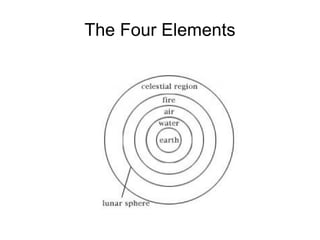
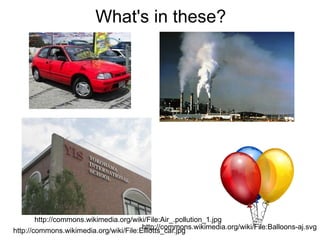
The Four Elements Everything “under the moon” (on Earth) was made of a combination of five elements: earth, air, fire and water.
Fire was the lightest, then air, then water, then earth.
Everything, if left alone, would move to its “natural state” and stop moving.
Iron was mostly Earth, whereas wood had some earth, some water and some air.
The Four Elements
What's in these? http://commons.wikimedia.org/wiki/File:Elliotts_car.jpg http://commons.wikimedia.org/wiki/File:Balloons-aj.svg http://commons.wikimedia.org/wiki/File:Air_.pollution_1.jpg
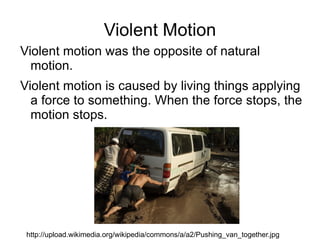
Violent Motion Violent motion was the opposite of natural motion.
Violent motion is caused by living things applying a force to something. When the force stops, the motion stops. http://upload.wikimedia.org/wikipedia/commons/a/a2/Pushing_van_together.jpg
What Can't it Explain? http://godgrown.net/blog/2011/01/12/as-easy-as-the-arrows-job-in-archery/
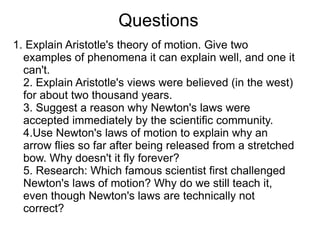
Questions 1. Explain Aristotle's theory of motion. Give two examples of phenomena it can explain well, and one it can't. 2. Explain Aristotle's views were believed (in the west) for about two thousand years. 3. Suggest a reason why Newton's laws were accepted immediately by the scientific community. 4.Use Newton's laws of motion to explain why an arrow flies so far after being released from a stretched bow. Why doesn't it fly forever?  5. Research: Which famous scientist first challenged Newton's laws of motion? Why do we still teach it, even though Newton's laws are technically not correct?
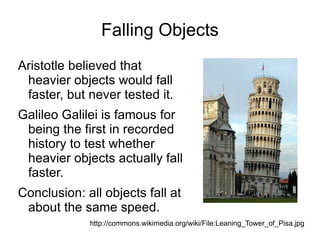
Falling Objects Aristotle believed that heavier objects would fall faster, but never tested it.
Galileo Galilei is famous for being the first in recorded history to test whether heavier objects actually fall faster.
Conclusion: all objects fall at about the same speed. http://commons.wikimedia.org/wiki/File:Leaning_Tower_of_Pisa.jpg
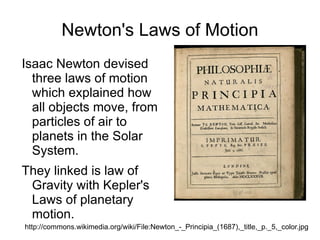
Newton's Laws of Motion Isaac Newton devised three laws of motion which explained how all objects move, from particles of air to planets in the Solar System.
They linked is law of Gravity with Kepler's Laws of planetary motion. http://commons.wikimedia.org/wiki/File:Newton_-_Principia_(1687),_title,_p._5,_color.jpg
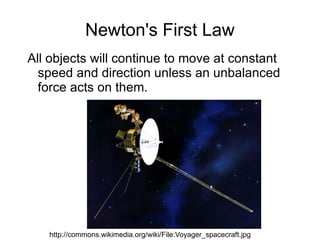
Newton's First Law All objects will continue to move at constant speed and direction unless an unbalanced force acts on them. http://commons.wikimedia.org/wiki/File:Voyager_spacecraft.jpg
Why do Cellphones Fly out Windows?
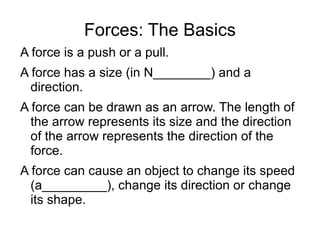
Forces: The Basics A force is a push or a pull.
A force has a size (in N________) and a direction.
A force can be drawn as an arrow. The length of the arrow represents its size and the direction of the arrow represents the direction of the force.
A force can cause an object to change its speed (a_________), change its direction or change its shape.
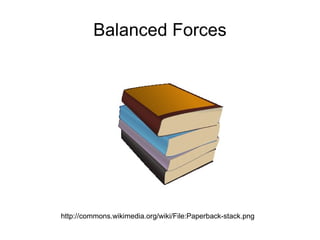
Balanced Forces http://commons.wikimedia.org/wiki/File:Paperback-stack.png
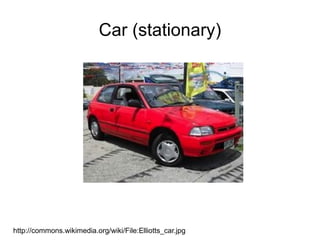
Car (stationary) http://commons.wikimedia.org/wiki/File:Elliotts_car.jpg
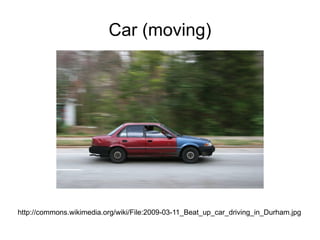
Car (moving) http://commons.wikimedia.org/wiki/File:2009-03-11_Beat_up_car_driving_in_Durham.jpg
Bookwork Integrated Science 2, pages 42, 43, 44 (all questions).
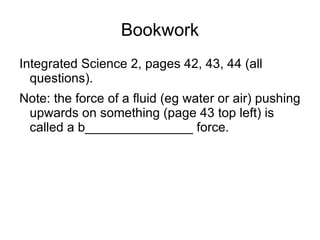
Note: the force of a fluid (eg water or air) pushing upwards on something (page 43 top left) is called a b_______________ force.
http://commons.wikimedia.org/wiki/File:Isarfloss.jpg
http://commons.wikimedia.org/wiki/File:Hot-air-balloon.jpg
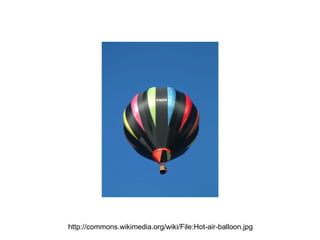
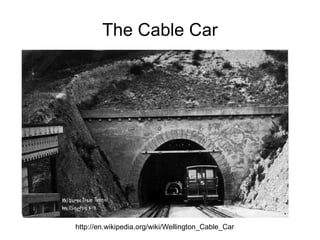
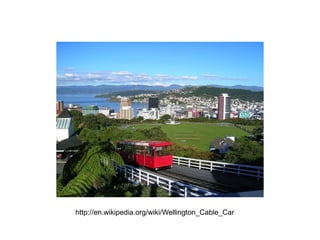
The Cable Car http://en.wikipedia.org/wiki/Wellington_Cable_Car
http://en.wikipedia.org/wiki/Wellington_Cable_Car
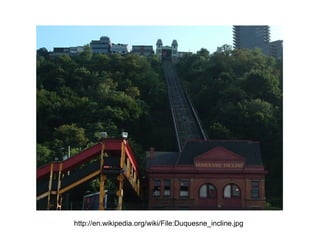
http://en.wikipedia.org/wiki/File:Duquesne_incline.jpg
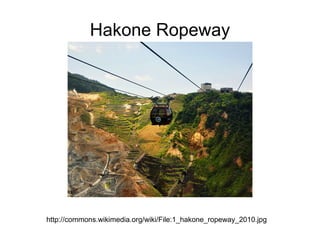
Hakone Ropeway http://commons.wikimedia.org/wiki/File:1_hakone_ropeway_2010.jpg
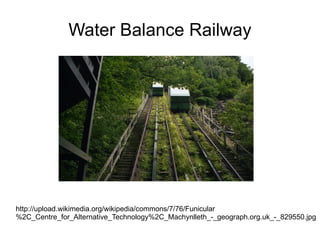
Water Balance Railway http://upload.wikimedia.org/wikipedia/commons/7/76/Funicular%2C_Centre_for_Alternative_Technology%2C_Machynlleth_-_geograph.org.uk_-_829550.jpg
Integrated Science book 2 Questions page 42-43
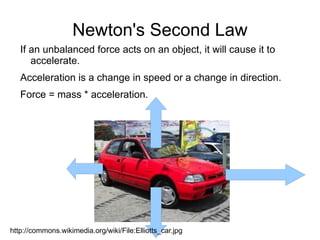
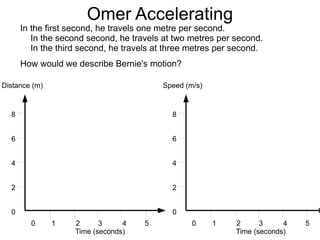
Newton's Second Law If an unbalanced force acts on an object, it will cause it to accelerate.
Acceleration is a change in speed or a change in direction.
Force = mass * acceleration. http://commons.wikimedia.org/wiki/File:Elliotts_car.jpg
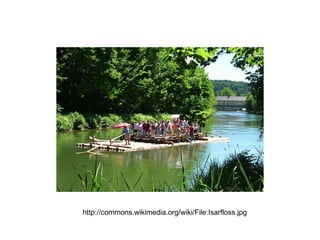
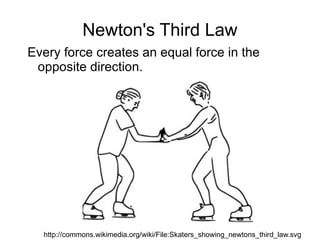
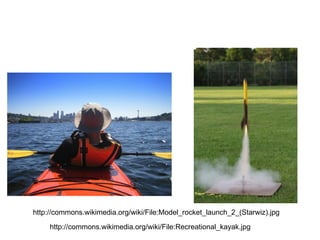
Newton's Third Law Every force creates an equal force in the opposite direction. http://commons.wikimedia.org/wiki/File:Skaters_showing_newtons_third_law.svg
http://commons.wikimedia.org/wiki/File:Recreational_kayak.jpg http://commons.wikimedia.org/wiki/File:Model_rocket_launch_2_(Starwiz).jpg
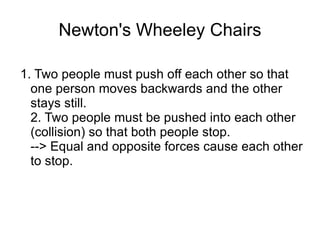
Newton's Wheeley Chairs 1. Two people must push off each other so that one person moves backwards and the other stays still. 2. Two people must be pushed into each other (collision) so that both people stop. --> Equal and opposite forces cause each other to stop.
Questions 1. Explain Aristotle's theory of motion. Give two examples of phenomena it can explain well, and one it can't. 2. Explain Aristotle's views were believed (in the west) for about two thousand years. 3. Suggest a reason why Newton's laws were accepted immediately by the scientific community. 4.Use Newton's laws of motion to explain why an arrow flies so far after being released from a stretched bow. Why doesn't it fly forever?  5. Research: Which famous scientist first challenged Newton's laws of motion? Why do we still teach it, even though Newton's laws are technically not correct?
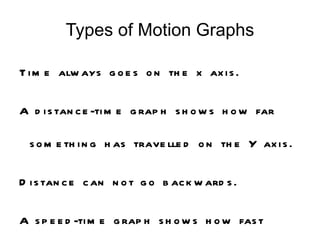
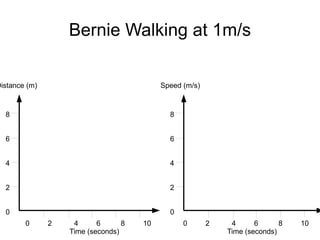
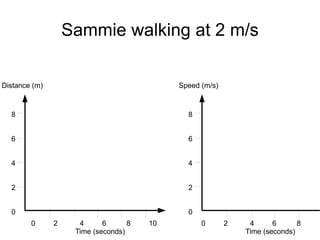
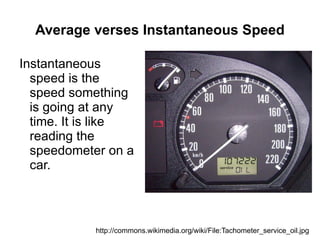
Speed Speed is a measure of how fast something moves.
Units are m/s (or cm/s, km/s etc).
Eg. Cliodhna is running during PE. After 20 seconds she has run 120. What is her speed? 1. Calculate how far Cliodhna would run in one minute (using the speed from the previous example).
2.A. Moena is swimming at 2m/s. How long will it take her to swim a length of a swimming pool (25m)? B. How far can Moena swim during a 45 minute PE class if she swims for the whole class?
Measuring Walking / Running Speed Work in groups of 4 or 5.
Measure the speed of a person walking and running. (It does not have to be the same person walking and running).
Use a distance of 5-10 metres.
Repeat each set at least twice, and take the average of all trials.
Present your results in a summary.
The Investigation Aim: To determine how fast _____ walks and ______ sprints.
Apparatus: stopwatches, meter rulers
Prediction: ________ will walk at _____ m/s and _________ will sprint at _____ m/s.
Method: 1. Measure a suitable distance for someone to walk, and sprint. 2. Arrange a system for ensuring that the timing is accurate. 3. Record at least three trials, and calculate the average speed for walking and running.
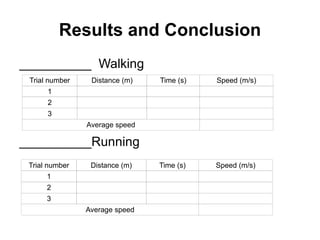
Results and Conclusion __________  Walking
__________Running Trial number Distance (m) Time (s) Speed (m/s) 1 2 3 Average speed Trial number Distance (m) Time (s) Speed (m/s) 1 2 3 Average speed
Measuring the Speed of Cars How will we measure the speed of cars along the road outside YIS first thing on Monday?
Equipment: tape measures, stopwatches
Work in group of 3, 4 or 5.
Safety:
No one is allowed on the road at any time (except crossing it at the proper crossing).
Signals should not distract cars. Write up a plan as a google doc for each group, and share it with me. It should include the names of each member of the group, and a detailed plan. It might help to have a table printed ready to go.
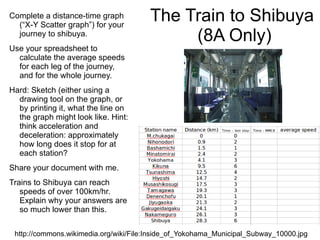
1. Compare your results to others in the class. Who is the fastest a) runner? b) walker? 2. The result obtained is an average speed. Explain what is meant by an average speed. You may need to do some research for this question. 3. Two years ago in Berlin, Usain Bolt from Jamaica set the world record for the 100m sprint, coming in at 9.58s. Calculate his average speed, and compare it to the fastest student in the class. 4. A. Convert your group's walking and sprinting speed to km/h. This may requires some thought. B. Use this, and google maps (directions) to calculate how long it would take to walk AND run to i) your home ii) Tokyo tower
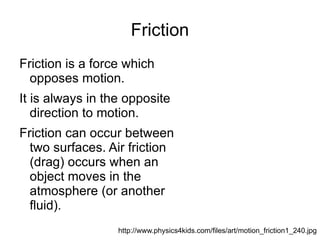
Friction Friction is a force which opposes motion.
It is always in the opposite direction to motion.
Friction can occur between two surfaces. Air friction (drag) occurs when an object moves in the atmosphere (or another fluid). http://www.physics4kids.com/files/art/motion_friction1_240.jpg
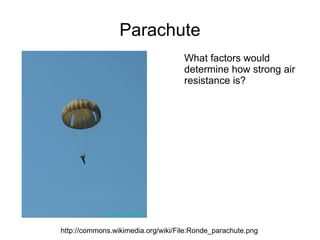
Parachute What factors would determine how strong air resistance is? http://commons.wikimedia.org/wiki/File:Ronde_parachute.png
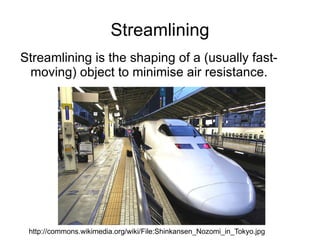
Streamlining Streamlining is the shaping of a (usually fast-moving) object to minimise air resistance. http://commons.wikimedia.org/wiki/File:Shinkansen_Nozomi_in_Tokyo.jpg

Grade 8 Forces Presentation

Editor's Notes

  • #7 8A got to here 23 August