ELECTRICITY AND
MAGNETISM
A JOURNEY TOWARDS THE SMALLEST PART OF MATTER
TOPICS
• Electric fields and magnetic field
• The presence of magnetic field in current carrying wire.
OBJECTIVES:
• Explain the behavior of charges in the electric field.

• State that a magnetic field exists around a current carrying wire.
• Explain how electricity is related to magnetism and the nature of magnetic
field.
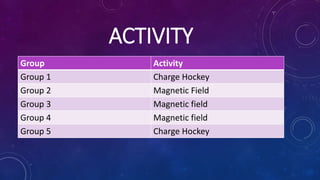
ACTIVITY
Group Activity
Group 1 Charge Hockey
Group 2 Magnetic Field
Group 3 Magnetic field
Group 4 Magnetic field
Group 5 Charge Hockey
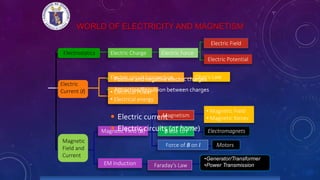
EM Induction
Magnetic Field (B)
Magnetism
B due to I
Force of B on I
Electromagnets
Motors
Faraday’s Law
•Generator/Transformer
•Power Transmission
• Magnetic Field
• Magnetic forces
• Electrical Power
• Electrical energy
Electric circuit/connection Ohm’s Law
Electric Charge Electric Force
Electric Field
Electric Potential
WORLD OF ELECTRICITY AND MAGNETISM
Electric
Current (I)
Electrostatics
Magnetic
Field and
Current
• Positive and negative electric charges
• Attraction/Repulsion between charges
 Electric current
 Electric circuits (at home)
• Involves…
Electric charges
The forces between them
 and their behavior in materials
Electrostatics
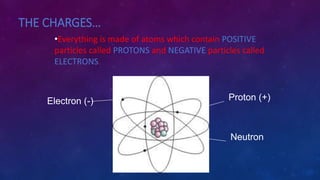
THE CHARGES…
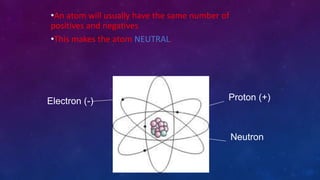
•Everything is made of atoms which contain POSITIVE
particles called PROTONS and NEGATIVE particles called
ELECTRONS.
Proton (+)
Neutron
Electron (-)
•An atom will usually have the same number of
positives and negatives
•This makes the atom NEUTRAL.
Proton (+)
Neutron
Electron (-)
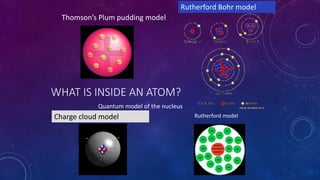
WHAT IS INSIDE AN ATOM?
Thomson’s Plum pudding model
Rutherford model
Rutherford Bohr model
Charge cloud model
Quantum model of the nucleus
ELECTRICAL CHARGE
• Electric charge is given the symbol
q
Electrons are the charge carriers that flow in an
electrical circuit –from the negative to positive
terminals.
ELECTRICAL CHARGE
• Charge is measured in
Coulombs
• which is given the symbol
C
ELECTRICAL CHARGE
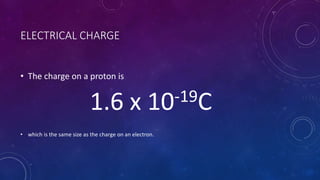
• The charge on a proton is
1.6 x 10⁻¹⁹C
• which is the same size as the charge on an electron.
FUNDAMENTAL
RULE OF THE
BASE OF ALL
ELECTRICAL
PHENOMENA
Like charges repel;
Opposite charges
attract.
Source; Paul Hewitt, (1998). Conceptual physics, CA: Saunders Publishing
CHARGING PROCESS
• Charging by friction and contact
• Charging by induction
• Charge polarization
ELECTRIC FIELDS AND
POTENTIALS
ELECTRIC FIELD
The space around every electric charge is filled with an electric
field-a kind of aura that extends through space.
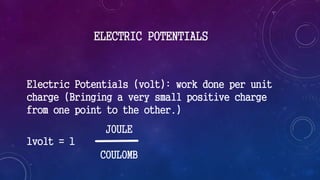
ELECTRIC POTENTIALS
Electric Potentials (volt): work done per unit
charge (Bringing a very small positive charge
from one point to the other.)
1volt = 1
JOULE
COULOMB
POTENTIAL DIFFERENCE OR VOLTAGE (V)
A 9 V battery will give how much energy
to each coulomb of charge passing
through the battery?
9 J
POTENTIAL DIFFERENCE OR VOLTAGE (V)
A 1.5 V battery will give how much energy
to each coulomb of charge passing
through the battery?
1.5 J
POTENTIAL DIFFERENCE OR VOLTAGE (V)
A battery with a p.d. of 6V will give how
much energy to each coulomb of charge
passing through the battery?
6 J
VOLTAGE OR P.D.
Voltage (or p.d.) is measured in
volts
and is given the symbol
V
WHAT IS ELECTRIC
CURRENT?
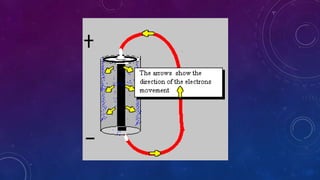
movement of charge round a circuit.
We call this electric current.
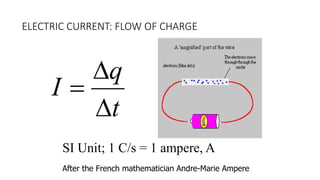
ELECTRIC CURRENT: FLOW OF CHARGE
t
q
I



SI Unit; 1 C/s = 1 ampere, A
After the French mathematician Andre-Marie Ampere
CHARGE, CURRENT & TIME
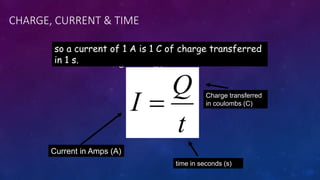
•If current is charge flowing per second then
t
Q
I 
time in seconds (s)
Current in Amps (A)
Charge transferred
in coulombs (C)
so a current of 1 A is 1 C of charge transferred
in 1 s.
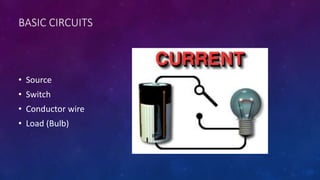
BASIC CIRCUITS
• Source
• Switch
• Conductor wire
• Load (Bulb)
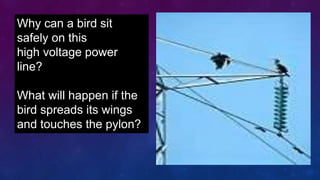
Why can a bird sit
safely on this
high voltage power
line?
What will happen if the
bird spreads its wings
and touches the pylon?
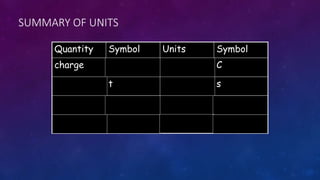
SUMMARY OF UNITS
Quantity Symbol Units Symbol
charge Q coulombs C
time t seconds s
current I amperes A
voltage V volts V
Magnets in Electricity
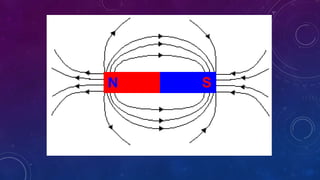
A magnetic field is the region around a
magnet in which a magnetic force can be
detected.
A moving charge (electric
current) produces
magnetic field
Hans Christian Oersted
IT CAME FROM…
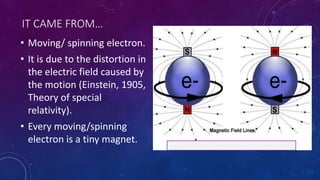
• Moving/ spinning electron.
• It is due to the distortion in
the electric field caused by
the motion (Einstein, 1905,
Theory of special
relativity).
• Every moving/spinning
electron is a tiny magnet.
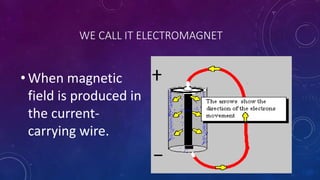
WE CALL IT ELECTROMAGNET
• When magnetic
field is produced in
the current-
carrying wire.
APPLICATIONS ARE…
THANK YOU
I can do all things
through Christ
which strengthen
me.
Philippians 4:13
To God be the Glory
REFERENCES
• Murphy & Smooth, (1998). Physics principles and problems, Toronto, Canada:
Charles E. Merill Publishing Co.
• Eby & Horton, (1986). Physical science, New York: Macmillan Publishing
Company
• Jones & Childers, (1992). Contemporary college physics, 2ndEd, California:
Addison-Wesley Publishing Company
• Paul Hewitt, (1998). Conceptual physics, CA: Saunders Publishing

Electricity and magnetism

  • 1.
    ELECTRICITY AND MAGNETISM A JOURNEYTOWARDS THE SMALLEST PART OF MATTER
  • 2.
    TOPICS • Electric fieldsand magnetic field • The presence of magnetic field in current carrying wire.
  • 3.
    OBJECTIVES: • Explain thebehavior of charges in the electric field. • State that a magnetic field exists around a current carrying wire. • Explain how electricity is related to magnetism and the nature of magnetic field.
  • 4.
    ACTIVITY Group Activity Group 1Charge Hockey Group 2 Magnetic Field Group 3 Magnetic field Group 4 Magnetic field Group 5 Charge Hockey
  • 5.
    EM Induction Magnetic Field(B) Magnetism B due to I Force of B on I Electromagnets Motors Faraday’s Law •Generator/Transformer •Power Transmission • Magnetic Field • Magnetic forces • Electrical Power • Electrical energy Electric circuit/connection Ohm’s Law Electric Charge Electric Force Electric Field Electric Potential WORLD OF ELECTRICITY AND MAGNETISM Electric Current (I) Electrostatics Magnetic Field and Current • Positive and negative electric charges • Attraction/Repulsion between charges  Electric current  Electric circuits (at home)
  • 6.
    • Involves… Electric charges Theforces between them  and their behavior in materials Electrostatics
  • 7.
    THE CHARGES… •Everything ismade of atoms which contain POSITIVE particles called PROTONS and NEGATIVE particles called ELECTRONS. Proton (+) Neutron Electron (-)
  • 8.
    •An atom willusually have the same number of positives and negatives •This makes the atom NEUTRAL. Proton (+) Neutron Electron (-)
  • 9.
    WHAT IS INSIDEAN ATOM? Thomson’s Plum pudding model Rutherford model Rutherford Bohr model Charge cloud model Quantum model of the nucleus
  • 10.
    ELECTRICAL CHARGE • Electriccharge is given the symbol q Electrons are the charge carriers that flow in an electrical circuit –from the negative to positive terminals.
  • 11.
    ELECTRICAL CHARGE • Chargeis measured in Coulombs • which is given the symbol C
  • 12.
    ELECTRICAL CHARGE • Thecharge on a proton is 1.6 x 10⁻¹⁹C • which is the same size as the charge on an electron.
  • 13.
    FUNDAMENTAL RULE OF THE BASEOF ALL ELECTRICAL PHENOMENA Like charges repel; Opposite charges attract. Source; Paul Hewitt, (1998). Conceptual physics, CA: Saunders Publishing
  • 14.
    CHARGING PROCESS • Chargingby friction and contact • Charging by induction • Charge polarization
  • 15.
  • 16.
    ELECTRIC FIELD The spacearound every electric charge is filled with an electric field-a kind of aura that extends through space.
  • 17.
    ELECTRIC POTENTIALS Electric Potentials(volt): work done per unit charge (Bringing a very small positive charge from one point to the other.) 1volt = 1 JOULE COULOMB
  • 18.
    POTENTIAL DIFFERENCE ORVOLTAGE (V) A 9 V battery will give how much energy to each coulomb of charge passing through the battery? 9 J
  • 19.
    POTENTIAL DIFFERENCE ORVOLTAGE (V) A 1.5 V battery will give how much energy to each coulomb of charge passing through the battery? 1.5 J
  • 20.
    POTENTIAL DIFFERENCE ORVOLTAGE (V) A battery with a p.d. of 6V will give how much energy to each coulomb of charge passing through the battery? 6 J
  • 21.
    VOLTAGE OR P.D. Voltage(or p.d.) is measured in volts and is given the symbol V
  • 22.
    WHAT IS ELECTRIC CURRENT? movementof charge round a circuit. We call this electric current.
  • 24.
    ELECTRIC CURRENT: FLOWOF CHARGE t q I    SI Unit; 1 C/s = 1 ampere, A After the French mathematician Andre-Marie Ampere
  • 25.
    CHARGE, CURRENT &TIME •If current is charge flowing per second then t Q I  time in seconds (s) Current in Amps (A) Charge transferred in coulombs (C) so a current of 1 A is 1 C of charge transferred in 1 s.
  • 26.
    BASIC CIRCUITS • Source •Switch • Conductor wire • Load (Bulb)
  • 27.
    Why can abird sit safely on this high voltage power line? What will happen if the bird spreads its wings and touches the pylon?
  • 29.
    SUMMARY OF UNITS QuantitySymbol Units Symbol charge Q coulombs C time t seconds s current I amperes A voltage V volts V
  • 30.
  • 32.
    A magnetic fieldis the region around a magnet in which a magnetic force can be detected.
  • 33.
    A moving charge(electric current) produces magnetic field Hans Christian Oersted
  • 34.
    IT CAME FROM… •Moving/ spinning electron. • It is due to the distortion in the electric field caused by the motion (Einstein, 1905, Theory of special relativity). • Every moving/spinning electron is a tiny magnet.
  • 35.
    WE CALL ITELECTROMAGNET • When magnetic field is produced in the current- carrying wire.
  • 36.
  • 37.
    THANK YOU I cando all things through Christ which strengthen me. Philippians 4:13 To God be the Glory
  • 38.
    REFERENCES • Murphy &Smooth, (1998). Physics principles and problems, Toronto, Canada: Charles E. Merill Publishing Co. • Eby & Horton, (1986). Physical science, New York: Macmillan Publishing Company • Jones & Childers, (1992). Contemporary college physics, 2ndEd, California: Addison-Wesley Publishing Company • Paul Hewitt, (1998). Conceptual physics, CA: Saunders Publishing