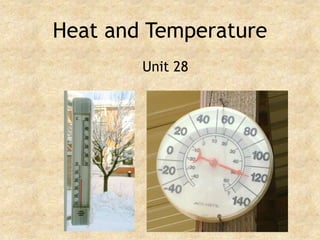
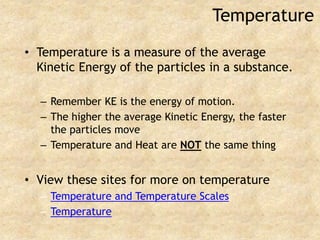
Heat and TemperatureUnit 28
TemperatureTemperature is a measure of the average Kinetic Energy of the particles in a substance.Remember KE is the energy of motion.The higher the average Kinetic Energy, the faster the particles moveTemperature and Heat are NOT the same thingView these sites for more on temperatureTemperature and Temperature ScalesTemperature
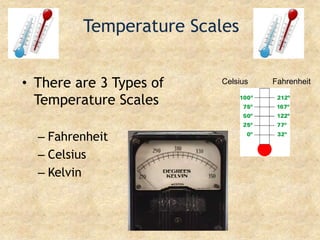
Temperature ScalesThere are 3 Types of Temperature ScalesFahrenheitCelsiusKelvinCelsius           Fahrenheit
Fahrenheit ScaleMost commonly used in United States.  (originated in Great Britain)Non-metric system scaleNot usually used in scienceVisit these “cool” web sitesConverting between oF and oCFahrenheit and Celsius ScalesHistory of Fahrenheit Scale
How Fahrenheit WorksWater freezes at 32°FWater boils at 212°FZero was based on the lowest they could get water to stay liquid at the time 	(with salt in it).100° was based on the highest it was believed humans could survive at the time
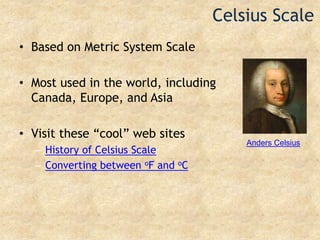
Celsius ScaleBased on Metric System ScaleMost used in the world, including Canada, Europe, and AsiaVisit these “cool” web sitesHistory of Celsius ScaleConverting between oF and oCAnders Celsius
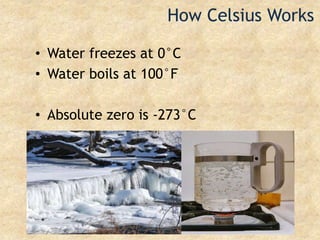
How Celsius WorksWater freezes at 0°CWater boils at 100°FAbsolute zero is -273°C
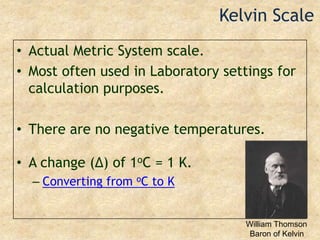
Kelvin ScaleActual Metric System scale.Most often used in Laboratory settings for calculation purposes.There are no negative temperatures.A change (Δ) of 1oC = 1 K.Converting from oC to KWilliam ThomsonBaron of Kelvin
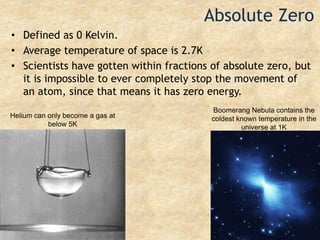
Absolute ZeroDefined as 0 Kelvin.Average temperature of space is 2.7KScientists have gotten within fractions of absolute zero, but it is impossible to ever completely stop the movement of an atom, since that means it has zero energy.Boomerang Nebula contains the coldest known temperature in the universe at 1KHelium can only become a gas at below 5K
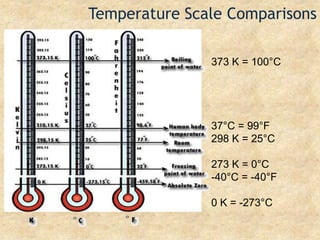
Temperature Scale Comparisons373 K = 100°C37°C = 99°F298 K = 25°C273 K = 0°C-40°C = -40°F0 K = -273°C
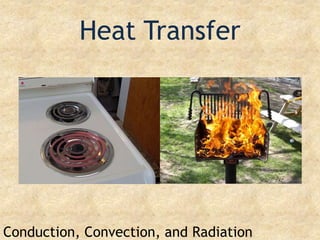
Heat TransferConduction, Convection, and Radiation
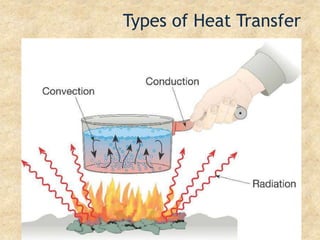
Types of Heat Transfer
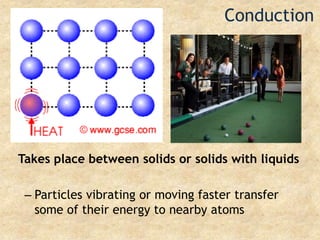
ConductionTakes place between solids or solids with liquidsParticles vibrating or moving faster transfer some of their energy to nearby atoms
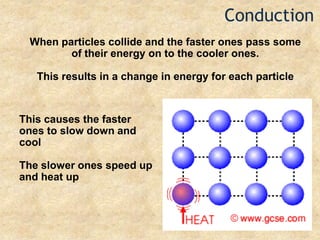
ConductionWhen particles collide and the faster ones pass some of their energy on to the cooler ones.This results in a change in energy for each particleThis causes the faster ones to slow down and cool The slower ones speed up and heat up
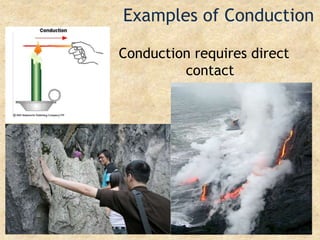
Examples of ConductionConduction requires direct contact
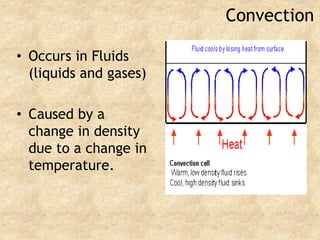
ConvectionOccurs in Fluids (liquids and gases)Caused by a change in density due to a change in temperature.
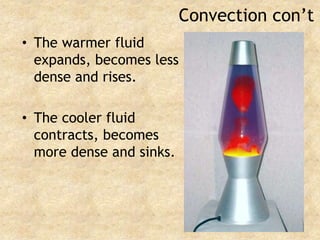
Convection con’tThe warmer fluid expands, becomes less dense and rises.The cooler fluid contracts, becomes more dense and sinks.
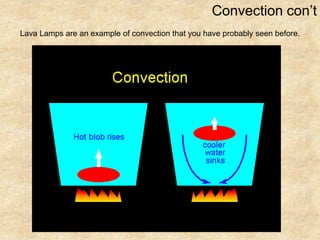
Convection con’tLava Lamps are an example of convection that you have probably seen before.
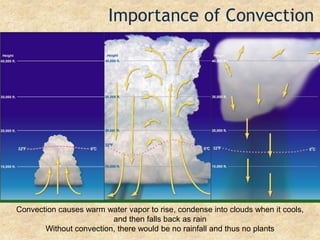
Importance of ConvectionConvection causes warm water vapor to rise, condense into clouds when it cools, and then falls back as rainWithout convection, there would be no rainfall and thus no plants
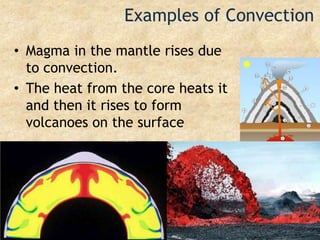
Examples of ConvectionMagma in the mantle rises due to convection.The heat from the core heats it and then it rises to form volcanoes on the surface
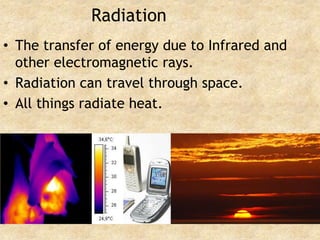
RadiationThe transfer of energy due to Infrared and other electromagnetic rays.Radiation can travel through space.All things radiate heat.
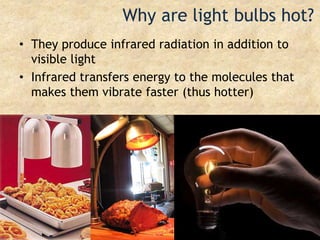
Why are light bulbs hot?They produce infrared radiation in addition to visible lightInfrared transfers energy to the molecules that makes them vibrate faster (thus hotter)
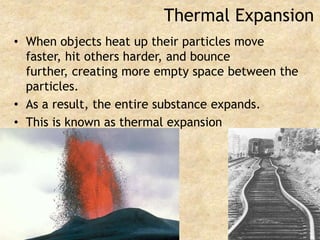
Thermal ExpansionWhen objects heat up their particles move faster, hit others harder, and bounce further, creating more empty space between the particles.As a result, the entire substance expands.This is known as thermal expansion
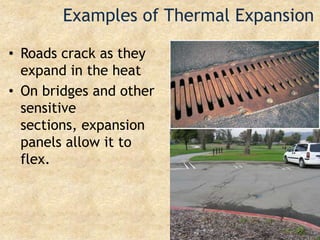
Examples of Thermal ExpansionRoads crack as they expand in the heatOn bridges and other sensitive sections, expansion panels allow it to flex.
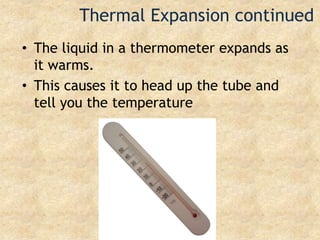
Thermal Expansion continuedThe liquid in a thermometer expands as it warms.This causes it to head up the tube and tell you the temperature
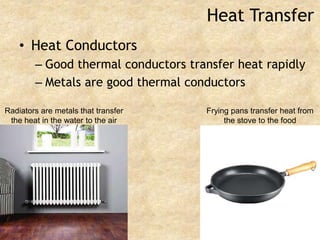
Heat TransferHeat ConductorsGood thermal conductors transfer heat rapidlyMetals are good thermal conductorsRadiators are metals that transfer the heat in the water to the airFrying pans transfer heat from the stove to the food
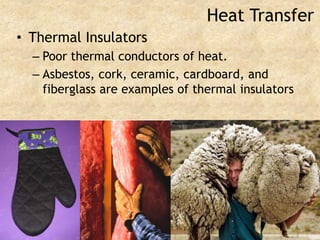
Heat TransferThermal InsulatorsPoor thermal conductors of heat.Asbestos, cork, ceramic, cardboard, and fiberglass are examples of thermal insulators

Unit 28 - Heat And Temperature

  • 1.
  • 2.
    TemperatureTemperature is ameasure of the average Kinetic Energy of the particles in a substance.Remember KE is the energy of motion.The higher the average Kinetic Energy, the faster the particles moveTemperature and Heat are NOT the same thingView these sites for more on temperatureTemperature and Temperature ScalesTemperature
  • 3.
    Temperature ScalesThere are3 Types of Temperature ScalesFahrenheitCelsiusKelvinCelsius Fahrenheit
  • 4.
    Fahrenheit ScaleMost commonlyused in United States. (originated in Great Britain)Non-metric system scaleNot usually used in scienceVisit these “cool” web sitesConverting between oF and oCFahrenheit and Celsius ScalesHistory of Fahrenheit Scale
  • 5.
    How Fahrenheit WorksWaterfreezes at 32°FWater boils at 212°FZero was based on the lowest they could get water to stay liquid at the time (with salt in it).100° was based on the highest it was believed humans could survive at the time
  • 6.
    Celsius ScaleBased onMetric System ScaleMost used in the world, including Canada, Europe, and AsiaVisit these “cool” web sitesHistory of Celsius ScaleConverting between oF and oCAnders Celsius
  • 7.
    How Celsius WorksWaterfreezes at 0°CWater boils at 100°FAbsolute zero is -273°C
  • 8.
    Kelvin ScaleActual MetricSystem scale.Most often used in Laboratory settings for calculation purposes.There are no negative temperatures.A change (Δ) of 1oC = 1 K.Converting from oC to KWilliam ThomsonBaron of Kelvin
  • 9.
    Absolute ZeroDefined as0 Kelvin.Average temperature of space is 2.7KScientists have gotten within fractions of absolute zero, but it is impossible to ever completely stop the movement of an atom, since that means it has zero energy.Boomerang Nebula contains the coldest known temperature in the universe at 1KHelium can only become a gas at below 5K
  • 10.
    Temperature Scale Comparisons373K = 100°C37°C = 99°F298 K = 25°C273 K = 0°C-40°C = -40°F0 K = -273°C
  • 11.
  • 12.
  • 13.
    ConductionTakes place betweensolids or solids with liquidsParticles vibrating or moving faster transfer some of their energy to nearby atoms
  • 14.
    ConductionWhen particles collideand the faster ones pass some of their energy on to the cooler ones.This results in a change in energy for each particleThis causes the faster ones to slow down and cool The slower ones speed up and heat up
  • 15.
    Examples of ConductionConductionrequires direct contact
  • 16.
    ConvectionOccurs in Fluids(liquids and gases)Caused by a change in density due to a change in temperature.
  • 17.
    Convection con’tThe warmerfluid expands, becomes less dense and rises.The cooler fluid contracts, becomes more dense and sinks.
  • 18.
    Convection con’tLava Lampsare an example of convection that you have probably seen before.
  • 19.
    Importance of ConvectionConvectioncauses warm water vapor to rise, condense into clouds when it cools, and then falls back as rainWithout convection, there would be no rainfall and thus no plants
  • 20.
    Examples of ConvectionMagmain the mantle rises due to convection.The heat from the core heats it and then it rises to form volcanoes on the surface
  • 21.
    RadiationThe transfer ofenergy due to Infrared and other electromagnetic rays.Radiation can travel through space.All things radiate heat.
  • 22.
    Why are lightbulbs hot?They produce infrared radiation in addition to visible lightInfrared transfers energy to the molecules that makes them vibrate faster (thus hotter)
  • 23.
    Thermal ExpansionWhen objectsheat up their particles move faster, hit others harder, and bounce further, creating more empty space between the particles.As a result, the entire substance expands.This is known as thermal expansion
  • 24.
    Examples of ThermalExpansionRoads crack as they expand in the heatOn bridges and other sensitive sections, expansion panels allow it to flex.
  • 25.
    Thermal Expansion continuedTheliquid in a thermometer expands as it warms.This causes it to head up the tube and tell you the temperature
  • 26.
    Heat TransferHeat ConductorsGoodthermal conductors transfer heat rapidlyMetals are good thermal conductorsRadiators are metals that transfer the heat in the water to the airFrying pans transfer heat from the stove to the food
  • 27.
    Heat TransferThermal InsulatorsPoorthermal conductors of heat.Asbestos, cork, ceramic, cardboard, and fiberglass are examples of thermal insulators