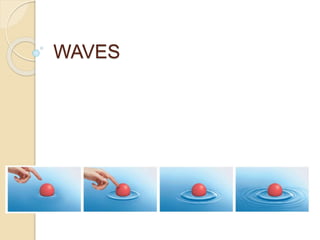
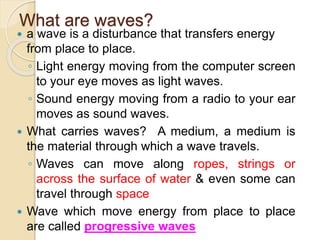
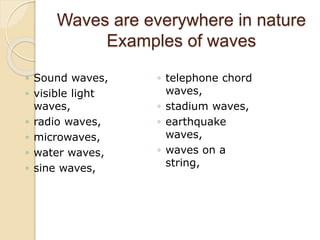
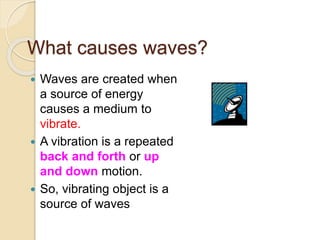
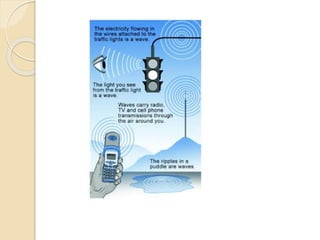
WAVES
What are waves?
 a wave is a disturbance that transfers energy
from place to place.
◦ Light energy moving from the computer screen
to your eye moves as light waves.
◦ Sound energy moving from a radio to your ear
moves as sound waves.
 What carries waves? A medium, a medium is
the material through which a wave travels.
◦ Waves can move along ropes, strings or
across the surface of water & even some can
travel through space
 Wave which move energy from place to place
are called progressive waves
Waves are everywhere in nature
Examples of waves
◦ Sound waves,
◦ visible light
waves,
◦ radio waves,
◦ microwaves,
◦ water waves,
◦ sine waves,
◦ telephone chord
waves,
◦ stadium waves,
◦ earthquake
waves,
◦ waves on a
string,
What causes waves?
 Waves are created when
a source of energy
causes a medium to
vibrate.
 A vibration is a repeated
back and forth or up
and down motion.
 So, vibrating object is a
source of waves
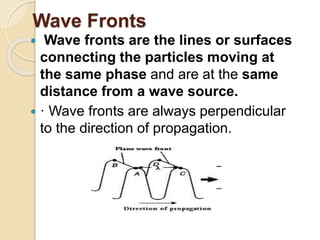
Wave Fronts
 Wave fronts are the lines or surfaces
connecting the particles moving at
the same phase and are at the same
distance from a wave source.
 · Wave fronts are always perpendicular
to the direction of propagation.
TYPES OF WAVES
There are two (2) types of waves: transverse and longitudinal
waves
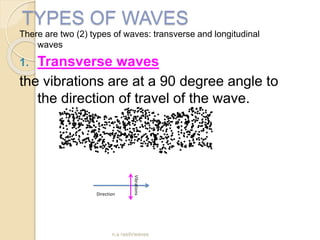
1. Transverse waves
the vibrations are at a 90 degree angle to
the direction of travel of the wave.
n.a rasih/waves
Direction
Vibrations
n.a rasih/waves
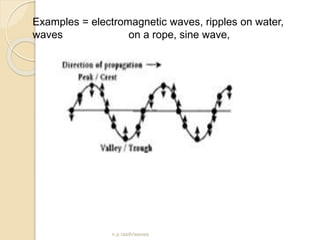
Examples = electromagnetic waves, ripples on water,
waves on a rope, sine wave,
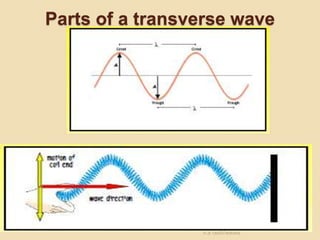
Parts of a transverse wave
n.a rasih/waves
2. Longitudinal waves
n.a rasih/waves
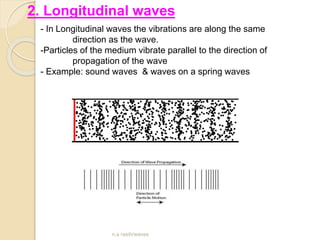
- In Longitudinal waves the vibrations are along the same
direction as the wave.
-Particles of the medium vibrate parallel to the direction of
propagation of the wave
- Example: sound waves & waves on a spring waves
Parts of a longitudinal wave
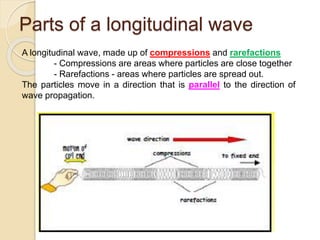
A longitudinal wave, made up of compressions and rarefactions
- Compressions are areas where particles are close together
- Rarefactions - areas where particles are spread out.
The particles move in a direction that is parallel to the direction of
wave propagation.
parts of a transverse waves
Wavelength ()
Amplitude (A)
Frequency (f)
Period (T)
Wavelength
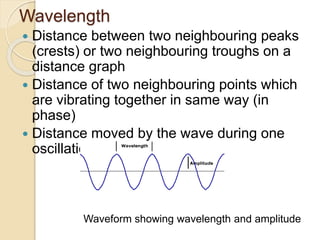
 Distance between two neighbouring peaks
(crests) or two neighbouring troughs on a
distance graph
 Distance of two neighbouring points which
are vibrating together in same way (in
phase)
 Distance moved by the wave during one
oscillation.
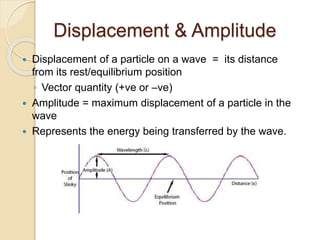
Waveform showing wavelength and amplitude
Displacement & Amplitude
 Displacement of a particle on a wave = its distance
from its rest/equilibrium position
◦ Vector quantity (+ve or –ve)
 Amplitude = maximum displacement of a particle in the
wave
 Represents the energy being transferred by the wave.
Period & Frequency
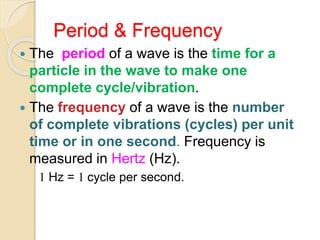
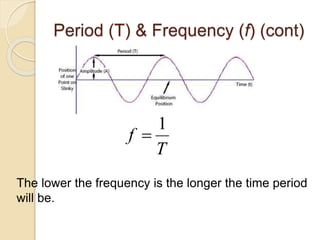
 The period of a wave is the time for a
particle in the wave to make one
complete cycle/vibration.
 The frequency of a wave is the number
of complete vibrations (cycles) per unit
time or in one second. Frequency is
measured in Hertz (Hz).
1 Hz = 1 cycle per second.
Period (T) & Frequency (f) (cont)
T
f
1

The lower the frequency is the longer the time period
will be.
 Wave speed is measured in metres per second (m/s).
What is the formula for wave
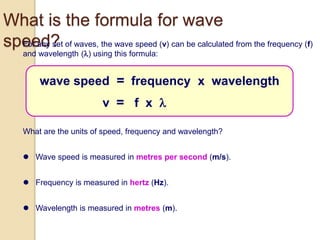
speed?For any set of waves, the wave speed (v) can be calculated from the frequency (f)
and wavelength () using this formula:
What are the units of speed, frequency and wavelength?
 Frequency is measured in hertz (Hz).
 Wavelength is measured in metres (m).
wave speed = frequency x wavelength
v = f x 

x
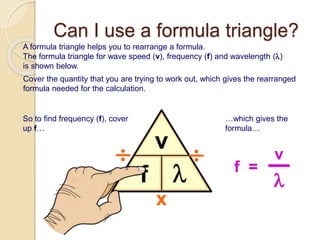
A formula triangle helps you to rearrange a formula.
The formula triangle for wave speed (v), frequency (f) and wavelength ()
is shown below.
Cover the quantity that you are trying to work out, which gives the rearranged
formula needed for the calculation.
So to find frequency (f), cover
up f…
…which gives the
formula…
Can I use a formula triangle?
f =
v

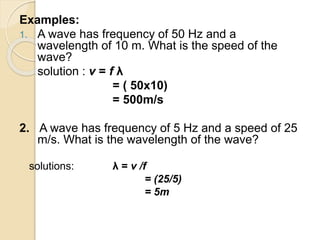
Examples:
1. A wave has frequency of 50 Hz and a
wavelength of 10 m. What is the speed of the
wave?
solution : v = f λ
= ( 50x10)
= 500m/s
2. A wave has frequency of 5 Hz and a speed of 25
m/s. What is the wavelength of the wave?
solutions: λ = v /f
= (25/5)
= 5m
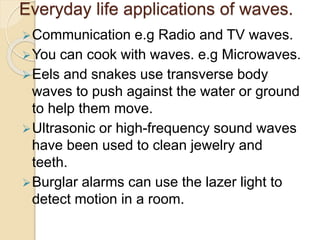
Everyday life applications of waves.
Communication e.g Radio and TV waves.
You can cook with waves. e.g Microwaves.
Eels and snakes use transverse body
waves to push against the water or ground
to help them move.
Ultrasonic or high-frequency sound waves
have been used to clean jewelry and
teeth.
Burglar alarms can use the lazer light to
detect motion in a room.
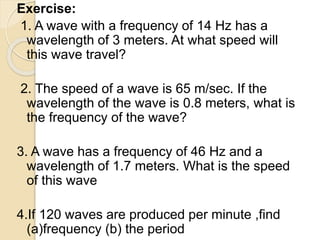
Exercise:
1. A wave with a frequency of 14 Hz has a
wavelength of 3 meters. At what speed will
this wave travel?
2. The speed of a wave is 65 m/sec. If the
wavelength of the wave is 0.8 meters, what is
the frequency of the wave?
3. A wave has a frequency of 46 Hz and a
wavelength of 1.7 meters. What is the speed
of this wave
4.If 120 waves are produced per minute ,find
(a)frequency (b) the period
1. A wave has a wavelength of 15 cm and has a
frequency of 10 waves/second. What is the
speed of the wave?
2.The speed of a wave on a rope is 50cm/s and
it’s wavelength is 10cm. What is it’s
frequency?
3.A wave is traveling with a velocity of 125m/s
and has a frequency of 20 waves/second.
What is the length of the wave?
Homework Questions
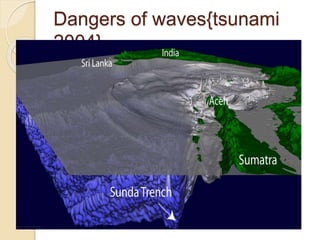
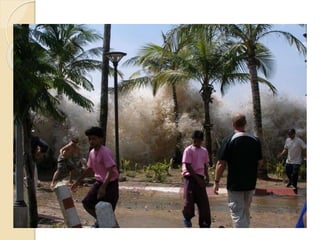
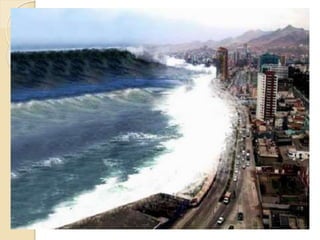
Dangers of waves{tsunami
2004}
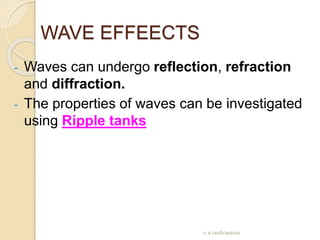
WAVE EFFEECTS
- Waves can undergo reflection, refraction
and diffraction.
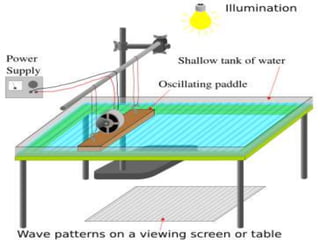
- The properties of waves can be investigated
using Ripple tanks
n.a rasih/waves
n.a rasih/waves
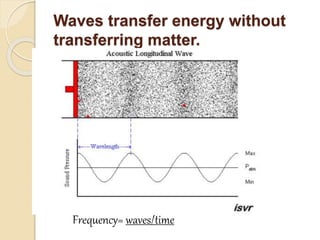
Waves transfer energy without
transferring matter.
Frequency= waves/time
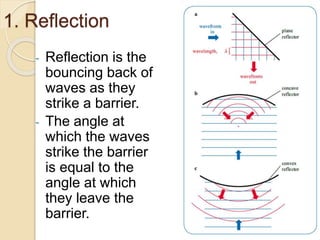
1. Reflection
- Reflection is the
bouncing back of
waves as they
strike a barrier.
- The angle at
which the waves
strike the barrier
is equal to the
angle at which
they leave the
barrier.
n.a rasih/waves
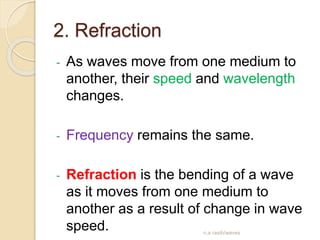
2. Refraction
- As waves move from one medium to
another, their speed and wavelength
changes.
- Frequency remains the same.
- Refraction is the bending of a wave
as it moves from one medium to
another as a result of change in wave
speed. n.a rasih/waves
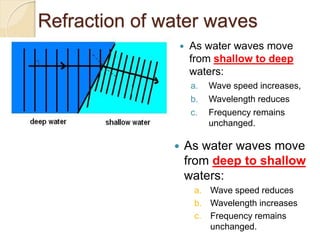
Refraction of water waves
 As water waves move
from shallow to deep
waters:
a. Wave speed increases,
b. Wavelength reduces
c. Frequency remains
unchanged.
 As water waves move
from deep to shallow
waters:
a. Wave speed reduces
b. Wavelength increases
c. Frequency remains
unchanged.
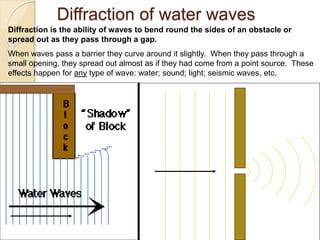
Diffraction of water waves
Diffraction is the ability of waves to bend round the sides of an obstacle or
spread out as they pass through a gap.
When waves pass a barrier they curve around it slightly. When they pass through a
small opening, they spread out almost as if they had come from a point source. These
effects happen for any type of wave: water; sound; light; seismic waves, etc.
3.1 form 4 general wave properties

3.1 form 4 general wave properties

  • 1.
  • 2.
    What are waves? a wave is a disturbance that transfers energy from place to place. ◦ Light energy moving from the computer screen to your eye moves as light waves. ◦ Sound energy moving from a radio to your ear moves as sound waves.  What carries waves? A medium, a medium is the material through which a wave travels. ◦ Waves can move along ropes, strings or across the surface of water & even some can travel through space  Wave which move energy from place to place are called progressive waves
  • 3.
    Waves are everywherein nature Examples of waves ◦ Sound waves, ◦ visible light waves, ◦ radio waves, ◦ microwaves, ◦ water waves, ◦ sine waves, ◦ telephone chord waves, ◦ stadium waves, ◦ earthquake waves, ◦ waves on a string,
  • 4.
    What causes waves? Waves are created when a source of energy causes a medium to vibrate.  A vibration is a repeated back and forth or up and down motion.  So, vibrating object is a source of waves
  • 5.
    Wave Fronts  Wavefronts are the lines or surfaces connecting the particles moving at the same phase and are at the same distance from a wave source.  · Wave fronts are always perpendicular to the direction of propagation.
  • 6.
    TYPES OF WAVES Thereare two (2) types of waves: transverse and longitudinal waves 1. Transverse waves the vibrations are at a 90 degree angle to the direction of travel of the wave. n.a rasih/waves Direction Vibrations
  • 7.
    n.a rasih/waves Examples =electromagnetic waves, ripples on water, waves on a rope, sine wave,
  • 8.
    Parts of atransverse wave n.a rasih/waves
  • 9.
    2. Longitudinal waves n.arasih/waves - In Longitudinal waves the vibrations are along the same direction as the wave. -Particles of the medium vibrate parallel to the direction of propagation of the wave - Example: sound waves & waves on a spring waves
  • 10.
    Parts of alongitudinal wave A longitudinal wave, made up of compressions and rarefactions - Compressions are areas where particles are close together - Rarefactions - areas where particles are spread out. The particles move in a direction that is parallel to the direction of wave propagation.
  • 11.
    parts of atransverse waves Wavelength () Amplitude (A) Frequency (f) Period (T)
  • 12.
    Wavelength  Distance betweentwo neighbouring peaks (crests) or two neighbouring troughs on a distance graph  Distance of two neighbouring points which are vibrating together in same way (in phase)  Distance moved by the wave during one oscillation. Waveform showing wavelength and amplitude
  • 13.
    Displacement & Amplitude Displacement of a particle on a wave = its distance from its rest/equilibrium position ◦ Vector quantity (+ve or –ve)  Amplitude = maximum displacement of a particle in the wave  Represents the energy being transferred by the wave.
  • 14.
    Period & Frequency The period of a wave is the time for a particle in the wave to make one complete cycle/vibration.  The frequency of a wave is the number of complete vibrations (cycles) per unit time or in one second. Frequency is measured in Hertz (Hz). 1 Hz = 1 cycle per second.
  • 15.
    Period (T) &Frequency (f) (cont) T f 1  The lower the frequency is the longer the time period will be.
  • 16.
     Wave speedis measured in metres per second (m/s). What is the formula for wave speed?For any set of waves, the wave speed (v) can be calculated from the frequency (f) and wavelength () using this formula: What are the units of speed, frequency and wavelength?  Frequency is measured in hertz (Hz).  Wavelength is measured in metres (m). wave speed = frequency x wavelength v = f x 
  • 17.
     x A formula trianglehelps you to rearrange a formula. The formula triangle for wave speed (v), frequency (f) and wavelength () is shown below. Cover the quantity that you are trying to work out, which gives the rearranged formula needed for the calculation. So to find frequency (f), cover up f… …which gives the formula… Can I use a formula triangle? f = v 
  • 18.
    Examples: 1. A wavehas frequency of 50 Hz and a wavelength of 10 m. What is the speed of the wave? solution : v = f λ = ( 50x10) = 500m/s 2. A wave has frequency of 5 Hz and a speed of 25 m/s. What is the wavelength of the wave? solutions: λ = v /f = (25/5) = 5m
  • 19.
    Everyday life applicationsof waves. Communication e.g Radio and TV waves. You can cook with waves. e.g Microwaves. Eels and snakes use transverse body waves to push against the water or ground to help them move. Ultrasonic or high-frequency sound waves have been used to clean jewelry and teeth. Burglar alarms can use the lazer light to detect motion in a room.
  • 20.
    Exercise: 1. A wavewith a frequency of 14 Hz has a wavelength of 3 meters. At what speed will this wave travel? 2. The speed of a wave is 65 m/sec. If the wavelength of the wave is 0.8 meters, what is the frequency of the wave? 3. A wave has a frequency of 46 Hz and a wavelength of 1.7 meters. What is the speed of this wave 4.If 120 waves are produced per minute ,find (a)frequency (b) the period
  • 21.
    1. A wavehas a wavelength of 15 cm and has a frequency of 10 waves/second. What is the speed of the wave? 2.The speed of a wave on a rope is 50cm/s and it’s wavelength is 10cm. What is it’s frequency? 3.A wave is traveling with a velocity of 125m/s and has a frequency of 20 waves/second. What is the length of the wave? Homework Questions
  • 22.
  • 25.
    WAVE EFFEECTS - Wavescan undergo reflection, refraction and diffraction. - The properties of waves can be investigated using Ripple tanks n.a rasih/waves
  • 26.
  • 27.
    Waves transfer energywithout transferring matter. Frequency= waves/time
  • 28.
    1. Reflection - Reflectionis the bouncing back of waves as they strike a barrier. - The angle at which the waves strike the barrier is equal to the angle at which they leave the barrier. n.a rasih/waves
  • 29.
    2. Refraction - Aswaves move from one medium to another, their speed and wavelength changes. - Frequency remains the same. - Refraction is the bending of a wave as it moves from one medium to another as a result of change in wave speed. n.a rasih/waves
  • 30.
    Refraction of waterwaves  As water waves move from shallow to deep waters: a. Wave speed increases, b. Wavelength reduces c. Frequency remains unchanged.  As water waves move from deep to shallow waters: a. Wave speed reduces b. Wavelength increases c. Frequency remains unchanged.
  • 31.
    Diffraction of waterwaves Diffraction is the ability of waves to bend round the sides of an obstacle or spread out as they pass through a gap. When waves pass a barrier they curve around it slightly. When they pass through a small opening, they spread out almost as if they had come from a point source. These effects happen for any type of wave: water; sound; light; seismic waves, etc.

Editor's Notes

  • #17 Boardworks GCSE Science: Physics Wave Properties
  • #18 Boardworks GCSE Science: Physics Wave Properties