MODULE 5:
SOUNDS
WHAT IS A SOUND?
2
1
Let’s do an
Activity!
3
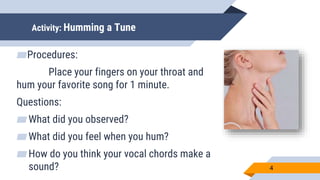
Activity: Humming a Tune
▰Procedures:
Place your fingers on your throat and
hum your favorite song for 1 minute.
Questions:
▰What did you observed?
▰What did you feel when you hum?
▰How do you think your vocal chords make a
sound? 4
“Sound is produced when
matter vibrates. These
vibrations travel outwards
from the source.
55
Sound consists of waves and
these waves travel as a
longitudinal wave.
LONGITUDINAL WAVE
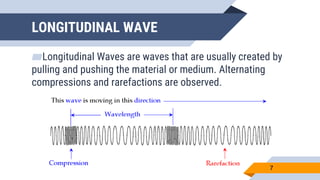
▰Longitudinal Waves are waves that are usually created by
pulling and pushing the material or medium. Alternating
compressions and rarefactions are observed.
7
LONGITUDINAL WAVE
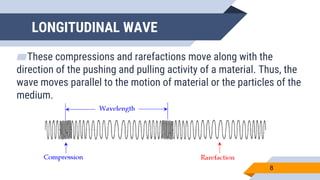
▰These compressions and rarefactions move along with the
direction of the pushing and pulling activity of a material. Thus, the
wave moves parallel to the motion of material or the particles of the
medium.
8
LONGITUDINAL WAVE
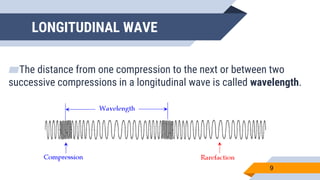
▰The distance from one compression to the next or between two
successive compressions in a longitudinal wave is called wavelength.
9
LONGITUDINAL WAVE
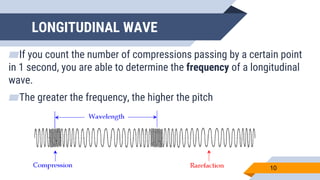
▰If you count the number of compressions passing by a certain point
in 1 second, you are able to determine the frequency of a longitudinal
wave.
▰The greater the frequency, the higher the pitch
10
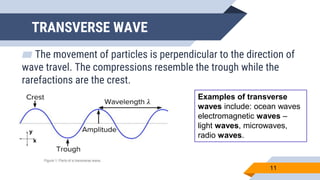
TRANSVERSE WAVE
▰ The movement of particles is perpendicular to the direction of
wave travel. The compressions resemble the trough while the
rarefactions are the crest.
11
Examples of transverse
waves include: ocean waves
electromagnetic waves –
light waves, microwaves,
radio waves.
Can sound waves travel
in solid, liquid or gas?
12
YES!
13
SOUND WAVES can
travel through solids,
liquids and gases but not
through a vacuum.
14
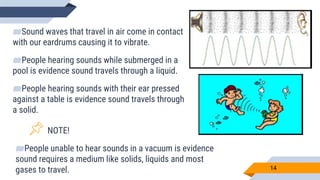
▰Sound waves that travel in air come in contact
with our eardrums causing it to vibrate.
▰People hearing sounds while submerged in a
pool is evidence sound travels through a liquid.
▰People hearing sounds with their ear pressed
against a table is evidence sound travels through
a solid.
NOTE!
▰People unable to hear sounds in a vacuum is evidence
sound requires a medium like solids, liquids and most
gases to travel.
Where does the sound
travel fastest: solid,
liquid or gas?
15
16
17
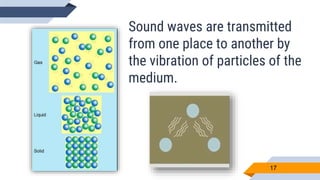
Sound waves are transmitted
from one place to another by
the vibration of particles of the
medium.
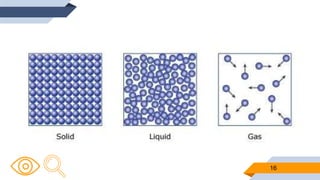
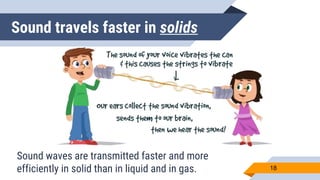
Sound travels faster in solids
Sound waves are transmitted faster and more
efficiently in solid than in liquid and in gas. 18
Faster sound…
In hotter or
cooler?
19
20
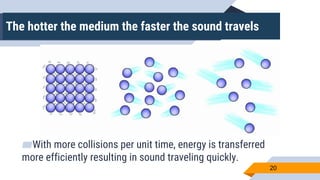
The hotter the medium the faster the sound travels
▰With more collisions per unit time, energy is transferred
more efficiently resulting in sound traveling quickly.
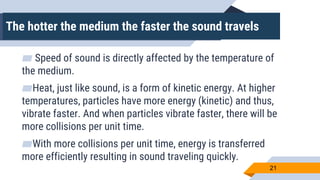
The hotter the medium the faster the sound travels
▰ Speed of sound is directly affected by the temperature of
the medium.
▰Heat, just like sound, is a form of kinetic energy. At higher
temperatures, particles have more energy (kinetic) and thus,
vibrate faster. And when particles vibrate faster, there will be
more collisions per unit time.
▰With more collisions per unit time, energy is transferred
more efficiently resulting in sound traveling quickly.
21
22
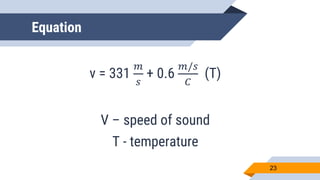
▰Sound travels at about 331
𝑚
𝑠
in dry air at 0˚ C. The speed of sound
is dependent on temperature of the medium where an increase is
observed with an increase in temperature.
▰T is the temperature of air in Celsius degree and 0.6
𝑚/𝑠
𝐶
is a
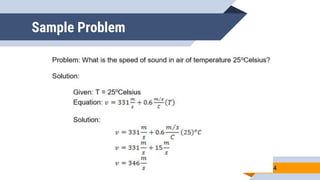
constant factor of temperature. Let’s try it out at a room temperature
of 25˚Celsius.
Equation
v = 331
𝑚
𝑠
+ 0.6
𝑚/𝑠
𝐶
(T)
V – speed of sound
T - temperature
23
Sample Problem
24
Sample Problem
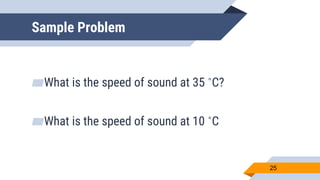
▰What is the speed of sound at 35 ˚C?
▰What is the speed of sound at 10 ˚C
25
Solutions and Answer
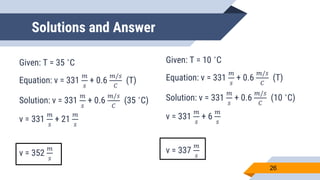
Given: T = 35 ˚C
Equation: v = 331
𝑚
𝑠
+ 0.6
𝑚/𝑠
𝐶
(T)
Solution: v = 331
𝑚
𝑠
+ 0.6
𝑚/𝑠
𝐶
(35 ˚C)
v = 331
𝑚
𝑠
+ 21
𝑚
𝑠
v = 352
𝑚
𝑠
26
Given: T = 10 ˚C
Equation: v = 331
𝑚
𝑠
+ 0.6
𝑚/𝑠
𝐶
(T)
Solution: v = 331
𝑚
𝑠
+ 0.6
𝑚/𝑠
𝐶
(10 ˚C)
v = 331
𝑚
𝑠
+ 6
𝑚
𝑠
v = 337
𝑚
𝑠
Properties of
Sound
REFLECTION
OF SOUND 27
REFLECTION
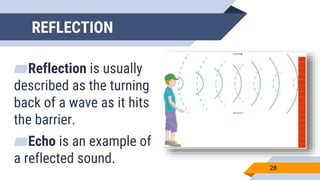
▰Reflection is usually
described as the turning
back of a wave as it hits
the barrier.
▰Echo is an example of
a reflected sound.
28
REVERBERATION
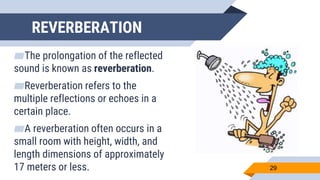
▰The prolongation of the reflected
sound is known as reverberation.
▰Reverberation refers to the
multiple reflections or echoes in a
certain place.
▰A reverberation often occurs in a
small room with height, width, and
length dimensions of approximately
17 meters or less. 29
ECHO SOUNDING
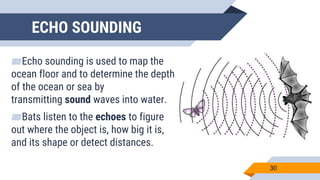
▰Echo sounding is used to map the
ocean floor and to determine the depth
of the ocean or sea by
transmitting sound waves into water.
▰Bats listen to the echoes to figure
out where the object is, how big it is,
and its shape or detect distances.
30
Properties of
Sound
REFRACTION
OF SOUND 31
REFRACTION
▰Refraction is described as the change in speed
of sound when it encounters a medium of
different density.
▰This change in speed of sound during
refraction is also manifested as sort of
”bending” of sound waves.
32
33
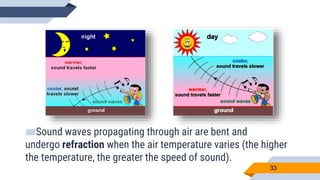
▰Sound waves propagating through air are bent and
undergo refraction when the air temperature varies (the higher
the temperature, the greater the speed of sound).
END OF LESSON

Grade 8 - Module 5: Sounds

  • 1.
  • 2.
    WHAT IS ASOUND? 2 1
  • 3.
  • 4.
    Activity: Humming aTune ▰Procedures: Place your fingers on your throat and hum your favorite song for 1 minute. Questions: ▰What did you observed? ▰What did you feel when you hum? ▰How do you think your vocal chords make a sound? 4
  • 5.
    “Sound is producedwhen matter vibrates. These vibrations travel outwards from the source. 55
  • 6.
    Sound consists ofwaves and these waves travel as a longitudinal wave.
  • 7.
    LONGITUDINAL WAVE ▰Longitudinal Wavesare waves that are usually created by pulling and pushing the material or medium. Alternating compressions and rarefactions are observed. 7
  • 8.
    LONGITUDINAL WAVE ▰These compressionsand rarefactions move along with the direction of the pushing and pulling activity of a material. Thus, the wave moves parallel to the motion of material or the particles of the medium. 8
  • 9.
    LONGITUDINAL WAVE ▰The distancefrom one compression to the next or between two successive compressions in a longitudinal wave is called wavelength. 9
  • 10.
    LONGITUDINAL WAVE ▰If youcount the number of compressions passing by a certain point in 1 second, you are able to determine the frequency of a longitudinal wave. ▰The greater the frequency, the higher the pitch 10
  • 11.
    TRANSVERSE WAVE ▰ Themovement of particles is perpendicular to the direction of wave travel. The compressions resemble the trough while the rarefactions are the crest. 11 Examples of transverse waves include: ocean waves electromagnetic waves – light waves, microwaves, radio waves.
  • 12.
    Can sound wavestravel in solid, liquid or gas? 12
  • 13.
    YES! 13 SOUND WAVES can travelthrough solids, liquids and gases but not through a vacuum.
  • 14.
    14 ▰Sound waves thattravel in air come in contact with our eardrums causing it to vibrate. ▰People hearing sounds while submerged in a pool is evidence sound travels through a liquid. ▰People hearing sounds with their ear pressed against a table is evidence sound travels through a solid. NOTE! ▰People unable to hear sounds in a vacuum is evidence sound requires a medium like solids, liquids and most gases to travel.
  • 15.
    Where does thesound travel fastest: solid, liquid or gas? 15
  • 16.
  • 17.
    17 Sound waves aretransmitted from one place to another by the vibration of particles of the medium.
  • 18.
    Sound travels fasterin solids Sound waves are transmitted faster and more efficiently in solid than in liquid and in gas. 18
  • 19.
  • 20.
    20 The hotter themedium the faster the sound travels ▰With more collisions per unit time, energy is transferred more efficiently resulting in sound traveling quickly.
  • 21.
    The hotter themedium the faster the sound travels ▰ Speed of sound is directly affected by the temperature of the medium. ▰Heat, just like sound, is a form of kinetic energy. At higher temperatures, particles have more energy (kinetic) and thus, vibrate faster. And when particles vibrate faster, there will be more collisions per unit time. ▰With more collisions per unit time, energy is transferred more efficiently resulting in sound traveling quickly. 21
  • 22.
    22 ▰Sound travels atabout 331 𝑚 𝑠 in dry air at 0˚ C. The speed of sound is dependent on temperature of the medium where an increase is observed with an increase in temperature. ▰T is the temperature of air in Celsius degree and 0.6 𝑚/𝑠 𝐶 is a constant factor of temperature. Let’s try it out at a room temperature of 25˚Celsius.
  • 23.
    Equation v = 331 𝑚 𝑠 +0.6 𝑚/𝑠 𝐶 (T) V – speed of sound T - temperature 23
  • 24.
  • 25.
    Sample Problem ▰What isthe speed of sound at 35 ˚C? ▰What is the speed of sound at 10 ˚C 25
  • 26.
    Solutions and Answer Given:T = 35 ˚C Equation: v = 331 𝑚 𝑠 + 0.6 𝑚/𝑠 𝐶 (T) Solution: v = 331 𝑚 𝑠 + 0.6 𝑚/𝑠 𝐶 (35 ˚C) v = 331 𝑚 𝑠 + 21 𝑚 𝑠 v = 352 𝑚 𝑠 26 Given: T = 10 ˚C Equation: v = 331 𝑚 𝑠 + 0.6 𝑚/𝑠 𝐶 (T) Solution: v = 331 𝑚 𝑠 + 0.6 𝑚/𝑠 𝐶 (10 ˚C) v = 331 𝑚 𝑠 + 6 𝑚 𝑠 v = 337 𝑚 𝑠
  • 27.
  • 28.
    REFLECTION ▰Reflection is usually describedas the turning back of a wave as it hits the barrier. ▰Echo is an example of a reflected sound. 28
  • 29.
    REVERBERATION ▰The prolongation ofthe reflected sound is known as reverberation. ▰Reverberation refers to the multiple reflections or echoes in a certain place. ▰A reverberation often occurs in a small room with height, width, and length dimensions of approximately 17 meters or less. 29
  • 30.
    ECHO SOUNDING ▰Echo soundingis used to map the ocean floor and to determine the depth of the ocean or sea by transmitting sound waves into water. ▰Bats listen to the echoes to figure out where the object is, how big it is, and its shape or detect distances. 30
  • 31.
  • 32.
    REFRACTION ▰Refraction is describedas the change in speed of sound when it encounters a medium of different density. ▰This change in speed of sound during refraction is also manifested as sort of ”bending” of sound waves. 32
  • 33.
    33 ▰Sound waves propagatingthrough air are bent and undergo refraction when the air temperature varies (the higher the temperature, the greater the speed of sound).
  • 34.