Waves
Definition, Behavior,
and Classification
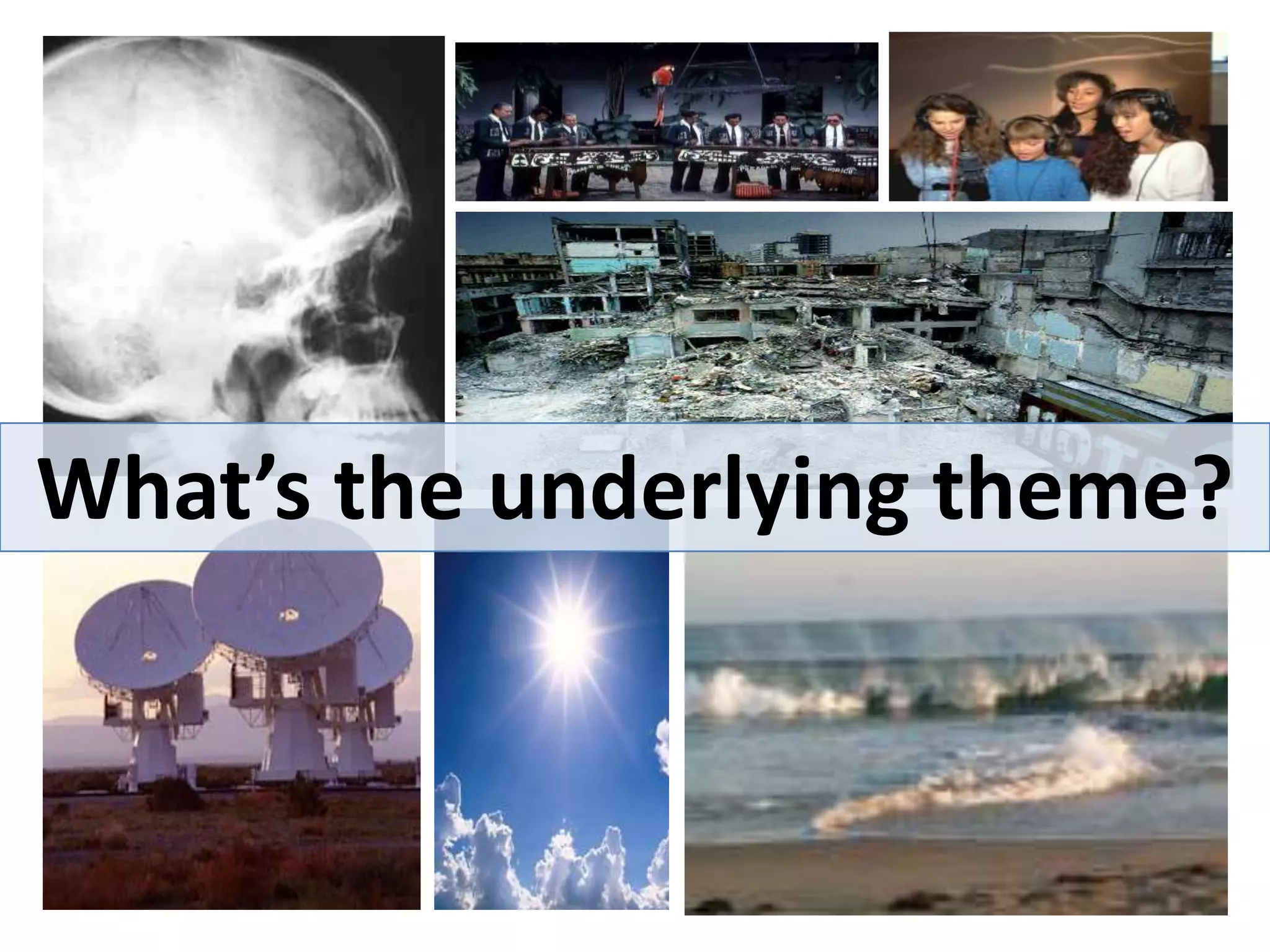
What’s the underlying theme?
What is a wave?
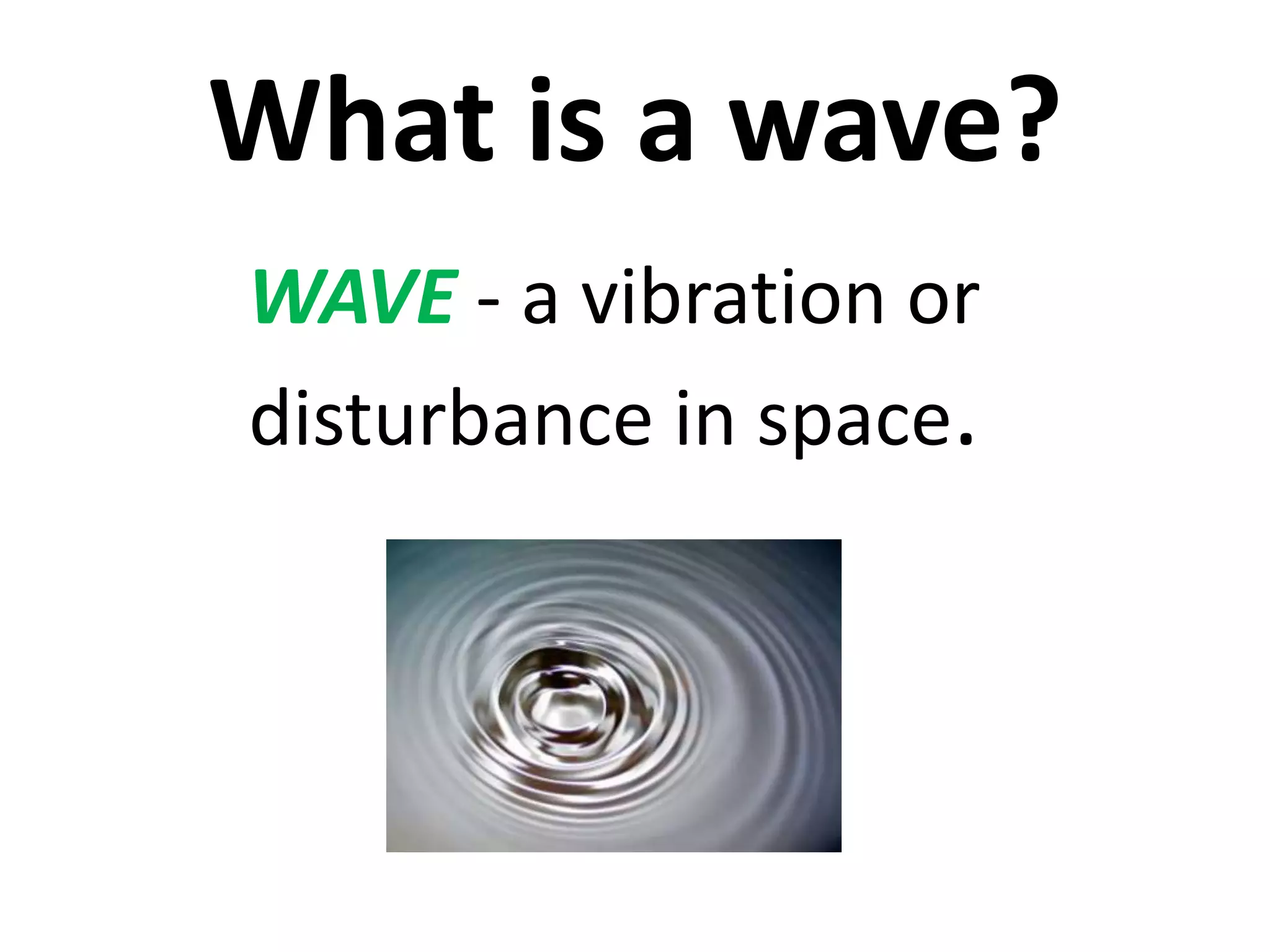
WAVE - a vibration or
disturbance in space.
What is a wave?
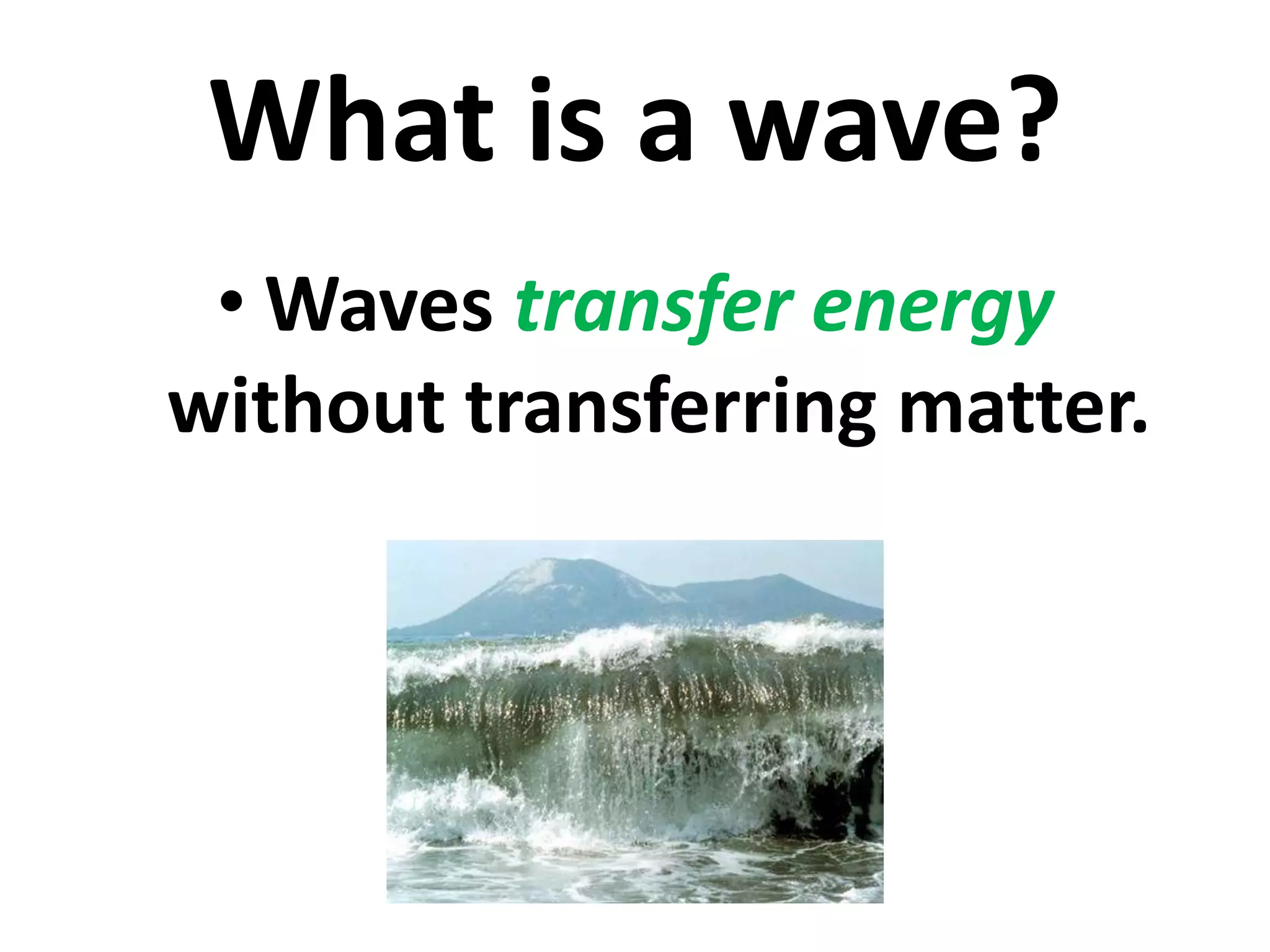
• Waves transfer energy
without transferring matter.
How are waves classified?
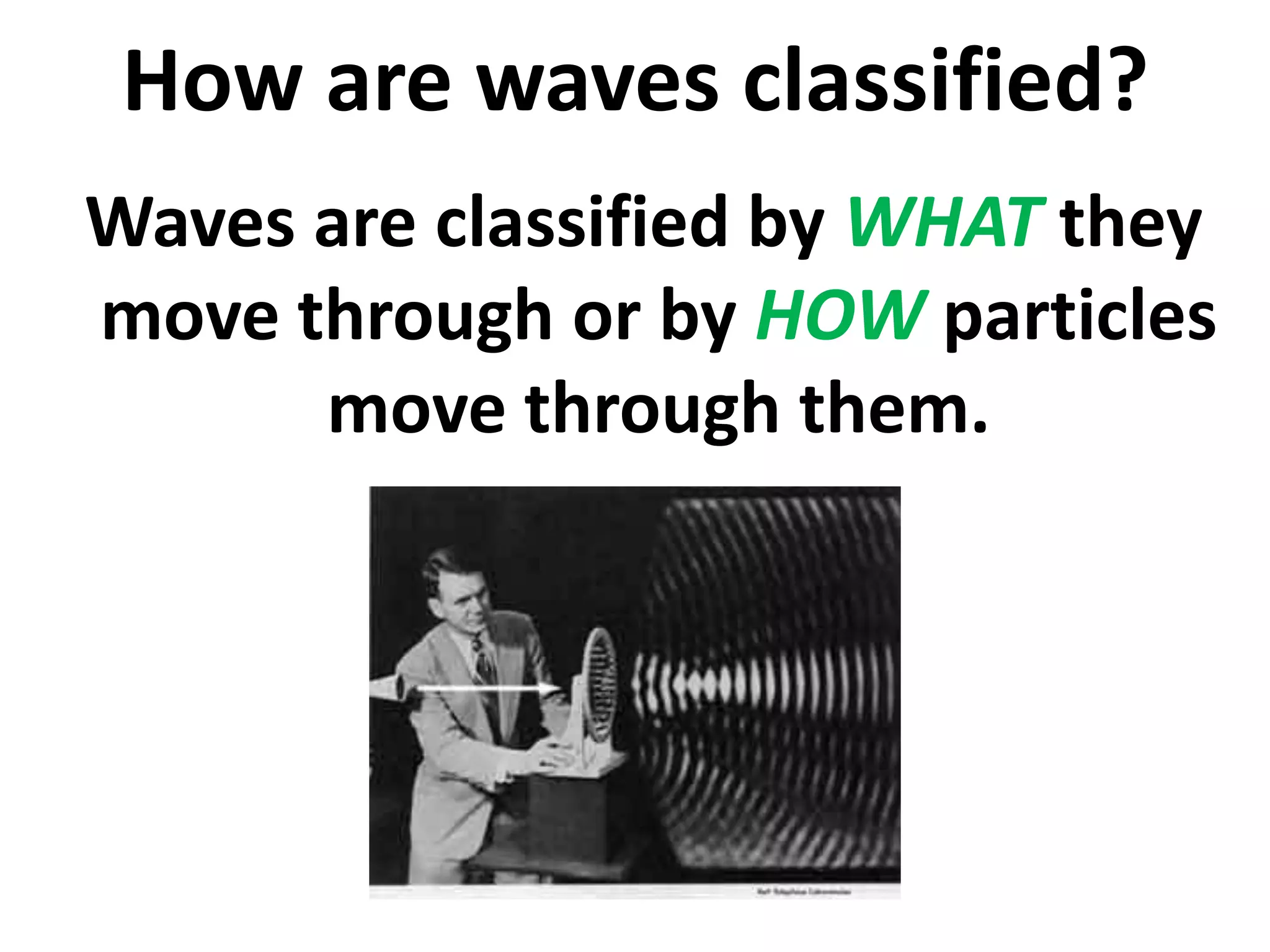
Waves are classified by WHAT they
move through or by HOW particles
move through them.
What material do waves move through?
MEDIUM- the substance that waves
travel through and need to have in
order to move.
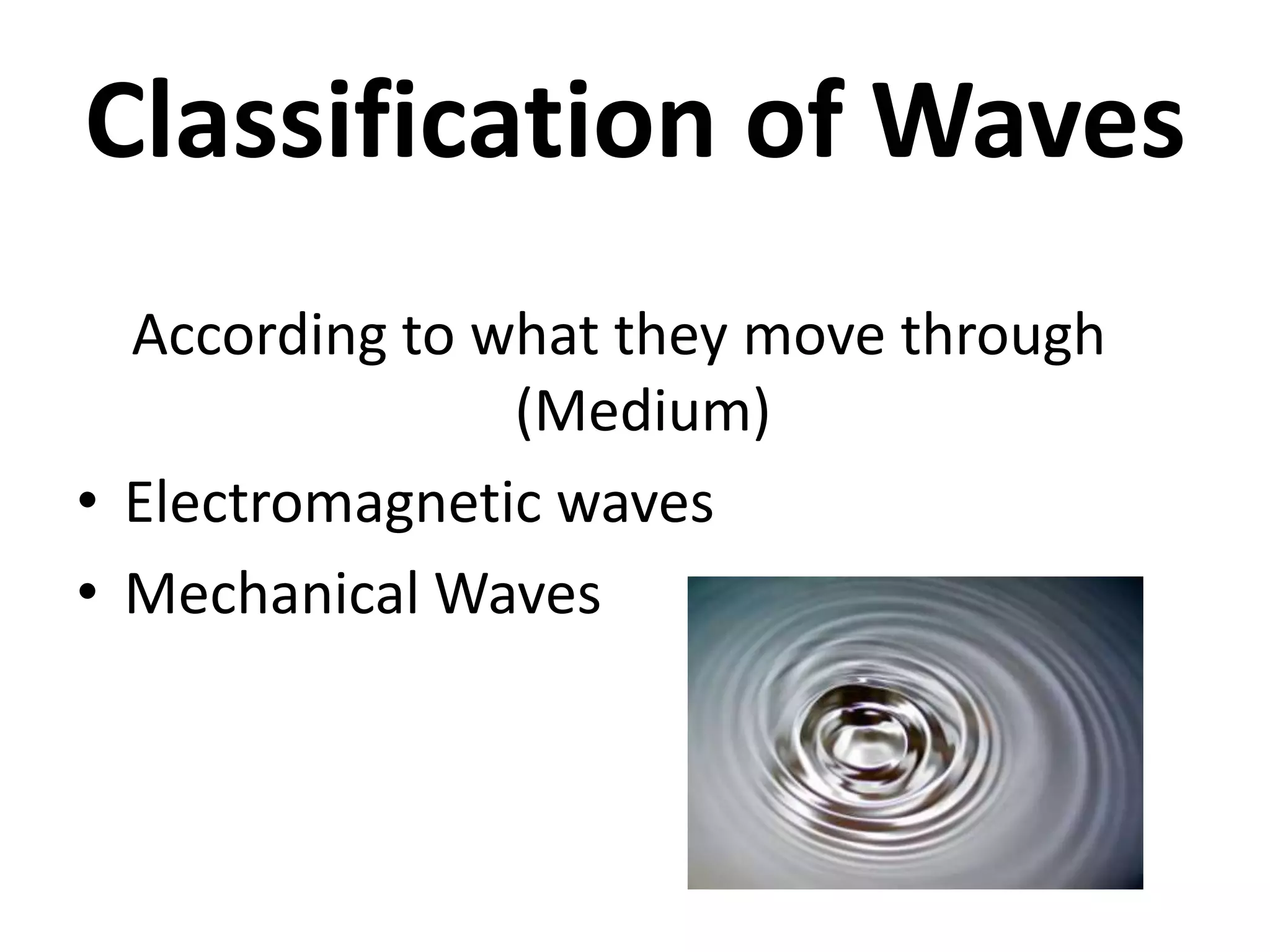
Classification of Waves
According to what they move through
(Medium)
• Electromagnetic waves
• Mechanical Waves
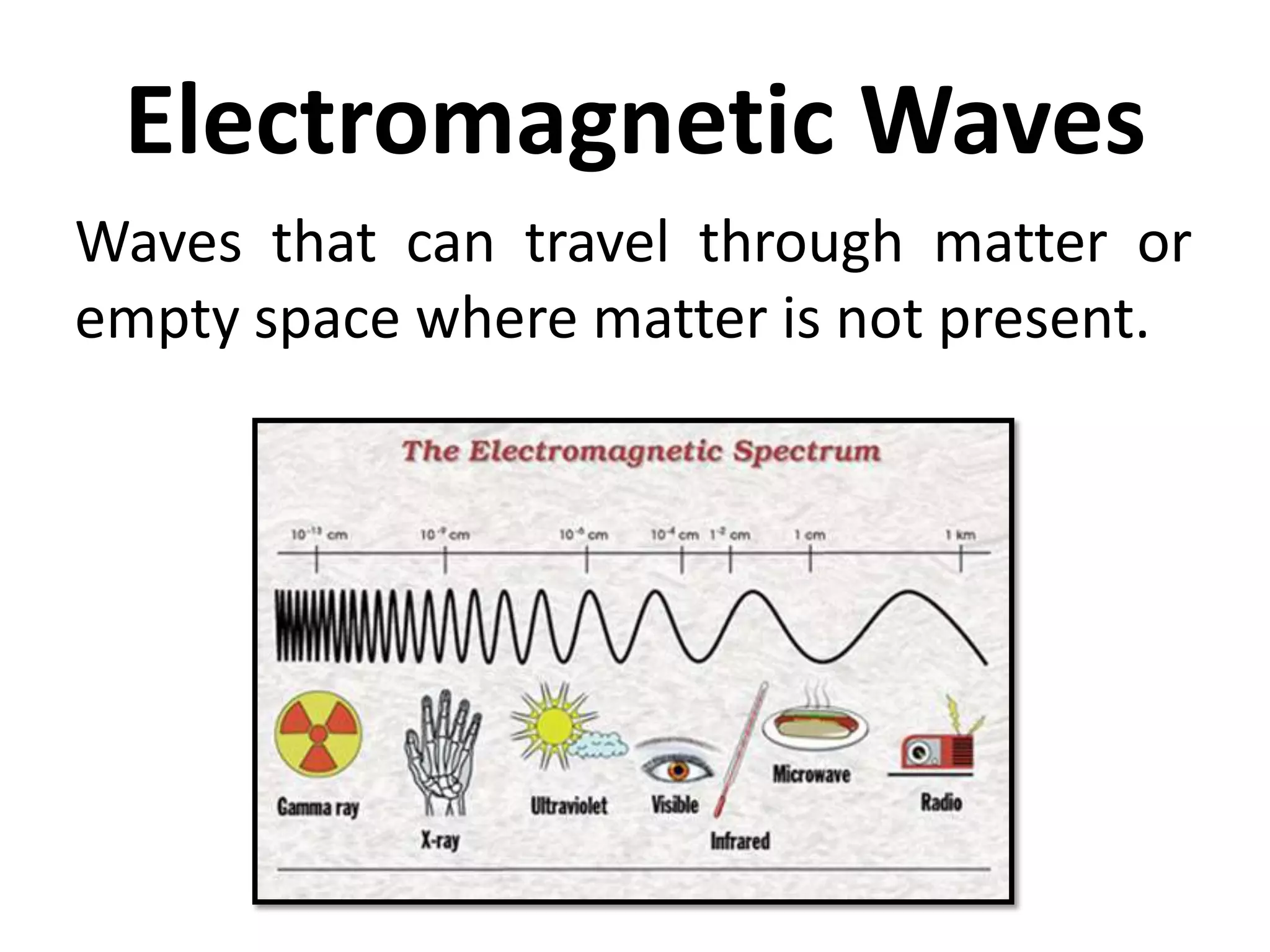
Electromagnetic Waves
Waves that can travel through matter or
empty space where matter is not present.
• radio waves
• microwaves
• infrared waves
• visible light
• ultraviolet rays
• X-rays
Types of Electromagnetic
Waves
Mechanical Waves
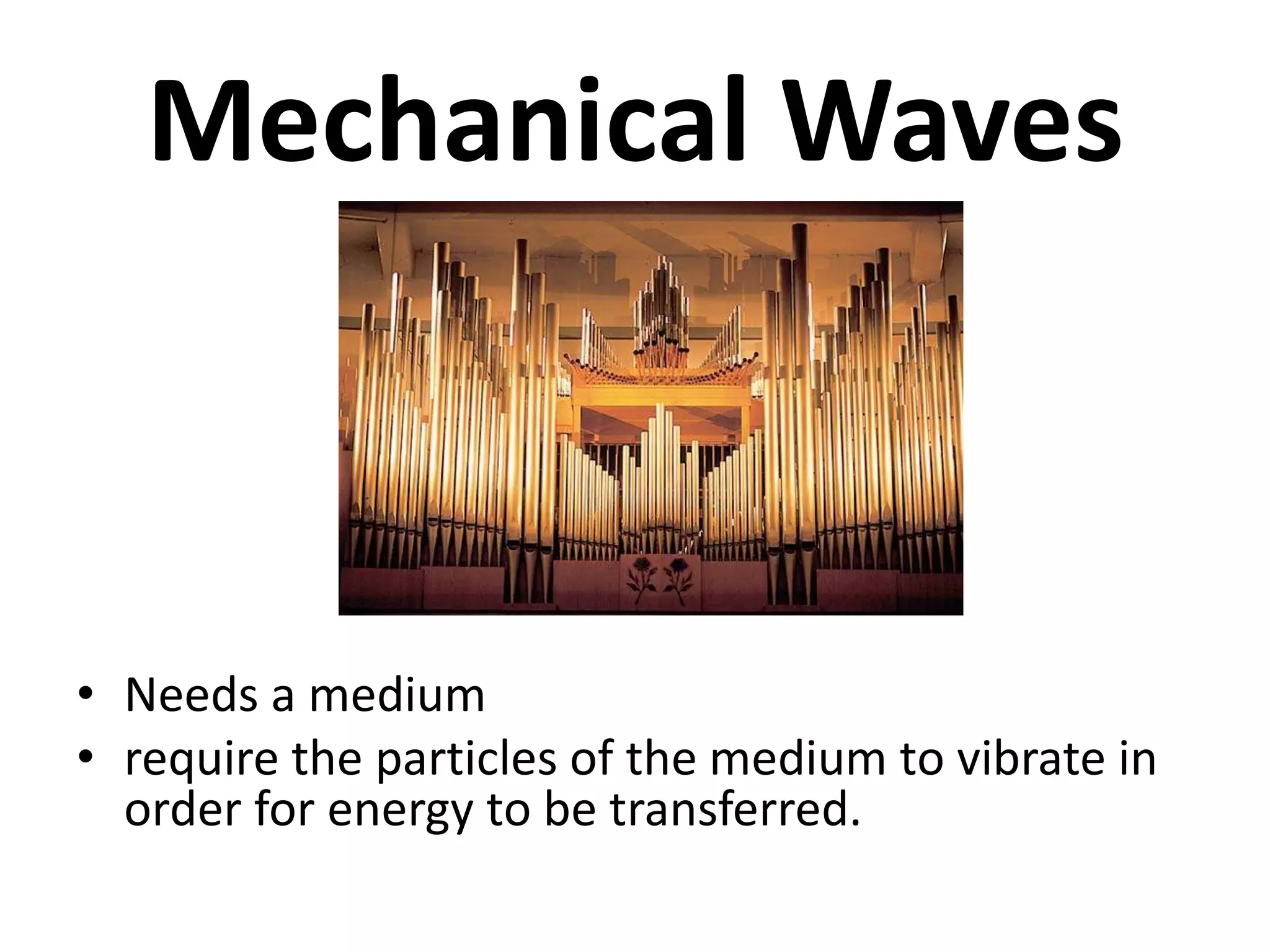
• Needs a medium
• require the particles of the medium to vibrate in
order for energy to be transferred.
• water waves
• earthquake/seismic waves
• sound waves
• waves that travel down a
rope or spring
Types of Mechanical
Waves
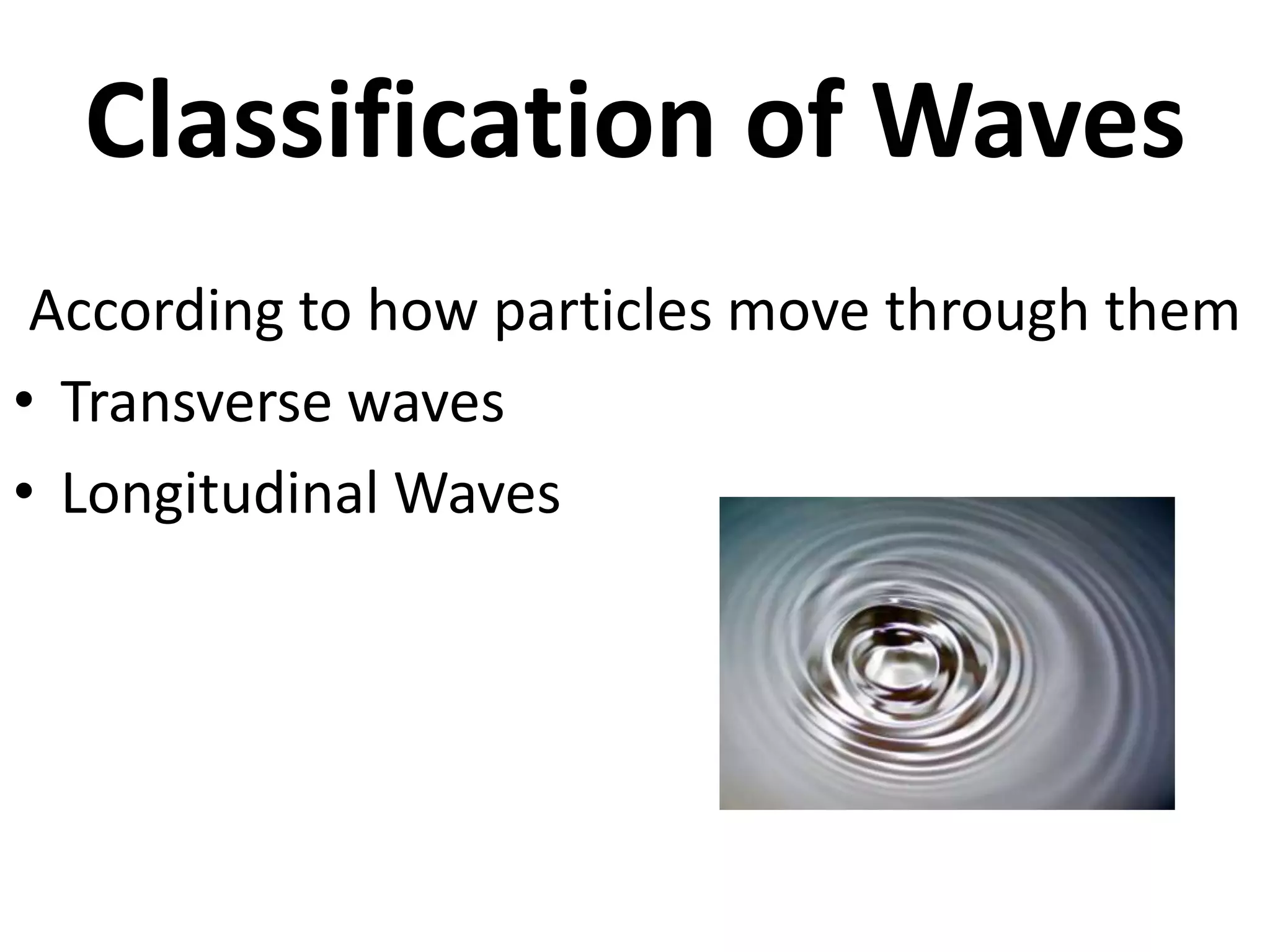
Classification of Waves
According to how particles move through them
• Transverse waves
• Longitudinal Waves
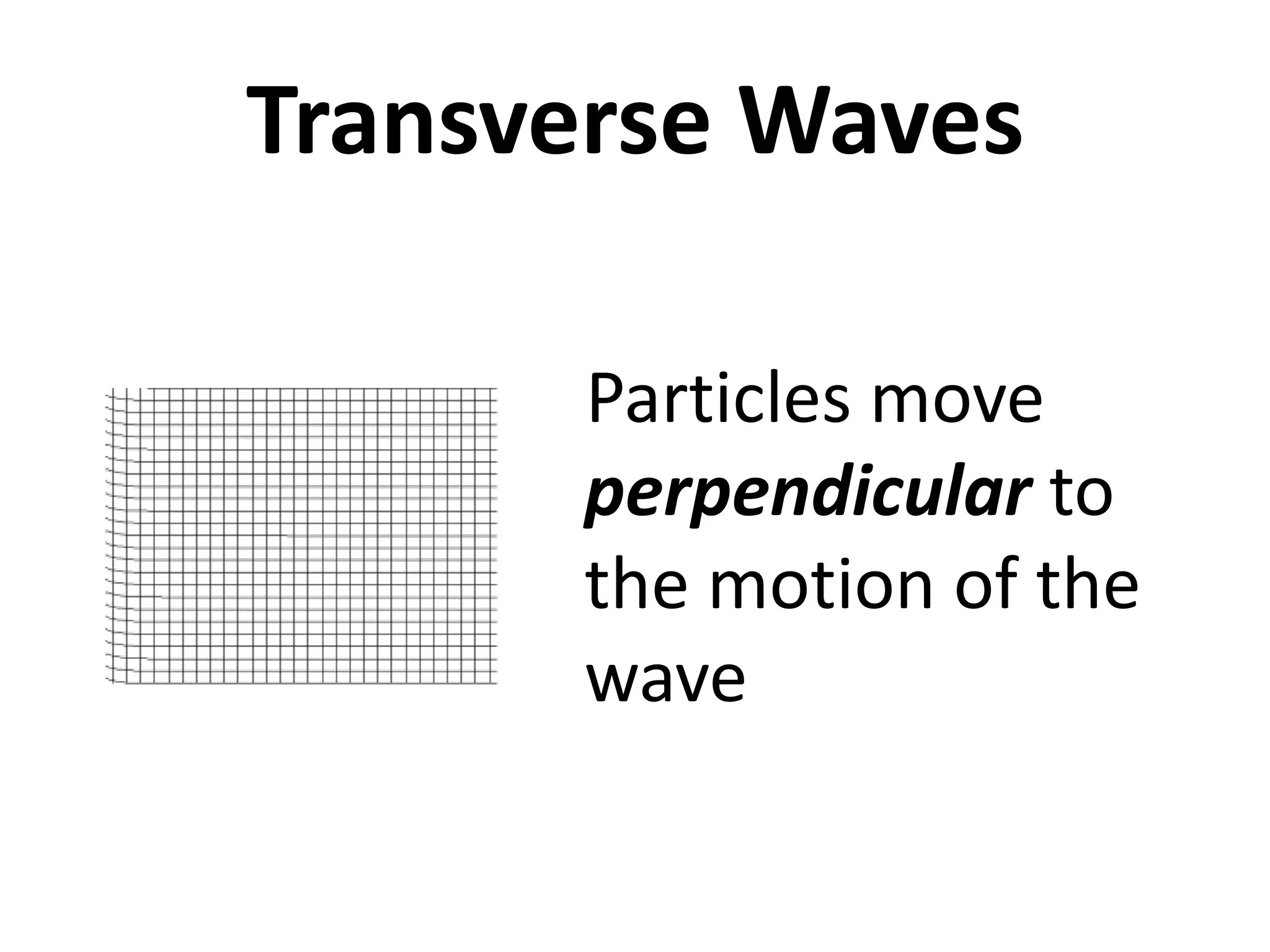
Transverse Waves
Particles move
perpendicular to
the motion of the
wave
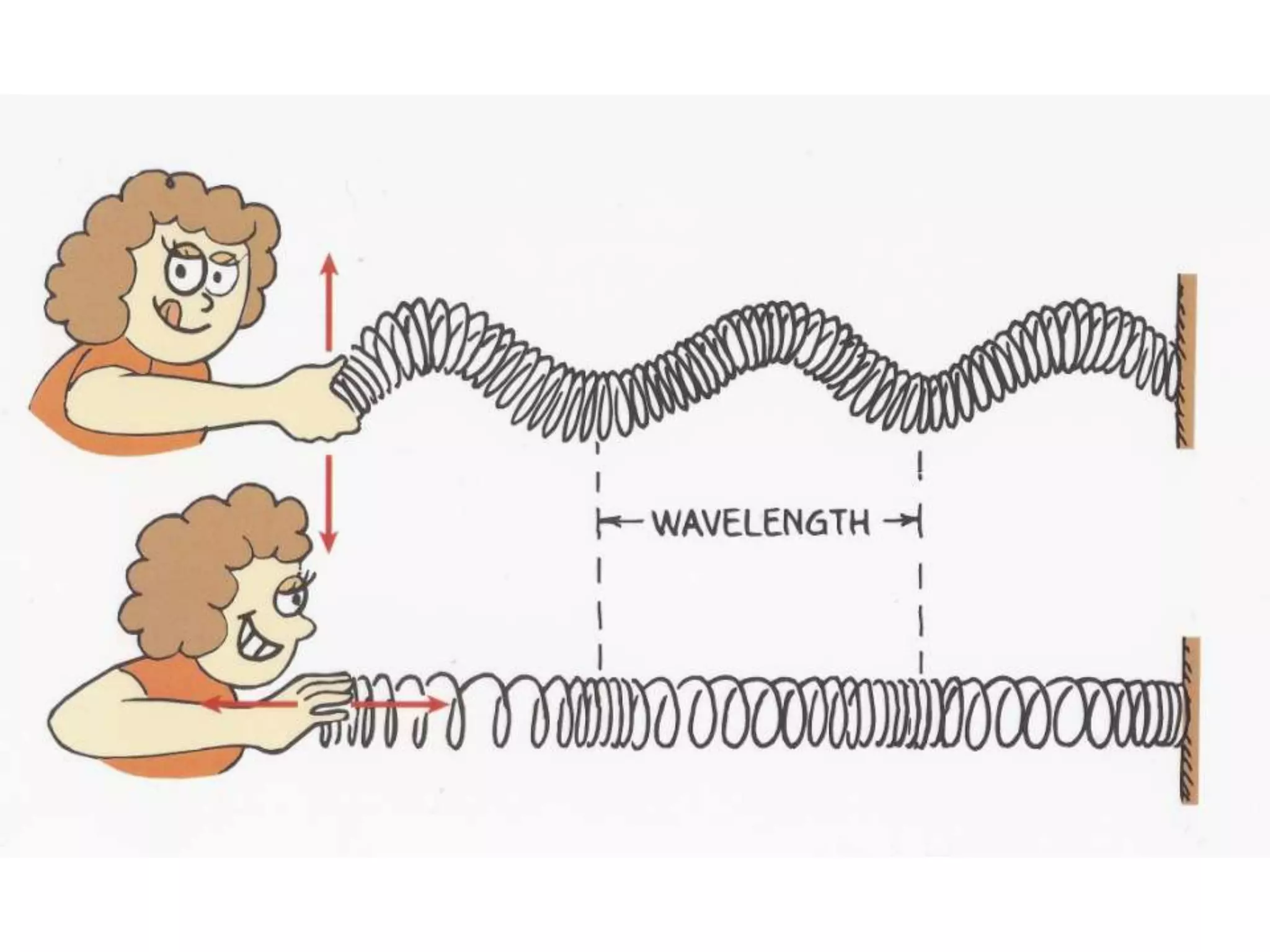
Wavelength
Crest
Amplitude
Trough
Wavelength (λ)
The distance from crest to crest
(or trough to trough); expressed
in meters
Amplitude (A)
The distance of crest (or trough)
from the midpoint of the wave
Longitudinal Waves
particles move
parallel to the
motion of the wave.
Longitudinal Waves
Compression- a crowded
area causing a high-
pressure region
Rarefaction- a spread
out area causing a low-
pressure region
http://www.lcse.umn.edu/specs/labs/glossary_items/rarefaction_spring.html
Transverse and Longitudinal Wave
Which is which?
Wave Characteristics
Frequency (f)
The number of waves that
passed a fixed point per second
Unit: hertz (Hz)
f= 1/T
Wave Characteristics
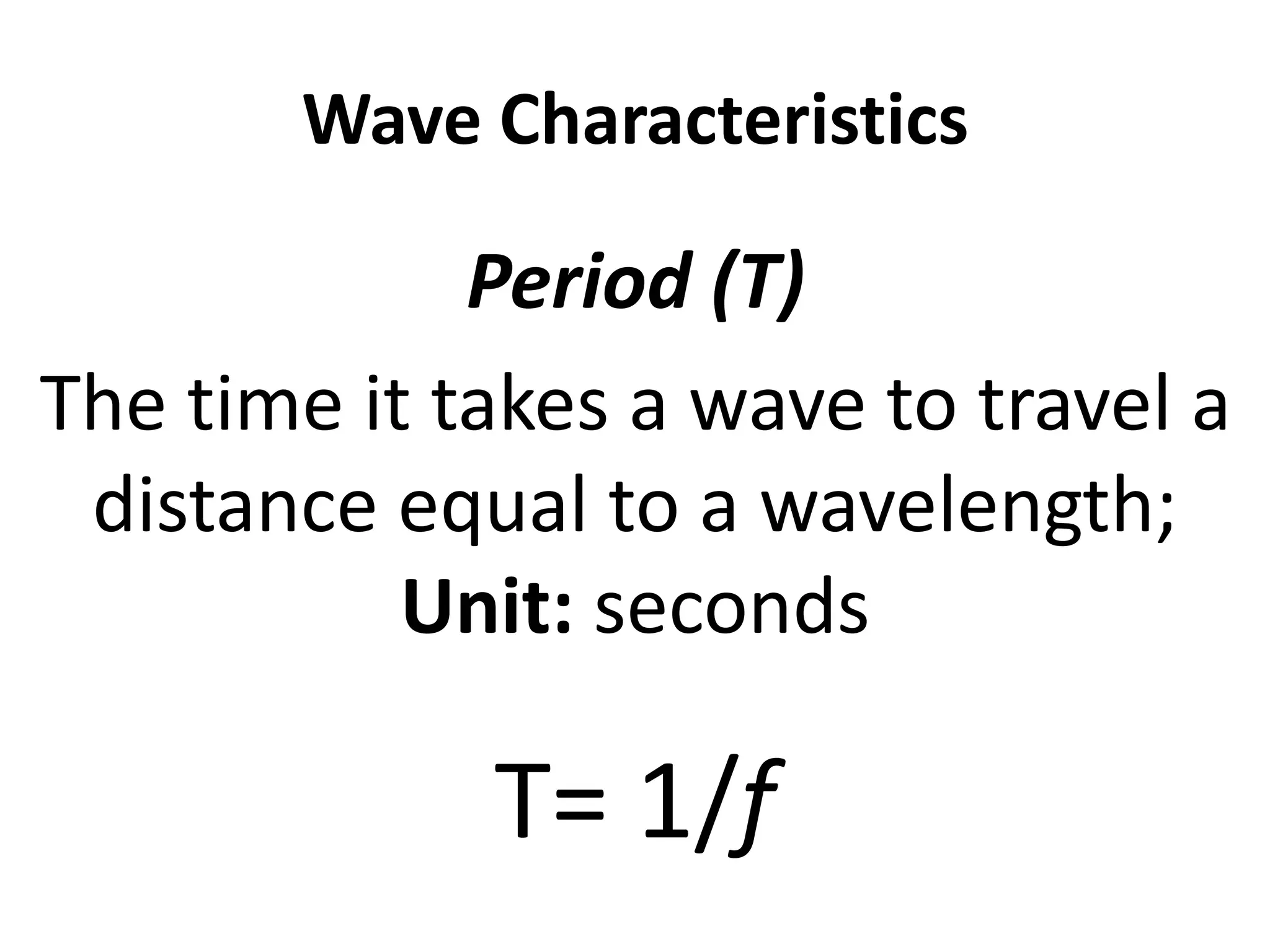
Period (T)
The time it takes a wave to travel a
distance equal to a wavelength;
Unit: seconds
T= 1/f
Wave Characteristics
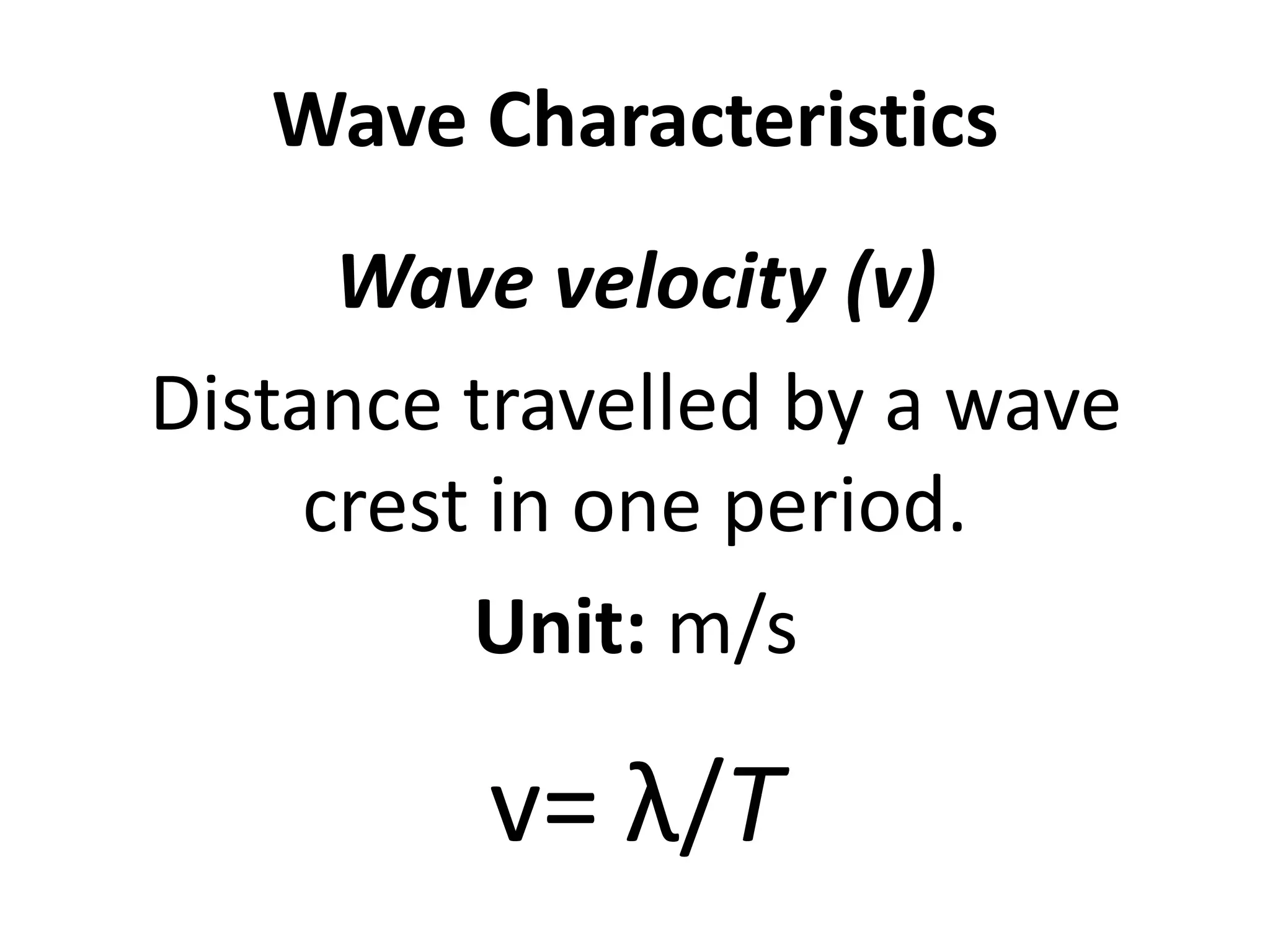
Wave velocity (v)
Distance travelled by a wave
crest in one period.
Unit: m/s
v= λ/T
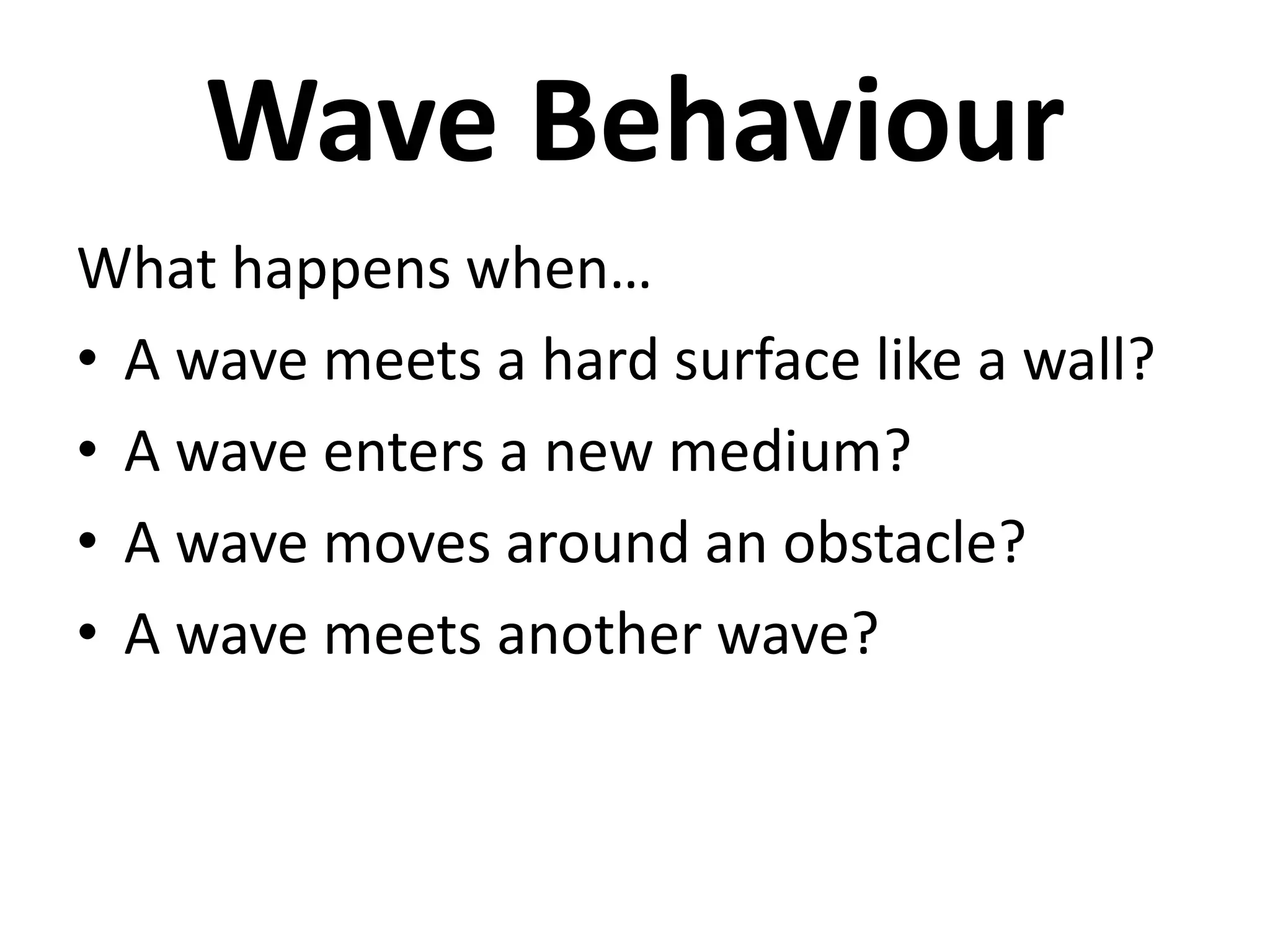
Wave Behaviour
What happens when…
• A wave meets a hard surface like a wall?
• A wave enters a new medium?
• A wave moves around an obstacle?
• A wave meets another wave?
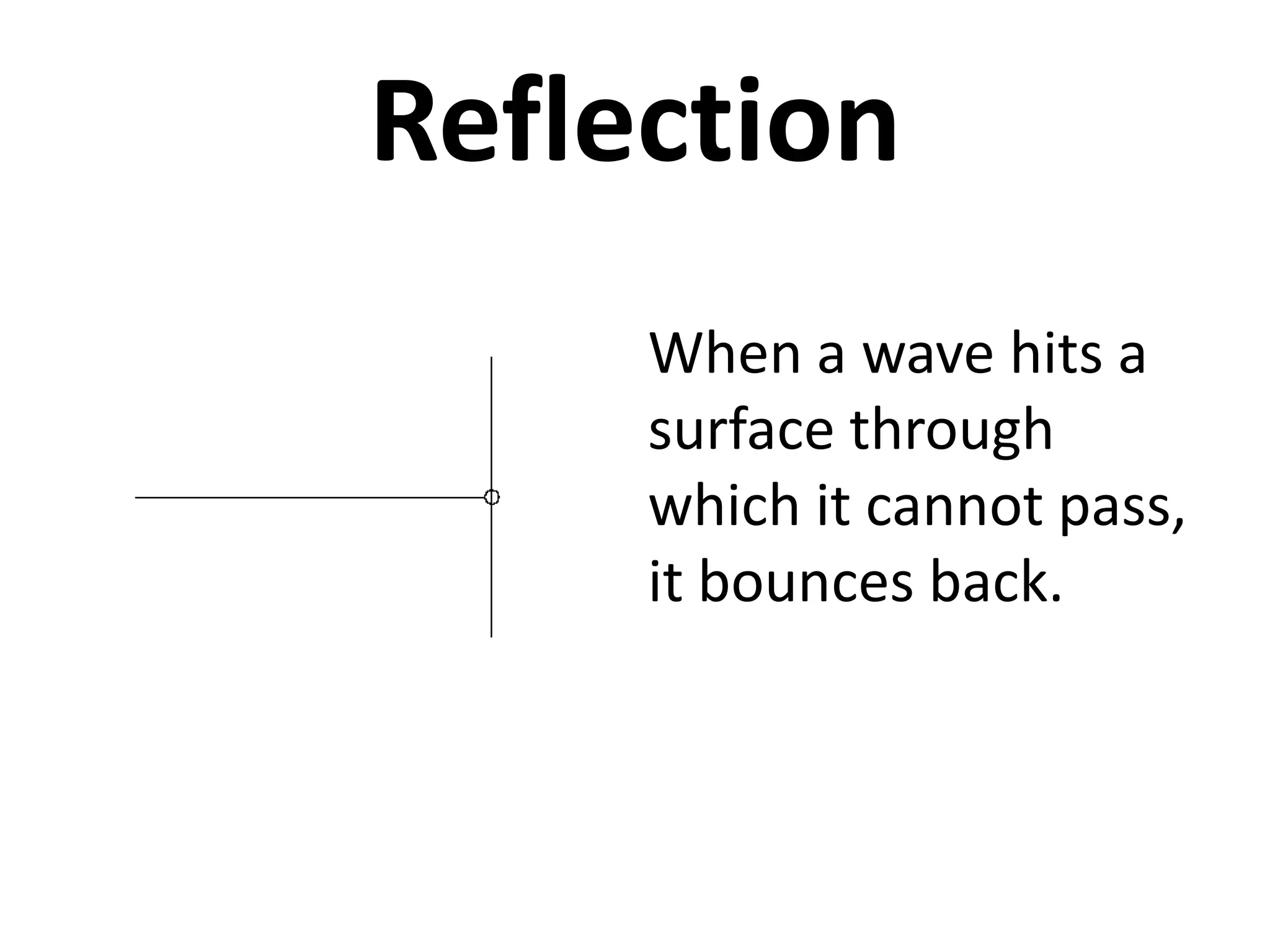
Reflection
When a wave hits a
surface through
which it cannot pass,
it bounces back.
Reflection
• Reflection does
not change the
speed or frequency
of the wave, BUT
the wave can be
flipped upside
down!
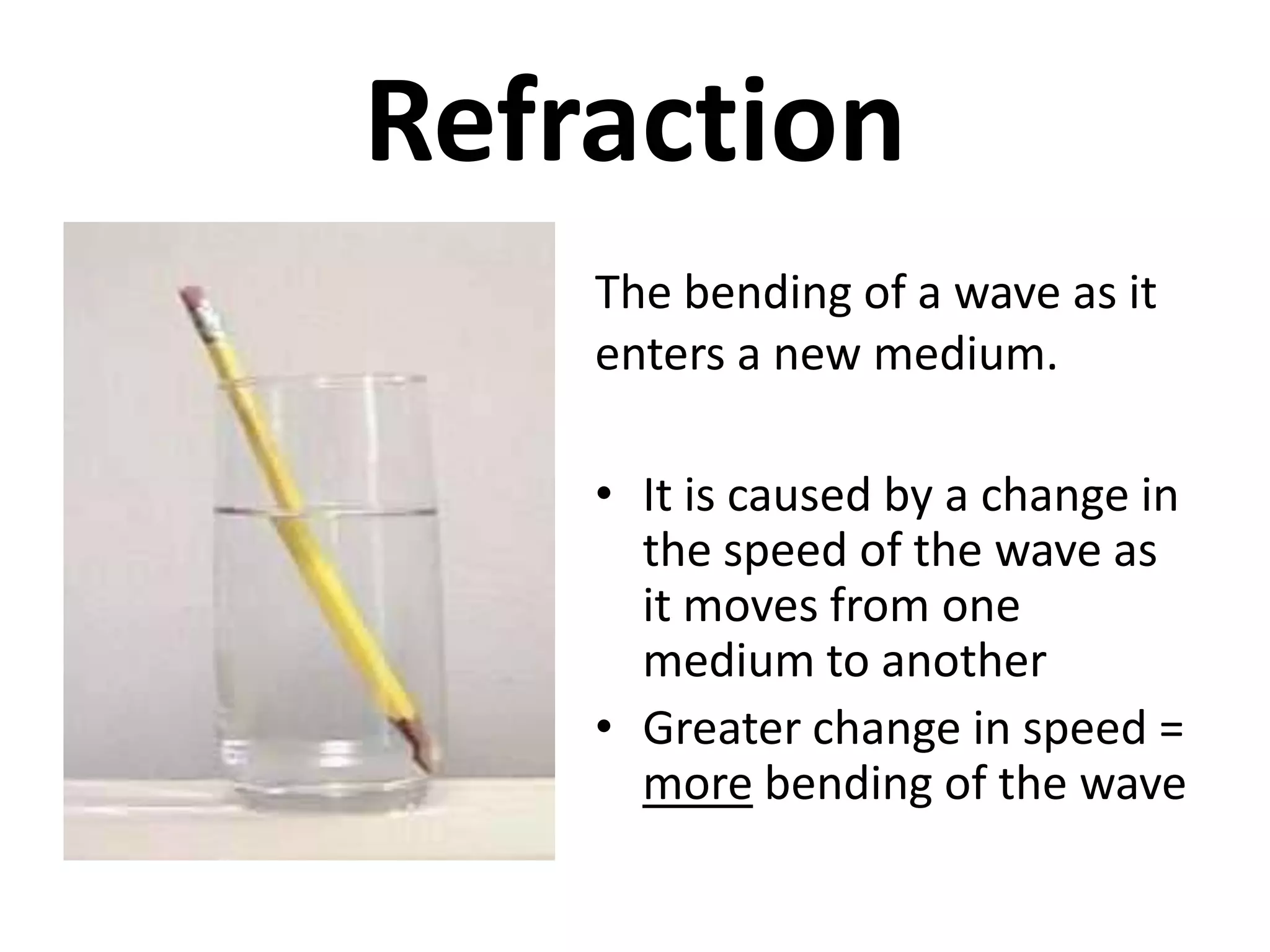
Refraction
The bending of a wave as it
enters a new medium.
• It is caused by a change in
the speed of the wave as
it moves from one
medium to another
• Greater change in speed =
more bending of the wave
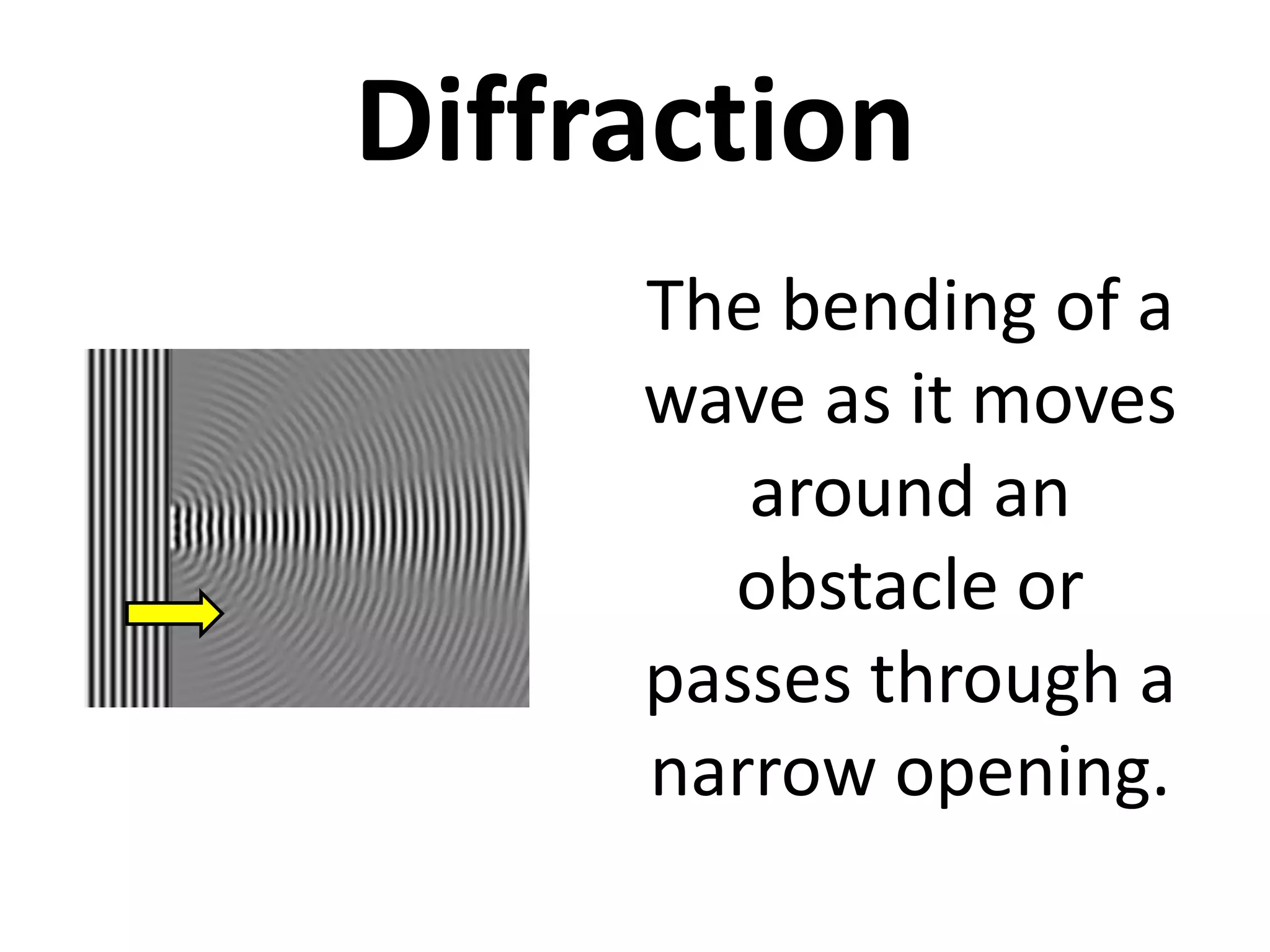
Diffraction
The bending of a
wave as it moves
around an
obstacle or
passes through a
narrow opening.
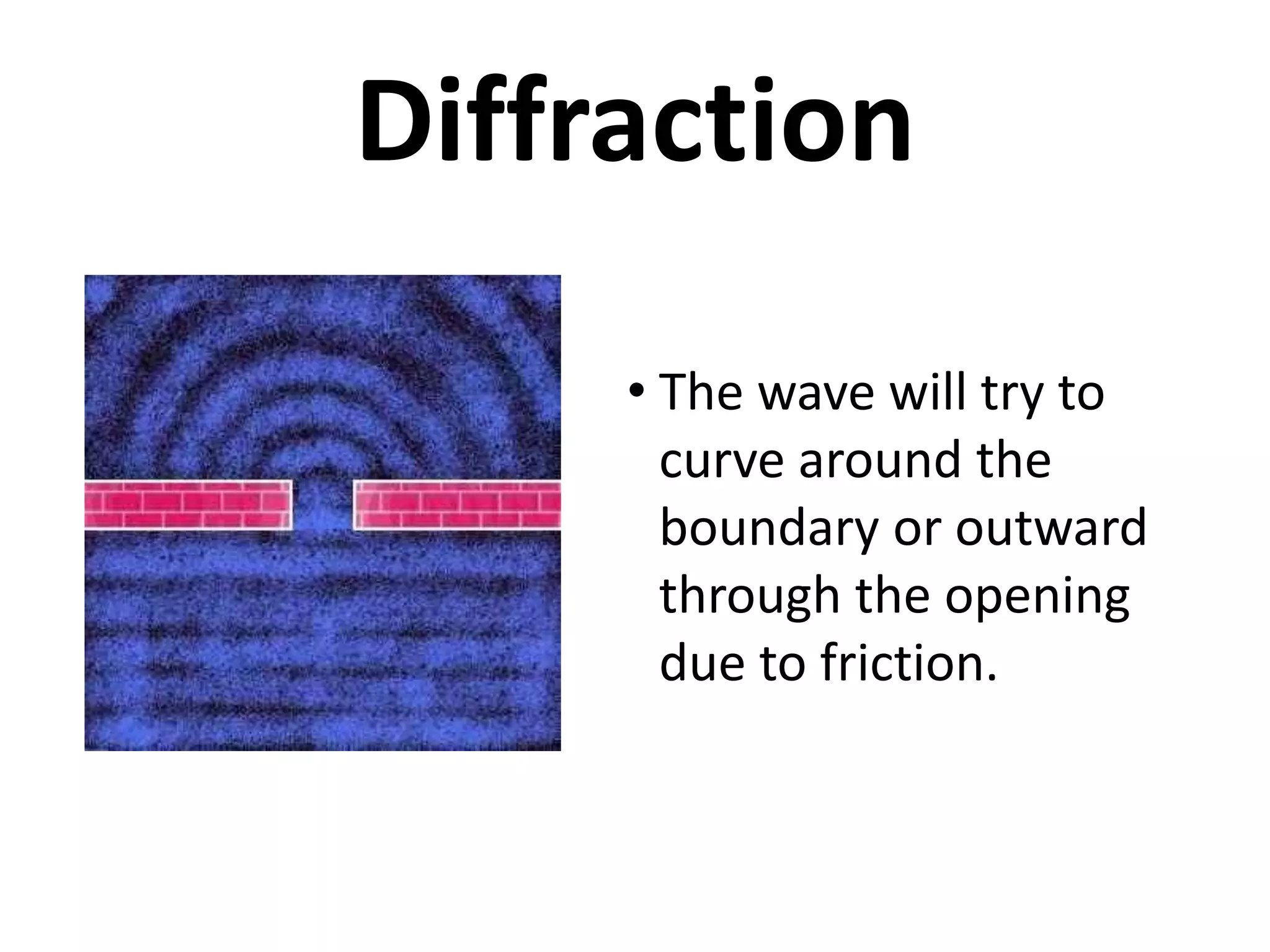
Diffraction
• The wave will try to
curve around the
boundary or outward
through the opening
due to friction.
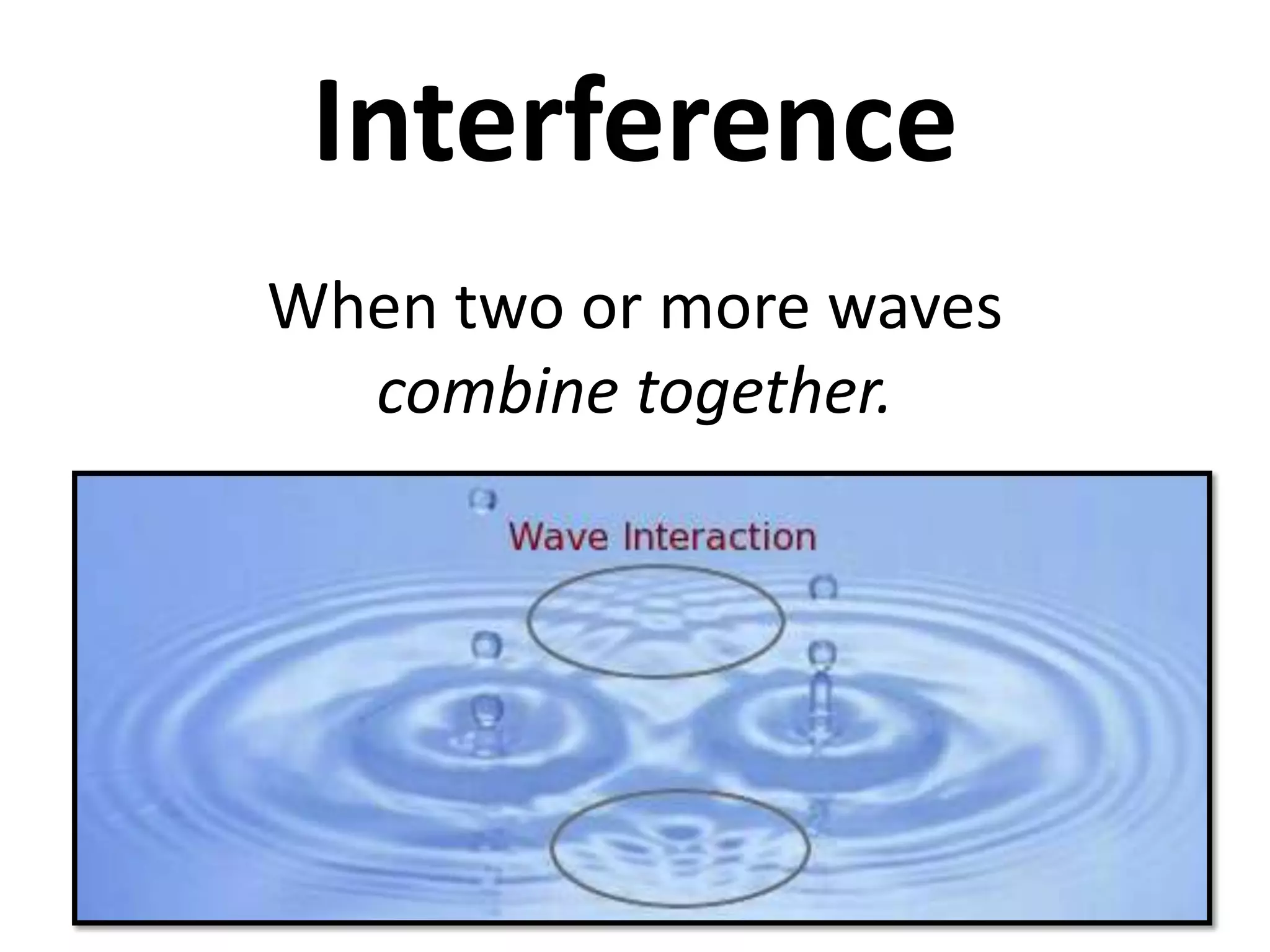
Interference
When two or more waves
combine together.
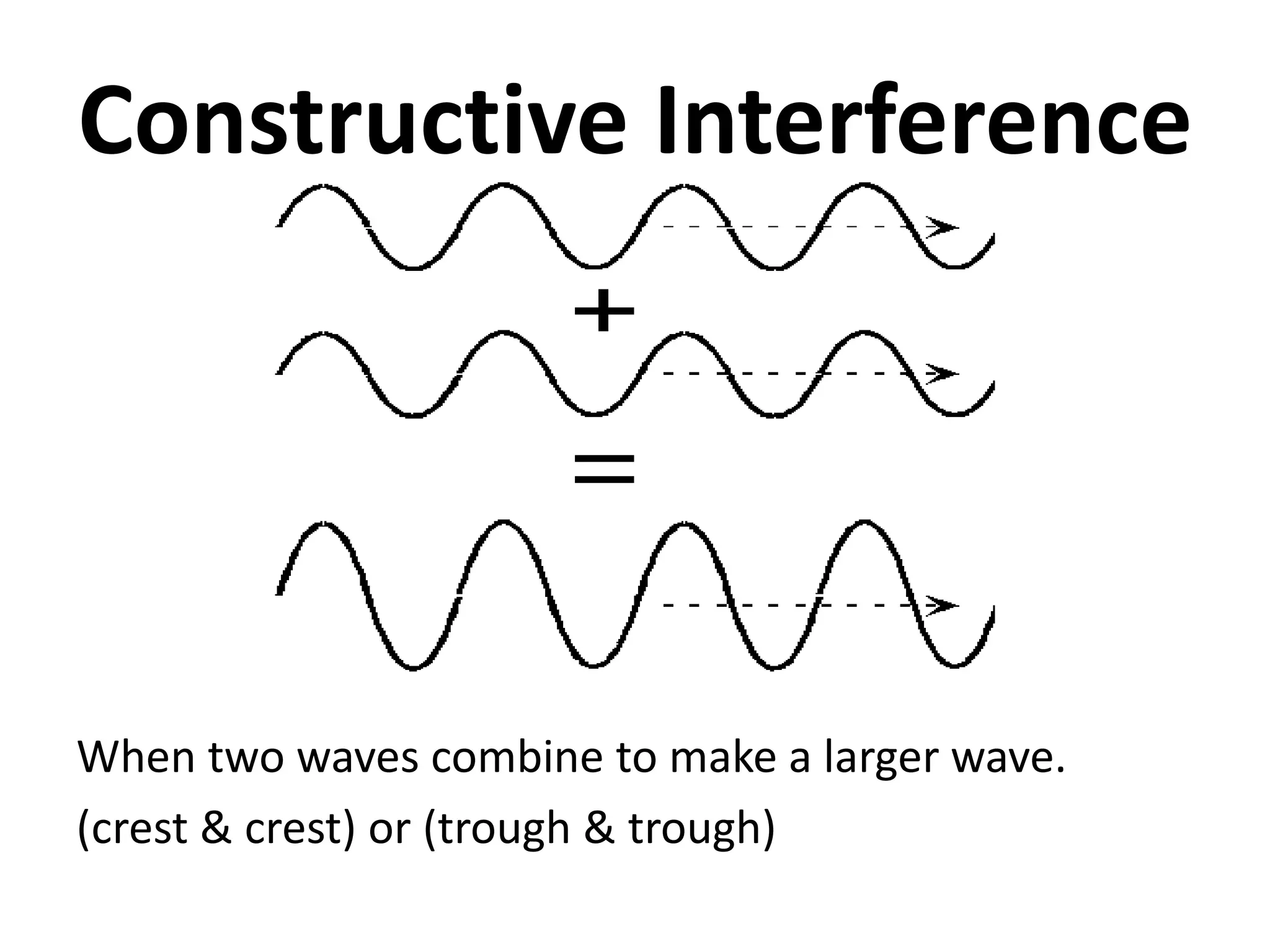
Constructive Interference
When two waves combine to make a larger wave.
(crest & crest) or (trough & trough)
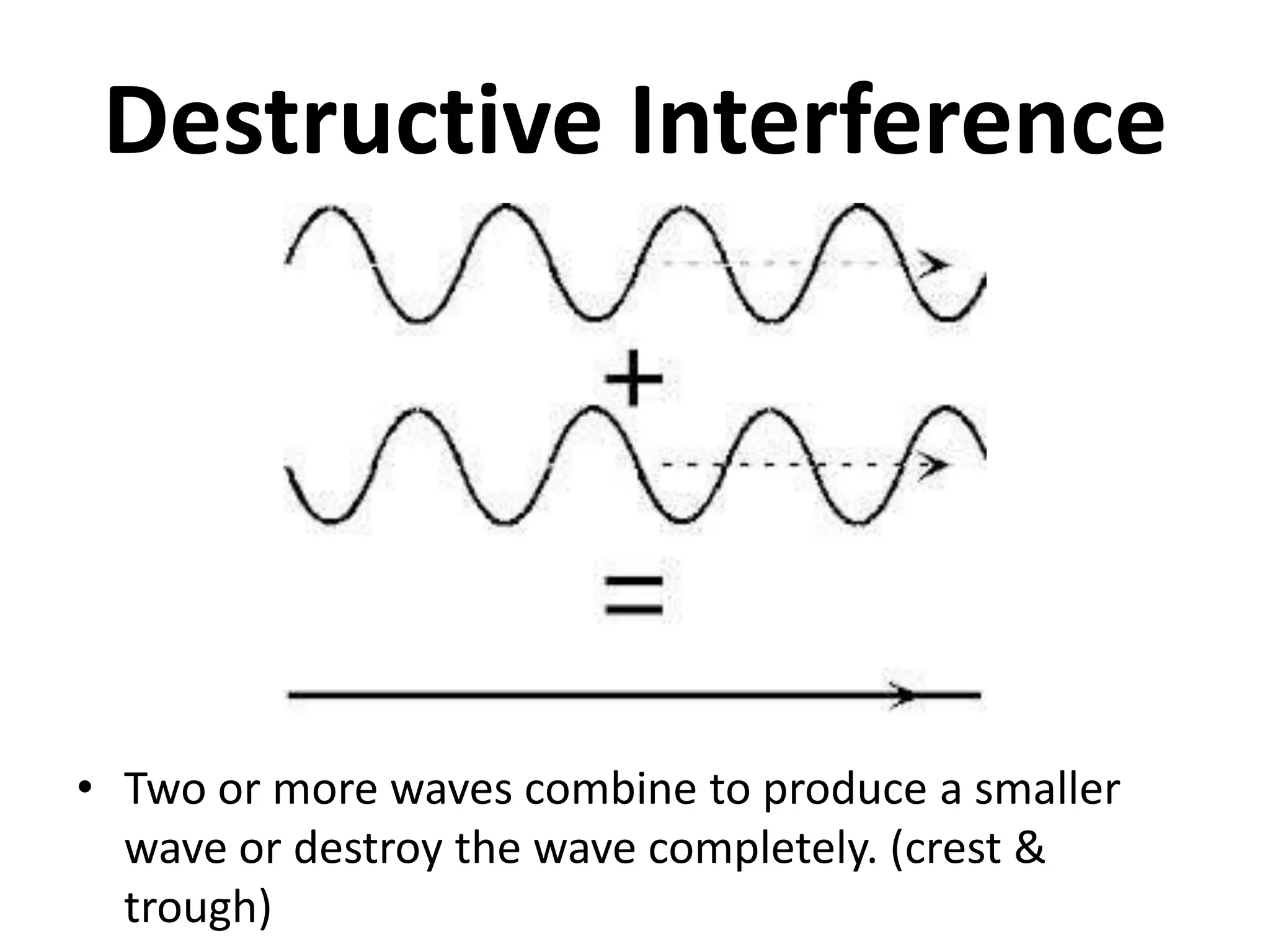
Destructive Interference
• Two or more waves combine to produce a smaller
wave or destroy the wave completely. (crest &
trough)
Polarization
Filtering radiating light (moves in all
directions) to allow only light
traveling in one direction through
Polarization
Resonance
When one object vibrates another
without touching
• The 2 objects resonate at the
same frequency
• Amplitude increases
Resonance

Waves ppt.

Editor's Notes

  • #12 All of these examplesCANNOT move through empty space.
  • #14 Compressional
  • #15 The highest point of a transverse wave is the crest and the lowest point is called a trough.
  • #18 Compressional
  • #19 CompressionalThe place on the wave that is pushed together is called the compression and the place that is moving apart is the rarefaction.
  • #29 The wave bends because as it enters a new medium it either speeds up or slows down!