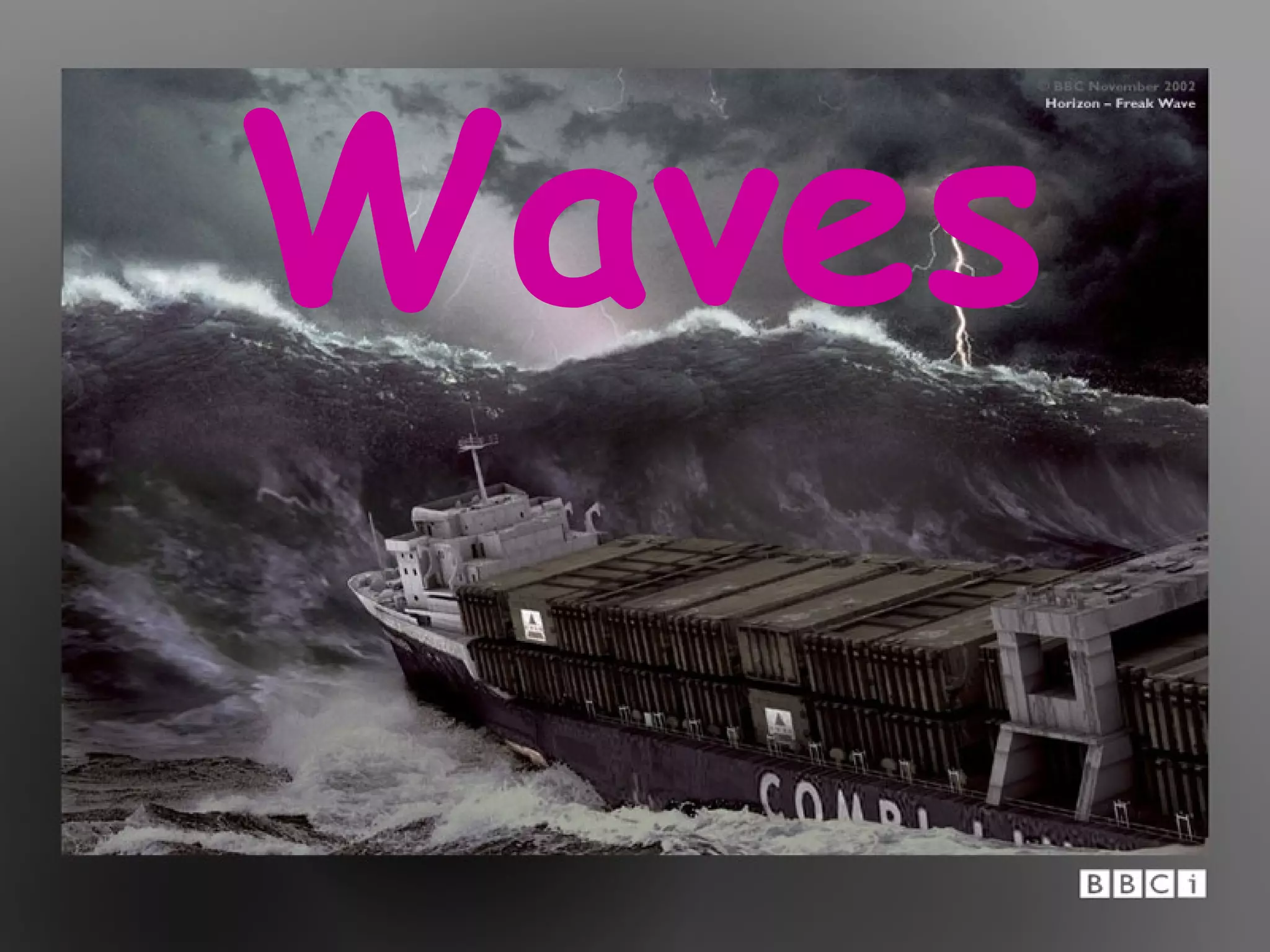
Waves
 
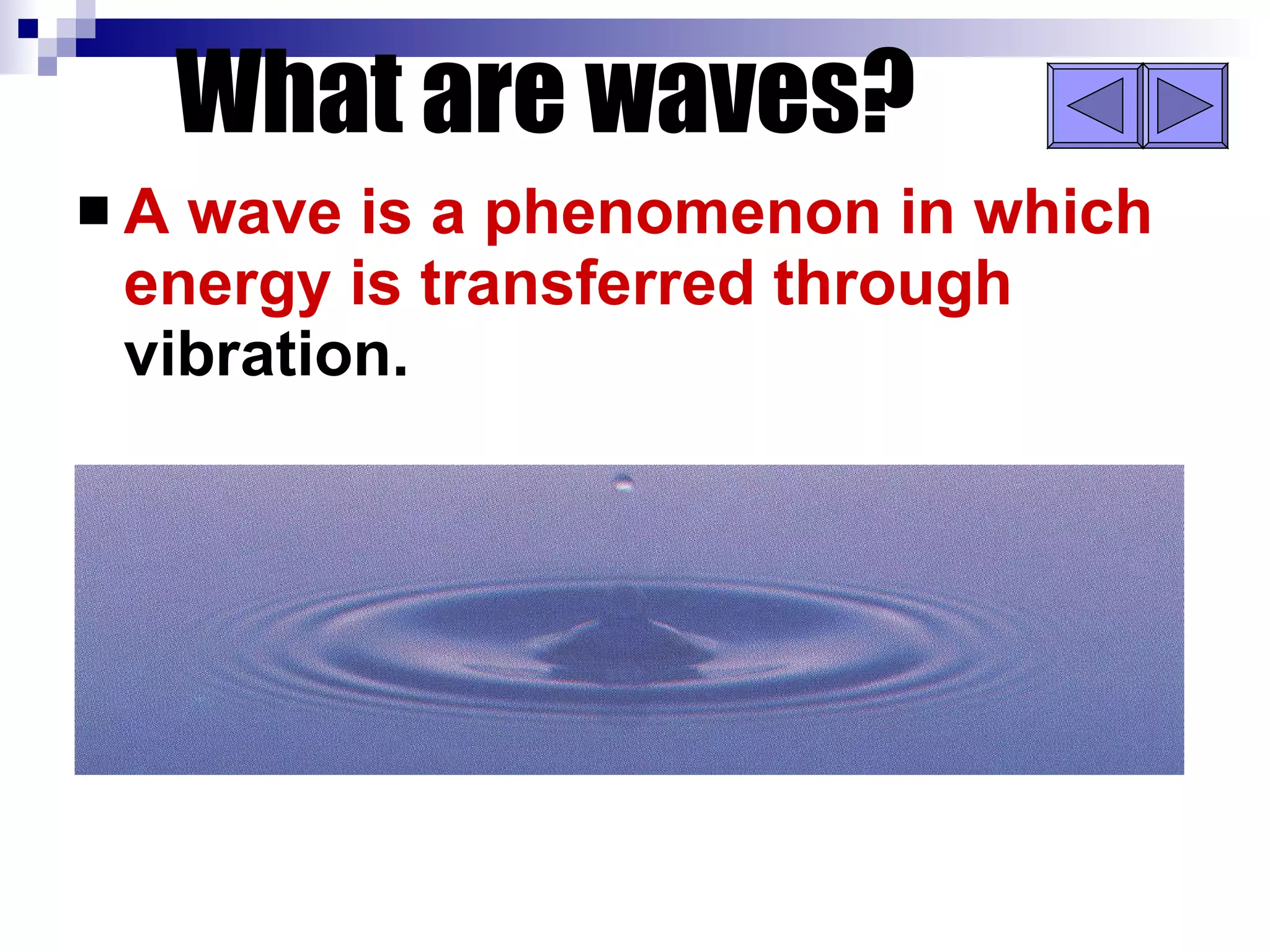
What are waves? A wave is a phenomenon in which energy is transferred through  vibration.
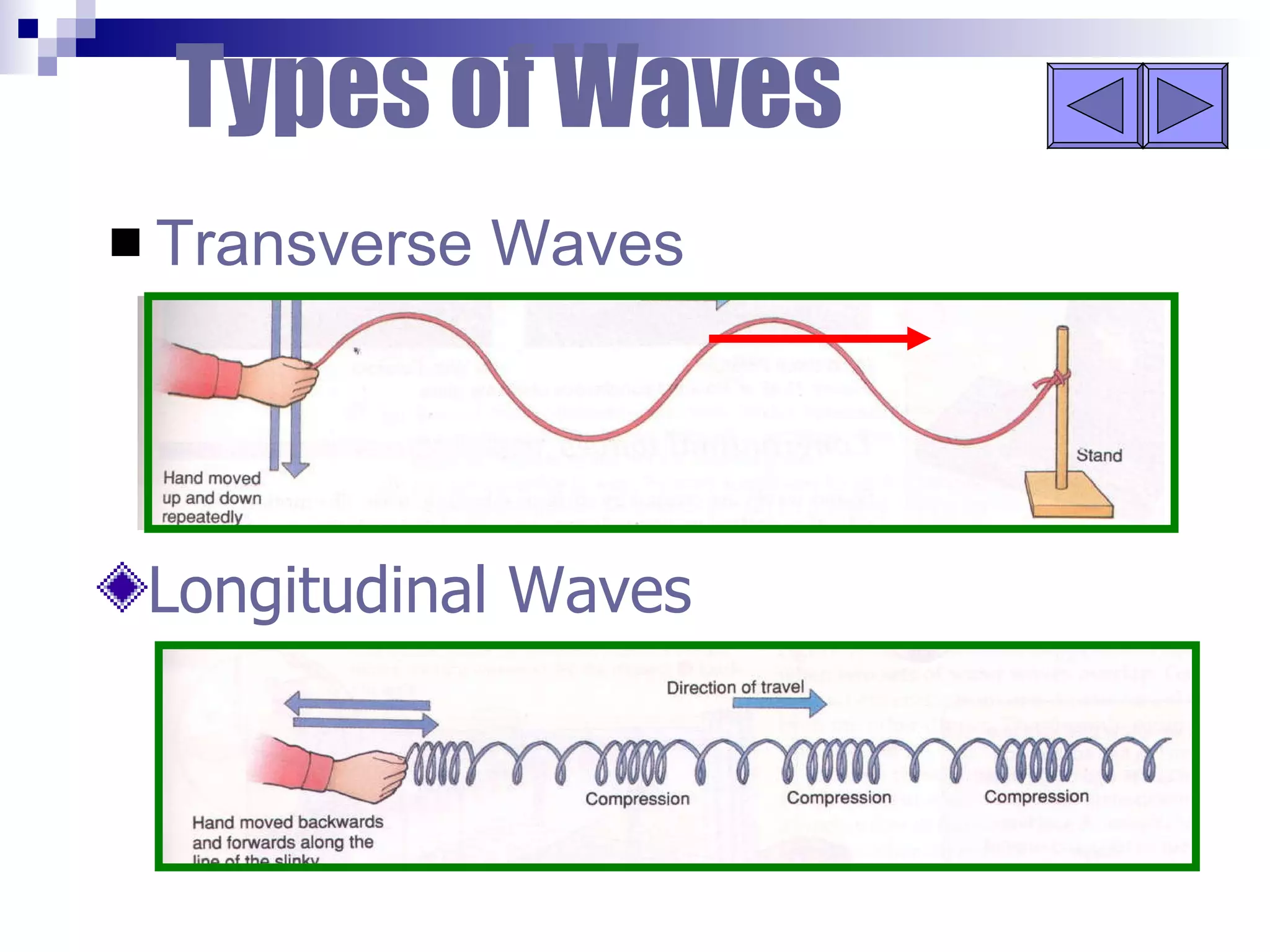
Types of Waves Transverse Waves Longitudinal Waves
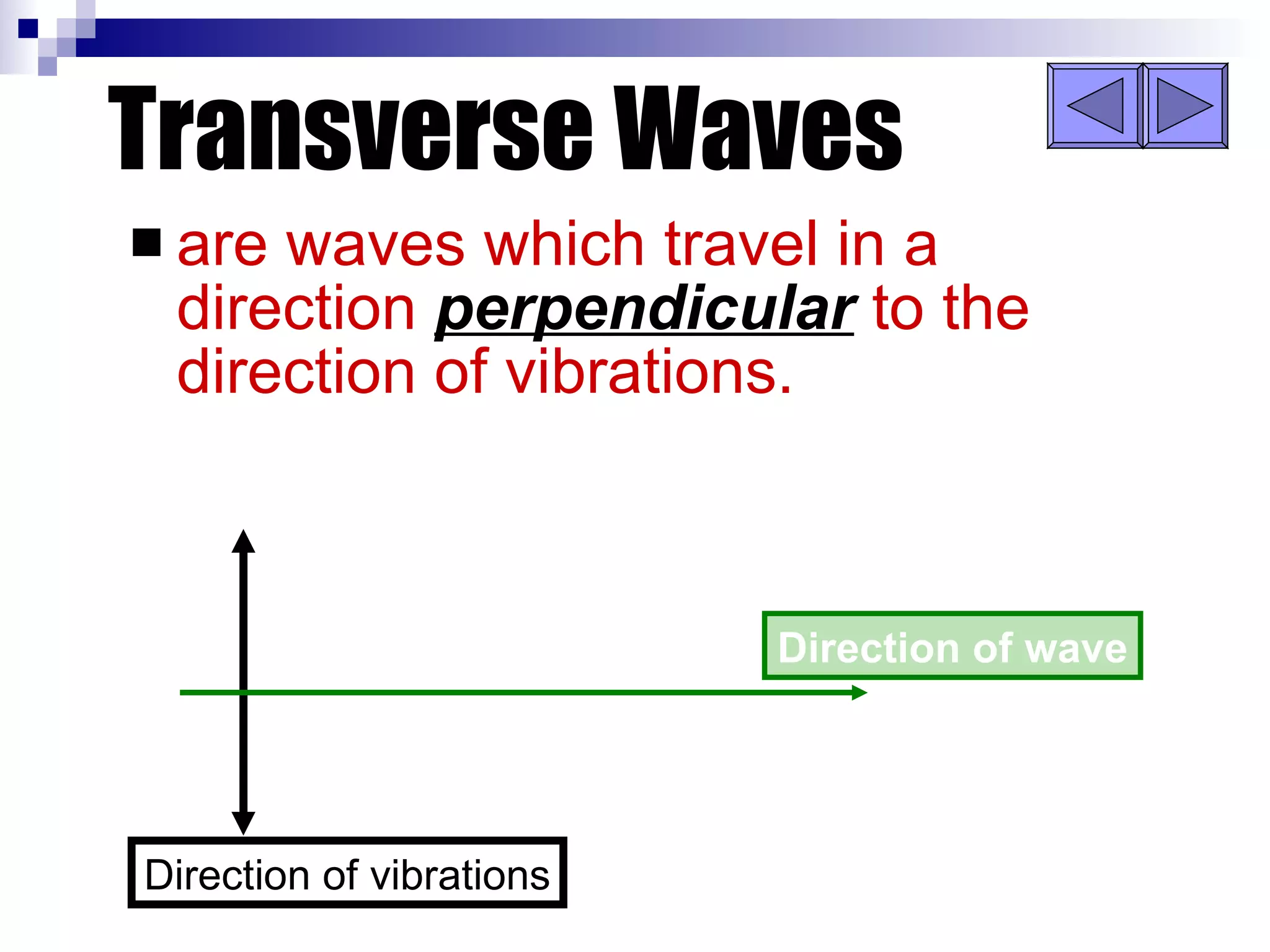
Transverse Waves are waves which travel in a direction  perpendicular  to the direction of vibrations. Direction of vibrations Direction of wave
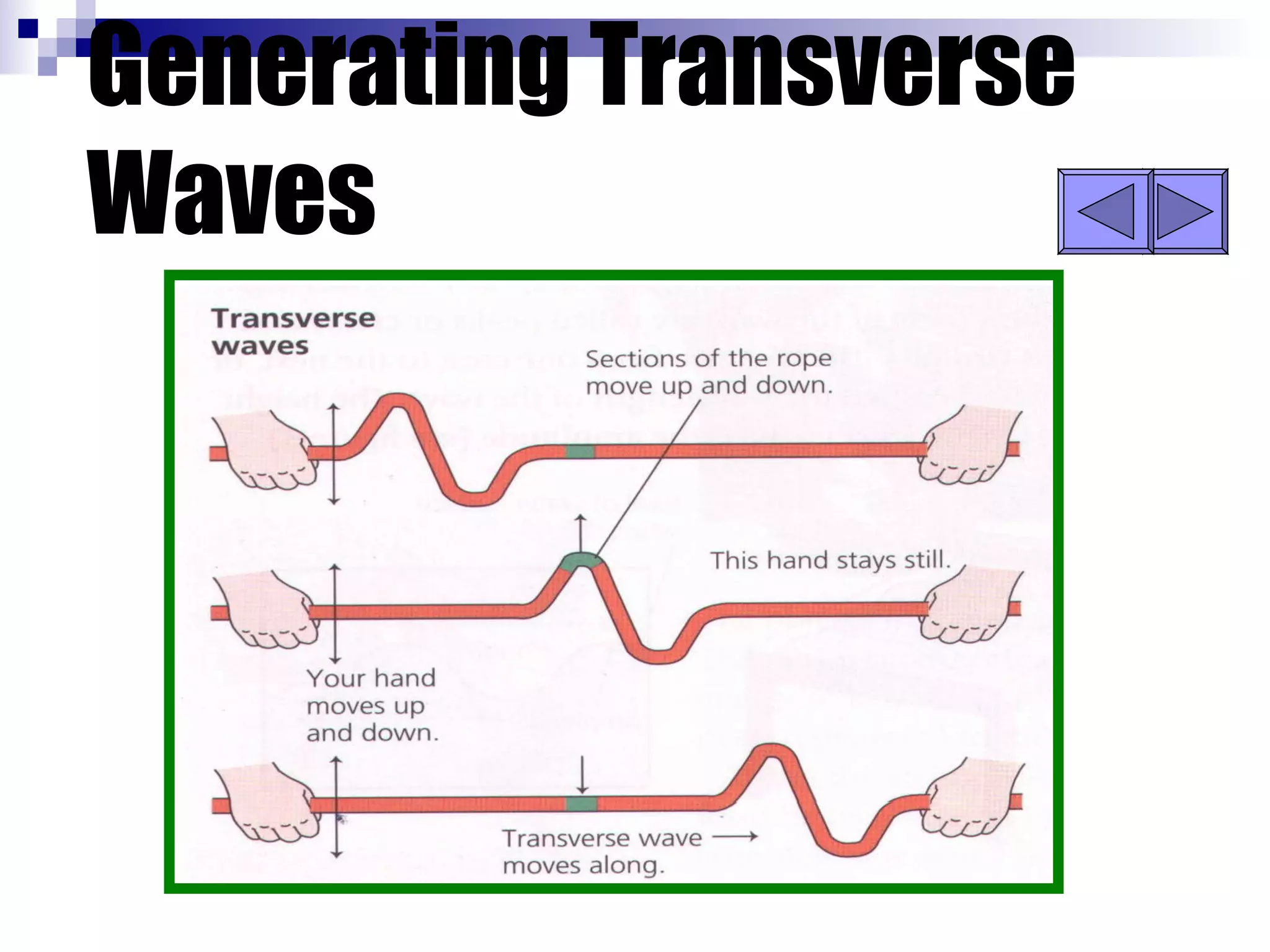
Generating Transverse Waves
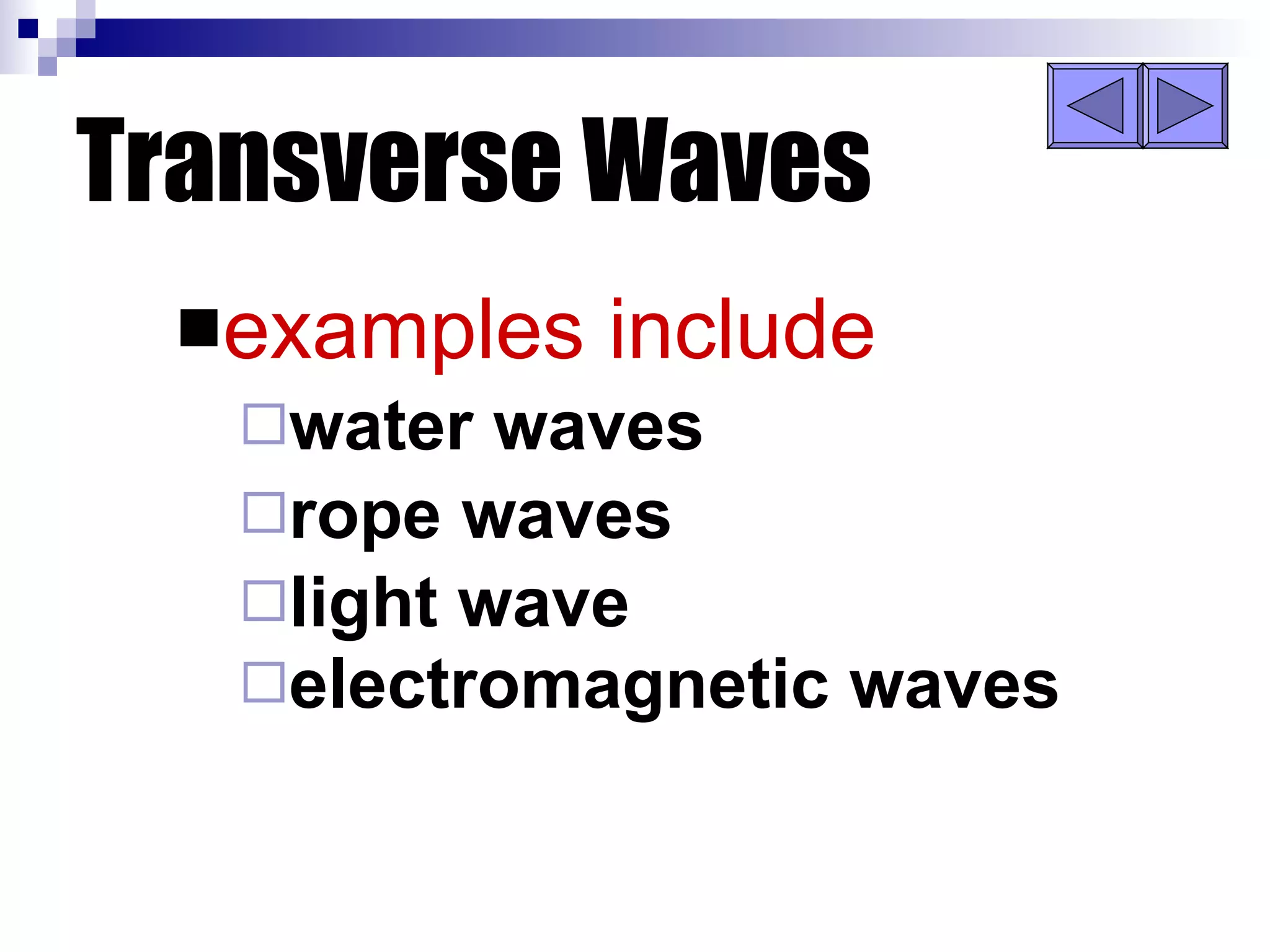
Transverse Waves examples include water waves rope waves light wave electromagnetic waves
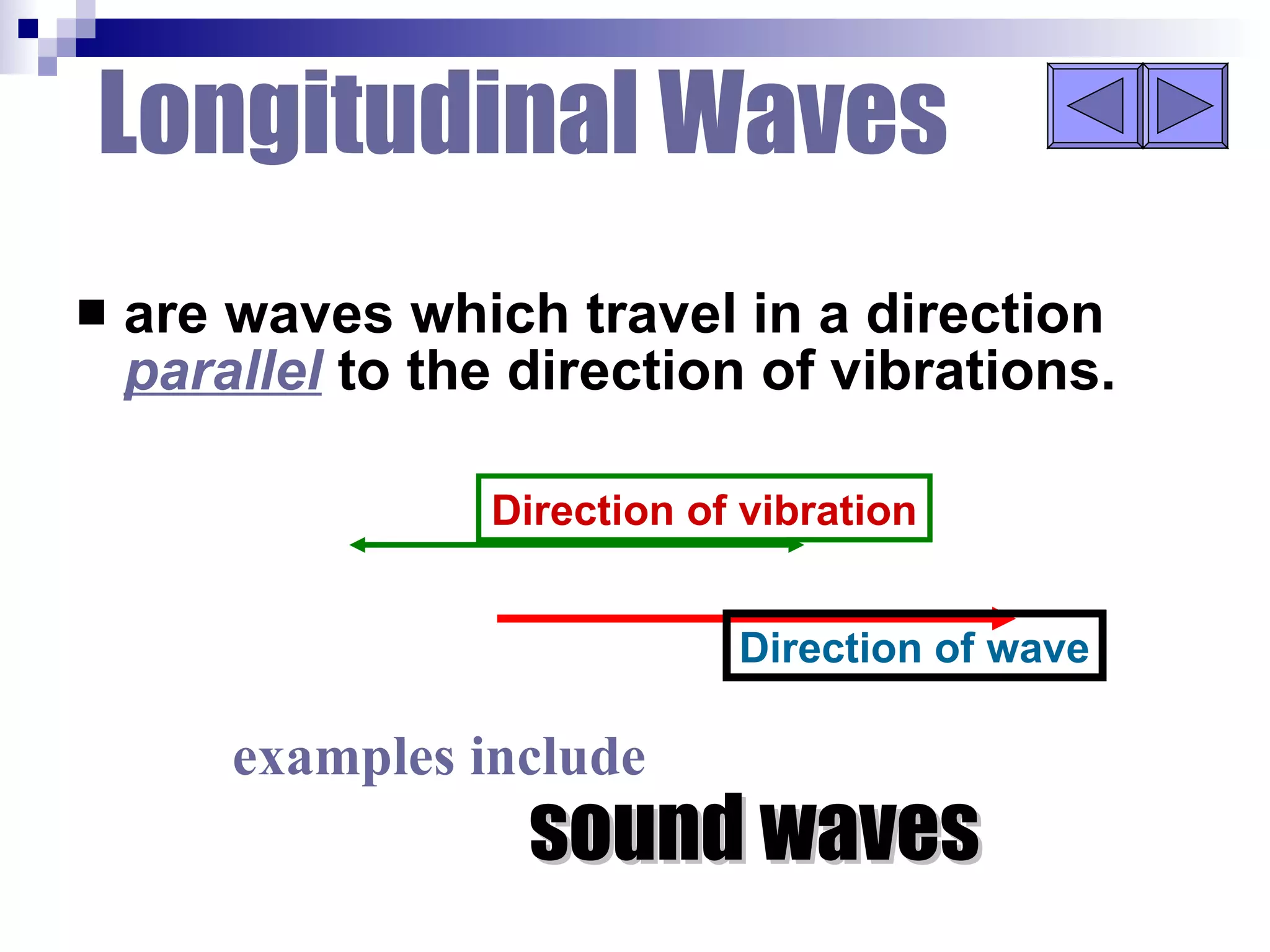
Longitudinal Waves are waves which travel in a direction  parallel  to the direction of vibrations. examples   include sound waves Direction of vibration Direction of wave
Generating of Longitudinal Waves   [slinky spring]
Characteristics of A Wave Crests and Troughs Amplitude Wavelength Frequency Period Speed
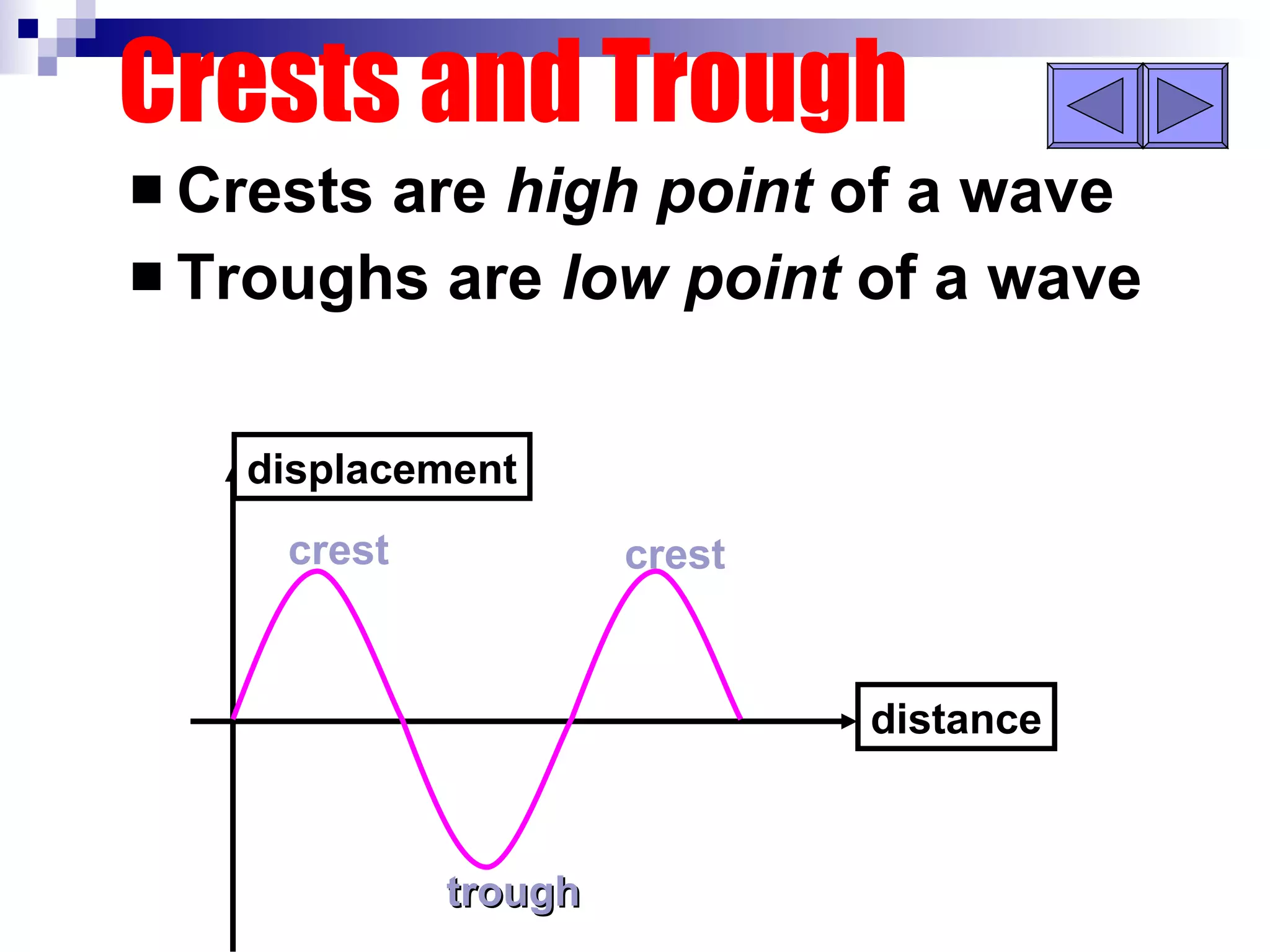
Crests and Trough Crests are  high point  of a wave Troughs are  low point  of a wave trough displacement distance crest crest
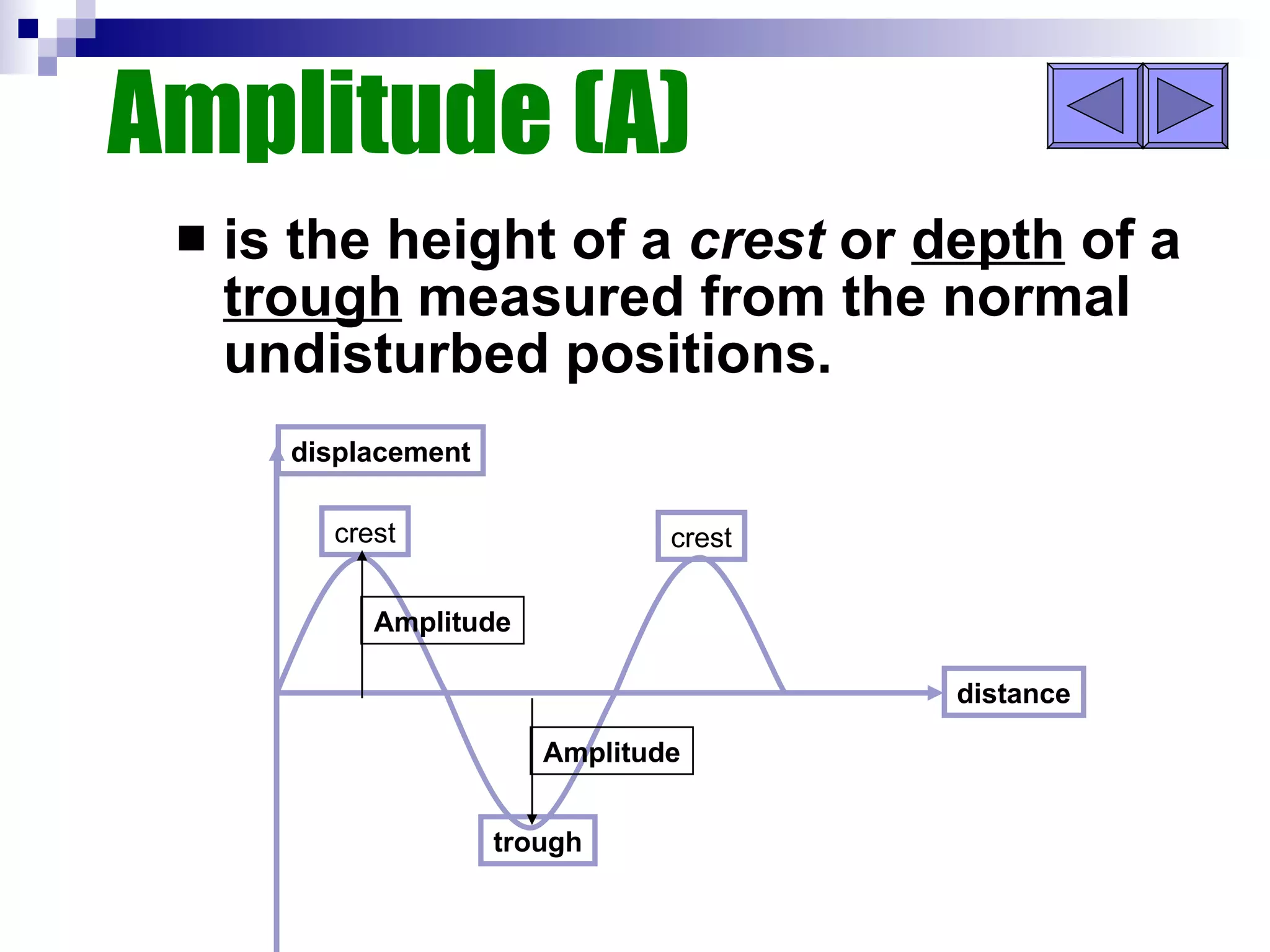
Amplitude (A) is the height of a  crest  or  depth  of a  trough  measured from the normal undisturbed positions. displacement distance crest crest trough Amplitude Amplitude
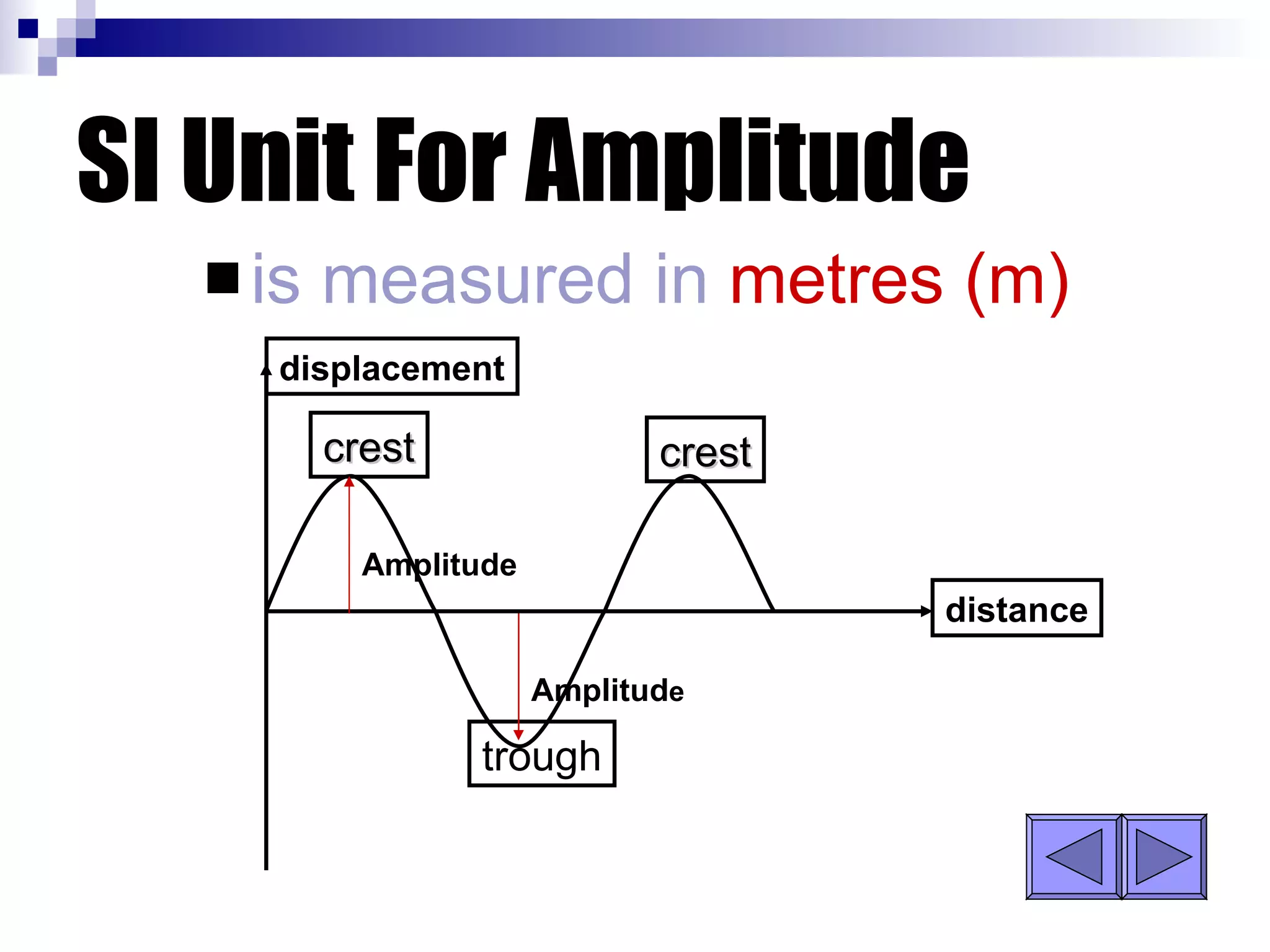
SI Unit For Amplitude is measured in   metres (m) displacement distance crest crest trough Amplitude Amplitud e
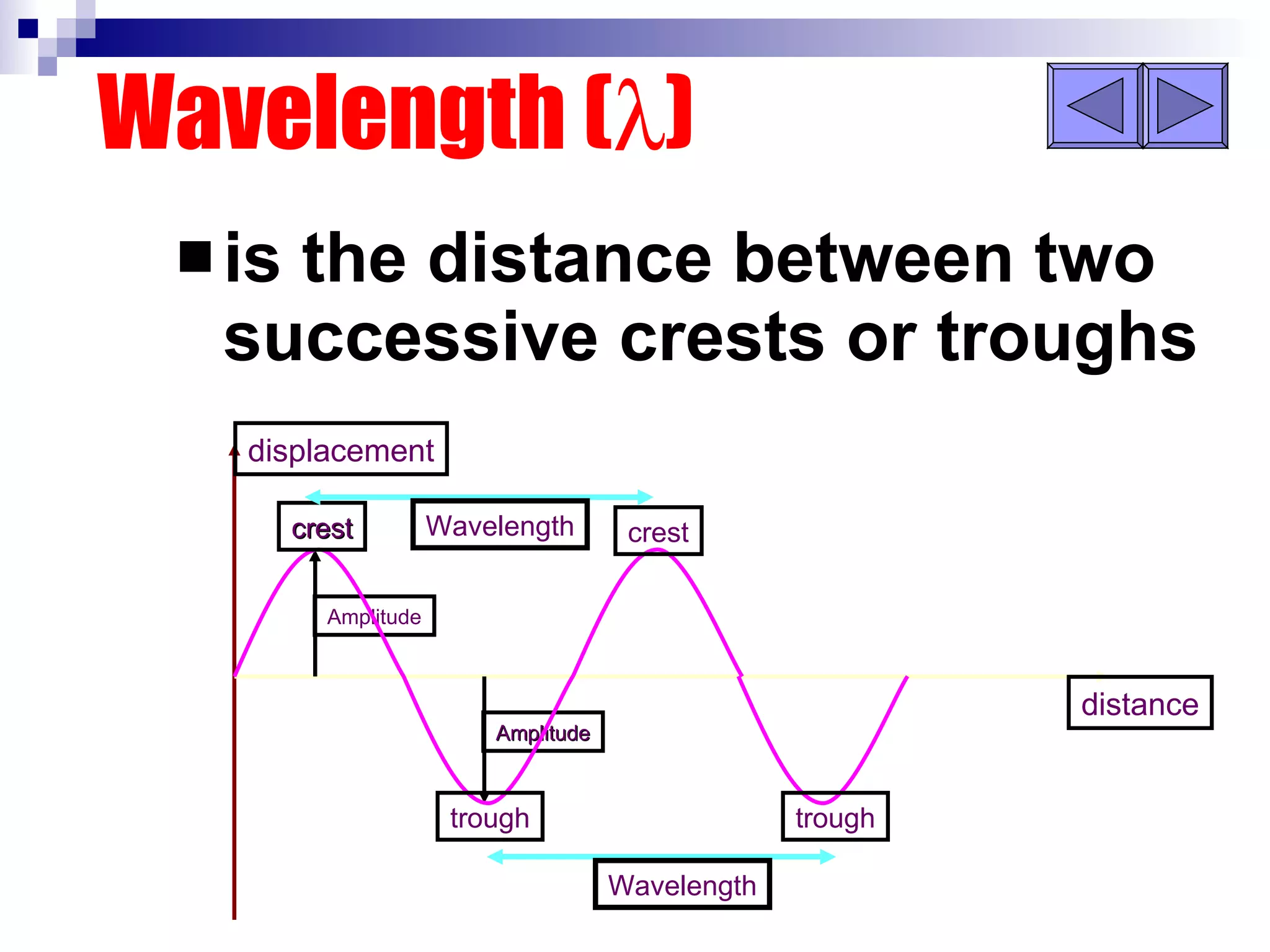
Wavelength (  ) is the distance between two successive crests   or troughs displacement distance Amplitude Amplitude crest crest trough trough Wavelength Wavelength
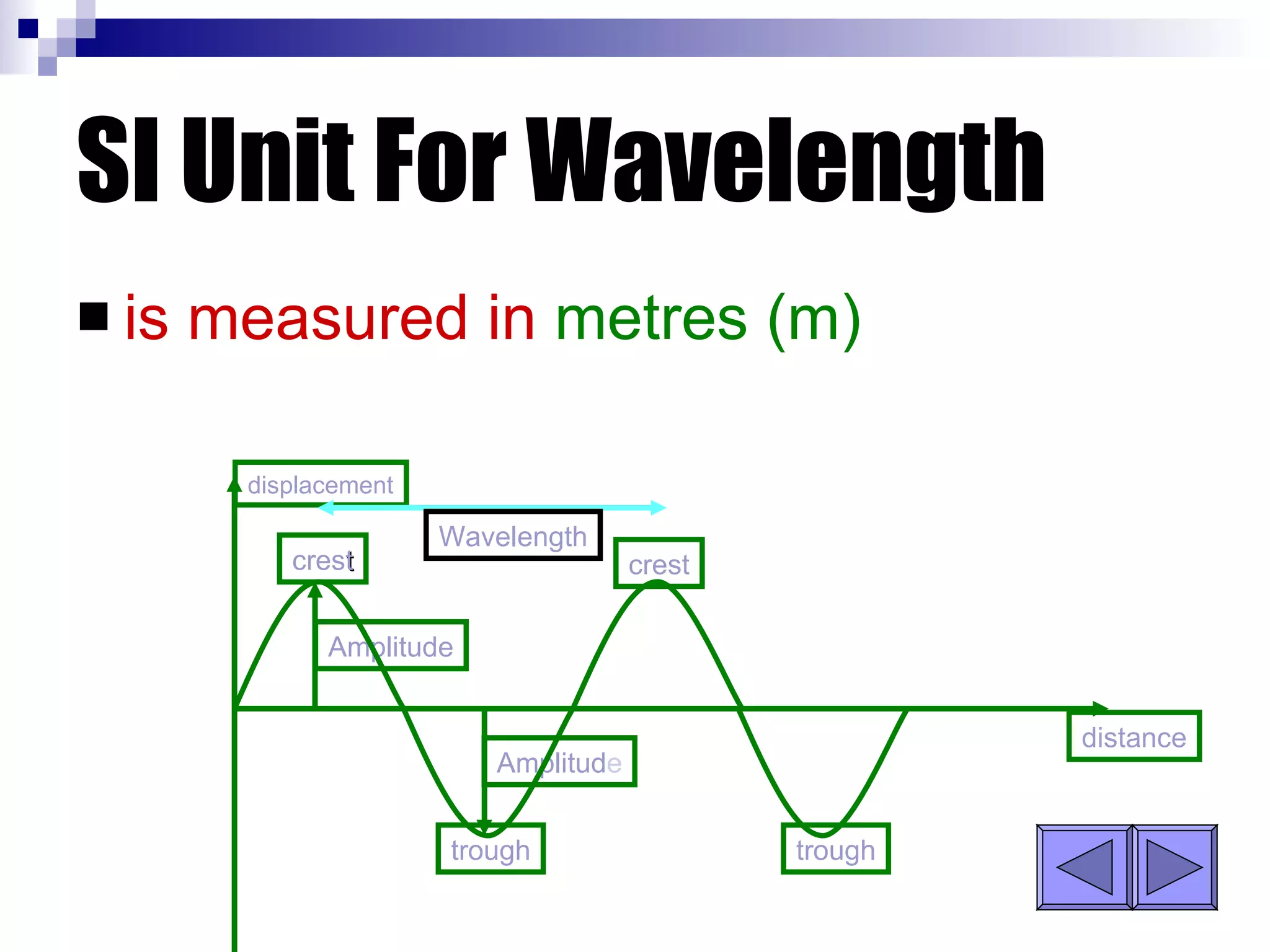
SI Unit For Wavelength is measured in  metres (m) displacement distance Amplitude Amplitud e cres t crest trough trough Wavelength
Frequency (f) is the   number of vibrations in one second.
SI Unit For Frequency is the  Hertz  (Hz) 1 Hz is 1 vibration in 1 second. 50 Hz is 50 vibrations in 1 second.
Test Yourselves Explain the meaning of 28  Hz, 100  Hz , 135  Hz, 1570 Hz .
Period (T) is the time taken for one complete vibration. (or oscillation or cycle)
SI Unit For Period is measured in second (s)
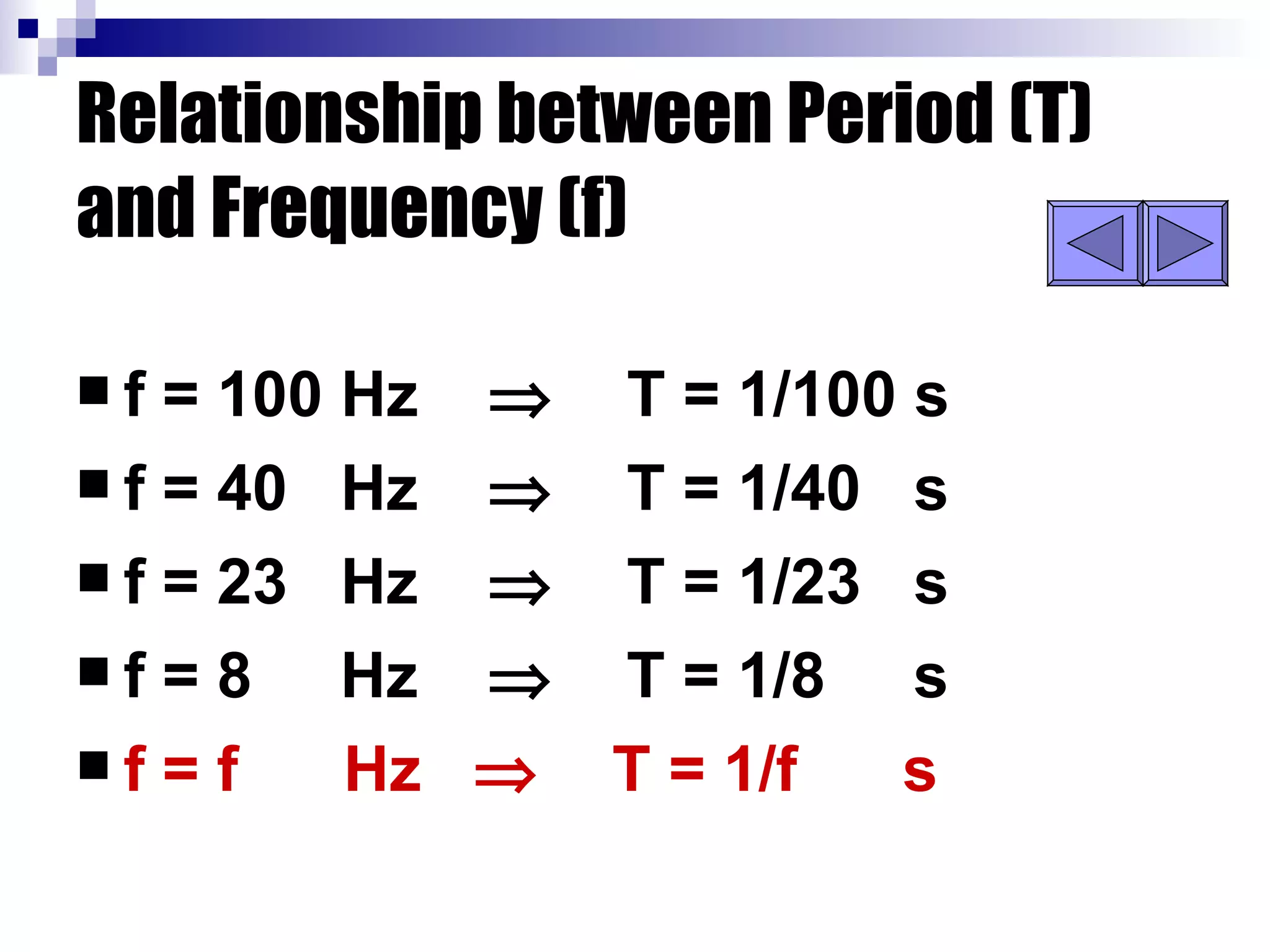
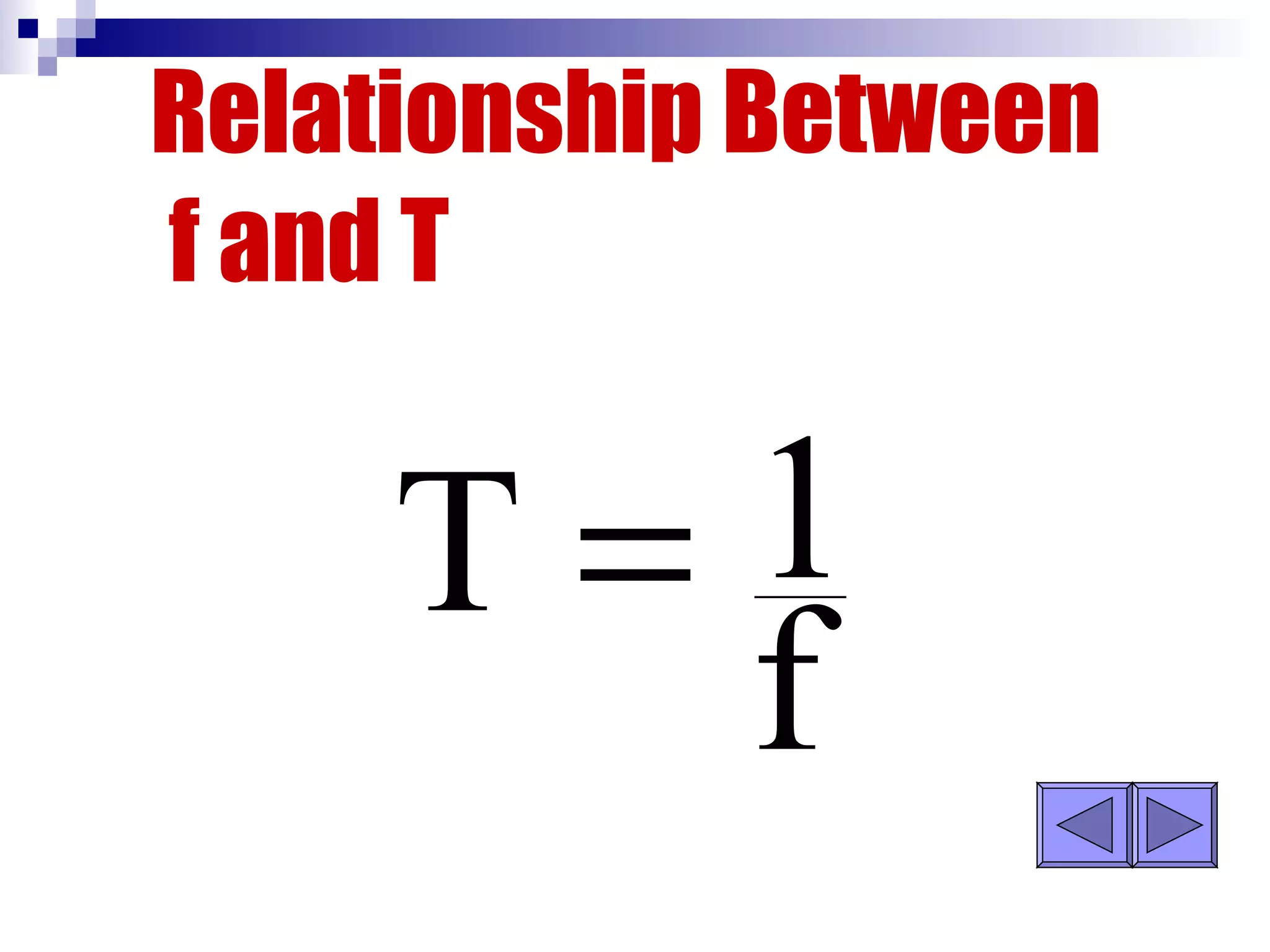
Relationship between Period (T) and Frequency (f) f = 100 Hz     T = 1/100 s f = 40  Hz     T = 1/40  s f = 23  Hz     T = 1/23  s f = 8  Hz     T = 1/8  s f = f  Hz     T = 1/f  s
Relationship Between  f and T
Speed Of a Wave is the distance moved in one second .
SI Unit For Speed is measured in metre per second (ms -1 or  m/s)
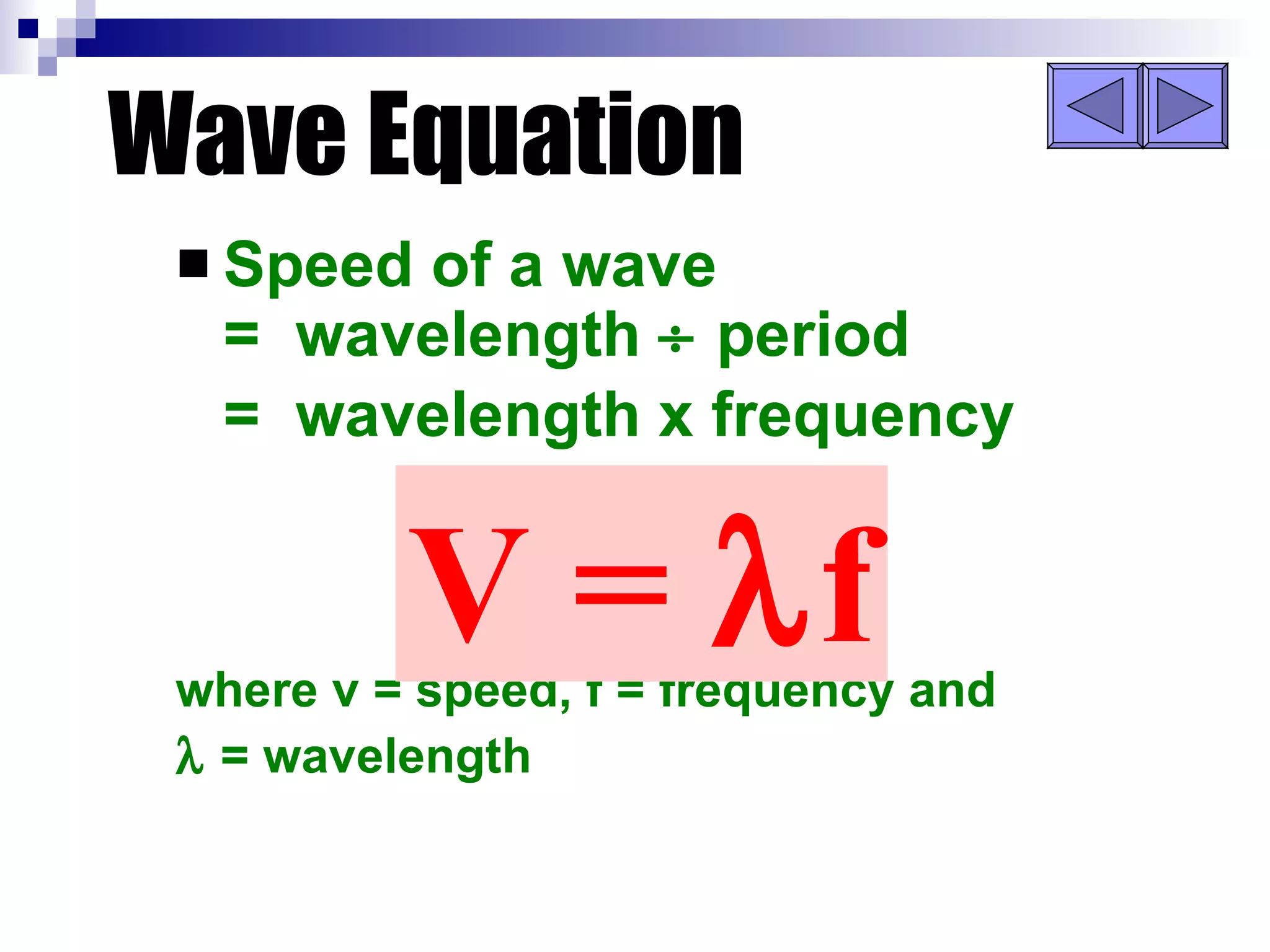
Wave Equation Speed of a wave =  wavelength    period =  wavelength x frequency where v = speed, f = frequency and    = wavelength V =   f
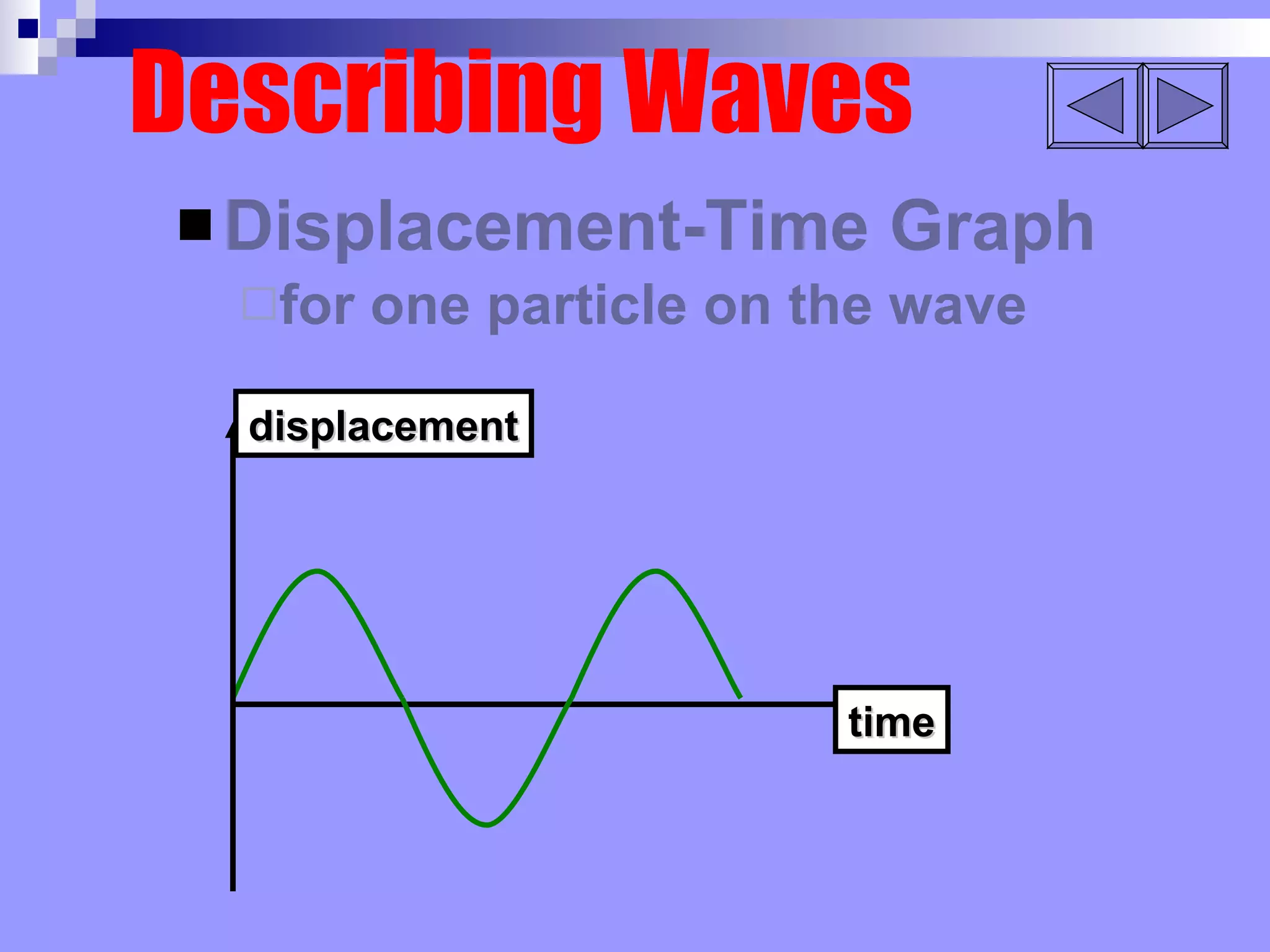
Describing Waves Displacement-Time Graph for one particle on the wave time displacement
GCE O-Level   Past Examination Paper Science (Physics)
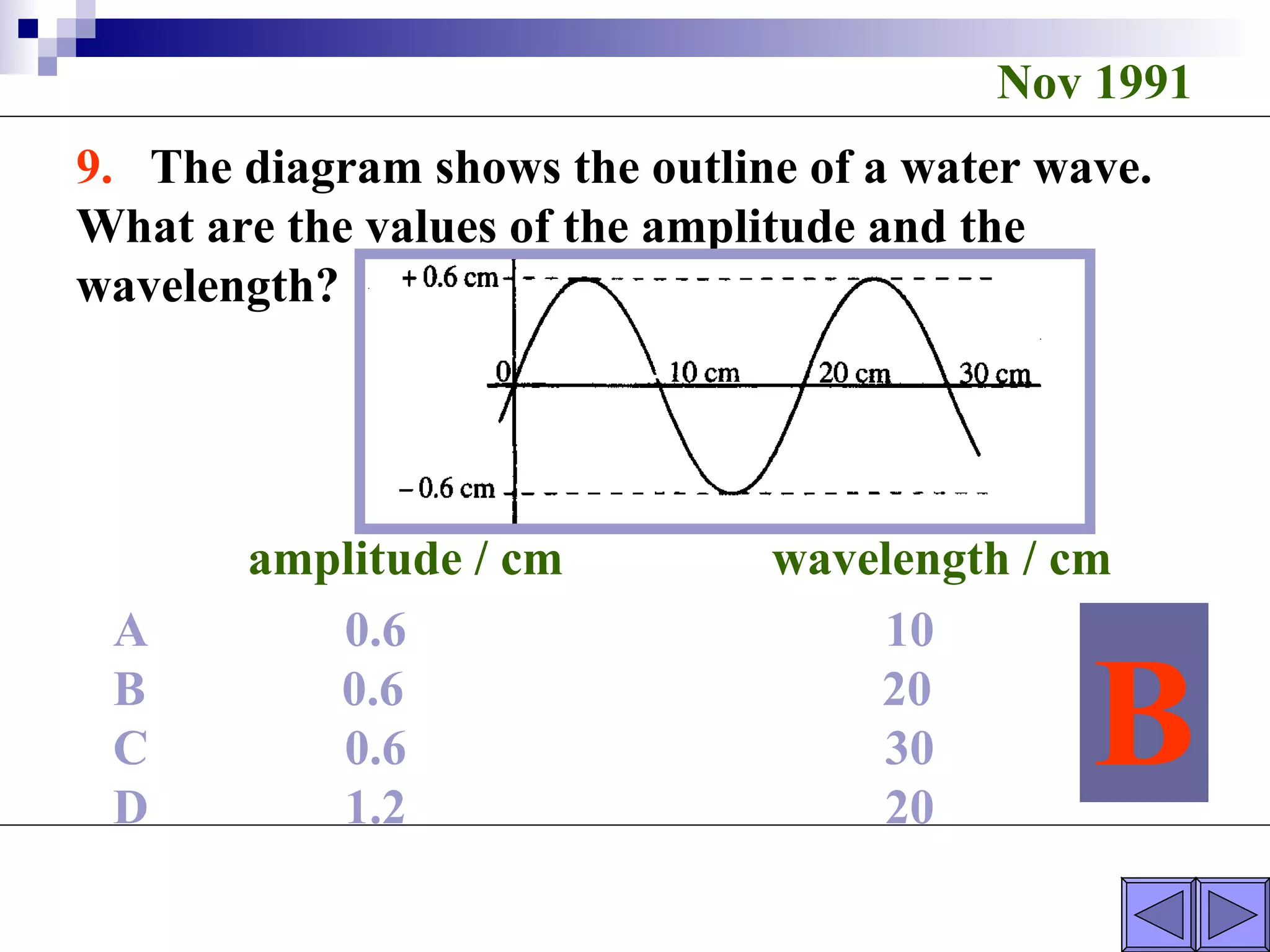
Nov 1991 9.  The diagram shows the outline of a water wave. What are the values of the amplitude and the wavelength?  amplitude / cm  wavelength / cm A  0.6  10 B  0.6  20 C  0.6  30 D  1.2  20 B
GCE  O  Nov  1994 11.  Which wave is longitudinal ? A  light B  radio C  sound D  water C
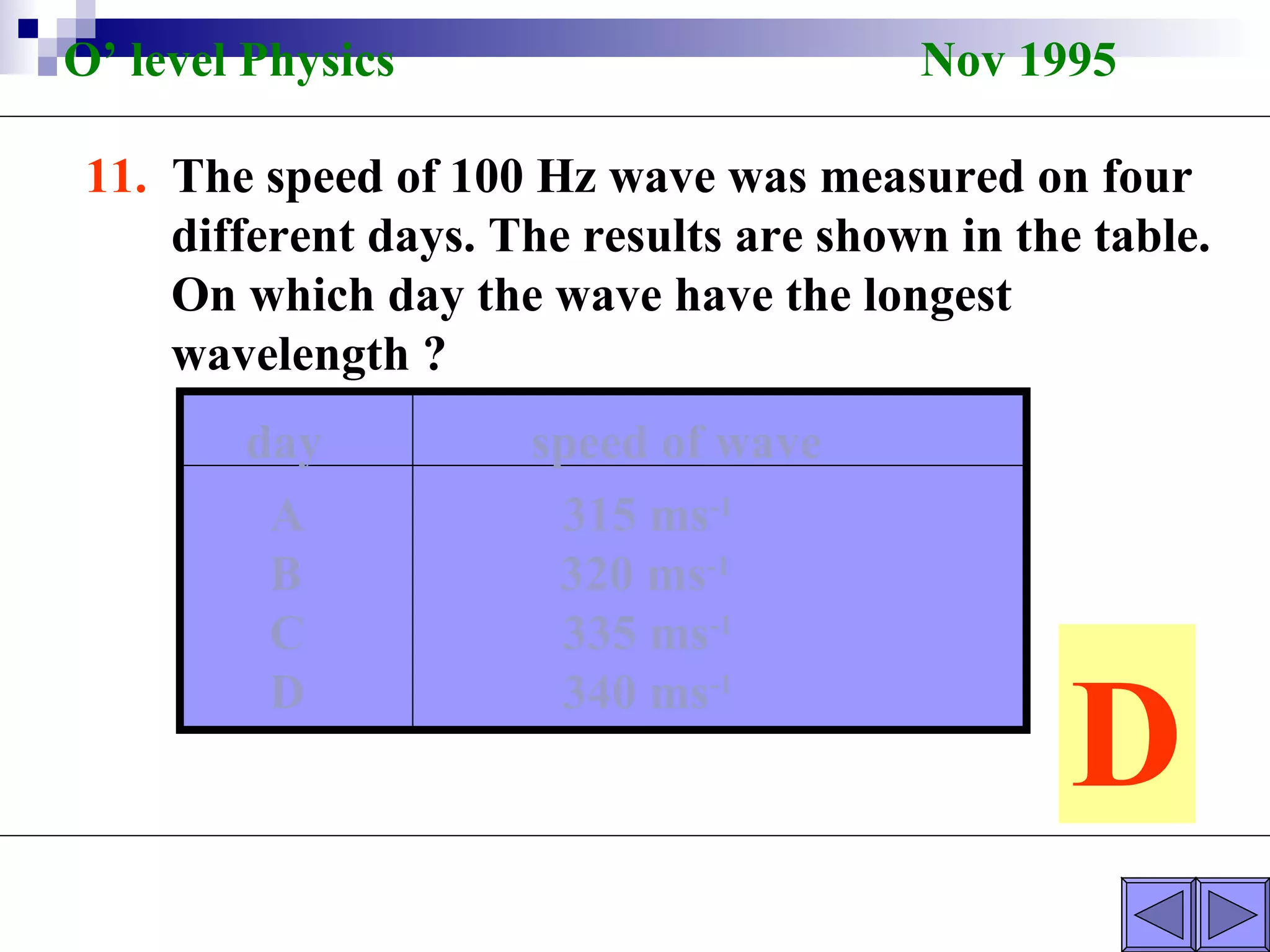
D O’ level Physics Nov 1995 11.  The speed of 100 Hz wave was measured on four different days. The results are shown in the table. On which day the wave have the longest  wavelength ? day  speed of wave A  315 ms -1 B  320 ms -1 C  335 ms -1 D  340 ms -1
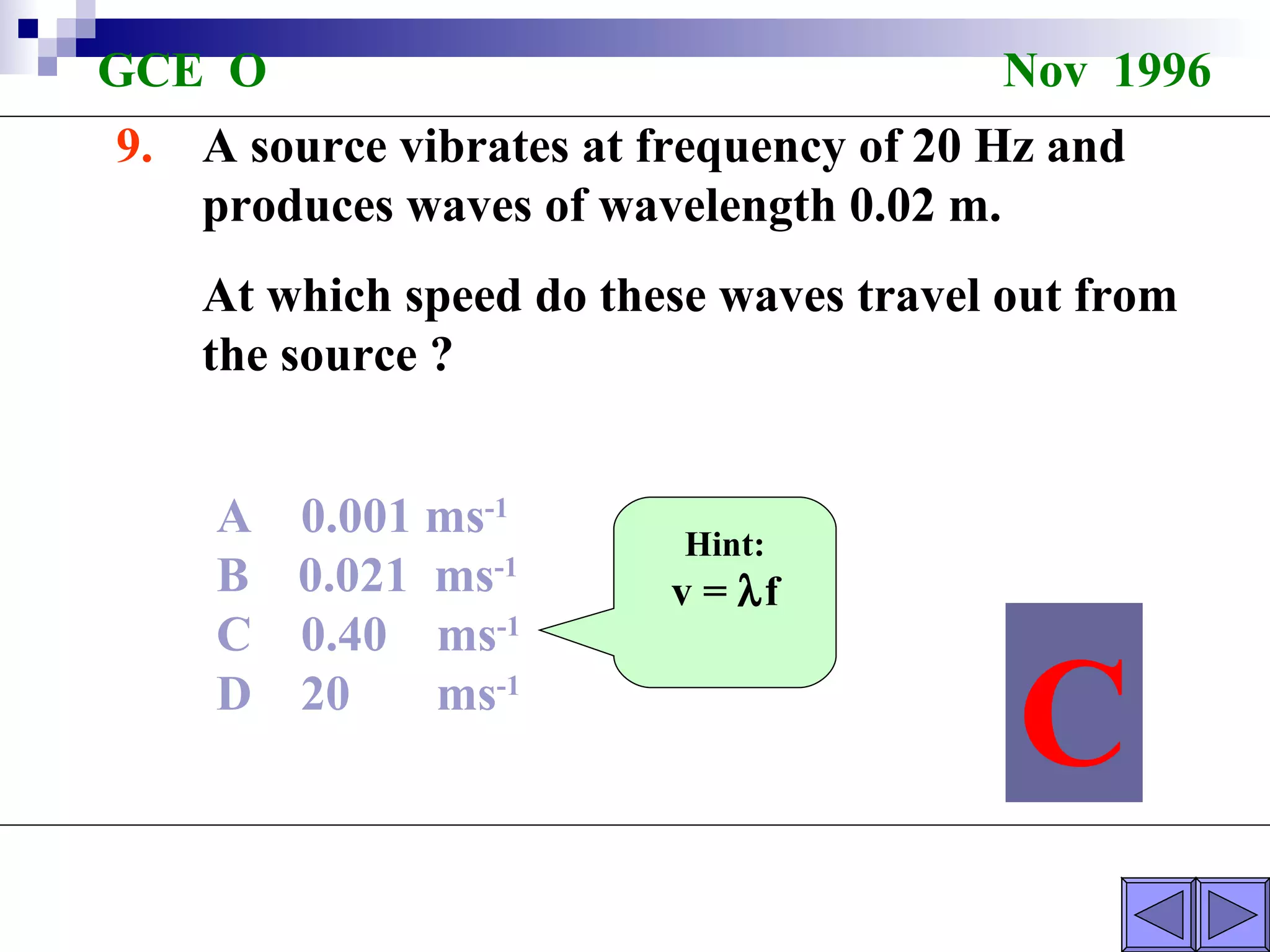
GCE  O  Nov  1996 9.  A source vibrates at frequency of 20 Hz and  produces waves of wavelength 0.02 m. At which speed do these waves travel out from the source ? A  0.001 ms -1   B  0.021  ms -1   C  0.40  ms -1   D  20  ms -1   C Hint: v =   f
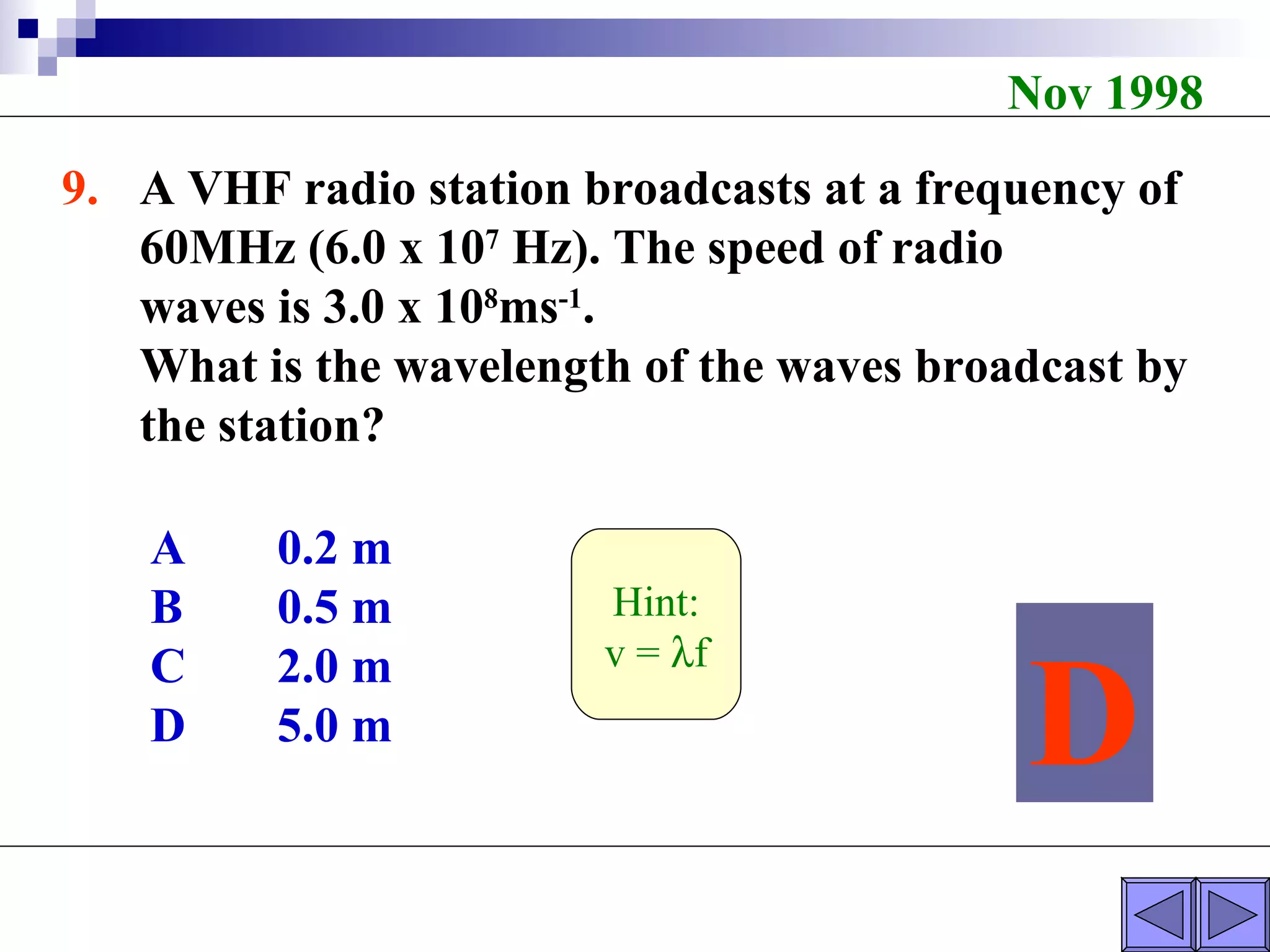
Nov 1998 9. A VHF radio station broadcasts at a frequency of  60MHz (6.0 x 10 7  Hz). The speed of radio  waves is 3.0 x 10 8 ms -1 . What is the wavelength of the waves broadcast by  the station? A 0.2 m B 0.5 m C 2.0 m D 5.0 m D Hint: v =   f
Nov 1998 5. The diagram shows a coil spring along which a  longitudinal wave is moving. (a)  Mark on the diagram a distance equal to the  wave length of the wave.  [1] (b)  Label on the diagram with the letter C where the coils of the spring are compressed.  [1] Wave length C (continue in next slide) C C
(c)  Is the wave on the spring more like a sound wave  or a light wave?  [1] Nov 1998 (Cont. …)  Q 5 Sound wave, because sound wave is a longitudinal wave but light wave is a transverse wave..
Nov 1997 5.   The diagram below shows a transverse wave travelling a rope. (a)  Mark on the diagram which is equal to  (i)  the wavelength,  (ii)  the amplitude of the wave. Label your answers.  [2]   (b)  If the wavelength is 0.8m and the frequency is 2 Hz, what is the speed at which the wave moves along the rope ?  [2] wavelength amplitude v =   f  = 0.8 x 2  =  1.6 ms -1
Nov 1996 6(a) Explain the difference between a transverse  and a longitudinal wave.  [2] (b) State one example of each type of wave. Transverse Longitudinal  [2] Light Sound Transverse  wave is a wave that its direction of vibration is perpendicular to the direction of propagation. It can travel through vacuum.  Longitudinal  wave is a wave that its direction of vibration is parallel to the direction of propagation. It needs medium to travel.
9.(a) Explain the difference between transverse and  longitudinal waves, referring in your answer to  the direction in which the waves travel.  [2] GCE ‘O’ LEVEL  Nov 1995 Transverse waves are waves that their direction of vibration is perpendicular to their direction of propagation.  Longitudinal  waves are waves that their direction of vibration is parallel to their direction of  propagation.  (continue on next slide)
9.(b)  The speed of sound in water is 1500m/s. What is a  wave length of a sound wave of frequency 250Hz  travelling through water ?  [2] Since  v =   f therefore  1500 =    250    = 1500 / 250 =  6.0 m (Cont. …)  Q. 9  Nov 1995
Nov 1993 6.  The diagram shows the air pressure at different  distances from a loudspeaker. (continue on next slide) (a)  Mark carefully on the diagram:  [2] (i)   a distance which is the wavelength of the  sound wave; (ii)  the amplitude of the sound waves.  wavelength amplitude
6(b)  If the wavelength of a sound wave of frequency  250 Hz is 1.4 m, calculate the speed of the wave. [2] (Cont. …)  Q. 6  Nov 1993 since  v =   f therefore,  =  1.4 x 250 =  350 ms -1
5.(a) With the aid of a diagram, explain what is meant  by the frequency and wavelength of a wave.  [5] GCE O  Nov 1990 (b)  What is a longitudinal wave ?  [2]  Frequency is the number of vibrations per second. Wavelength is the distance from a point on a  wave to its next corresponding point. It usually denote as   .. Longitudinal wave is a wave that its direction of vibration always parallel to the direction of propagation. (continue in next slide)

Longitudinal and transverse waves

  • 1.
  • 2.
  • 3.
    What are waves?A wave is a phenomenon in which energy is transferred through vibration.
  • 4.
    Types of WavesTransverse Waves Longitudinal Waves
  • 5.
    Transverse Waves arewaves which travel in a direction perpendicular to the direction of vibrations. Direction of vibrations Direction of wave
  • 6.
  • 7.
    Transverse Waves examplesinclude water waves rope waves light wave electromagnetic waves
  • 8.
    Longitudinal Waves arewaves which travel in a direction parallel to the direction of vibrations. examples include sound waves Direction of vibration Direction of wave
  • 9.
    Generating of LongitudinalWaves [slinky spring]
  • 10.
    Characteristics of AWave Crests and Troughs Amplitude Wavelength Frequency Period Speed
  • 11.
    Crests and TroughCrests are high point of a wave Troughs are low point of a wave trough displacement distance crest crest
  • 12.
    Amplitude (A) isthe height of a crest or depth of a trough measured from the normal undisturbed positions. displacement distance crest crest trough Amplitude Amplitude
  • 13.
    SI Unit ForAmplitude is measured in metres (m) displacement distance crest crest trough Amplitude Amplitud e
  • 14.
    Wavelength ( ) is the distance between two successive crests or troughs displacement distance Amplitude Amplitude crest crest trough trough Wavelength Wavelength
  • 15.
    SI Unit ForWavelength is measured in metres (m) displacement distance Amplitude Amplitud e cres t crest trough trough Wavelength
  • 16.
    Frequency (f) isthe number of vibrations in one second.
  • 17.
    SI Unit ForFrequency is the Hertz (Hz) 1 Hz is 1 vibration in 1 second. 50 Hz is 50 vibrations in 1 second.
  • 18.
    Test Yourselves Explainthe meaning of 28 Hz, 100 Hz , 135 Hz, 1570 Hz .
  • 19.
    Period (T) isthe time taken for one complete vibration. (or oscillation or cycle)
  • 20.
    SI Unit ForPeriod is measured in second (s)
  • 21.
    Relationship between Period(T) and Frequency (f) f = 100 Hz  T = 1/100 s f = 40 Hz  T = 1/40 s f = 23 Hz  T = 1/23 s f = 8 Hz  T = 1/8 s f = f Hz  T = 1/f s
  • 22.
  • 23.
    Speed Of aWave is the distance moved in one second .
  • 24.
    SI Unit ForSpeed is measured in metre per second (ms -1 or m/s)
  • 25.
    Wave Equation Speedof a wave = wavelength  period = wavelength x frequency where v = speed, f = frequency and  = wavelength V =  f
  • 26.
    Describing Waves Displacement-TimeGraph for one particle on the wave time displacement
  • 27.
    GCE O-Level Past Examination Paper Science (Physics)
  • 28.
    Nov 1991 9. The diagram shows the outline of a water wave. What are the values of the amplitude and the wavelength? amplitude / cm wavelength / cm A 0.6 10 B 0.6 20 C 0.6 30 D 1.2 20 B
  • 29.
    GCE O Nov 1994 11. Which wave is longitudinal ? A light B radio C sound D water C
  • 30.
    D O’ levelPhysics Nov 1995 11. The speed of 100 Hz wave was measured on four different days. The results are shown in the table. On which day the wave have the longest wavelength ? day speed of wave A 315 ms -1 B 320 ms -1 C 335 ms -1 D 340 ms -1
  • 31.
    GCE O Nov 1996 9. A source vibrates at frequency of 20 Hz and produces waves of wavelength 0.02 m. At which speed do these waves travel out from the source ? A 0.001 ms -1 B 0.021 ms -1 C 0.40 ms -1 D 20 ms -1 C Hint: v =  f
  • 32.
    Nov 1998 9.A VHF radio station broadcasts at a frequency of 60MHz (6.0 x 10 7 Hz). The speed of radio waves is 3.0 x 10 8 ms -1 . What is the wavelength of the waves broadcast by the station? A 0.2 m B 0.5 m C 2.0 m D 5.0 m D Hint: v =  f
  • 33.
    Nov 1998 5.The diagram shows a coil spring along which a longitudinal wave is moving. (a) Mark on the diagram a distance equal to the wave length of the wave. [1] (b) Label on the diagram with the letter C where the coils of the spring are compressed. [1] Wave length C (continue in next slide) C C
  • 34.
    (c) Isthe wave on the spring more like a sound wave or a light wave? [1] Nov 1998 (Cont. …) Q 5 Sound wave, because sound wave is a longitudinal wave but light wave is a transverse wave..
  • 35.
    Nov 1997 5. The diagram below shows a transverse wave travelling a rope. (a) Mark on the diagram which is equal to (i) the wavelength, (ii) the amplitude of the wave. Label your answers. [2] (b) If the wavelength is 0.8m and the frequency is 2 Hz, what is the speed at which the wave moves along the rope ? [2] wavelength amplitude v =  f = 0.8 x 2 = 1.6 ms -1
  • 36.
    Nov 1996 6(a)Explain the difference between a transverse and a longitudinal wave. [2] (b) State one example of each type of wave. Transverse Longitudinal [2] Light Sound Transverse wave is a wave that its direction of vibration is perpendicular to the direction of propagation. It can travel through vacuum. Longitudinal wave is a wave that its direction of vibration is parallel to the direction of propagation. It needs medium to travel.
  • 37.
    9.(a) Explain thedifference between transverse and longitudinal waves, referring in your answer to the direction in which the waves travel. [2] GCE ‘O’ LEVEL Nov 1995 Transverse waves are waves that their direction of vibration is perpendicular to their direction of propagation. Longitudinal waves are waves that their direction of vibration is parallel to their direction of propagation. (continue on next slide)
  • 38.
    9.(b) Thespeed of sound in water is 1500m/s. What is a wave length of a sound wave of frequency 250Hz travelling through water ? [2] Since v =  f therefore 1500 =  250  = 1500 / 250 = 6.0 m (Cont. …) Q. 9 Nov 1995
  • 39.
    Nov 1993 6. The diagram shows the air pressure at different distances from a loudspeaker. (continue on next slide) (a) Mark carefully on the diagram: [2] (i) a distance which is the wavelength of the sound wave; (ii) the amplitude of the sound waves. wavelength amplitude
  • 40.
    6(b) Ifthe wavelength of a sound wave of frequency 250 Hz is 1.4 m, calculate the speed of the wave. [2] (Cont. …) Q. 6 Nov 1993 since v =  f therefore, = 1.4 x 250 = 350 ms -1
  • 41.
    5.(a) With theaid of a diagram, explain what is meant by the frequency and wavelength of a wave. [5] GCE O Nov 1990 (b) What is a longitudinal wave ? [2]  Frequency is the number of vibrations per second. Wavelength is the distance from a point on a wave to its next corresponding point. It usually denote as  .. Longitudinal wave is a wave that its direction of vibration always parallel to the direction of propagation. (continue in next slide)