Wave PropertiesStudents will be able toExplain wave structureContrast transverse and longitudinal wavesDescribe properties of a wave
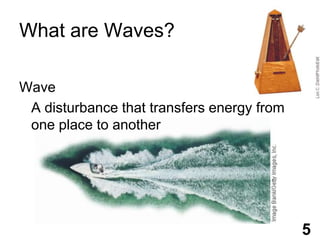
What are Waves?Wave	A disturbance that transfers energy from one place to another5
What Carries Waves?Medium	The material through which a wave travelsExamples: Liquids, Air, Solids…Mechanical Waves	Waves that need a mediumExamples: Water and SoundElectromagnetic Waves	Waves that do not need a medium	Light6
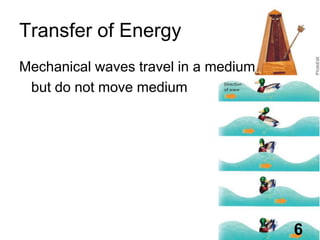
Transfer of EnergyMechanical waves travel in a medium	but do not move medium6
What Causes WavesA source of energy causes medium	to vibrate7
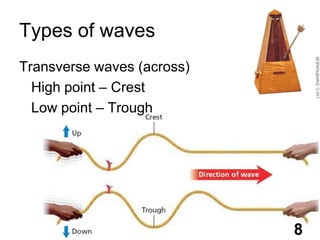
Types of wavesTransverse waves (across)	High point – Crest	Low point – Trough8
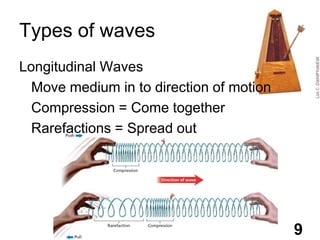
Types of wavesLongitudinal Waves 	Move medium in to direction of motion	Compression = Come togetherRarefactions = Spread out9
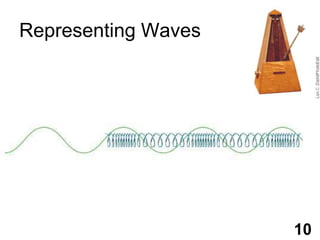
Representing Waves10
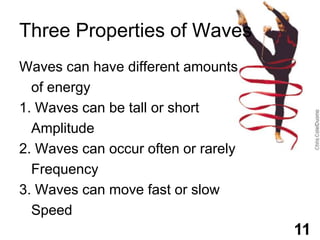
Three Properties of WavesWaves can have different amounts	of energy1. Waves can be tall or short	Amplitude2. Waves can occur often or rarely	Frequency3. Waves can move fast or slow	Speed11
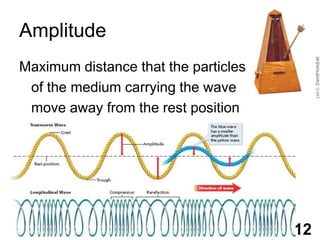
AmplitudeMaximum distance that the particles	of the medium carrying the wave	move away from the rest position12
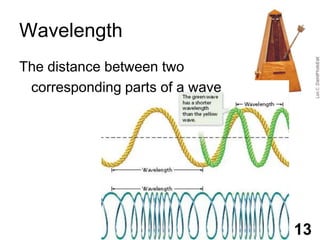
WavelengthThe distance between two	corresponding parts of a wave13
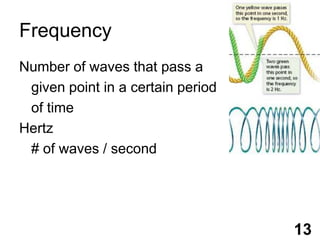
FrequencyNumber of waves that pass a	given point in a certain period	of timeHertz	# of waves / second13
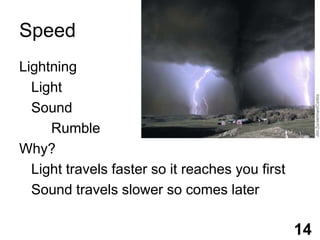
SpeedLightningLightSound	RumbleWhy?	Light travels faster so it reaches you first	Sound travels slower so comes later14
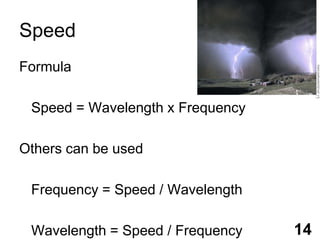
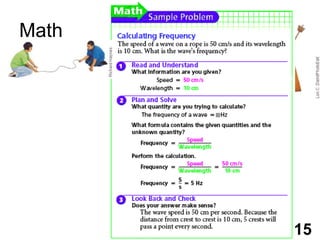
SpeedFormula	Speed = Wavelength x Frequency Others can be used	Frequency = Speed / Wavelength	Wavelength = Speed / Frequency14
Math15
HomeworkDraw and label a transverse and alongitudinal wave.

Wave Properties