Alvarez Beltran Enrique
Aguilar Tirado Jordan Onel
         Lau Solorio Mariel
Aviña Peña Raul Alejandro
   The genetic code is the
    set of rules by which
    information encoded in
    genetic material
    (DNA or
    mRNA sequences)
    is translated into protei
    ns (amino
    acid sequences) by
    living cells.
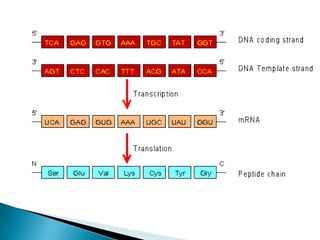
   The genetic code is the relation between the
    sequence of bases in DNA (or its RNA
    transcripts) and the sequence of amino acids
    in proteins.
   Not all genetic information is stored using the
    genetic code. All organisms' DNA contains
    regulatory sequences, intergenic
    segments, chromosomal structural areas, and
    other non-coding DNA that can contribute
    greatly to phenotype.
1.   Three nucleotides encode an amino acid.

2.   The code is nonoverlapping.

3.   The code has no punctuation.

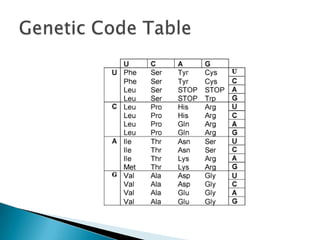
4.   The genetic code is degenerate.
Because the code is highly degenerate, only
tryptophan and methionine are encoded by
just one triplet each. Each of the other 18
amino acids is encoded by two or more.
Indeed, leucine, arginine, and serine are
specified by six codons each. The number of
codons for a particular amino acid correlates
with its frequency of occurrence in proteins.
Sequences of
three nucleotides that
specify which amino
acid will be added next
during protein
synthesis.
   Codons that specify the same amino acid.
     Note that synonyms are not distributed
    haphazardly throughout the genetic code.

   Most synonyms differ only in the last base of
    the triplet.
   If the code where not degenerate, 20 codons
    would designated amino acids and 44 would
    lead to chain termination.

   The probability of mutating to chain
    termination would therefore be much higher
    with a non degenerate code.
   mRNA is translated into proteins on
    ribosomes
   Start signal is complex in bacteria
   Polypeptide chains in bacteria start with a
    modified amino acid (formylmethionine, fMet)
   fMet recognizes the codon AUG or GUG
The base sequence of many wild-type and
mutant genes are known, as are the amino
acid sequences of their encoded proteins.
For each mutant, the nucleotide change in
the gene and the amino acid change in the
protein are as predicted by the genetic
code.
   Serious efforts to
    understand how proteins
    are encoded began after
    the structure of DNA was
    discovered by James
    Watson and Francis
    Crick, who used the
    experimental evidence of
    Maurice Wilkins and
    Rosalind Franklin (among
    others)
    George Gamow postulated
    that a three-letter code
    must be employed to
    encode the 20 standard
    amino acids used by living
    cells to encode proteins.
    With four different
    nucleotides, a code of 2
    nucleotides could only code
    for a maximum of 16 amino
    acids. A code of 3
    nucleotides could code for
    a maximum of 64 amino
    acids.
   The Crick, Brenner et al. experiment was the
    first to demonstrate that codons consist of
    three DNA bases.

   Marshall Nirenberg and Heinrich J.
    Matthaei were the first to elucidate the nature
    of a codon in 1961 at the National Institutes
    of Health.
   Biochemestry
    Sixth edition
  Jeremy M. Berg
  John L. Tymoczko
  Lubert Stryler
http://en.wikipedia.org/wiki/Genetic_code

The Genetic Code

  • 1.
    Alvarez Beltran Enrique AguilarTirado Jordan Onel Lau Solorio Mariel Aviña Peña Raul Alejandro
  • 2.
    The genetic code is the set of rules by which information encoded in genetic material (DNA or mRNA sequences) is translated into protei ns (amino acid sequences) by living cells.
  • 3.
    The genetic code is the relation between the sequence of bases in DNA (or its RNA transcripts) and the sequence of amino acids in proteins.  Not all genetic information is stored using the genetic code. All organisms' DNA contains regulatory sequences, intergenic segments, chromosomal structural areas, and other non-coding DNA that can contribute greatly to phenotype.
  • 4.
    1. Three nucleotides encode an amino acid. 2. The code is nonoverlapping. 3. The code has no punctuation. 4. The genetic code is degenerate.
  • 5.
    Because the codeis highly degenerate, only tryptophan and methionine are encoded by just one triplet each. Each of the other 18 amino acids is encoded by two or more. Indeed, leucine, arginine, and serine are specified by six codons each. The number of codons for a particular amino acid correlates with its frequency of occurrence in proteins.
  • 6.
    Sequences of three nucleotidesthat specify which amino acid will be added next during protein synthesis.
  • 7.
    Codons that specify the same amino acid. Note that synonyms are not distributed haphazardly throughout the genetic code.  Most synonyms differ only in the last base of the triplet.
  • 8.
    If the code where not degenerate, 20 codons would designated amino acids and 44 would lead to chain termination.  The probability of mutating to chain termination would therefore be much higher with a non degenerate code.
  • 10.
    mRNA is translated into proteins on ribosomes  Start signal is complex in bacteria  Polypeptide chains in bacteria start with a modified amino acid (formylmethionine, fMet)  fMet recognizes the codon AUG or GUG
  • 12.
    The base sequenceof many wild-type and mutant genes are known, as are the amino acid sequences of their encoded proteins. For each mutant, the nucleotide change in the gene and the amino acid change in the protein are as predicted by the genetic code.
  • 13.
    Serious efforts to understand how proteins are encoded began after the structure of DNA was discovered by James Watson and Francis Crick, who used the experimental evidence of Maurice Wilkins and Rosalind Franklin (among others)
  • 14.
    George Gamow postulated that a three-letter code must be employed to encode the 20 standard amino acids used by living cells to encode proteins. With four different nucleotides, a code of 2 nucleotides could only code for a maximum of 16 amino acids. A code of 3 nucleotides could code for a maximum of 64 amino acids.
  • 15.
    The Crick, Brenner et al. experiment was the first to demonstrate that codons consist of three DNA bases.  Marshall Nirenberg and Heinrich J. Matthaei were the first to elucidate the nature of a codon in 1961 at the National Institutes of Health.
  • 16.
    Biochemestry Sixth edition Jeremy M. Berg John L. Tymoczko Lubert Stryler http://en.wikipedia.org/wiki/Genetic_code