GENETIC CODE
Submitted By:-
SATHISH.K
2022002160
What is Genetic code???
• Genetic code is a dictionary that corresponds
with sequence of nucleotides and sequence of
amino acids.
• Genetic code is a set of rules by which
information encoded in genetic material(DNA
or RNA sequences) is translated into proteins
by living cells.
• Term given By ″ Goerge Gamow ʺ
DISCOVERY
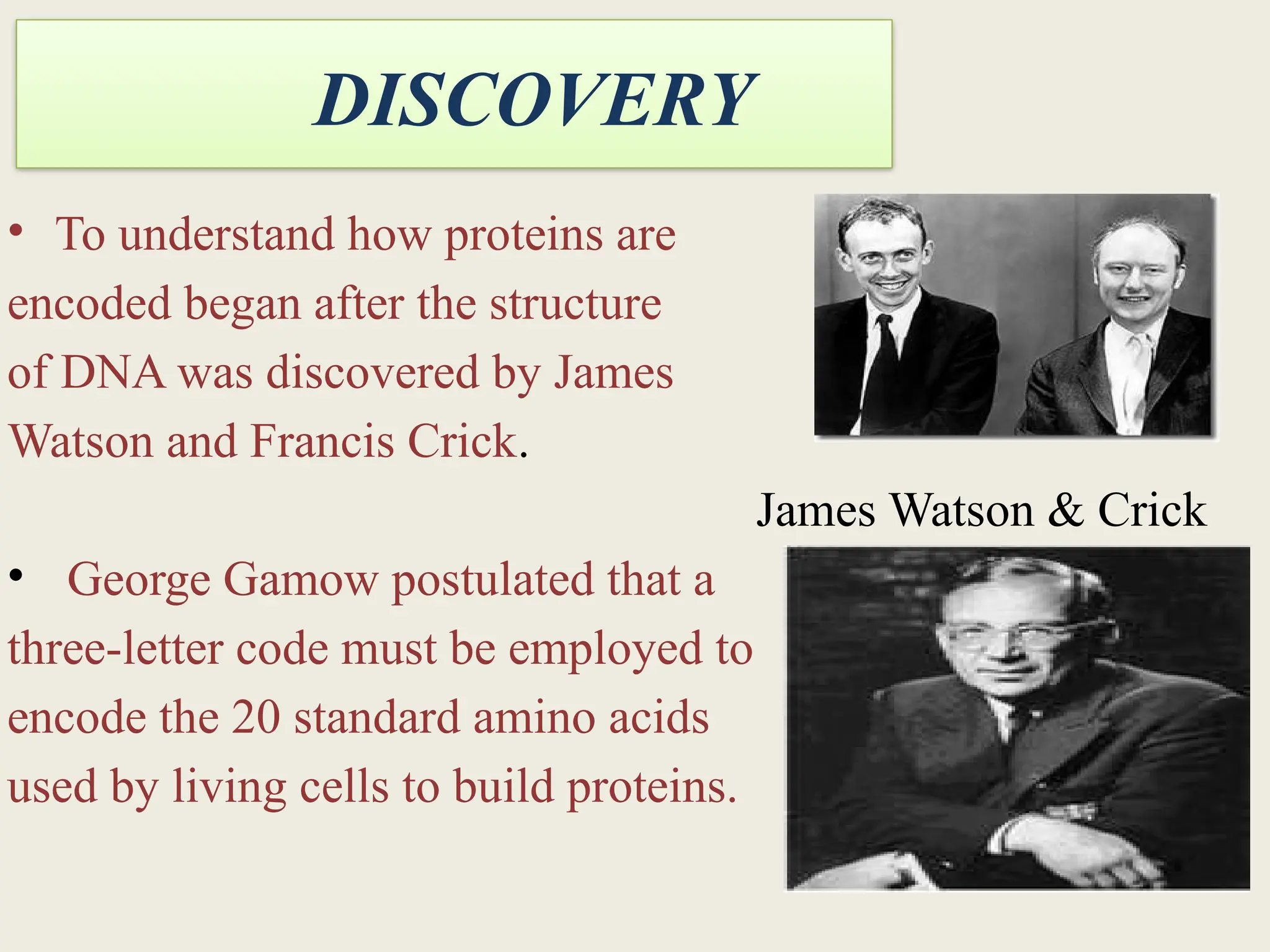
• To understand how proteins are
encoded began after the structure
of DNA was discovered by James
Watson and Francis Crick.
James Watson & Crick
• George Gamow postulated that a
three-letter code must be employed to
encode the 20 standard amino acids
used by living cells to build proteins.
Introduction of genetic code
• The letters A,G,T and C correspond to the
nucleotides found in DNA. They are organized into
codon.
• The collection of codons is called Genetics code.
• For 20 amino acids there should be 20 codons.
• Each codon should have 3 nucleotides to impart
specificity to each of the amino acid for a specific
codon.
1 nucleotide – 4 combinations
2 nucleotide-16 combinations
3nucleotide- 64 combinations( most suited for 20 amino
acids)
Genetic code can be expressed
in a simple table with 64 entries
Codon and its type
• Genetic code is a Dictionary consists of
“Genetic words” called CODONS.
• Each codon consists of three bases (triplet)
• There are 64 codons.
• 61 codons code for 20 amino acids found in
protein.
• 3 codons do not code for any amino acid.
Type of codon
 Sense Codons
 Signal Codons
• Start codons
• Stop codons
 Sense codon:- The codon that code for amino
acid are called sense codon.
 Signal codon:- Those codons that code for
signal during protein synthesis
are called signal codons.
For Example:- AUG, UAA, UAG &
UGA
conti…..
“Terminating Codons”
UAA, UAG & UGA are termination codons or
nonsense codons & are often referred to as amber, ochre
& opal codons.
“Initiating codon”
AUG is the initiation codon. It codes for the first amino
acid in all proteins.
At the starting point it codes for methionine in
eukaryotes & formyl methionine in prokaryotes.
ANTICODON
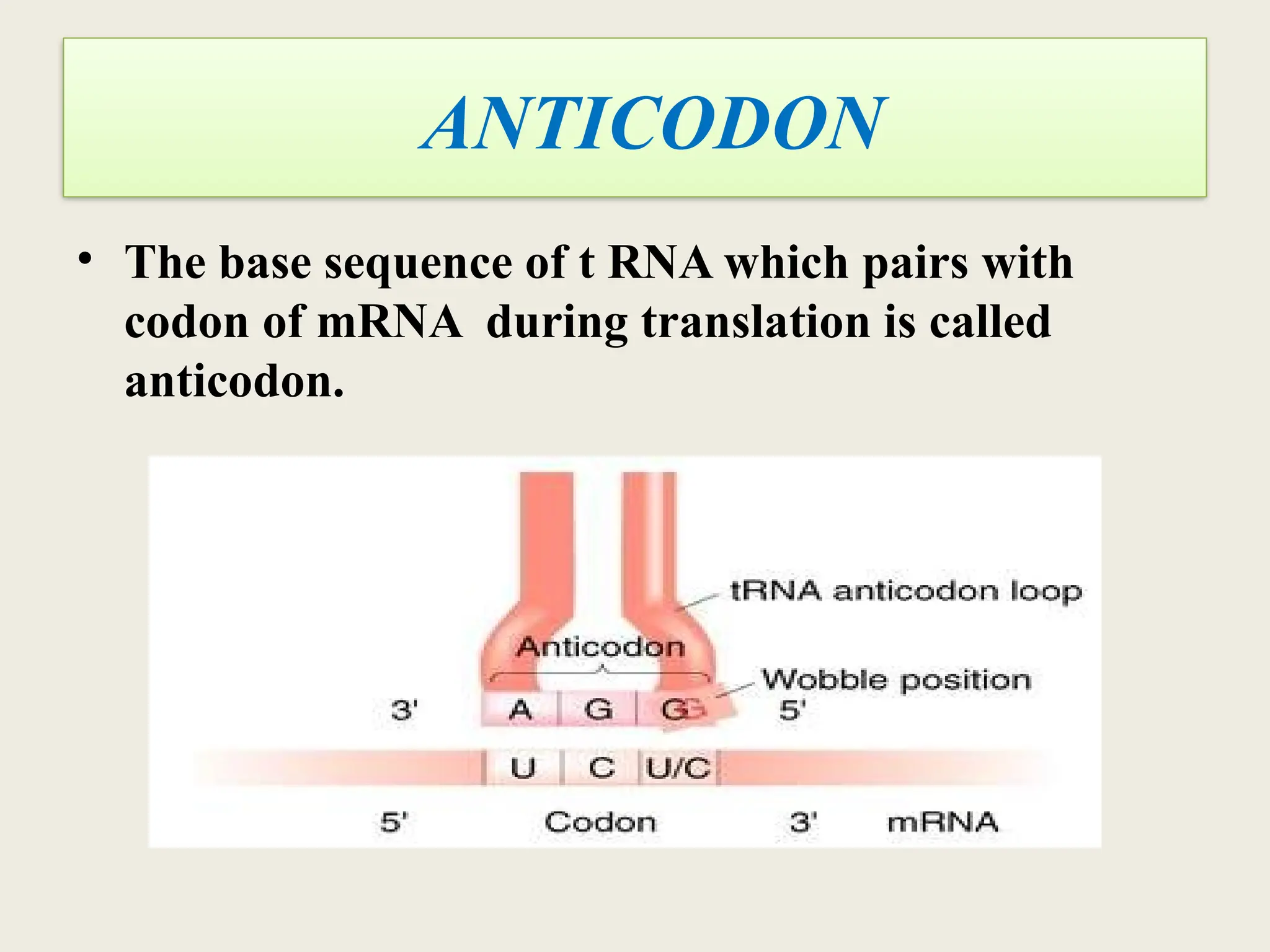
• The base sequence of t RNA which pairs with
codon of mRNA during translation is called
anticodon.
Characteristic of the genetic code
1. Triplet code
2. Comma less
3. Nonoverlapping code
4. The coding dictionary
5. Degenerate code
6. Universality of code
7. Non ambiguous code
8. Chain inition code
9. Chain termination codons
“Genetic code is triplet”
• The genetic code is triplet. There are 64 codons.
“Universality”
• The genetic code is universal.
• AUG is the codon for methionine in mitochondria. The
same codon (AUG) codes for isoleucine in cytoplasm.
With some exceptions noted the genetic code is universal.
“ Non-Ambiguous”
• The genetic code is non-ambiguous.
• Thus one codon can not specify more than one amino
acid.
“Non-overlapping”
• One base cannot participate in the formation of more than
one codon.
• This means that the code is non-overlapping.
“Continuous Translation”
• The gene is transcribed & translated continuously from a
fixed starting point to a fixed stop point.
• Punctuations are not present between the codons.
“The code has polarity”
• The code has a definite direction for reading of message
which is referred to as polarity.
• Reading of message from left to right & right to left will
specify for different amino acids.
• For Example UUG stands for leucine, & from right to left it
is GUU which stands for valine.
Degeneracy of genetic code
• An amino acid can be coded for by more than one
codon. This is called degeneracy of genetic code.
Wobble hypothesis
• Crick postulated the ‘wobble hypothesis’ to
account for the degeneracy of genetic code.
According this hypothesis, the first two bases of a
codon pair according to the normal base pairing
rules with the last two bases of the anticodon.
Base-pairing at the third position of a codon is
wobble
Wobble hypothesis explains
degeneracy
• Wobble hypothesis explains the
degeneracy of the genetic code, i.e,
existence of multiple codons for a single
amino acid. Although there are 61 codons
for amino acids, the number of tRNA is
far less (around 40)which is due to
wobbling.
CLINIC SIGNIFICANCE
• Mutation can be well explained using the genetic
code.
• A) Point Mutations
1) Silent
2) Misense
3) Nonsense
• B) Frame shift mutations
APPLICATIONS
Genetic code applications are numerous and
diverse, transforming various fields
Biotechnology
1. Genetic engineering 2. Gene therapy
3.Biopharmaceuticals
Agriculture
1. Crop improvement 2. Plant breeding.
3. Precision agriculture
Medicine
1. Genetic testing 2. Personalizedmedicine.
3. Gene editing
Forensic Science
1. DNA fingerprinting 2. Paternity testing.
3. Genetic profiling
Others
Conservation biology,Synthetic
Biology,Pharmaceuticals,Data Analysis and
Computing
Conclusion
• The genetic code is a remarkable, complex
system underlying life’s diversity. Continued
research and innovation will unlock new
applications, transforming our understanding
of life and improving human well-being
Detailed account on Genetic code Pbg.pptx

Detailed account on Genetic code Pbg.pptx

  • 1.
  • 2.
    What is Geneticcode??? • Genetic code is a dictionary that corresponds with sequence of nucleotides and sequence of amino acids. • Genetic code is a set of rules by which information encoded in genetic material(DNA or RNA sequences) is translated into proteins by living cells. • Term given By ″ Goerge Gamow ʺ
  • 3.
    DISCOVERY • To understandhow proteins are encoded began after the structure of DNA was discovered by James Watson and Francis Crick. James Watson & Crick • George Gamow postulated that a three-letter code must be employed to encode the 20 standard amino acids used by living cells to build proteins.
  • 4.
    Introduction of geneticcode • The letters A,G,T and C correspond to the nucleotides found in DNA. They are organized into codon. • The collection of codons is called Genetics code. • For 20 amino acids there should be 20 codons. • Each codon should have 3 nucleotides to impart specificity to each of the amino acid for a specific codon. 1 nucleotide – 4 combinations 2 nucleotide-16 combinations 3nucleotide- 64 combinations( most suited for 20 amino acids)
  • 6.
    Genetic code canbe expressed in a simple table with 64 entries
  • 7.
    Codon and itstype • Genetic code is a Dictionary consists of “Genetic words” called CODONS. • Each codon consists of three bases (triplet) • There are 64 codons. • 61 codons code for 20 amino acids found in protein. • 3 codons do not code for any amino acid.
  • 8.
    Type of codon Sense Codons  Signal Codons • Start codons • Stop codons  Sense codon:- The codon that code for amino acid are called sense codon.  Signal codon:- Those codons that code for signal during protein synthesis are called signal codons. For Example:- AUG, UAA, UAG & UGA
  • 9.
    conti….. “Terminating Codons” UAA, UAG& UGA are termination codons or nonsense codons & are often referred to as amber, ochre & opal codons. “Initiating codon” AUG is the initiation codon. It codes for the first amino acid in all proteins. At the starting point it codes for methionine in eukaryotes & formyl methionine in prokaryotes.
  • 10.
    ANTICODON • The basesequence of t RNA which pairs with codon of mRNA during translation is called anticodon.
  • 11.
    Characteristic of thegenetic code 1. Triplet code 2. Comma less 3. Nonoverlapping code 4. The coding dictionary 5. Degenerate code 6. Universality of code 7. Non ambiguous code 8. Chain inition code 9. Chain termination codons
  • 12.
    “Genetic code istriplet” • The genetic code is triplet. There are 64 codons.
  • 13.
    “Universality” • The geneticcode is universal. • AUG is the codon for methionine in mitochondria. The same codon (AUG) codes for isoleucine in cytoplasm. With some exceptions noted the genetic code is universal. “ Non-Ambiguous” • The genetic code is non-ambiguous. • Thus one codon can not specify more than one amino acid.
  • 14.
    “Non-overlapping” • One basecannot participate in the formation of more than one codon. • This means that the code is non-overlapping. “Continuous Translation” • The gene is transcribed & translated continuously from a fixed starting point to a fixed stop point. • Punctuations are not present between the codons.
  • 15.
    “The code haspolarity” • The code has a definite direction for reading of message which is referred to as polarity. • Reading of message from left to right & right to left will specify for different amino acids. • For Example UUG stands for leucine, & from right to left it is GUU which stands for valine.
  • 16.
    Degeneracy of geneticcode • An amino acid can be coded for by more than one codon. This is called degeneracy of genetic code.
  • 17.
    Wobble hypothesis • Crickpostulated the ‘wobble hypothesis’ to account for the degeneracy of genetic code. According this hypothesis, the first two bases of a codon pair according to the normal base pairing rules with the last two bases of the anticodon. Base-pairing at the third position of a codon is wobble
  • 18.
    Wobble hypothesis explains degeneracy •Wobble hypothesis explains the degeneracy of the genetic code, i.e, existence of multiple codons for a single amino acid. Although there are 61 codons for amino acids, the number of tRNA is far less (around 40)which is due to wobbling.
  • 19.
    CLINIC SIGNIFICANCE • Mutationcan be well explained using the genetic code. • A) Point Mutations 1) Silent 2) Misense 3) Nonsense • B) Frame shift mutations
  • 20.
    APPLICATIONS Genetic code applicationsare numerous and diverse, transforming various fields Biotechnology 1. Genetic engineering 2. Gene therapy 3.Biopharmaceuticals Agriculture 1. Crop improvement 2. Plant breeding. 3. Precision agriculture
  • 21.
    Medicine 1. Genetic testing2. Personalizedmedicine. 3. Gene editing Forensic Science 1. DNA fingerprinting 2. Paternity testing. 3. Genetic profiling Others Conservation biology,Synthetic Biology,Pharmaceuticals,Data Analysis and Computing
  • 22.
    Conclusion • The geneticcode is a remarkable, complex system underlying life’s diversity. Continued research and innovation will unlock new applications, transforming our understanding of life and improving human well-being