 Acts as an intermediary, carrying genetic information from the DNA to the
machinery of protein synthesis.
 Synthesizes all types of RNA in the cell. Inhibited by rifampicin and
Actinomycin D binds to the DNA preventing transcription.
 Performs the same reaction in all cells, from bacteria to humans. Made up
of multiple subunits.
 In cells , RNAP is necessary for constructing RNA chains using DNA genes
as templates, a process called transcription.
 RNAP is a nucleotidyl transferase that polymerises ribonucleotides at the 3’
end of an RNA transcript.
 RNA Polymerase can be isolated
By a phosphocellulose column
By glycerol gradient centrifugation
By a DNA column
By an ion chromatography column
 RNAP was discovered independently by Charles Loe, Audrey Stevens, and Jerard
Hurwitz in 1960. By this time, one half of the 1959 Noble Prize in Medicine had been
awarded to Severo ochoa for the discovery of what was believed to be RNAP.
 The 2006 Nobel Prize in Chemistry was awarded to Roger D. Kornberg for creating
detailed molecular images of RNA polymerase during various stages of the transcription
process.
 Using Yeast, Kornberg identified the role of RNA polymerase II and other proteins in
transcribing DNA, and he created three-dimensional images of the protein cluster using
X-Ray crystallography. Polymerase II is used by all organisms with nuclei, including
humans, to transcribe DNA.
 Kornberg's research group at Stanford later succeeded in the development of a faithful
transcription system from baker’s yeast, a simple unicellular eukaryote, which they
then used to isolate in a purified form all of the several dozen proteins required for the
transcription process.
 Using this system, Kornberg made the major discovery that transmission of gene
regulatory signals to the RNA polymerase machinery is accomplished by an additional
protein complex that they dubbed Mediator. The discovery of Mediator is therefore a
true milestone in the understanding of the transcription process.
 He devoted two decades to the development of methods to visualize the atomic structure
of RNA polymerase and its associated protein components.
 Kornberg took advantage of expertise with lipid membranes gained from his graduate
studies to devise a technique for the formation of two-dimensional protein crystals on
lipid bilayers. These 2D crystals could then be analyzed using electron microscopy to
derive low-resolution images of the protein's structure. Eventually, Kornberg was able to
use X-Ray crystallography to solve the 3- Dimensional structure of RNA polymerase
at atomic resolution.
 He has recently extended these studies to obtain structural images of RNA polymerase
associated with accessory proteins.
Messenger RNA
Non-coding RNA or "RNA genes
Transfer RNA
Ribosomal RNA
Micro RNA
Catalytic RNA (Ribozyme)
 RNAP accomplishes de novo synthesis. It is able to do this because
specific interactions with the initiating nucleotide hold RNAP rigidly
in place, facilitating chemical attack on the incoming nucleotide-
RNAP prefers to start transcripts with ATP (followed by GTP, UTP,
and then CTP). In contrast to DNAP, RNAP includes
helicase activity, no separate enzyme is needed to unwind DNA.
Prokaryotic Eukaryotic
Bacterial Archaeal RNAP Ⅰ RNAP Ⅱ RNAP Ⅲ
Core Core (Pol Ⅰ ) (Pol Ⅱ) (Pol Ⅲ)
β‘ A’/A” RPC1 RPB1 RPC1
β B RPA2 RPB2 RPC5
α’ D RPC5 RPB3 RPC5
α“ L RPC9 RPB11 RPC6
ω K RPB6 RPB6 RPB6
[+6 other] [+9 others] [+7 others] [+11 others]
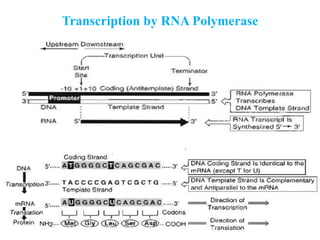
Transcription by RNA Polymerase
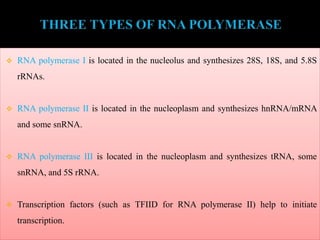
 RNA polymerase I is located in the nucleolus and synthesizes 28S, 18S, and 5.8S
rRNAs.
 RNA polymerase II is located in the nucleoplasm and synthesizes hnRNA/mRNA
and some snRNA.
 RNA polymerase III is located in the nucleoplasm and synthesizes tRNA, some
snRNA, and 5S rRNA.
 Transcription factors (such as TFIID for RNA polymerase II) help to initiate
transcription.
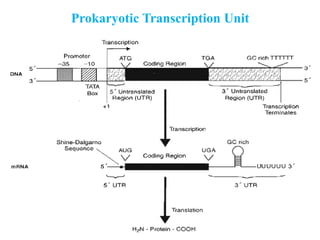
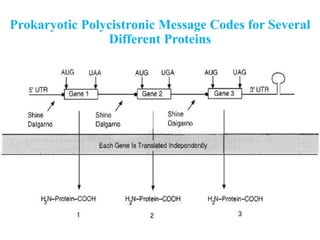
Prokaryotic Transcription Unit
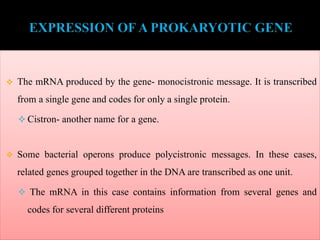
 The mRNA produced by the gene- monocistronic message. It is transcribed
from a single gene and codes for only a single protein.
 Cistron- another name for a gene.
 Some bacterial operons produce polycistronic messages. In these cases,
related genes grouped together in the DNA are transcribed as one unit.
 The mRNA in this case contains information from several genes and
codes for several different proteins
Prokaryotic Polycistronic Message Codes for Several
Different Proteins
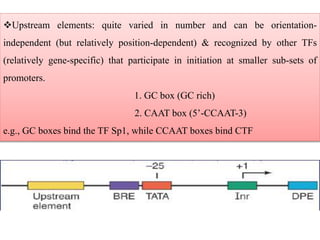
Upstream elements: quite varied in number and can be orientation-
independent (but relatively position-dependent) & recognized by other TFs
(relatively gene-specific) that participate in initiation at smaller sub-sets of
promoters.
1. GC box (GC rich)
2. CAAT box (5’-CCAAT-3)
e.g., GC boxes bind the TF Sp1, while CCAAT boxes bind CTF
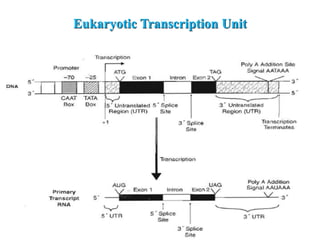
Eukaryotic Transcription Unit
 Enhancers: Increase the amount of Transcription from a nearby
promoter (core + upstream elements)
 Silencers: Decrease amount of Transcription from nearby promoters
 Initially Defined as being “Position and orientation independent”
Found upstream, within, or downstream of genes
Function in either orientation.
 RNA polymerase dissociates the RNA transcript from the DNA as it
is transcribed.
 Multiple RNA polymerase can transcribe the same gene at the same
time
 A cell can synthesize a large number of RNA transcripts in a short
time.
 Glen M Borchert et al; demonstrated that mammalian microRNA expression requires RNAP II.
However, the transcriptional requirements of many miRNAs remain untested.
 Genomic analysis of miRNAs in the human chromosome19 miRNA cluster (C19MC) revealed that
they are interspersed among Alu repeats.
 Because Alu transcription occurs through RNAP III recruitment, and they found that Alu elements
upstream of C19MC miRNAs retain sequences important for Pol III activity, they tested the promoter
requirements of C19MC miRNAs.
 Chromatin immunoprecipitation and cell-free transcription assays showed that Pol III, but not Pol II, is
associated with miRNA genomic sequence and sufficient for transcription
 The mature miRNA sequences of approximately 50 additional human miRNAs lie within Alu and other
known repetitive elements.
 Benjamin Albert et al; showed that the Rpa49 and Rpa34 Pol I subunits, which
do not have counterparts in Pol II and Pol III complexes, are functionally conserved
using heterospecific complementation of the human and Schizosaccharomyces
pombe orthologues in Saccharomyces cerevisiae.
 Deletion of RPA49 leads to the disappearance of nucleolar structure, but nucleolar
assembly can be restored by decreasing ribosomal gene copy number from 190 to
25.
 Statistical analysis of Miller spreads in the absence of Rpa49 demonstrates a
fourfold decrease in Pol I loading rate per gene an decreased contact between
adjacent Pol I complexes.
 Michael Thomm et al; presented the crystal structure of the complete Pol II–B complex
at 4.3A° resolution, and complementary functional data. The mechanism of transcription
initiation, including the transition to RNA elongation. Promoter DNA is positioned over
the Pol II active centre cleft with the ‘B-core’ domain that binds the wall at the end of
the cleft.
 DNA is then opened with the help of the ‘B-linker’ that binds the Pol II rudder and
clamp coiled-coil at the edge of the cleft. The DNA template strand slips into the cleft
and is scanned for the transcription start site with the help of the ‘B-reader’ that
approaches the active site.
 Synthesis of the RNA chain and rewinding of upstream DNA displace the B-reader and
B-linker, respectively, to trigger B release and elongation complex formation.
 The effects of different active site NTPs in both open and closed trigger loop (TL)
structures of RNAPs are compared. Unfavorable initial binding of mismatched
substrates in the active site with an open TL.
 The closing motion of the TL, required for catalysis, is hindered by the presence of
mismatched NTPs. Mismatched NTPs- conformational changes in the active site, which
perturb the coordination of Mg ions and affect the ability to proceed with catalysis.
 Structural perturbations in the template DNA and the nascent RNA in the presence of
mismatches- hinder nucleotide addition and provide the structural foundation for
backtracking followed by removing erroneously incorporated nucleotides during
proofreading.

Rna polymerase

  • 2.
     Acts asan intermediary, carrying genetic information from the DNA to the machinery of protein synthesis.  Synthesizes all types of RNA in the cell. Inhibited by rifampicin and Actinomycin D binds to the DNA preventing transcription.  Performs the same reaction in all cells, from bacteria to humans. Made up of multiple subunits.  In cells , RNAP is necessary for constructing RNA chains using DNA genes as templates, a process called transcription.  RNAP is a nucleotidyl transferase that polymerises ribonucleotides at the 3’ end of an RNA transcript.
  • 3.
     RNA Polymerasecan be isolated By a phosphocellulose column By glycerol gradient centrifugation By a DNA column By an ion chromatography column
  • 4.
     RNAP wasdiscovered independently by Charles Loe, Audrey Stevens, and Jerard Hurwitz in 1960. By this time, one half of the 1959 Noble Prize in Medicine had been awarded to Severo ochoa for the discovery of what was believed to be RNAP.  The 2006 Nobel Prize in Chemistry was awarded to Roger D. Kornberg for creating detailed molecular images of RNA polymerase during various stages of the transcription process.  Using Yeast, Kornberg identified the role of RNA polymerase II and other proteins in transcribing DNA, and he created three-dimensional images of the protein cluster using X-Ray crystallography. Polymerase II is used by all organisms with nuclei, including humans, to transcribe DNA.
  • 5.
     Kornberg's researchgroup at Stanford later succeeded in the development of a faithful transcription system from baker’s yeast, a simple unicellular eukaryote, which they then used to isolate in a purified form all of the several dozen proteins required for the transcription process.  Using this system, Kornberg made the major discovery that transmission of gene regulatory signals to the RNA polymerase machinery is accomplished by an additional protein complex that they dubbed Mediator. The discovery of Mediator is therefore a true milestone in the understanding of the transcription process.  He devoted two decades to the development of methods to visualize the atomic structure of RNA polymerase and its associated protein components.
  • 6.
     Kornberg tookadvantage of expertise with lipid membranes gained from his graduate studies to devise a technique for the formation of two-dimensional protein crystals on lipid bilayers. These 2D crystals could then be analyzed using electron microscopy to derive low-resolution images of the protein's structure. Eventually, Kornberg was able to use X-Ray crystallography to solve the 3- Dimensional structure of RNA polymerase at atomic resolution.  He has recently extended these studies to obtain structural images of RNA polymerase associated with accessory proteins.
  • 7.
    Messenger RNA Non-coding RNAor "RNA genes Transfer RNA Ribosomal RNA Micro RNA Catalytic RNA (Ribozyme)
  • 8.
     RNAP accomplishesde novo synthesis. It is able to do this because specific interactions with the initiating nucleotide hold RNAP rigidly in place, facilitating chemical attack on the incoming nucleotide- RNAP prefers to start transcripts with ATP (followed by GTP, UTP, and then CTP). In contrast to DNAP, RNAP includes helicase activity, no separate enzyme is needed to unwind DNA.
  • 9.
    Prokaryotic Eukaryotic Bacterial ArchaealRNAP Ⅰ RNAP Ⅱ RNAP Ⅲ Core Core (Pol Ⅰ ) (Pol Ⅱ) (Pol Ⅲ) β‘ A’/A” RPC1 RPB1 RPC1 β B RPA2 RPB2 RPC5 α’ D RPC5 RPB3 RPC5 α“ L RPC9 RPB11 RPC6 ω K RPB6 RPB6 RPB6 [+6 other] [+9 others] [+7 others] [+11 others]
  • 10.
  • 11.
     RNA polymeraseI is located in the nucleolus and synthesizes 28S, 18S, and 5.8S rRNAs.  RNA polymerase II is located in the nucleoplasm and synthesizes hnRNA/mRNA and some snRNA.  RNA polymerase III is located in the nucleoplasm and synthesizes tRNA, some snRNA, and 5S rRNA.  Transcription factors (such as TFIID for RNA polymerase II) help to initiate transcription.
  • 12.
  • 13.
     The mRNAproduced by the gene- monocistronic message. It is transcribed from a single gene and codes for only a single protein.  Cistron- another name for a gene.  Some bacterial operons produce polycistronic messages. In these cases, related genes grouped together in the DNA are transcribed as one unit.  The mRNA in this case contains information from several genes and codes for several different proteins
  • 14.
    Prokaryotic Polycistronic MessageCodes for Several Different Proteins
  • 15.
    Upstream elements: quitevaried in number and can be orientation- independent (but relatively position-dependent) & recognized by other TFs (relatively gene-specific) that participate in initiation at smaller sub-sets of promoters. 1. GC box (GC rich) 2. CAAT box (5’-CCAAT-3) e.g., GC boxes bind the TF Sp1, while CCAAT boxes bind CTF
  • 16.
  • 17.
     Enhancers: Increasethe amount of Transcription from a nearby promoter (core + upstream elements)  Silencers: Decrease amount of Transcription from nearby promoters  Initially Defined as being “Position and orientation independent” Found upstream, within, or downstream of genes Function in either orientation.
  • 18.
     RNA polymerasedissociates the RNA transcript from the DNA as it is transcribed.  Multiple RNA polymerase can transcribe the same gene at the same time  A cell can synthesize a large number of RNA transcripts in a short time.
  • 19.
     Glen MBorchert et al; demonstrated that mammalian microRNA expression requires RNAP II. However, the transcriptional requirements of many miRNAs remain untested.  Genomic analysis of miRNAs in the human chromosome19 miRNA cluster (C19MC) revealed that they are interspersed among Alu repeats.  Because Alu transcription occurs through RNAP III recruitment, and they found that Alu elements upstream of C19MC miRNAs retain sequences important for Pol III activity, they tested the promoter requirements of C19MC miRNAs.  Chromatin immunoprecipitation and cell-free transcription assays showed that Pol III, but not Pol II, is associated with miRNA genomic sequence and sufficient for transcription  The mature miRNA sequences of approximately 50 additional human miRNAs lie within Alu and other known repetitive elements.
  • 20.
     Benjamin Albertet al; showed that the Rpa49 and Rpa34 Pol I subunits, which do not have counterparts in Pol II and Pol III complexes, are functionally conserved using heterospecific complementation of the human and Schizosaccharomyces pombe orthologues in Saccharomyces cerevisiae.  Deletion of RPA49 leads to the disappearance of nucleolar structure, but nucleolar assembly can be restored by decreasing ribosomal gene copy number from 190 to 25.  Statistical analysis of Miller spreads in the absence of Rpa49 demonstrates a fourfold decrease in Pol I loading rate per gene an decreased contact between adjacent Pol I complexes.
  • 21.
     Michael Thommet al; presented the crystal structure of the complete Pol II–B complex at 4.3A° resolution, and complementary functional data. The mechanism of transcription initiation, including the transition to RNA elongation. Promoter DNA is positioned over the Pol II active centre cleft with the ‘B-core’ domain that binds the wall at the end of the cleft.  DNA is then opened with the help of the ‘B-linker’ that binds the Pol II rudder and clamp coiled-coil at the edge of the cleft. The DNA template strand slips into the cleft and is scanned for the transcription start site with the help of the ‘B-reader’ that approaches the active site.  Synthesis of the RNA chain and rewinding of upstream DNA displace the B-reader and B-linker, respectively, to trigger B release and elongation complex formation.
  • 22.
     The effectsof different active site NTPs in both open and closed trigger loop (TL) structures of RNAPs are compared. Unfavorable initial binding of mismatched substrates in the active site with an open TL.  The closing motion of the TL, required for catalysis, is hindered by the presence of mismatched NTPs. Mismatched NTPs- conformational changes in the active site, which perturb the coordination of Mg ions and affect the ability to proceed with catalysis.  Structural perturbations in the template DNA and the nascent RNA in the presence of mismatches- hinder nucleotide addition and provide the structural foundation for backtracking followed by removing erroneously incorporated nucleotides during proofreading.