Genetic Code
And Protein
Biosynthesis
Presented by –
Deepanshu Banyal
MAU23PBT010
Presented to – Rajni
Sharma
Department of
Biotechnology
Content
 Introduction to Genetic Code
 Types of Genetic Code
 Types of Codons
 Difference between Codon and
Anticodon
 Wobble Hypothesis
 Properties of Genetic Code
 Introduction to Protein
Biosynthesis
 Function of Proteins
 Transcription
 Translation
 References
Introduction to Genetic Code
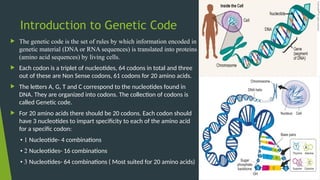
 The genetic code is the set of rules by which information encoded in
genetic material (DNA or RNA sequences) is translated into proteins
(amino acid sequences) by living cells.
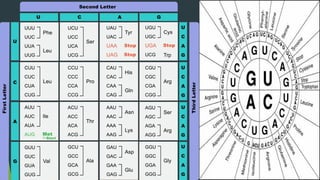
 Each codon is a triplet of nucleotides, 64 codons in total and three
out of these are Non Sense codons, 61 codons for 20 amino acids.
 The letters A, G, T and C correspond to the nucleotides found in
DNA. They are organized into codons. The collection of codons is
called Genetic code.
 For 20 amino acids there should be 20 codons. Each codon should
have 3 nucleotides to impart specificity to each of the amino acid
for a specific codon:
• 1 Nucleotide- 4 combinations
• 2 Nucleotides- 16 combinations
• 3 Nucleotides- 64 combinations ( Most suited for 20 amino acids)
Types of Genetic Code
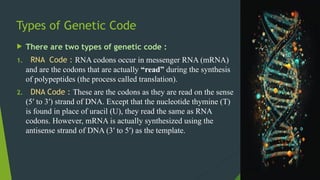
 There are two types of genetic code :
1. RNA Code : RNA codons occur in messenger RNA (mRNA)
and are the codons that are actually “read” during the synthesis
of polypeptides (the process called translation).
2. DNA Code : These are the codons as they are read on the sense
(5′ to 3′) strand of DNA. Except that the nucleotide thymine (T)
is found in place of uracil (U), they read the same as RNA
codons. However, mRNA is actually synthesized using the
antisense strand of DNA (3′ to 5′) as the template.
Types of Codons
 The codons are of two types
 Sense Codons: Those codons that code for amino acids are called sense
codons. There are 61 sense codons in the genetic code which code for
20 amino acids.
 Signal Codons: Those codons that code for signals during protein
synthesis are known as signal codons. There are four codons which
code for signal. These are AUG, UAA, UAG and UGA.
 Signal Codons are of two types :
 Start Codons
 Stop Codons
Signal Codons types continued
 Start Codons : Starts the translation process and initiates
the synthesis of polypeptide chain. Example is AUG
( codes for the amino acid methionine). In some cases,
valine (GUG) codes for start signal. In eukaryotes, the
starting amino acid is methionine, while in prokaryotes it
is N formyl methionine.
 Stop Codons : Also known as termination codons because
they provide signal for the termination and release of
polypeptide chain. Examples are UAA, UAG and UGA.
Since stop signal codons do not code for any amino acid
they were earlier called as non sense codons.
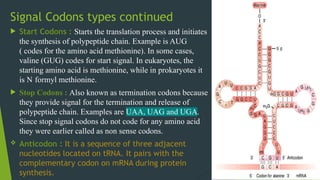
 Anticodon : It is a sequence of three adjacent
nucleotides located on tRNA. It pairs with the
complementary codon on mRNA during protein
synthesis.
Difference between Codon and
Anticodon
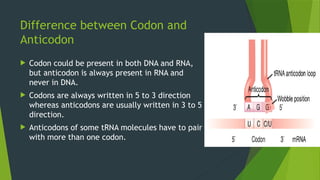
 Codon could be present in both DNA and RNA,
but anticodon is always present in RNA and
never in DNA.
 Codons are always written in 5 to 3 direction
whereas anticodons are usually written in 3 to 5
direction.
 Anticodons of some tRNA molecules have to pair
with more than one codon.
Wobble Hypothesis
 Francis Crick proposed the wobble hypothesis to explain degeneracy in the genetic
code.
 The wobble hypothesis focuses on the third position of the codon-anticodon
interaction.
 At the third position, non-standard base pairing, known as "wobble" base pairing, can
occur.
 For example, inosine (I) in the anticodon can pair with adenine (A), cytosine (C), or
uracil (U) in the third position of the codon.
 Implications:
 Enhances the versatility of tRNAs, allowing fewer tRNA molecules to recognize multiple
codons.
 Reduces the number of tRNA species required for protein synthesis.
 Facilitates the accommodation of degeneracy in the genetic code while maintaining
fidelity.
Properties of Genetic Code
1. A triplet codon is used
 The nucleotides in mRNA are organised into a linear series of codons, with each
codon consisting of three nitrogenous bases in succession, i.e., it is a triplet codon.
Two types of point mutations have been used to support the idea of triplet codons:
frameshift mutations and base substitutions.
 (i) Frameshift mutations : The genetic code is read in a particular frame in a
succession of three-letter words after it is launched at a fixed position. Any deletion
or addition of one or more bases would cause the framework to be disrupted.
 When frameshift mutations are crossed, they create wild type normal genes in
specific combinations. It was determined that one was a deletion and the other was
an addition, implying that the frame’s disordered order will be restored by the other.
 (ii) Base substitution : If one base pair is replaced by another in an mRNA molecule at
a specific position without any deletion or addition, the meaning of one codon
containing that altered base will be modified. As a result, another amino acid will be
substituted for a specific amino acid at a specific location in a polypeptide.
2. Degeneracy
 The coding is degenerate, which implies that more than one base
triplet codes for the same amino acid. Degeneracy in protein synthesis
does not indicate a lack of specificity.
There are two forms of coding degeneracy: partial and total.
 The first two nucleotides of a partly degenerate codon are similar, but
the third (i.e., 3′ base) nucleotide varies; for example, CUU and CUC
code for leucine.
 When any of the four bases can take the third position and yet code
for the same amino acid, complete degeneracy occurs; for example,
UCU, UCC, UCA, and UCG all code for serine.
3. Doesn’t overlap
 The genetic code doesn’t overlap, which means that neighbouring
codons don’t overlap.
 The term “nonoverlapping code” refers to the employment of the same
letter for two separate codons. To put it another way, no one base can
be involved in the production of several codons.
4.No commas
 In the genetic code (or comma-free). There is no signal to indicate
when one codon ends and the next begins.
 Between the codons, there are no intervening nucleotides (or commas).
5. Non-ambiguity
 A non-ambiguous code is one in which a certain codon is not ambiguous.
6. There is polarity in the code
 The code is always read in the same direction, i.e. in the 5’3′ direction.
To put it another way, the codon possesses polarity. Because the codon’s
base sequence is inverted, it is obvious that if the code is read
backwards, it will define two distinct proteins.
7. The code is universal
 The same genetic code has been discovered to be valid in all creatures,
from bacteria to humans. Marshall, Caskey, and Nirenberg (1967)
discovered that E. coli (Bacterium), Xenopus laevis (Amphibian), and
guinea pig (mammal) amino acyl-tRNA utilise almost the same coding.
8. Some codons operate as stop codons
 The chain stop or termination codons are UAG, UAA, and UGA. They
can’t code for any of the amino acids. These codons aren’t read by any
tRNA molecules (due to their anticodons), but they are read by a group
of proteins known as release factors (e.g., RF-1, RF-2, RF-3 in
prokaryotes and RF in eukaryotes).
9. Some codes operate as start codons
 The AUG codon is the start or initiation codon in most organisms,
meaning that the polypeptide chain begins with methionine
(eukaryotes) or N- formylmethionine (prokaryotes). The starting site of
mRNA which has the AUG is bound to N-formylmethionyl-tRNA.
Introduction to Protein Biosynthesis
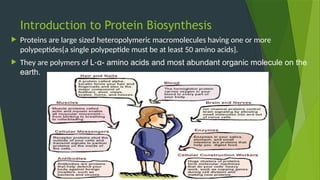
 Proteins are large sized heteropolymeric macromolecules having one or more
polypeptides{a single polypeptide must be at least 50 amino acids}.
 They are polymers of L-α- amino acids and most abundant organic molecule on the
earth.
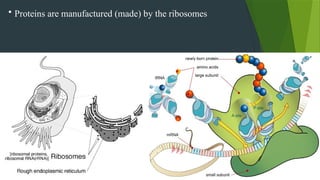
• Proteins are manufactured (made) by the ribosomes
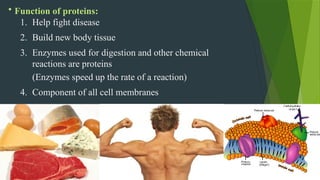
• Function of proteins:
1. Help fight disease
2. Build new body tissue
3. Enzymes used for digestion and other chemical
reactions are proteins
(Enzymes speed up the rate of a reaction)
4. Component of all cell membranes
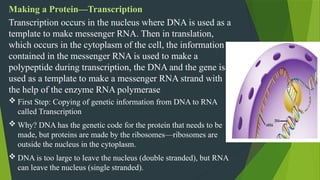
Making a Protein—Transcription
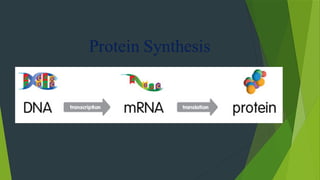
Transcription occurs in the nucleus where DNA is used as a
template to make messenger RNA. Then in translation,
which occurs in the cytoplasm of the cell, the information
contained in the messenger RNA is used to make a
polypeptide during transcription, the DNA and the gene is
used as a template to make a messenger RNA strand with
the help of the enzyme RNA polymerase
 First Step: Copying of genetic information from DNA to RNA
called Transcription
 Why? DNA has the genetic code for the protein that needs to be
made, but proteins are made by the ribosomes—ribosomes are
outside the nucleus in the cytoplasm.
 DNA is too large to leave the nucleus (double stranded), but RNA
can leave the nucleus (single stranded).
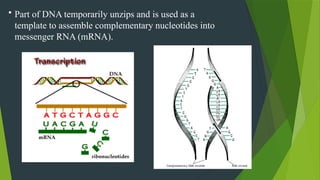
• Part of DNA temporarily unzips and is used as a
template to assemble complementary nucleotides into
messenger RNA (mRNA).
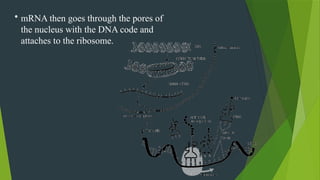
• mRNA then goes through the pores of
the nucleus with the DNA code and
attaches to the ribosome.
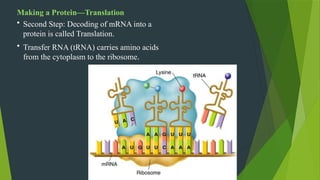
Making a Protein—Translation
• Second Step: Decoding of mRNA into a
protein is called Translation.
• Transfer RNA (tRNA) carries amino acids
from the cytoplasm to the ribosome.
These amino acids come from the food we eat. Proteins we
eat are broken down into individual amino acids and then
simply rearranged into new proteins according to the needs
and directions of our DNA.
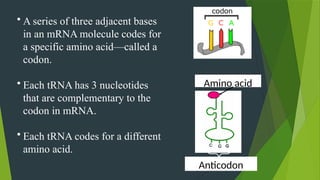
• A series of three adjacent bases
in an mRNA molecule codes for
a specific amino acid—called a
codon.
• Each tRNA has 3 nucleotides
that are complementary to the
codon in mRNA.
• Each tRNA codes for a different
amino acid.
Amino acid
Anticodon
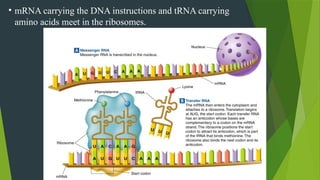
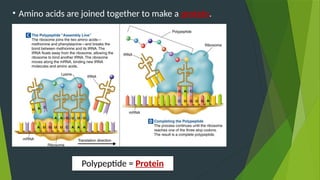
• mRNA carrying the DNA instructions and tRNA carrying
amino acids meet in the ribosomes.
• Amino acids are joined together to make a protein.
Polypeptide = Protein
References
 Nirenberg, M. W. (1963). The genetic code. Scientific American, 208(3), 80-95.
 Crick, F. H. (1968). The origin of the genetic code. Journal of molecular biology, 38(3), 367-
379.
 Wang, L., & Schultz, P. G. (2005). Expanding the genetic code. Angewandte Chemie
International Edition, 44(1), 34-66.
 Woese, C. R. (1965). On the evolution of the genetic code. Proceedings of the National
Academy of Sciences, 54(6), 1546-1552.
 Lucas-Lenard, J. E. A. N., & Lipmann, F. R. I. T. Z. (1971). Protein biosynthesis. Annual
review of biochemistry, 40(1), 409-448.
 Lengyel, P., & Söll, D. (1969). Mechanism of protein biosynthesis. Bacteriological
Reviews, 33(2), 264-301.
 Simpson, M. V. (1962). Protein biosynthesis. Annual review of biochemistry, 31(1), 333-
368.
 Maitra, U., Stringer, E. A., & Chaudhuri, A. (1982). Initiation factors in protein
biosynthesis. Annual review of biochemistry, 51(1), 869-900.

Genetic Code and Protein Biosynthesis.pptx

  • 1.
    Genetic Code And Protein Biosynthesis Presentedby – Deepanshu Banyal MAU23PBT010 Presented to – Rajni Sharma Department of Biotechnology
  • 2.
    Content  Introduction toGenetic Code  Types of Genetic Code  Types of Codons  Difference between Codon and Anticodon  Wobble Hypothesis  Properties of Genetic Code  Introduction to Protein Biosynthesis  Function of Proteins  Transcription  Translation  References
  • 3.
    Introduction to GeneticCode  The genetic code is the set of rules by which information encoded in genetic material (DNA or RNA sequences) is translated into proteins (amino acid sequences) by living cells.  Each codon is a triplet of nucleotides, 64 codons in total and three out of these are Non Sense codons, 61 codons for 20 amino acids.  The letters A, G, T and C correspond to the nucleotides found in DNA. They are organized into codons. The collection of codons is called Genetic code.  For 20 amino acids there should be 20 codons. Each codon should have 3 nucleotides to impart specificity to each of the amino acid for a specific codon: • 1 Nucleotide- 4 combinations • 2 Nucleotides- 16 combinations • 3 Nucleotides- 64 combinations ( Most suited for 20 amino acids)
  • 4.
    Types of GeneticCode  There are two types of genetic code : 1. RNA Code : RNA codons occur in messenger RNA (mRNA) and are the codons that are actually “read” during the synthesis of polypeptides (the process called translation). 2. DNA Code : These are the codons as they are read on the sense (5′ to 3′) strand of DNA. Except that the nucleotide thymine (T) is found in place of uracil (U), they read the same as RNA codons. However, mRNA is actually synthesized using the antisense strand of DNA (3′ to 5′) as the template.
  • 5.
    Types of Codons The codons are of two types  Sense Codons: Those codons that code for amino acids are called sense codons. There are 61 sense codons in the genetic code which code for 20 amino acids.  Signal Codons: Those codons that code for signals during protein synthesis are known as signal codons. There are four codons which code for signal. These are AUG, UAA, UAG and UGA.  Signal Codons are of two types :  Start Codons  Stop Codons
  • 6.
    Signal Codons typescontinued  Start Codons : Starts the translation process and initiates the synthesis of polypeptide chain. Example is AUG ( codes for the amino acid methionine). In some cases, valine (GUG) codes for start signal. In eukaryotes, the starting amino acid is methionine, while in prokaryotes it is N formyl methionine.  Stop Codons : Also known as termination codons because they provide signal for the termination and release of polypeptide chain. Examples are UAA, UAG and UGA. Since stop signal codons do not code for any amino acid they were earlier called as non sense codons.  Anticodon : It is a sequence of three adjacent nucleotides located on tRNA. It pairs with the complementary codon on mRNA during protein synthesis.
  • 7.
    Difference between Codonand Anticodon  Codon could be present in both DNA and RNA, but anticodon is always present in RNA and never in DNA.  Codons are always written in 5 to 3 direction whereas anticodons are usually written in 3 to 5 direction.  Anticodons of some tRNA molecules have to pair with more than one codon.
  • 8.
    Wobble Hypothesis  FrancisCrick proposed the wobble hypothesis to explain degeneracy in the genetic code.  The wobble hypothesis focuses on the third position of the codon-anticodon interaction.  At the third position, non-standard base pairing, known as "wobble" base pairing, can occur.  For example, inosine (I) in the anticodon can pair with adenine (A), cytosine (C), or uracil (U) in the third position of the codon.  Implications:  Enhances the versatility of tRNAs, allowing fewer tRNA molecules to recognize multiple codons.  Reduces the number of tRNA species required for protein synthesis.  Facilitates the accommodation of degeneracy in the genetic code while maintaining fidelity.
  • 9.
    Properties of GeneticCode 1. A triplet codon is used  The nucleotides in mRNA are organised into a linear series of codons, with each codon consisting of three nitrogenous bases in succession, i.e., it is a triplet codon. Two types of point mutations have been used to support the idea of triplet codons: frameshift mutations and base substitutions.  (i) Frameshift mutations : The genetic code is read in a particular frame in a succession of three-letter words after it is launched at a fixed position. Any deletion or addition of one or more bases would cause the framework to be disrupted.  When frameshift mutations are crossed, they create wild type normal genes in specific combinations. It was determined that one was a deletion and the other was an addition, implying that the frame’s disordered order will be restored by the other.  (ii) Base substitution : If one base pair is replaced by another in an mRNA molecule at a specific position without any deletion or addition, the meaning of one codon containing that altered base will be modified. As a result, another amino acid will be substituted for a specific amino acid at a specific location in a polypeptide.
  • 10.
    2. Degeneracy  Thecoding is degenerate, which implies that more than one base triplet codes for the same amino acid. Degeneracy in protein synthesis does not indicate a lack of specificity. There are two forms of coding degeneracy: partial and total.  The first two nucleotides of a partly degenerate codon are similar, but the third (i.e., 3′ base) nucleotide varies; for example, CUU and CUC code for leucine.  When any of the four bases can take the third position and yet code for the same amino acid, complete degeneracy occurs; for example, UCU, UCC, UCA, and UCG all code for serine.
  • 11.
    3. Doesn’t overlap The genetic code doesn’t overlap, which means that neighbouring codons don’t overlap.  The term “nonoverlapping code” refers to the employment of the same letter for two separate codons. To put it another way, no one base can be involved in the production of several codons. 4.No commas  In the genetic code (or comma-free). There is no signal to indicate when one codon ends and the next begins.  Between the codons, there are no intervening nucleotides (or commas). 5. Non-ambiguity  A non-ambiguous code is one in which a certain codon is not ambiguous.
  • 12.
    6. There ispolarity in the code  The code is always read in the same direction, i.e. in the 5’3′ direction. To put it another way, the codon possesses polarity. Because the codon’s base sequence is inverted, it is obvious that if the code is read backwards, it will define two distinct proteins. 7. The code is universal  The same genetic code has been discovered to be valid in all creatures, from bacteria to humans. Marshall, Caskey, and Nirenberg (1967) discovered that E. coli (Bacterium), Xenopus laevis (Amphibian), and guinea pig (mammal) amino acyl-tRNA utilise almost the same coding.
  • 13.
    8. Some codonsoperate as stop codons  The chain stop or termination codons are UAG, UAA, and UGA. They can’t code for any of the amino acids. These codons aren’t read by any tRNA molecules (due to their anticodons), but they are read by a group of proteins known as release factors (e.g., RF-1, RF-2, RF-3 in prokaryotes and RF in eukaryotes). 9. Some codes operate as start codons  The AUG codon is the start or initiation codon in most organisms, meaning that the polypeptide chain begins with methionine (eukaryotes) or N- formylmethionine (prokaryotes). The starting site of mRNA which has the AUG is bound to N-formylmethionyl-tRNA.
  • 15.
    Introduction to ProteinBiosynthesis  Proteins are large sized heteropolymeric macromolecules having one or more polypeptides{a single polypeptide must be at least 50 amino acids}.  They are polymers of L-α- amino acids and most abundant organic molecule on the earth.
  • 16.
    • Proteins aremanufactured (made) by the ribosomes
  • 17.
    • Function ofproteins: 1. Help fight disease 2. Build new body tissue 3. Enzymes used for digestion and other chemical reactions are proteins (Enzymes speed up the rate of a reaction) 4. Component of all cell membranes
  • 19.
    Making a Protein—Transcription Transcriptionoccurs in the nucleus where DNA is used as a template to make messenger RNA. Then in translation, which occurs in the cytoplasm of the cell, the information contained in the messenger RNA is used to make a polypeptide during transcription, the DNA and the gene is used as a template to make a messenger RNA strand with the help of the enzyme RNA polymerase  First Step: Copying of genetic information from DNA to RNA called Transcription  Why? DNA has the genetic code for the protein that needs to be made, but proteins are made by the ribosomes—ribosomes are outside the nucleus in the cytoplasm.  DNA is too large to leave the nucleus (double stranded), but RNA can leave the nucleus (single stranded).
  • 20.
    • Part ofDNA temporarily unzips and is used as a template to assemble complementary nucleotides into messenger RNA (mRNA).
  • 21.
    • mRNA thengoes through the pores of the nucleus with the DNA code and attaches to the ribosome.
  • 23.
    Making a Protein—Translation •Second Step: Decoding of mRNA into a protein is called Translation. • Transfer RNA (tRNA) carries amino acids from the cytoplasm to the ribosome.
  • 24.
    These amino acidscome from the food we eat. Proteins we eat are broken down into individual amino acids and then simply rearranged into new proteins according to the needs and directions of our DNA.
  • 25.
    • A seriesof three adjacent bases in an mRNA molecule codes for a specific amino acid—called a codon. • Each tRNA has 3 nucleotides that are complementary to the codon in mRNA. • Each tRNA codes for a different amino acid. Amino acid Anticodon
  • 26.
    • mRNA carryingthe DNA instructions and tRNA carrying amino acids meet in the ribosomes.
  • 27.
    • Amino acidsare joined together to make a protein. Polypeptide = Protein
  • 29.
    References  Nirenberg, M.W. (1963). The genetic code. Scientific American, 208(3), 80-95.  Crick, F. H. (1968). The origin of the genetic code. Journal of molecular biology, 38(3), 367- 379.  Wang, L., & Schultz, P. G. (2005). Expanding the genetic code. Angewandte Chemie International Edition, 44(1), 34-66.  Woese, C. R. (1965). On the evolution of the genetic code. Proceedings of the National Academy of Sciences, 54(6), 1546-1552.  Lucas-Lenard, J. E. A. N., & Lipmann, F. R. I. T. Z. (1971). Protein biosynthesis. Annual review of biochemistry, 40(1), 409-448.  Lengyel, P., & Söll, D. (1969). Mechanism of protein biosynthesis. Bacteriological Reviews, 33(2), 264-301.  Simpson, M. V. (1962). Protein biosynthesis. Annual review of biochemistry, 31(1), 333- 368.  Maitra, U., Stringer, E. A., & Chaudhuri, A. (1982). Initiation factors in protein biosynthesis. Annual review of biochemistry, 51(1), 869-900.