The Beat Generation Alberto Quiñonez Alejandro Rodriguez Lara
The Beat Generation refers to a group of American post-WWII writers who came to prominence in the 1950s, as well as the cultural phenomena that they both documented and inspired
Central elements of "Beat" culture included experimentation with drugs, alternative forms of sexuality, an interest in Eastern religion, a rejection of materialism, and the idealizing of exuberant, unexpurgated means of expression and being.
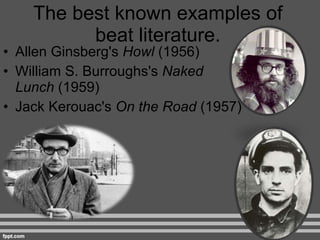
The best known examples of beat literature. Allen Ginsberg's  Howl  (1956) William S. Burroughs's  Naked Lunch  (1959) Jack Kerouac's  On the Road  (1957)
Jack Kerouac introduced the phrase "Beat Generation" in 1948 to characterize a perceived underground, anti-conformist youth movement in New York. The name arose in a conversation with writer John Clellon Holmes. The adjective "beat" could colloquially mean "tired" or "beaten down"
Influences Romanticism Early American sources French Surrealism Modernism: Though the Beat aesthetic posited itself against T. S. Eliot's creed of strict objectivity and literary modernism's new classicism, certain modernist poets were major influences on the Beats, includingEzra Pound, William Carlos Williams, and H.D.. Pound was specifically important to Gary Snyder and Allen Ginsberg.
Influences on the Western Culture In 1982, Ginsberg published a summary of "the essential effects" of the Beat Generation: Spiritual liberation, sexual "revolution" or "liberation," i.e., gay liberation, somewhat catalyzing women's liberation, black liberation, Gray Panther activism. Liberation of the world from censorship. Demystification and/or decriminalization of cannabis and other drugs. The evolution of rhythm and blues into rock and roll as a high art form, as evidenced by the Beatles, Bob Dylan, and other popular musicians influenced in the later fifties and sixties by Beat generation poets' and writers' works.
Jack Kerouac (wrote), Robert Frank and Alfred Leslie (directed)  Pull My Daisy  (1958) Heart Beat  (1980) Richard Lerner and Lewis MacAdams (directed)  Whatever Happened To Kerouac?  (1986) Documentary. David Cronenberg (wrote and directed)  Naked Lunch  (1991) Chuck Workman (wrote and directed)  The Source  (1999) Gary Walkow (wrote and directed)  Beat  (2000) Allen Ginsberg Live in London  (1995) Howl  (2010)
HOWL by Allen Ginsberg I saw the best minds of my generation destroyed by  madness, starving hysterical naked,  dragging themselves through the negro streets at dawn  looking for an angry fix,  angelheaded hipsters burning for the ancient heavenly  connection to the starry dynamo in the machinery of night,  who poverty and tatters and hollow-eyed and high sat  up smoking in the supernatural darkness of  cold-water flats floating across the tops of cities  contemplating jazz,  who bared their brains to Heaven under the El and  saw Mohammedan angels staggering on tenement roofs illuminated,  who passed through universities with radiant cool eyes  hallucinating Arkansas and Blake-light tragedy  among the scholars of war,

The beat generation.11

  • 1.
    The Beat GenerationAlberto Quiñonez Alejandro Rodriguez Lara
  • 2.
    The Beat Generation refers toa group of American post-WWII writers who came to prominence in the 1950s, as well as the cultural phenomena that they both documented and inspired
  • 3.
    Central elements of"Beat" culture included experimentation with drugs, alternative forms of sexuality, an interest in Eastern religion, a rejection of materialism, and the idealizing of exuberant, unexpurgated means of expression and being.
  • 4.
    The best knownexamples of beat literature. Allen Ginsberg's  Howl  (1956) William S. Burroughs's  Naked Lunch  (1959) Jack Kerouac's  On the Road  (1957)
  • 5.
    Jack Kerouac introduced thephrase "Beat Generation" in 1948 to characterize a perceived underground, anti-conformist youth movement in New York. The name arose in a conversation with writer John Clellon Holmes. The adjective "beat" could colloquially mean "tired" or "beaten down"
  • 6.
    Influences Romanticism EarlyAmerican sources French Surrealism Modernism: Though the Beat aesthetic posited itself against T. S. Eliot's creed of strict objectivity and literary modernism's new classicism, certain modernist poets were major influences on the Beats, includingEzra Pound, William Carlos Williams, and H.D.. Pound was specifically important to Gary Snyder and Allen Ginsberg.
  • 7.
    Influences on theWestern Culture In 1982, Ginsberg published a summary of "the essential effects" of the Beat Generation: Spiritual liberation, sexual "revolution" or "liberation," i.e., gay liberation, somewhat catalyzing women's liberation, black liberation, Gray Panther activism. Liberation of the world from censorship. Demystification and/or decriminalization of cannabis and other drugs. The evolution of rhythm and blues into rock and roll as a high art form, as evidenced by the Beatles, Bob Dylan, and other popular musicians influenced in the later fifties and sixties by Beat generation poets' and writers' works.
  • 8.
    Jack Kerouac (wrote),Robert Frank and Alfred Leslie (directed)  Pull My Daisy  (1958) Heart Beat  (1980) Richard Lerner and Lewis MacAdams (directed)  Whatever Happened To Kerouac?  (1986) Documentary. David Cronenberg (wrote and directed)  Naked Lunch  (1991) Chuck Workman (wrote and directed)  The Source  (1999) Gary Walkow (wrote and directed)  Beat  (2000) Allen Ginsberg Live in London  (1995) Howl  (2010)
  • 9.
    HOWL by AllenGinsberg I saw the best minds of my generation destroyed by madness, starving hysterical naked, dragging themselves through the negro streets at dawn looking for an angry fix, angelheaded hipsters burning for the ancient heavenly connection to the starry dynamo in the machinery of night, who poverty and tatters and hollow-eyed and high sat up smoking in the supernatural darkness of cold-water flats floating across the tops of cities contemplating jazz, who bared their brains to Heaven under the El and saw Mohammedan angels staggering on tenement roofs illuminated, who passed through universities with radiant cool eyes hallucinating Arkansas and Blake-light tragedy among the scholars of war,