Institute of Botany
Presentation on genetic
code in the honor of Ma’am
Rehana Qausar
M.Sc
3rd Semester
Maryam Ayub
Roll # 23
Group # 5
Group Members
 Jaweria Ghazi
 Muhammad Mohin Qureshi
 Muhammad Abbas
 Uzma Yousaf
 Muhammad Mahboob
Presentation Outlines
• Introduction to genetic code
• Discovery
• Codon & its types
• Anticodon & Differences between codon & anticodon
• Characteristics
• Degeneracy of genetic code
• Wobble hypothesis
• Mutation & genetic code
• Conclusion
• Bibliography
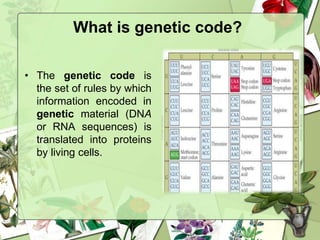
What is genetic code?
• The genetic code is
the set of rules by which
information encoded in
genetic material (DNA
or RNA sequences) is
translated into proteins
by living cells.
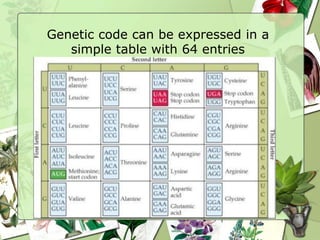
Genetic code can be expressed in a
simple table with 64 entries
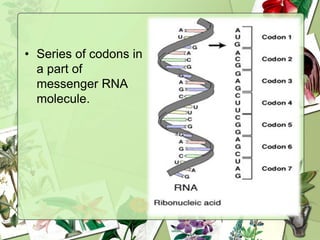
• Series of codons in
a part of
messenger RNA
molecule.
“Discovery”
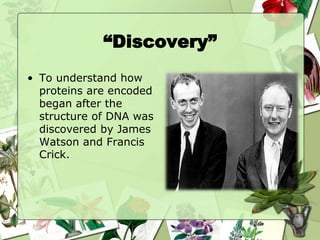
• To understand how
proteins are encoded
began after the
structure of DNA was
discovered by James
Watson and Francis
Crick.
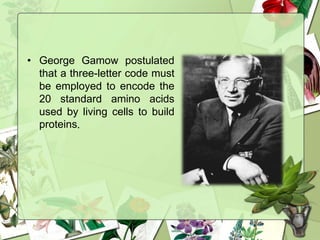
• George Gamow postulated
that a three-letter code must
be employed to encode the
20 standard amino acids
used by living cells to build
proteins.
• The Crick, Brenner experiment first demonstrated
that codons consist of three DNA bases.
• First elucidation of
codon was done by
Marshall Nirenberg &
Heinrich J-Matthaei in
1961 at the National
Institute of Health.
Jaweria Ghazi
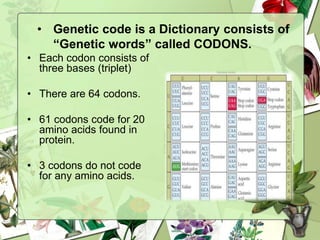
• Genetic code is a Dictionary consists of
“Genetic words” called CODONS.
• Each codon consists of
three bases (triplet)
• There are 64 codons.
• 61 codons code for 20
amino acids found in
protein.
• 3 codons do not code
for any amino acids.
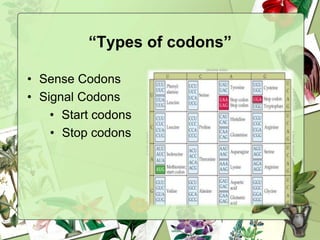
“Types of codons”
• Sense Codons
• Signal Codons
• Start codons
• Stop codons
• Sense codon:
The codon that code for amino acid are called sense
codon.
• Signal codon:
Those codons that code for signal during protein
synthesis are called signal codons.
For Example: AUG, UAA, UAG & UGA.
There are Two types of signal codons.
• Terminating Codon
• Initiating Codon
“Terminating Codons”
• UAA, UAG & UGA are termination codons or non-
sense codons & are often referred to as amber, ochre
& opal codons.
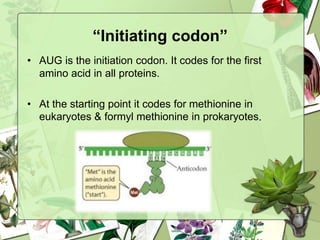
“Initiating codon”
• AUG is the initiation codon. It codes for the first
amino acid in all proteins.
• At the starting point it codes for methionine in
eukaryotes & formyl methionine in prokaryotes.
Muhammad Mohin
Qureshi
Roll #28
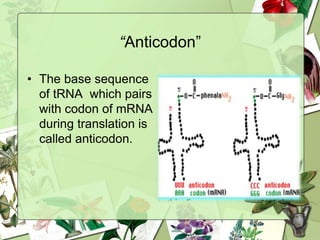
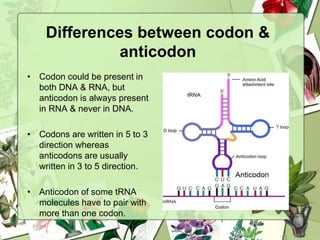
“Anticodon”
• The base sequence
of tRNA which pairs
with codon of mRNA
during translation is
called anticodon.
Differences between codon &
anticodon
• Codon could be present in
both DNA & RNA, but
anticodon is always present
in RNA & never in DNA.
• Codons are written in 5 to 3
direction whereas
anticodons are usually
written in 3 to 5 direction.
• Anticodon of some tRNA
molecules have to pair with
more than one codon.
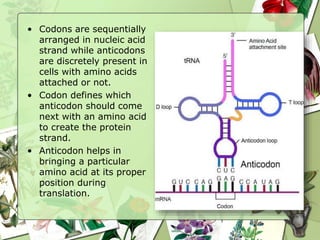
• Codons are sequentially
arranged in nucleic acid
strand while anticodons
are discretely present in
cells with amino acids
attached or not.
• Codon defines which
anticodon should come
next with an amino acid
to create the protein
strand.
• Anticodon helps in
bringing a particular
amino acid at its proper
position during
translation.
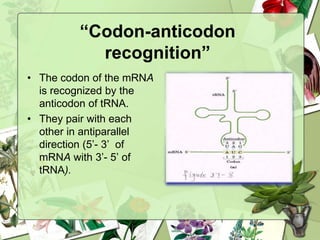
“Codon-anticodon
recognition”
• The codon of the mRNA
is recognized by the
anticodon of tRNA.
• They pair with each
other in antiparallel
direction (5’- 3’ of
mRNA with 3’- 5’ of
tRNA).
Muhammad Abbas
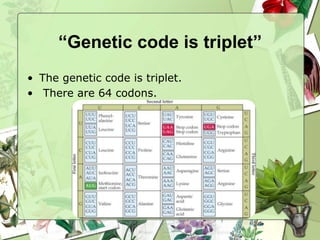
“Genetic code is triplet”
• The genetic code is triplet.
• There are 64 codons.
“Universality”
• The genetic code is universal.
• AUA is the codon for methionine in mitochondria. The
same codon (AUA) codes for isoleucine in cytoplasm.
With some exceptions noted the genetic code is
universal.
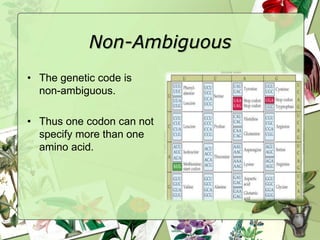
Non-Ambiguous
• The genetic code is
non-ambiguous.
• Thus one codon can not
specify more than one
amino acid.
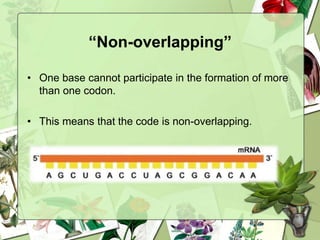
“Non-overlapping”
• One base cannot participate in the formation of more
than one codon.
• This means that the code is non-overlapping.
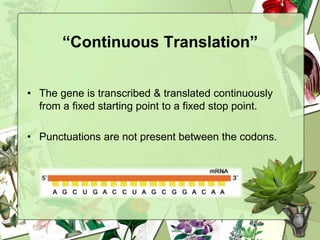
“Continuous Translation”
• The gene is transcribed & translated continuously
from a fixed starting point to a fixed stop point.
• Punctuations are not present between the codons.
“The code has polarity”
• The code has a definite direction for reading of
message which is referred to as polarity.
• Reading of message from left to right & right to left
will specify for different amino acids.
• For Example UUG stands for leucine, & from right to
left it is GUU which stands for valine.
Uzma Yousaf
Roll # 57
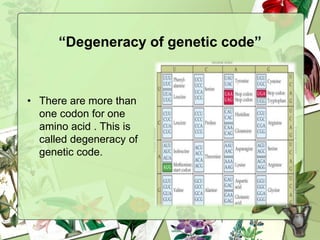
“Degeneracy of genetic code”
• There are more than
one codon for one
amino acid . This is
called degeneracy of
genetic code.
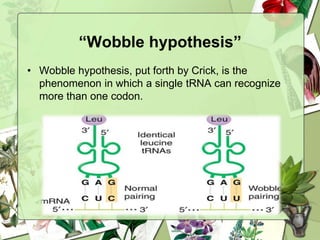
“Wobble hypothesis”
• Wobble hypothesis, put forth by Crick, is the
phenomenon in which a single tRNA can recognize
more than one codon.
“Wobble hypothesis explains
degeneracy”
• Wobble hypothesis explains the degeneracy of the
genetic code, i.e, existence of multiple codons for a
single amino acid. Although there are 61 codons for
amino acids, the number of tRNA is far less (around
40)which is due to wobbling.
“Biological significance of
degeneracy of the genetic code”
• If the code were not degenerate, 20 codons would
designated amino acids and 44 would lead to chain
termination.
• The probability of mutating to chain termination would
therefore be much higher with a non degenerate
code.
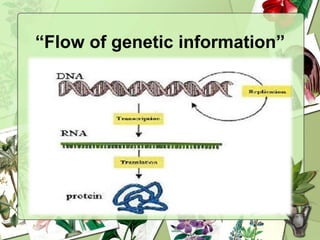
“Flow of genetic information”
Muhammad Mahboob
“Mutations & Genetic Code”
• Mutations results in change of nucleotide sequences
in the DNA & in RNA.
• Effect of mutations is on translation through the
alteration in codons. Some of the mutations are
harmful.
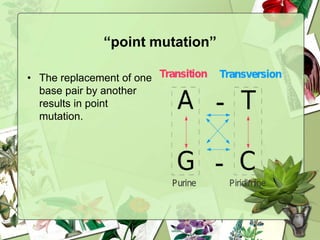
“point mutation”
• The replacement of one
base pair by another
results in point
mutation.
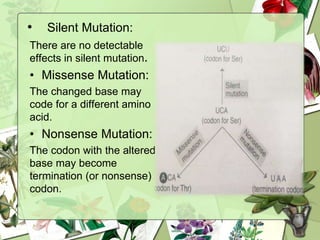
• Silent Mutation:
There are no detectable
effects in silent mutation.
• Missense Mutation:
The changed base may
code for a different amino
acid.
• Nonsense Mutation:
The codon with the altered
base may become
termination (or nonsense)
codon.
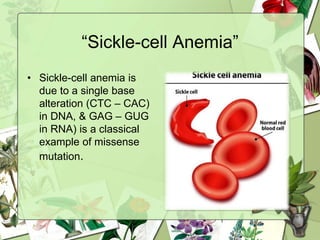
“Sickle-cell Anemia”
• Sickle-cell anemia is
due to a single base
alteration (CTC – CAC)
in DNA, & GAG – GUG
in RNA) is a classical
example of missense
mutation.
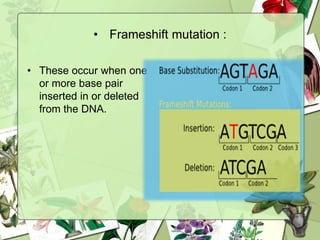
• Frameshift mutation :
• These occur when one
or more base pair
inserted in or deleted
from the DNA.
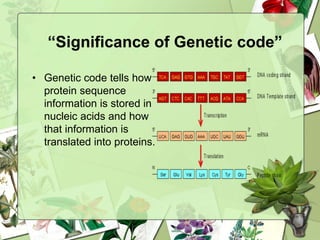
“Significance of Genetic code”
• Genetic code tells how
protein sequence
information is stored in
nucleic acids and how
that information is
translated into proteins.
Is the genetic code is similar in all living
organism?
• The base sequence of many wild-type and mutant
genes are known, as are the amino acid sequences
of their encoded proteins.
• For each mutant, the nucleotide change in the gene
and the amino acid change in the protein are as
predicted by the genetic code.
“Conclusion”
• Despite these differences, all known species codes
are very similar to each other and the coding
mechanism is the same for all organisms: three base
codons, tRNA, ribosomes, reading the code in the
same direction and translating the code 3 letters at a
time into sequence of amino acids.
“Bibliography”
BIOTECHNOLOGY
Dr. U. Satyanarayana
M.Sc., Ph.D., F.I.C., F.A.C.B.
Genetic code

Genetic code

  • 2.
    Institute of Botany Presentationon genetic code in the honor of Ma’am Rehana Qausar M.Sc 3rd Semester Maryam Ayub Roll # 23 Group # 5
  • 3.
    Group Members  JaweriaGhazi  Muhammad Mohin Qureshi  Muhammad Abbas  Uzma Yousaf  Muhammad Mahboob
  • 4.
    Presentation Outlines • Introductionto genetic code • Discovery • Codon & its types • Anticodon & Differences between codon & anticodon • Characteristics • Degeneracy of genetic code • Wobble hypothesis • Mutation & genetic code • Conclusion • Bibliography
  • 5.
    What is geneticcode? • The genetic code is the set of rules by which information encoded in genetic material (DNA or RNA sequences) is translated into proteins by living cells.
  • 6.
    Genetic code canbe expressed in a simple table with 64 entries
  • 7.
    • Series ofcodons in a part of messenger RNA molecule.
  • 8.
    “Discovery” • To understandhow proteins are encoded began after the structure of DNA was discovered by James Watson and Francis Crick.
  • 9.
    • George Gamowpostulated that a three-letter code must be employed to encode the 20 standard amino acids used by living cells to build proteins.
  • 10.
    • The Crick,Brenner experiment first demonstrated that codons consist of three DNA bases. • First elucidation of codon was done by Marshall Nirenberg & Heinrich J-Matthaei in 1961 at the National Institute of Health.
  • 11.
  • 12.
    • Genetic codeis a Dictionary consists of “Genetic words” called CODONS. • Each codon consists of three bases (triplet) • There are 64 codons. • 61 codons code for 20 amino acids found in protein. • 3 codons do not code for any amino acids.
  • 13.
    “Types of codons” •Sense Codons • Signal Codons • Start codons • Stop codons
  • 14.
    • Sense codon: Thecodon that code for amino acid are called sense codon. • Signal codon: Those codons that code for signal during protein synthesis are called signal codons. For Example: AUG, UAA, UAG & UGA. There are Two types of signal codons. • Terminating Codon • Initiating Codon
  • 15.
    “Terminating Codons” • UAA,UAG & UGA are termination codons or non- sense codons & are often referred to as amber, ochre & opal codons.
  • 16.
    “Initiating codon” • AUGis the initiation codon. It codes for the first amino acid in all proteins. • At the starting point it codes for methionine in eukaryotes & formyl methionine in prokaryotes.
  • 17.
  • 18.
    “Anticodon” • The basesequence of tRNA which pairs with codon of mRNA during translation is called anticodon.
  • 19.
    Differences between codon& anticodon • Codon could be present in both DNA & RNA, but anticodon is always present in RNA & never in DNA. • Codons are written in 5 to 3 direction whereas anticodons are usually written in 3 to 5 direction. • Anticodon of some tRNA molecules have to pair with more than one codon.
  • 20.
    • Codons aresequentially arranged in nucleic acid strand while anticodons are discretely present in cells with amino acids attached or not. • Codon defines which anticodon should come next with an amino acid to create the protein strand. • Anticodon helps in bringing a particular amino acid at its proper position during translation.
  • 21.
    “Codon-anticodon recognition” • The codonof the mRNA is recognized by the anticodon of tRNA. • They pair with each other in antiparallel direction (5’- 3’ of mRNA with 3’- 5’ of tRNA).
  • 22.
  • 23.
    “Genetic code istriplet” • The genetic code is triplet. • There are 64 codons.
  • 24.
    “Universality” • The geneticcode is universal. • AUA is the codon for methionine in mitochondria. The same codon (AUA) codes for isoleucine in cytoplasm. With some exceptions noted the genetic code is universal.
  • 25.
    Non-Ambiguous • The geneticcode is non-ambiguous. • Thus one codon can not specify more than one amino acid.
  • 26.
    “Non-overlapping” • One basecannot participate in the formation of more than one codon. • This means that the code is non-overlapping.
  • 27.
    “Continuous Translation” • Thegene is transcribed & translated continuously from a fixed starting point to a fixed stop point. • Punctuations are not present between the codons.
  • 28.
    “The code haspolarity” • The code has a definite direction for reading of message which is referred to as polarity. • Reading of message from left to right & right to left will specify for different amino acids. • For Example UUG stands for leucine, & from right to left it is GUU which stands for valine.
  • 29.
  • 30.
    “Degeneracy of geneticcode” • There are more than one codon for one amino acid . This is called degeneracy of genetic code.
  • 31.
    “Wobble hypothesis” • Wobblehypothesis, put forth by Crick, is the phenomenon in which a single tRNA can recognize more than one codon.
  • 32.
    “Wobble hypothesis explains degeneracy” •Wobble hypothesis explains the degeneracy of the genetic code, i.e, existence of multiple codons for a single amino acid. Although there are 61 codons for amino acids, the number of tRNA is far less (around 40)which is due to wobbling.
  • 33.
    “Biological significance of degeneracyof the genetic code” • If the code were not degenerate, 20 codons would designated amino acids and 44 would lead to chain termination. • The probability of mutating to chain termination would therefore be much higher with a non degenerate code.
  • 34.
    “Flow of geneticinformation”
  • 35.
  • 36.
    “Mutations & GeneticCode” • Mutations results in change of nucleotide sequences in the DNA & in RNA. • Effect of mutations is on translation through the alteration in codons. Some of the mutations are harmful.
  • 37.
    “point mutation” • Thereplacement of one base pair by another results in point mutation.
  • 38.
    • Silent Mutation: Thereare no detectable effects in silent mutation. • Missense Mutation: The changed base may code for a different amino acid. • Nonsense Mutation: The codon with the altered base may become termination (or nonsense) codon.
  • 39.
    “Sickle-cell Anemia” • Sickle-cellanemia is due to a single base alteration (CTC – CAC) in DNA, & GAG – GUG in RNA) is a classical example of missense mutation.
  • 40.
    • Frameshift mutation: • These occur when one or more base pair inserted in or deleted from the DNA.
  • 41.
    “Significance of Geneticcode” • Genetic code tells how protein sequence information is stored in nucleic acids and how that information is translated into proteins.
  • 42.
    Is the geneticcode is similar in all living organism? • The base sequence of many wild-type and mutant genes are known, as are the amino acid sequences of their encoded proteins. • For each mutant, the nucleotide change in the gene and the amino acid change in the protein are as predicted by the genetic code.
  • 43.
    “Conclusion” • Despite thesedifferences, all known species codes are very similar to each other and the coding mechanism is the same for all organisms: three base codons, tRNA, ribosomes, reading the code in the same direction and translating the code 3 letters at a time into sequence of amino acids.
  • 44.