Operon concept
Discovery of the Operon
In 1961, Jacob and Monod studied the metabolism of lactose by E.
coli
Three enzyme activities / three genes were induced together by
galactosides
Based on their observation they propossed operon concept
Nobel prize in the year 1965
Introduction
 An operon is a collection of prokaryotic genes
transcribed together on a single mRNA transcript
(polycistronic) to serve a single purpose
 Composed of
 An operator, an “on-off” switch
 A promoter
 Genes for metabolic enzymes
 Can be switched off by a repressor protein
 A corepressor is a small molecule that binds to a
repressor to switch an operon off
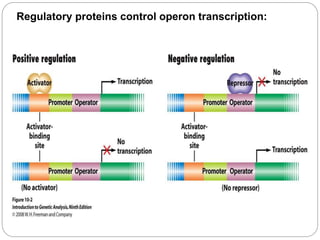
Regulatory proteins control operon transcription:
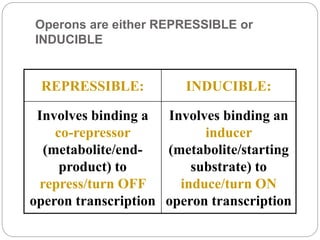
Operons are either REPRESSIBLE or
INDUCIBLE
REPRESSIBLE: INDUCIBLE:
Involves binding a
co-repressor
(metabolite/end-
product) to
repress/turn OFF
operon transcription
Involves binding an
inducer
(metabolite/starting
substrate) to
induce/turn ON
operon transcription
3 combinations found in nature:
REPRESSIBLE INDUCIBLE
NEGATIVE
This operon uses a
repressor that binds a co-
repressor to repress
transcription.
This operon uses a
repressor that binds an
inducer to induce
transcription.
POSITIVE Not found.
This operon uses an
activator that binds an
inducer to induce
transcriptionn.
Lac operon
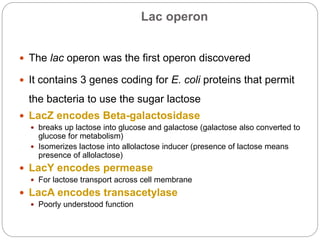
 The lac operon was the first operon discovered
 It contains 3 genes coding for E. coli proteins that permit
the bacteria to use the sugar lactose
 LacZ encodes Beta-galactosidase
 breaks up lactose into glucose and galactose (galactose also converted to
glucose for metabolism)
 Isomerizes lactose into allolactose inducer (presence of lactose means
presence of allolactose)
 LacY encodes permease
 For lactose transport across cell membrane
 LacA encodes transacetylase
 Poorly understood function
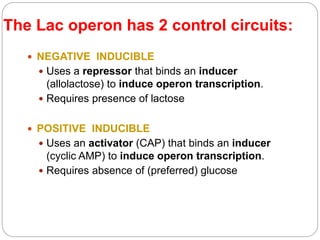
The Lac operon has 2 control circuits:
 NEGATIVE INDUCIBLE
 Uses a repressor that binds an inducer
(allolactose) to induce operon transcription.
 Requires presence of lactose
 POSITIVE INDUCIBLE
 Uses an activator (CAP) that binds an inducer
(cyclic AMP) to induce operon transcription.
 Requires absence of (preferred) glucose
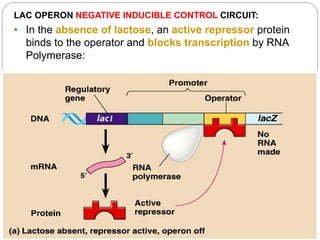
LAC OPERON NEGATIVE INDUCIBLE CONTROL CIRCUIT:
• In the absence of lactose, an active repressor protein
binds to the operator and blocks transcription by RNA
Polymerase:
•When lactose is present in the cell, allolactose, an
isomer of lactose, binds to the repressor.
•This inactivates the repressor, because it can no
longer bind the operator.
•Now RNA Polymerase can transcribe the Lac operon:
RNA polymerase have low affinity
towards lac operon
So even the operon is on
transcription will occur poorly
There comes the role of positive
inducible control
LAC OPERON POSITIVE INDUCIBLE CONTROL
CIRCUIT
 Attachment of RNA polymerase to the promoter requires the
presence of a Catabolite gene Activatior Protein (CAP) that is
bound to the cAMP
 Presence of glucose lowers the cAMP by inactivating adenylyl
cyclase responsible for the synthesis of cAMP
 Due to lesser cAMP formation of CAP-cAMP is low
 So RNA polymerase attachment and transcription will be
negligible in the presence of glucose
 As CAP-cAMP is essential for transcription of lac operon it is
considered as positive regulator.
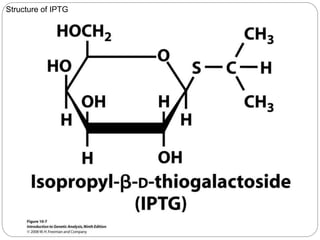
Structure of IPTG
Figure 10-7
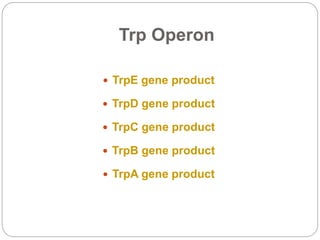
Trp Operon
 TrpE gene product
 TrpD gene product
 TrpC gene product
 TrpB gene product
 TrpA gene product
The Trp operon has 2 control mechanisms
 NEGATIVE REPRESSIBLE OPERON
 Uses a repressor that binds a co-repressor (end
product Trp) to repress operon transcription by 70-
fold
 Requires presence of Trp
 ATTENUATION
 Involves premature transcription termination
 Requires high Trp levels
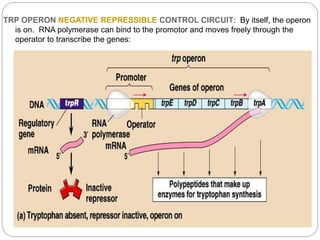
TRP OPERON NEGATIVE REPRESSIBLE CONTROL CIRCUIT: By itself, the operon
is on. RNA polymerase can bind to the promotor and moves freely through the
operator to transcribe the genes:
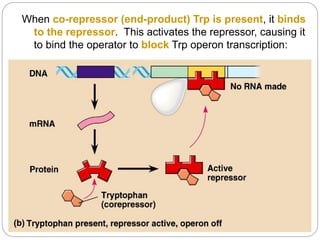
When co-repressor (end-product) Trp is present, it binds
to the repressor. This activates the repressor, causing it
to bind the operator to block Trp operon transcription:

operon concept

  • 1.
  • 2.
    Discovery of theOperon In 1961, Jacob and Monod studied the metabolism of lactose by E. coli Three enzyme activities / three genes were induced together by galactosides Based on their observation they propossed operon concept Nobel prize in the year 1965
  • 3.
    Introduction  An operonis a collection of prokaryotic genes transcribed together on a single mRNA transcript (polycistronic) to serve a single purpose  Composed of  An operator, an “on-off” switch  A promoter  Genes for metabolic enzymes  Can be switched off by a repressor protein  A corepressor is a small molecule that binds to a repressor to switch an operon off
  • 4.
    Regulatory proteins controloperon transcription:
  • 5.
    Operons are eitherREPRESSIBLE or INDUCIBLE REPRESSIBLE: INDUCIBLE: Involves binding a co-repressor (metabolite/end- product) to repress/turn OFF operon transcription Involves binding an inducer (metabolite/starting substrate) to induce/turn ON operon transcription
  • 6.
    3 combinations foundin nature: REPRESSIBLE INDUCIBLE NEGATIVE This operon uses a repressor that binds a co- repressor to repress transcription. This operon uses a repressor that binds an inducer to induce transcription. POSITIVE Not found. This operon uses an activator that binds an inducer to induce transcriptionn.
  • 7.
    Lac operon  Thelac operon was the first operon discovered  It contains 3 genes coding for E. coli proteins that permit the bacteria to use the sugar lactose  LacZ encodes Beta-galactosidase  breaks up lactose into glucose and galactose (galactose also converted to glucose for metabolism)  Isomerizes lactose into allolactose inducer (presence of lactose means presence of allolactose)  LacY encodes permease  For lactose transport across cell membrane  LacA encodes transacetylase  Poorly understood function
  • 8.
    The Lac operonhas 2 control circuits:  NEGATIVE INDUCIBLE  Uses a repressor that binds an inducer (allolactose) to induce operon transcription.  Requires presence of lactose  POSITIVE INDUCIBLE  Uses an activator (CAP) that binds an inducer (cyclic AMP) to induce operon transcription.  Requires absence of (preferred) glucose
  • 9.
    LAC OPERON NEGATIVEINDUCIBLE CONTROL CIRCUIT: • In the absence of lactose, an active repressor protein binds to the operator and blocks transcription by RNA Polymerase:
  • 10.
    •When lactose ispresent in the cell, allolactose, an isomer of lactose, binds to the repressor. •This inactivates the repressor, because it can no longer bind the operator. •Now RNA Polymerase can transcribe the Lac operon:
  • 11.
    RNA polymerase havelow affinity towards lac operon So even the operon is on transcription will occur poorly There comes the role of positive inducible control
  • 12.
    LAC OPERON POSITIVEINDUCIBLE CONTROL CIRCUIT  Attachment of RNA polymerase to the promoter requires the presence of a Catabolite gene Activatior Protein (CAP) that is bound to the cAMP  Presence of glucose lowers the cAMP by inactivating adenylyl cyclase responsible for the synthesis of cAMP  Due to lesser cAMP formation of CAP-cAMP is low  So RNA polymerase attachment and transcription will be negligible in the presence of glucose  As CAP-cAMP is essential for transcription of lac operon it is considered as positive regulator.
  • 14.
  • 15.
    Trp Operon  TrpEgene product  TrpD gene product  TrpC gene product  TrpB gene product  TrpA gene product
  • 16.
    The Trp operonhas 2 control mechanisms  NEGATIVE REPRESSIBLE OPERON  Uses a repressor that binds a co-repressor (end product Trp) to repress operon transcription by 70- fold  Requires presence of Trp  ATTENUATION  Involves premature transcription termination  Requires high Trp levels
  • 17.
    TRP OPERON NEGATIVEREPRESSIBLE CONTROL CIRCUIT: By itself, the operon is on. RNA polymerase can bind to the promotor and moves freely through the operator to transcribe the genes:
  • 18.
    When co-repressor (end-product)Trp is present, it binds to the repressor. This activates the repressor, causing it to bind the operator to block Trp operon transcription: