In today’s rapidly evolving digital economy, trust plays a critical role in enabling
online interactions, transactions, and data sharing. Traditionally, this trust has
been established through centralized intermediaries such as banks,
governments, or large technology platforms. However, these centralized
systems often introduce inefficiencies, high costs, data silos, and security risks.
This is where Blockchain application development emerges as a game-
changing innovation. By using decentralized networks and cryptographic
validation, blockchain enables trustless digital ecosystems where participants
can interact securely and transparently without relying on intermediaries or
third parties.
What Does “Trustless” Really Mean in
Blockchain?
The term “trustless” can be misleading. It does not imply a lack of trust altogether but
rather a shift in how trust is established. In blockchain systems, trust is placed in
mathematical algorithms, cryptography, and decentralized consensus instead of human
institutions.
In a trustless blockchain ecosystem:
• Transactions are verified through network consensus
• Rules are predefined and enforced by code
• Data cannot be altered once validated
This ensures that all participants operate under the same transparent rules, reducing the
risk of fraud, bias, or manipulation.
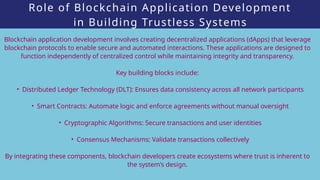
Role of Blockchain Application Development
in Building Trustless Systems
Blockchain application development involves creating decentralized applications (dApps) that leverage
blockchain protocols to enable secure and automated interactions. These applications are designed to
function independently of centralized control while maintaining integrity and transparency.
Key building blocks include:
• Distributed Ledger Technology (DLT): Ensures data consistency across all network participants
• Smart Contracts: Automate logic and enforce agreements without manual oversight
• Cryptographic Algorithms: Secure transactions and user identities
• Consensus Mechanisms: Validate transactions collectively
By integrating these components, blockchain developers create ecosystems where trust is inherent to
the system’s design.
How Decentralization Eliminates the Need for
Intermediaries
In traditional digital ecosystems, intermediaries are responsible for verifying transactions,
maintaining records, and resolving disputes. Blockchain removes this dependency by decentralizing
control across a network of nodes.
This decentralization results in:
• Peer-to-peer transactions without third-party approval
• Reduced operational and transaction costs
• Increased system transparency
• Greater resistance to censorship or downtime
Blockchain applications empower users to transact directly while relying on network consensus
rather than centralized oversight.
Smart Contracts: The Backbone of Trustless
Execution
In traditional digital ecosystems, intermediaries are responsible for verifying transactions,
maintaining records, and resolving disputes. Blockchain removes this dependency by decentralizing
control across a network of nodes.
This decentralization results in:
• Peer-to-peer transactions without third-party approval
• Reduced operational and transaction costs
• Increased system transparency
• Greater resistance to censorship or downtime
Blockchain applications empower users to transact directly while relying on network consensus
rather than centralized oversight.
Transparency and Immutability as Trust
Builders
One of blockchain’s most powerful features is its ability to provide transparency and immutability
simultaneously. Every transaction is recorded permanently on the blockchain and can be verified by
network participants.
This leads to:
• Increased accountability
• Reduced fraud and data tampering
• A single source of truth for all stakeholders
Blockchain applications ensure that historical data remains intact, fostering long-term trust and
confidence among users and organizations.
Real-World Use Cases of Trustless Digital
Ecosystems
Blockchain application development enables trustless ecosystems across diverse industries by
eliminating manual verification and centralized control.
Key use cases include:
• Decentralized Finance (DeFi): Lending, borrowing, and trading without banks
• Supply Chain Management: Transparent tracking of goods and provenance
• Healthcare: Secure sharing of patient records with controlled access
• Gaming and NFTs: True digital ownership and asset interoperability
• Governance: Tamper-proof voting and transparent decision-making
These applications demonstrate how blockchain transforms trust-dependent processes into
trustless systems.
Security and Resilience Through Distributed
Networks
Blockchain networks are inherently more secure than centralized systems due to their distributed
architecture. Attacking or altering the network would require compromising a majority of nodes
simultaneously.
Key security benefits include:
• No single point of failure
• High resistance to cyberattacks
• Continuous availability and uptime
Blockchain applications inherit these strengths, making them suitable for critical digital
infrastructures and long-term ecosystems.
Conclusion
Trustless digital ecosystems are redefining how value, data, and
authority are managed in the digital world. By combining
decentralization, smart contracts, and cryptographic security,
blockchain enables systems where trust is built into the technology
itself. Organizations aiming to future-proof their digital platforms can
leverage Blockchain application development services to build
scalable, secure, and transparent ecosystems that operate efficiently
without intermediaries.
THANK
YOU
www.blockchainx.tech
contact@blockchainx.tech
+91 7708889555

How Blockchain Application Development Enables Trustless Digital Ecosystems.pptx

  • 2.
    In today’s rapidlyevolving digital economy, trust plays a critical role in enabling online interactions, transactions, and data sharing. Traditionally, this trust has been established through centralized intermediaries such as banks, governments, or large technology platforms. However, these centralized systems often introduce inefficiencies, high costs, data silos, and security risks. This is where Blockchain application development emerges as a game- changing innovation. By using decentralized networks and cryptographic validation, blockchain enables trustless digital ecosystems where participants can interact securely and transparently without relying on intermediaries or third parties.
  • 3.
    What Does “Trustless”Really Mean in Blockchain? The term “trustless” can be misleading. It does not imply a lack of trust altogether but rather a shift in how trust is established. In blockchain systems, trust is placed in mathematical algorithms, cryptography, and decentralized consensus instead of human institutions. In a trustless blockchain ecosystem: • Transactions are verified through network consensus • Rules are predefined and enforced by code • Data cannot be altered once validated This ensures that all participants operate under the same transparent rules, reducing the risk of fraud, bias, or manipulation.
  • 4.
    Role of BlockchainApplication Development in Building Trustless Systems Blockchain application development involves creating decentralized applications (dApps) that leverage blockchain protocols to enable secure and automated interactions. These applications are designed to function independently of centralized control while maintaining integrity and transparency. Key building blocks include: • Distributed Ledger Technology (DLT): Ensures data consistency across all network participants • Smart Contracts: Automate logic and enforce agreements without manual oversight • Cryptographic Algorithms: Secure transactions and user identities • Consensus Mechanisms: Validate transactions collectively By integrating these components, blockchain developers create ecosystems where trust is inherent to the system’s design.
  • 5.
    How Decentralization Eliminatesthe Need for Intermediaries In traditional digital ecosystems, intermediaries are responsible for verifying transactions, maintaining records, and resolving disputes. Blockchain removes this dependency by decentralizing control across a network of nodes. This decentralization results in: • Peer-to-peer transactions without third-party approval • Reduced operational and transaction costs • Increased system transparency • Greater resistance to censorship or downtime Blockchain applications empower users to transact directly while relying on network consensus rather than centralized oversight.
  • 6.
    Smart Contracts: TheBackbone of Trustless Execution In traditional digital ecosystems, intermediaries are responsible for verifying transactions, maintaining records, and resolving disputes. Blockchain removes this dependency by decentralizing control across a network of nodes. This decentralization results in: • Peer-to-peer transactions without third-party approval • Reduced operational and transaction costs • Increased system transparency • Greater resistance to censorship or downtime Blockchain applications empower users to transact directly while relying on network consensus rather than centralized oversight.
  • 7.
    Transparency and Immutabilityas Trust Builders One of blockchain’s most powerful features is its ability to provide transparency and immutability simultaneously. Every transaction is recorded permanently on the blockchain and can be verified by network participants. This leads to: • Increased accountability • Reduced fraud and data tampering • A single source of truth for all stakeholders Blockchain applications ensure that historical data remains intact, fostering long-term trust and confidence among users and organizations.
  • 8.
    Real-World Use Casesof Trustless Digital Ecosystems Blockchain application development enables trustless ecosystems across diverse industries by eliminating manual verification and centralized control. Key use cases include: • Decentralized Finance (DeFi): Lending, borrowing, and trading without banks • Supply Chain Management: Transparent tracking of goods and provenance • Healthcare: Secure sharing of patient records with controlled access • Gaming and NFTs: True digital ownership and asset interoperability • Governance: Tamper-proof voting and transparent decision-making These applications demonstrate how blockchain transforms trust-dependent processes into trustless systems.
  • 9.
    Security and ResilienceThrough Distributed Networks Blockchain networks are inherently more secure than centralized systems due to their distributed architecture. Attacking or altering the network would require compromising a majority of nodes simultaneously. Key security benefits include: • No single point of failure • High resistance to cyberattacks • Continuous availability and uptime Blockchain applications inherit these strengths, making them suitable for critical digital infrastructures and long-term ecosystems.
  • 10.
    Conclusion Trustless digital ecosystemsare redefining how value, data, and authority are managed in the digital world. By combining decentralization, smart contracts, and cryptographic security, blockchain enables systems where trust is built into the technology itself. Organizations aiming to future-proof their digital platforms can leverage Blockchain application development services to build scalable, secure, and transparent ecosystems that operate efficiently without intermediaries.
  • 11.