RAMAN
SPECTROSCOPY
Submitted to :-
Dr. Rakesh Kumar Marwaha
Presented by:-
Mukesh Kumari
M. Pharmacy, 2nd sem.
Pharmaceutical Chemistry
Roll no. - 1840
CONTENTS:-
 Introduction
 Principle
 Applications
INTRODUCTION
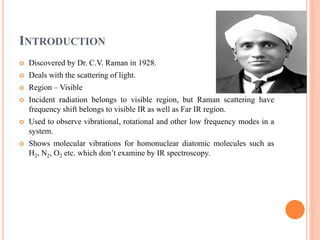
 Discovered by Dr. C.V. Raman in 1928.
 Deals with the scattering of light.
 Region – Visible
 Incident radiation belongs to visible region, but Raman scattering have
frequency shift belongs to visible IR as well as Far IR region.
 Used to observe vibrational, rotational and other low frequency modes in a
system.
 Shows molecular vibrations for homonuclear diatomic molecules such as
H2, N2, O2 etc. which don’t examine by IR spectroscopy.
RAMAN SPECTROSCOPY
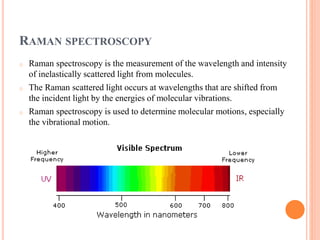
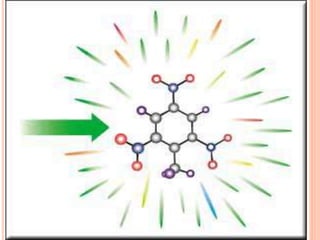
o Raman spectroscopy is the measurement of the wavelength and intensity
of inelastically scattered light from molecules.
o The Raman scattered light occurs at wavelengths that are shifted from
the incident light by the energies of molecular vibrations.
o Raman spectroscopy is used to determine molecular motions, especially
the vibrational motion.
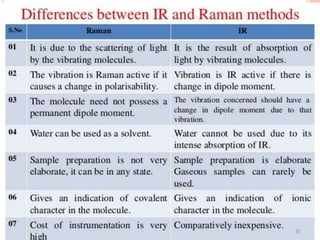
 Gives information about molecular vibrations that are inactive in IR
region because of molecular symmetry. According to ‘mutual exclusion
rule’ for centrosymmetric molecules (H2, CO2, etc), the vibration which is
active in IR is inactive in Raman and vice- versa.
 Uses UV light rather than IR radiation. Hence, sample cell and other units
of optical system can be made of glass or quartz rather than special
material.
 Can use aqueous medium since water is far more transparent in the visible
and UV regions rather than IR region
Advantages:-
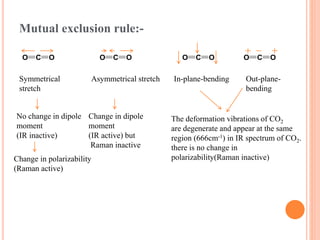
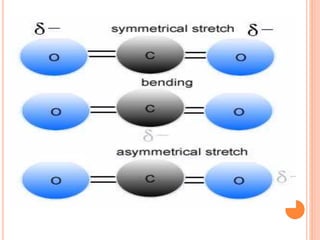
Mutual exclusion rule:-
C OO C OO C OO C OO
Symmetrical
stretch
Asymmetrical stretch In-plane-bending Out-plane-
bending
No change in dipole
moment
(IR inactive)
Change in polarizability
(Raman active)
Change in dipole
moment
(IR active) but
Raman inactive
The deformation vibrations of CO2
are degenerate and appear at the same
region (666cm-1) in IR spectrum of CO2.
there is no change in
polarizability(Raman inactive)
PRINCIPLE
 when monochromatic radiation is incident on a sample then this light will
interact with sample in some fashion. It may be reflected, absorbed and
scattered in some manner. It is the scattering of radiation that occurs,
gives information about molecular structure.
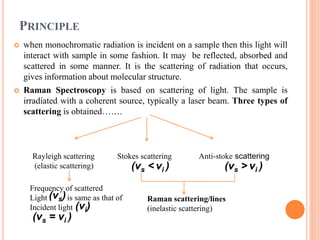
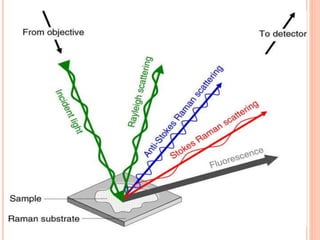
 Raman Spectroscopy is based on scattering of light. The sample is
irradiated with a coherent source, typically a laser beam. Three types of
scattering is obtained…….
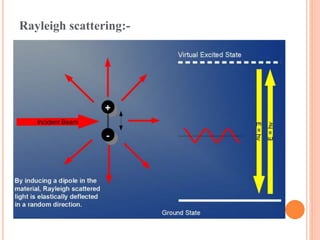
Rayleigh scattering
(elastic scattering)
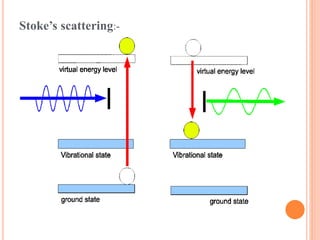
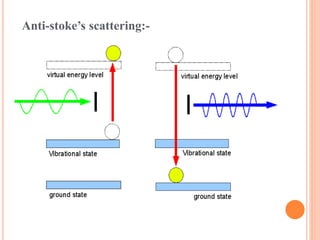
Stokes scattering Anti-stoke scattering
Raman scattering/lines
(inelastic scattering)
Frequency of scattered
Light is same as that of
Incident light
(νs < νi )
(νs)
(νi)
(νs > νi )
(νs = νi )
Rayleigh scattering:-
Stoke’s scattering:-
Anti-stoke’s scattering:-
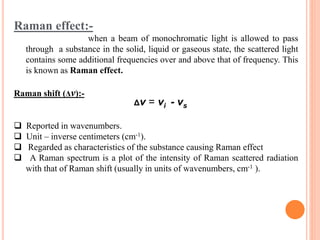
Raman effect:-
when a beam of monochromatic light is allowed to pass
through a substance in the solid, liquid or gaseous state, the scattered light
contains some additional frequencies over and above that of frequency. This
is known as Raman effect.
Raman shift (Δν):-
 Reported in wavenumbers.
 Unit – inverse centimeters (cm-1).
 Regarded as characteristics of the substance causing Raman effect
 A Raman spectrum is a plot of the intensity of Raman scattered radiation
with that of Raman shift (usually in units of wavenumbers, cm-1 ).
Δν = νi - νs
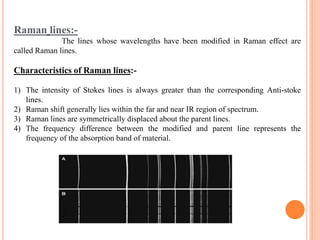
Raman lines:-
The lines whose wavelengths have been modified in Raman effect are
called Raman lines.
Characteristics of Raman lines:-
1) The intensity of Stokes lines is always greater than the corresponding Anti-stoke
lines.
2) Raman shift generally lies within the far and near IR region of spectrum.
3) Raman lines are symmetrically displaced about the parent lines.
4) The frequency difference between the modified and parent line represents the
frequency of the absorption band of material.
Mechanism of Raman effect:-
Mechanism of Raman effect is explained by two theories such as,
(1) Classical Theory of Raman Effect
(2)Quantum Theory of Raman Effect
(1) The Classical Theory of Raman Effect:-
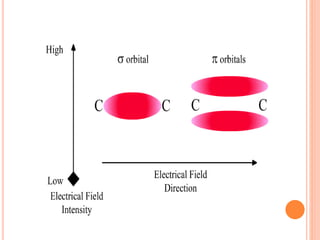
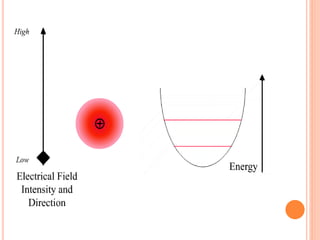
Electric field (E) is applied to a molecule
[visible light(electromagnetic light)]
( E,B) electrons and nuclei are displaced
induced dipole moment (μ) produced
polarisation
Polarizability:-
when electric field is applied to molecule,then the ease with
which molecule get polarised.
molecule under
study
get polarised
μ E here, E= applied electric field
μ = α E (1) μ = induced dipole moment
α is polarizability
E = Eo Sin2 πνt (2)
μ = α Eo Sin2πνt (3)
by applying electric field ,induced dipole moment produced and as a result
polarisability produced.
α = αo+(d α/dQ) Sin2πνvt (4)
αo = constant (amplitude)
d α/dQ = change in polarizability w.r.t. Coordinanat
Substituting eq. (4) in eq. (3)….
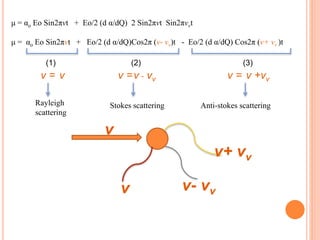
μ = [αo+(d α/dQ) Sin2πνvt ]Eo Sin2πνt
μ = αo Eo Sin2πνt + Eo/2 (d α/dQ) 2 Sin2πνt Sin2πνvt
by applying formula ( 2SinASinB = Cos(A-B) – Cos(A+B) )
μ = αo Eo Sin2πνt + Eo/2 (d α/dQ) 2 Sin2πνt Sin2πνvt
μ = αo Eo Sin2πνt + Eo/2 (d α/dQ)Cos2π (ν- νv)t - Eo/2 (d α/dQ) Cos2π (ν+ νv )t
(1) (2) (3)
ν ν - νv ν +νvν = ν = ν =
Rayleigh
scattering
Stokes scattering Anti-stokes scattering
ν
ν ν- νv
ν+ νv
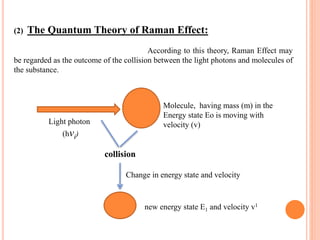
(2) The Quantum Theory of Raman Effect:
According to this theory, Raman Effect may
be regarded as the outcome of the collision between the light photons and molecules of
the substance.
Molecule, having mass (m) in the
Energy state Eo is moving with
velocity (v)Light photon
(hνi)
collision
Change in energy state and velocity
new energy state E1 and velocity v1
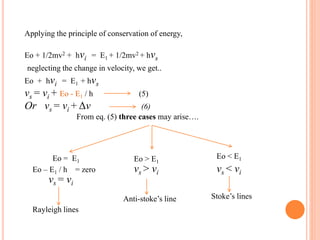
Applying the principle of conservation of energy,
Eo + 1/2mv2 + hνi = E1 + 1/2mv2 + hνs
neglecting the change in velocity, we get..
Eo + hνi = E1 + hνs
νs = νi + Eo - E1 / h (5)
Or νs = νi + Δν (6)
From eq. (5) three cases may arise….
Eo = E1 Eo > E1
Eo < E1
Eo – E1 / h = zero
νs = νi
νs > νi νs < νi
Rayleigh lines
Anti-stoke’s line Stoke’s lines
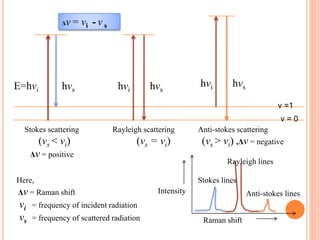
E=hνi
Stokes scattering
(νs < νi)
Δν = positive
Rayleigh scattering
(νs = νi)
Anti-stokes scattering
(νs > νi) ,Δν = negative
hνs hνi hνs
hνi hνs
Δν = νi - ν s
Here,
Δν = Raman shift
νi = frequency of incident radiation
νs = frequency of scattered radiation
v =1
v = 0
Raman shift
Intensity
Stokes lines
Rayleigh lines
Anti-stokes lines
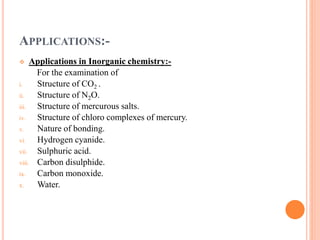
APPLICATIONS:-
 Applications in Inorganic chemistry:-
For the examination of
i. Structure of CO2 .
ii. Structure of N2O.
iii. Structure of mercurous salts.
iv. Structure of chloro complexes of mercury.
v. Nature of bonding.
vi. Hydrogen cyanide.
vii. Sulphuric acid.
viii. Carbon disulphide.
ix. Carbon monoxide.
x. Water.
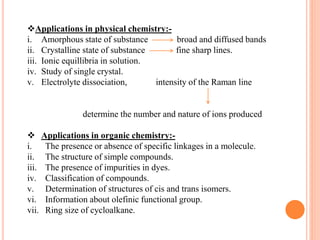
Applications in physical chemistry:-
i. Amorphous state of substance broad and diffused bands
ii. Crystalline state of substance fine sharp lines.
iii. Ionic equillibria in solution.
iv. Study of single crystal.
v. Electrolyte dissociation, intensity of the Raman line
determine the number and nature of ions produced
 Applications in organic chemistry:-
i. The presence or absence of specific linkages in a molecule.
ii. The structure of simple compounds.
iii. The presence of impurities in dyes.
iv. Classification of compounds.
v. Determination of structures of cis and trans isomers.
vi. Information about olefinic functional group.
vii. Ring size of cycloalkane.
REFERENCES:-
 Chatwal Gurdeep R. and Anand Sham K., “Instrumental Methods of Chemical
Analysis,” Fifth Edition, Published by:- Himalaya Publishing House, Page no.- 2.83-
2.110.
 Dr. Kaur H., “Instrumental Methods of Chemical Analysis,” Eleventh Edition,
Published by:- Pragati Prakashan, Page no.- 251-275.
 http://www.actrec.gov.in/pi-webpages/MuraliChilakapati/murali-raman.html as dated
on 5/03/2018.
 http://www.physik.uni-regensburg.de/forschung/schueller/Raman2D-e.phtml as dated
on 5/03/2018.
 http://photonicswiki.org/index.php?title=Polarization_and_Polarizability as dated on
6/03/2018.
 https://www.nature.com/articles/nprot.2016.036 as dated on 6/03/2018.
Raman spectroscopy

Raman spectroscopy

  • 1.
    RAMAN SPECTROSCOPY Submitted to :- Dr.Rakesh Kumar Marwaha Presented by:- Mukesh Kumari M. Pharmacy, 2nd sem. Pharmaceutical Chemistry Roll no. - 1840
  • 2.
  • 3.
    INTRODUCTION  Discovered byDr. C.V. Raman in 1928.  Deals with the scattering of light.  Region – Visible  Incident radiation belongs to visible region, but Raman scattering have frequency shift belongs to visible IR as well as Far IR region.  Used to observe vibrational, rotational and other low frequency modes in a system.  Shows molecular vibrations for homonuclear diatomic molecules such as H2, N2, O2 etc. which don’t examine by IR spectroscopy.
  • 4.
    RAMAN SPECTROSCOPY o Ramanspectroscopy is the measurement of the wavelength and intensity of inelastically scattered light from molecules. o The Raman scattered light occurs at wavelengths that are shifted from the incident light by the energies of molecular vibrations. o Raman spectroscopy is used to determine molecular motions, especially the vibrational motion.
  • 5.
     Gives informationabout molecular vibrations that are inactive in IR region because of molecular symmetry. According to ‘mutual exclusion rule’ for centrosymmetric molecules (H2, CO2, etc), the vibration which is active in IR is inactive in Raman and vice- versa.  Uses UV light rather than IR radiation. Hence, sample cell and other units of optical system can be made of glass or quartz rather than special material.  Can use aqueous medium since water is far more transparent in the visible and UV regions rather than IR region Advantages:-
  • 6.
    Mutual exclusion rule:- COO C OO C OO C OO Symmetrical stretch Asymmetrical stretch In-plane-bending Out-plane- bending No change in dipole moment (IR inactive) Change in polarizability (Raman active) Change in dipole moment (IR active) but Raman inactive The deformation vibrations of CO2 are degenerate and appear at the same region (666cm-1) in IR spectrum of CO2. there is no change in polarizability(Raman inactive)
  • 8.
    PRINCIPLE  when monochromaticradiation is incident on a sample then this light will interact with sample in some fashion. It may be reflected, absorbed and scattered in some manner. It is the scattering of radiation that occurs, gives information about molecular structure.  Raman Spectroscopy is based on scattering of light. The sample is irradiated with a coherent source, typically a laser beam. Three types of scattering is obtained……. Rayleigh scattering (elastic scattering) Stokes scattering Anti-stoke scattering Raman scattering/lines (inelastic scattering) Frequency of scattered Light is same as that of Incident light (νs < νi ) (νs) (νi) (νs > νi ) (νs = νi )
  • 12.
  • 13.
  • 14.
  • 15.
    Raman effect:- when abeam of monochromatic light is allowed to pass through a substance in the solid, liquid or gaseous state, the scattered light contains some additional frequencies over and above that of frequency. This is known as Raman effect. Raman shift (Δν):-  Reported in wavenumbers.  Unit – inverse centimeters (cm-1).  Regarded as characteristics of the substance causing Raman effect  A Raman spectrum is a plot of the intensity of Raman scattered radiation with that of Raman shift (usually in units of wavenumbers, cm-1 ). Δν = νi - νs
  • 16.
    Raman lines:- The lineswhose wavelengths have been modified in Raman effect are called Raman lines. Characteristics of Raman lines:- 1) The intensity of Stokes lines is always greater than the corresponding Anti-stoke lines. 2) Raman shift generally lies within the far and near IR region of spectrum. 3) Raman lines are symmetrically displaced about the parent lines. 4) The frequency difference between the modified and parent line represents the frequency of the absorption band of material.
  • 17.
    Mechanism of Ramaneffect:- Mechanism of Raman effect is explained by two theories such as, (1) Classical Theory of Raman Effect (2)Quantum Theory of Raman Effect (1) The Classical Theory of Raman Effect:- Electric field (E) is applied to a molecule [visible light(electromagnetic light)] ( E,B) electrons and nuclei are displaced induced dipole moment (μ) produced polarisation Polarizability:- when electric field is applied to molecule,then the ease with which molecule get polarised. molecule under study get polarised
  • 18.
    μ E here,E= applied electric field μ = α E (1) μ = induced dipole moment α is polarizability E = Eo Sin2 πνt (2) μ = α Eo Sin2πνt (3) by applying electric field ,induced dipole moment produced and as a result polarisability produced. α = αo+(d α/dQ) Sin2πνvt (4) αo = constant (amplitude) d α/dQ = change in polarizability w.r.t. Coordinanat Substituting eq. (4) in eq. (3)…. μ = [αo+(d α/dQ) Sin2πνvt ]Eo Sin2πνt μ = αo Eo Sin2πνt + Eo/2 (d α/dQ) 2 Sin2πνt Sin2πνvt by applying formula ( 2SinASinB = Cos(A-B) – Cos(A+B) )
  • 19.
    μ = αoEo Sin2πνt + Eo/2 (d α/dQ) 2 Sin2πνt Sin2πνvt μ = αo Eo Sin2πνt + Eo/2 (d α/dQ)Cos2π (ν- νv)t - Eo/2 (d α/dQ) Cos2π (ν+ νv )t (1) (2) (3) ν ν - νv ν +νvν = ν = ν = Rayleigh scattering Stokes scattering Anti-stokes scattering ν ν ν- νv ν+ νv
  • 20.
    (2) The QuantumTheory of Raman Effect: According to this theory, Raman Effect may be regarded as the outcome of the collision between the light photons and molecules of the substance. Molecule, having mass (m) in the Energy state Eo is moving with velocity (v)Light photon (hνi) collision Change in energy state and velocity new energy state E1 and velocity v1
  • 23.
    Applying the principleof conservation of energy, Eo + 1/2mv2 + hνi = E1 + 1/2mv2 + hνs neglecting the change in velocity, we get.. Eo + hνi = E1 + hνs νs = νi + Eo - E1 / h (5) Or νs = νi + Δν (6) From eq. (5) three cases may arise…. Eo = E1 Eo > E1 Eo < E1 Eo – E1 / h = zero νs = νi νs > νi νs < νi Rayleigh lines Anti-stoke’s line Stoke’s lines
  • 24.
    E=hνi Stokes scattering (νs <νi) Δν = positive Rayleigh scattering (νs = νi) Anti-stokes scattering (νs > νi) ,Δν = negative hνs hνi hνs hνi hνs Δν = νi - ν s Here, Δν = Raman shift νi = frequency of incident radiation νs = frequency of scattered radiation v =1 v = 0 Raman shift Intensity Stokes lines Rayleigh lines Anti-stokes lines
  • 26.
    APPLICATIONS:-  Applications inInorganic chemistry:- For the examination of i. Structure of CO2 . ii. Structure of N2O. iii. Structure of mercurous salts. iv. Structure of chloro complexes of mercury. v. Nature of bonding. vi. Hydrogen cyanide. vii. Sulphuric acid. viii. Carbon disulphide. ix. Carbon monoxide. x. Water.
  • 27.
    Applications in physicalchemistry:- i. Amorphous state of substance broad and diffused bands ii. Crystalline state of substance fine sharp lines. iii. Ionic equillibria in solution. iv. Study of single crystal. v. Electrolyte dissociation, intensity of the Raman line determine the number and nature of ions produced  Applications in organic chemistry:- i. The presence or absence of specific linkages in a molecule. ii. The structure of simple compounds. iii. The presence of impurities in dyes. iv. Classification of compounds. v. Determination of structures of cis and trans isomers. vi. Information about olefinic functional group. vii. Ring size of cycloalkane.
  • 29.
    REFERENCES:-  Chatwal GurdeepR. and Anand Sham K., “Instrumental Methods of Chemical Analysis,” Fifth Edition, Published by:- Himalaya Publishing House, Page no.- 2.83- 2.110.  Dr. Kaur H., “Instrumental Methods of Chemical Analysis,” Eleventh Edition, Published by:- Pragati Prakashan, Page no.- 251-275.  http://www.actrec.gov.in/pi-webpages/MuraliChilakapati/murali-raman.html as dated on 5/03/2018.  http://www.physik.uni-regensburg.de/forschung/schueller/Raman2D-e.phtml as dated on 5/03/2018.  http://photonicswiki.org/index.php?title=Polarization_and_Polarizability as dated on 6/03/2018.  https://www.nature.com/articles/nprot.2016.036 as dated on 6/03/2018.