Downloaded 975 times


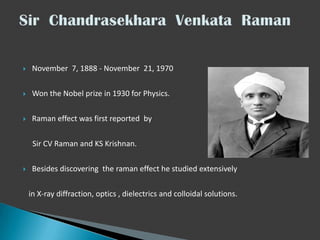
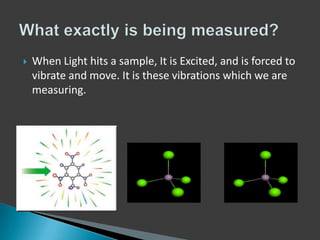
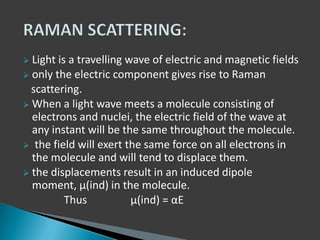
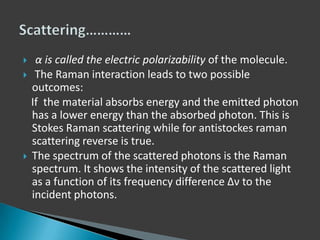
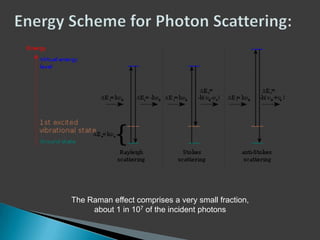
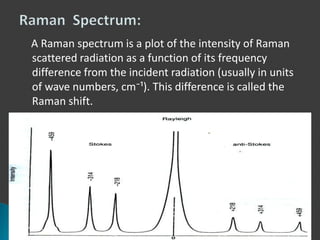
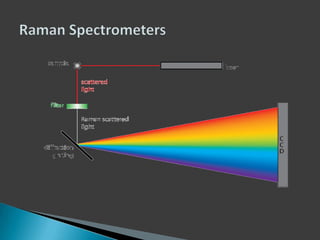
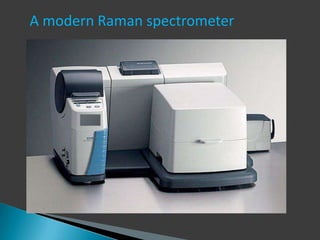
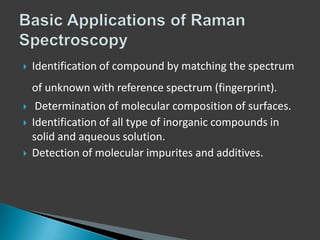
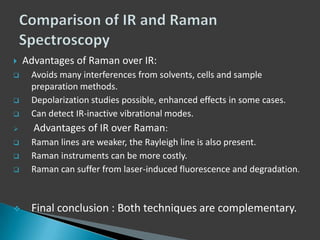

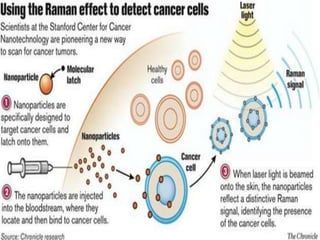


Sir CV Raman was an Indian physicist who won the Nobel Prize in 1930 for his work on the Raman effect. He discovered that when light scatters from molecules, a small fraction of the light shifts to different wavelengths, which is now known as Raman scattering. Raman made many contributions in areas like X-ray diffraction, optics, and colloidal solutions. Raman spectroscopy uses the Raman effect to study materials by analyzing the scattering of monochromatic light. It provides a molecular fingerprint to identify compounds and detect molecular impurities. Both Raman and infrared spectroscopy are useful techniques to analyze materials, but Raman spectroscopy has advantages like avoiding interference from solvents and being able to detect IR-inactive modes.


