CONTENTS :
History
Introduction
Types of fluorescence
Quenching of fluorescence
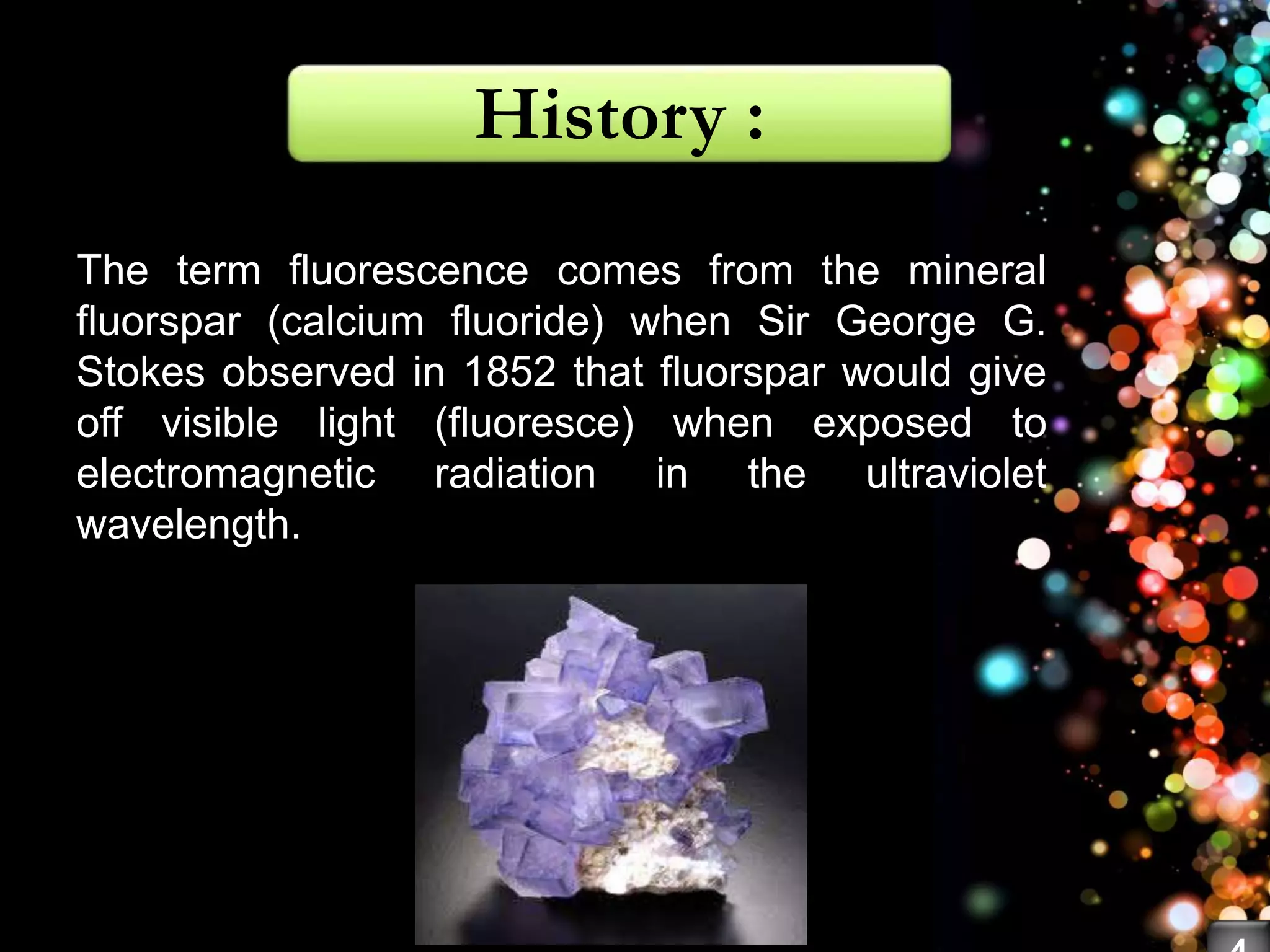
The term fluorescence comes from the mineral
fluorspar (calcium fluoride) when Sir George G.
Stokes observed in 1852 that fluorspar would give
off visible light (fluoresce) when exposed to
electromagnetic radiation in the ultraviolet
wavelength.
History :
Introduction:
Luminescence is the emission of light by a
substance. It occurs when an electron
returns to the electronic ground state from
an excited state and loses its excess energy as
a photon.
It is of 3 types.
Fluorescence spectroscopy.
Phosphorescence spectroscopy.
Chemiluminescence spectroscopy
Principle of fluorescence :
The electronic states of most organic molecules can be divided into
singlet states and triplet states :
• Singlet ground state : All electrons in the molecule are
spin-paired
• Singlet excited state : Unpaired electrons of opposite
spin present
• Triplet state : Unpaired electrons of same spin present
6
Perrin-Jablonski diagram:
7
Principle of fluorescence :
 Energy of emitted radiation is less than that of absorbed
radiation because a part of energy is lost due to
vibrational or collisional processes. Hence the emitted
radiation has longer wavelength (less energy) than the
absorbed radiation.
 Vibrational deactivation takes place through
intermolecular collisions at a time scale of 10 -12 s (faster
than that of fluorescence process) .
8
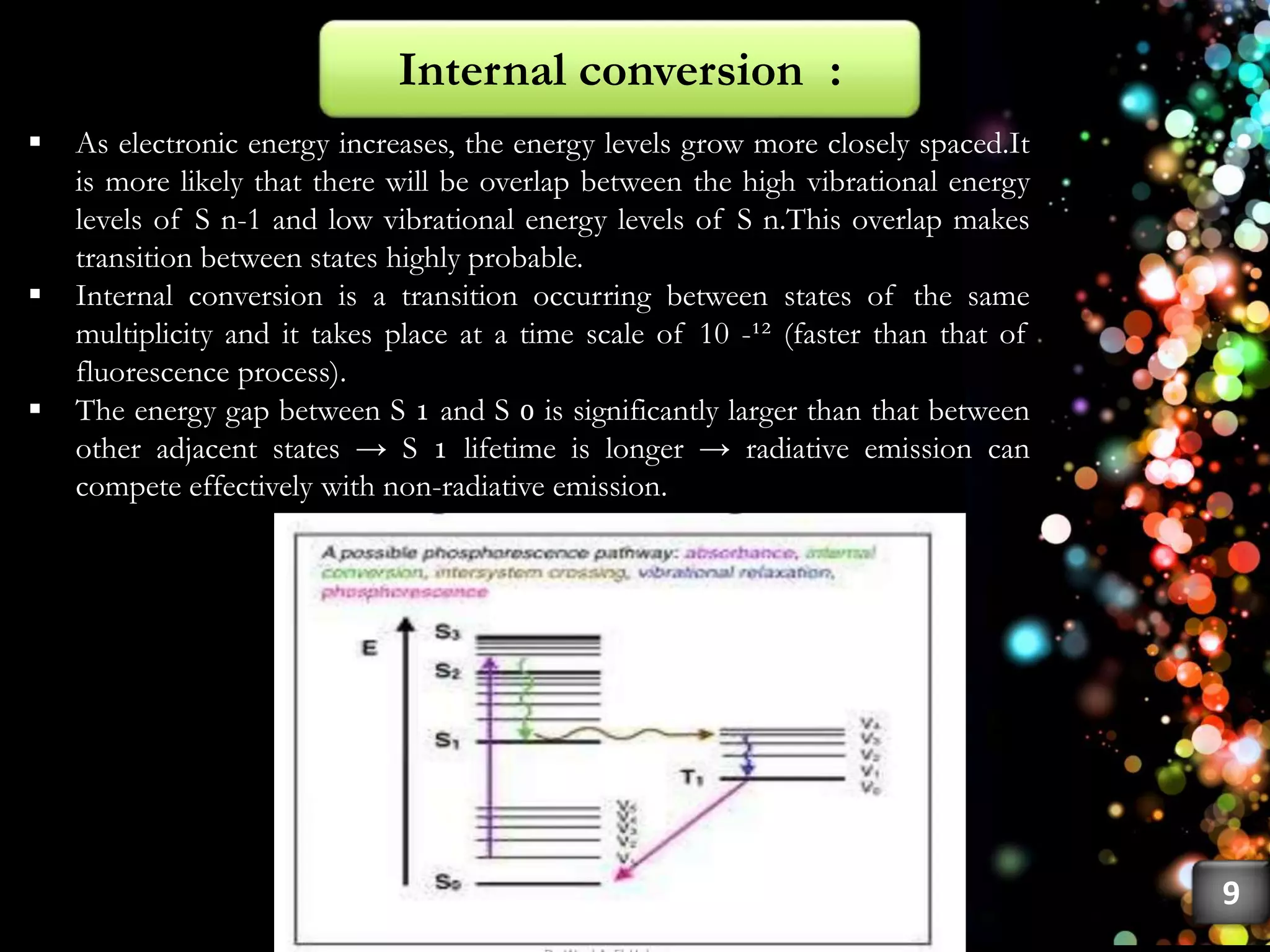
 As electronic energy increases, the energy levels grow more closely spaced.It
is more likely that there will be overlap between the high vibrational energy
levels of S n-1 and low vibrational energy levels of S n.This overlap makes
transition between states highly probable.
 Internal conversion is a transition occurring between states of the same
multiplicity and it takes place at a time scale of 10 -¹² (faster than that of
fluorescence process).
 The energy gap between S ₁ and S ₀ is significantly larger than that between
other adjacent states → S ₁ lifetime is longer → radiative emission can
compete effectively with non-radiative emission.
Internal conversion :
9
Stokes shift
Principle of fluorescence :
The difference btw the max wavelength of the excitation
light and the max wavelength of the emitted fluorescence
lights is a constant – stokes shift
10
Mirror image rule :
 Vibrational levels in the excited states and ground states are
similar.
 An absorption spectrum reflects the vibrational levels of
the electronically excited state.
 An emission spectrum reflects the vibrational levels of the
electronic ground state.
 Fluorescence emission spectrum is mirror image of
absorption spectrum
Principle of fluorescence :
11
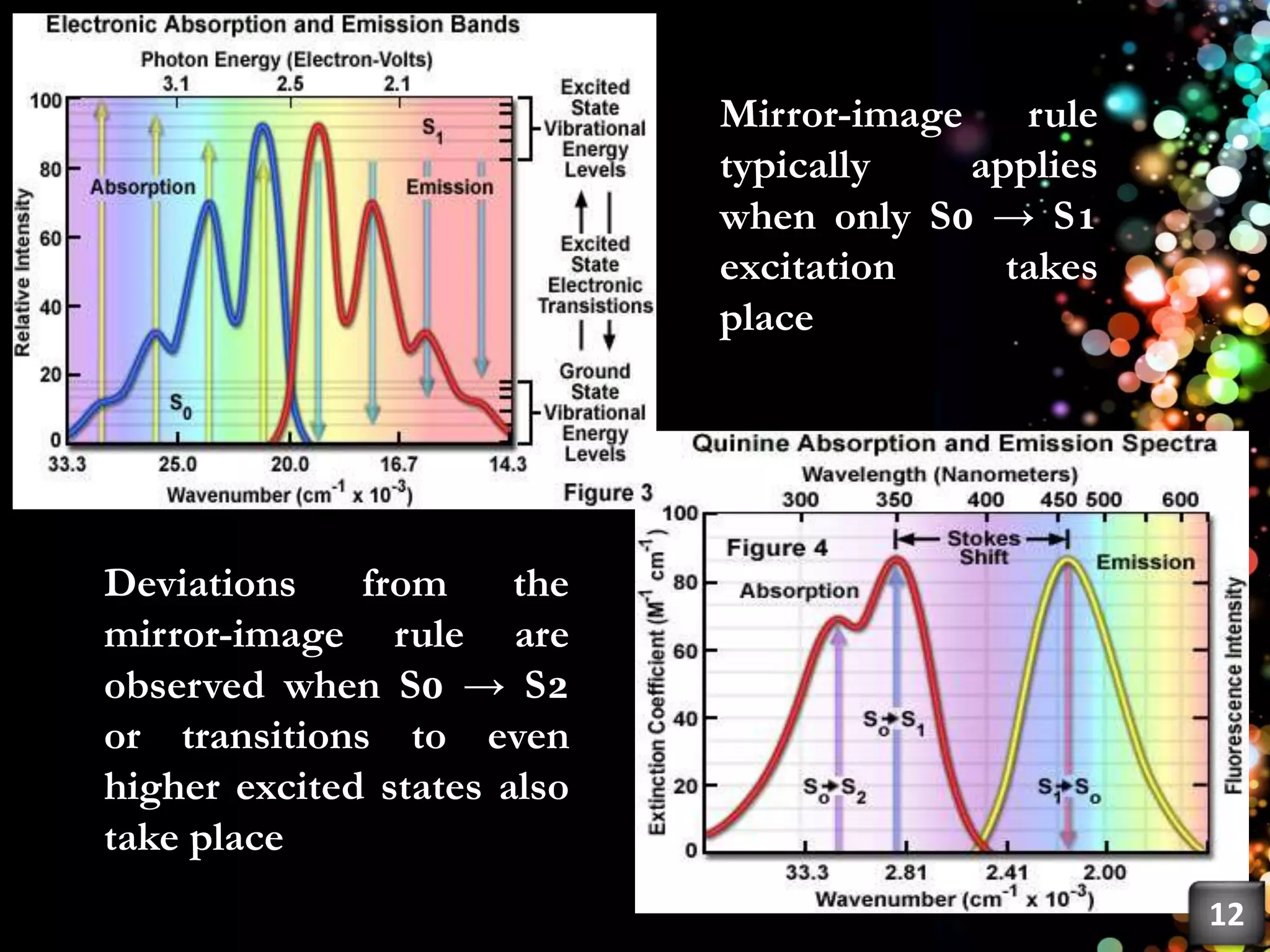
Mirror-image rule
typically applies
when only S₀ → S₁
excitation takes
place
Deviations from the
mirror-image rule are
observed when S₀ → S₂
or transitions to even
higher excited states also
take place
12
Types of fluorescence :
1. Stoke’s fluorescence: The wavelength of emitted radiation is longer
than the Absorbed radiation e.g . Conventional fluorimetric experiments.
2. Anti-stock’s fluorescence: The wavelength of emitted radiation is
shorter than the Absorbed radiation e.g. Thermally assisted fluorescence.
3. Resonance fluorescence: When the wavelength of emitted
radiation is equal to the Absorbed radiation e.g. Mercury vapour at 254 nm.
13
A) Based upon the wavelength of emitted radiation
when compared to absorbed radiation :
3 1 2
14
B) Based upon the phenomenon:
1) Prompt fluorescence:
2) Delayed fluorescence:
Delayed Fluorescencere are delayed emissions whose spectra
coincide exactly with the prompt fluorescence from the lowest
singlet state, the only difference is in their life time.
Types of fluorescence :
Two most important types of delayed fluorescence are:
• E-type delayed fluorescence
• P-type delayed fluorescence
Delayed fluorescence :
15
E-type delayed fluorescence
16
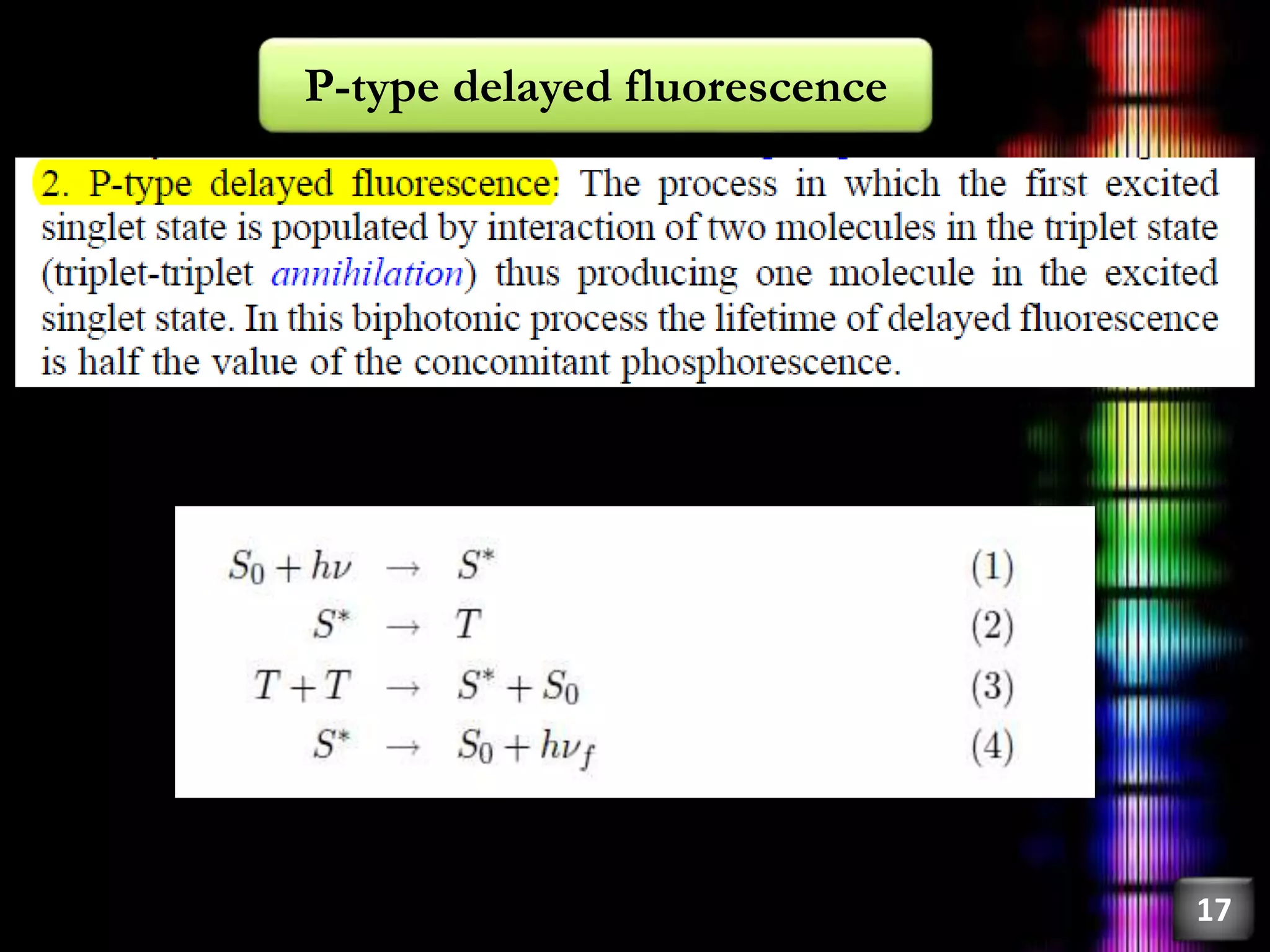
P-type delayed fluorescence
17
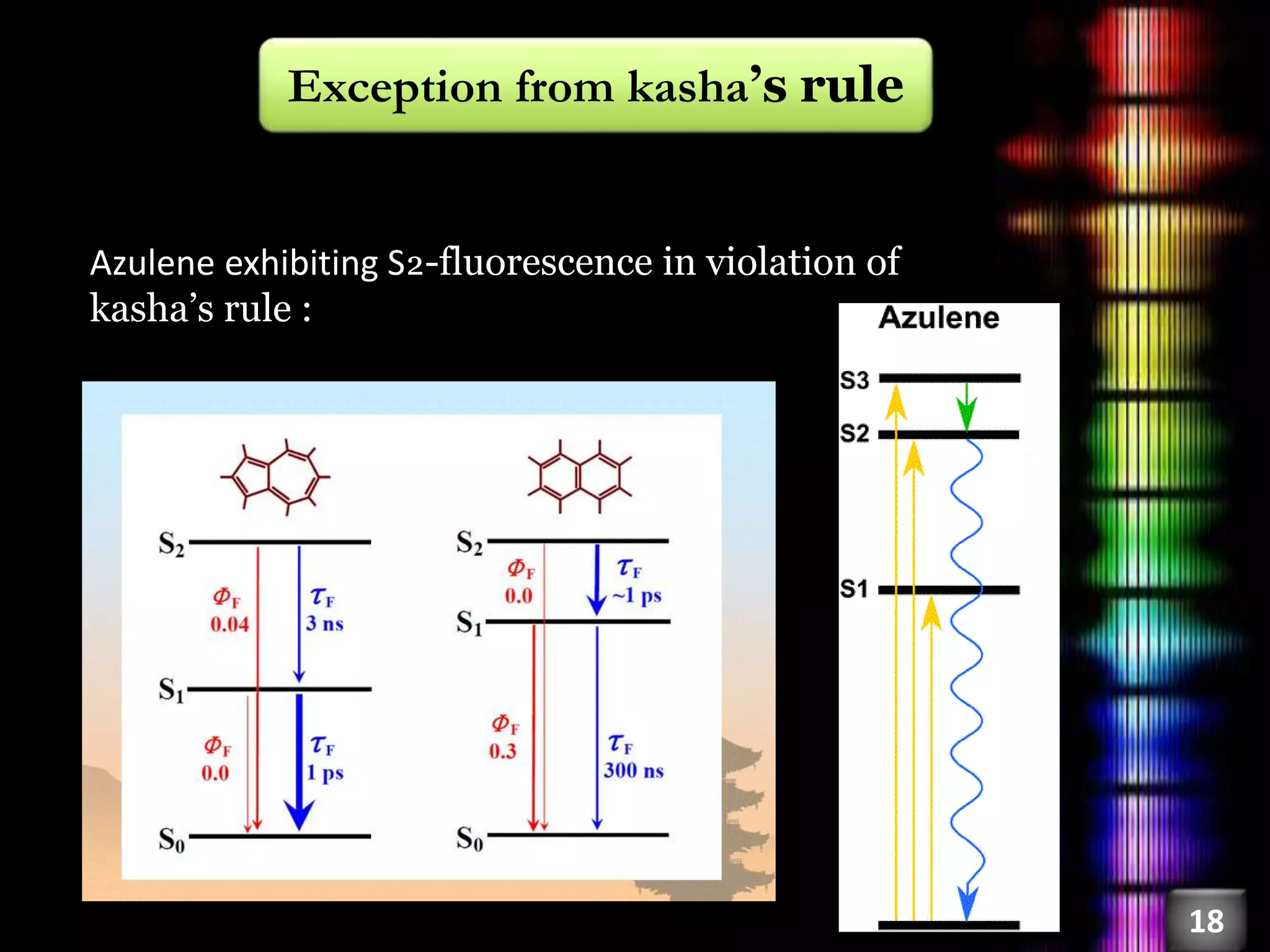
Exception from kasha’s rule
Azulene exhibiting S₂-fluorescence in violation of
kasha’s rule :
18
Self Quenching/ Concentration Quenching:
Fluorescence Concentration of
fluorescing species
Fluorescence
Concentration of
fluorescing species
Calibration curve
(Low con)
calibration curve
(High con)
20
Rigidity of structure
The fluorescence intensity of 8-hydroxyquinoline is much
less than that of the zinc complex.
21
•
22
Solvent effect on fluorescence spectra of
a spirooxazine
1. Matenova, M.; Horhoiu, V. L.; Dang, F. L.; Alster, J.; Burda,
J.V.; Balaban, T.S, Phys. Chem. Chem. Phys. 2014, 31, 16755-
16764.
2. Beer, M.; Longuet-Higgins, H. C, J. Chem. Phys. 1955, 23, 1390–
1391.
3. Soroka, K.; Vithanage, R.S.; Phillips, D. A.; Walker, B.; Dasgupta,
.K, Anal. Chem. 1987, 59, 629-636.
4. Química-Física, C.D, Phys. Chem. Comm. 2000, 5, 18-23.
5. Handbook of Fluorescence Spectroscopy and Imaging. M. Sauer,
J. Hofkens, and J. Enderlein
6. Nishkiori, H.; Takagi, K.; Fujii, T, Res. Chem. Internal. 2003, 29,
485-493.
Refrences
23
Intrinsic structure of a molecule
Environment of a molecule
1
2
1) Nature of molecule (conjugation)
2) Nature of substituent group
3) Rigidity of structure
1) Temperature
2) Viscosity
3) Oxygen
4) Effect of pH
Factors influencing fluorescence intensity :

Flourescence

  • 3.
    CONTENTS : History Introduction Types offluorescence Quenching of fluorescence
  • 4.
    The term fluorescencecomes from the mineral fluorspar (calcium fluoride) when Sir George G. Stokes observed in 1852 that fluorspar would give off visible light (fluoresce) when exposed to electromagnetic radiation in the ultraviolet wavelength. History :
  • 5.
    Introduction: Luminescence is theemission of light by a substance. It occurs when an electron returns to the electronic ground state from an excited state and loses its excess energy as a photon. It is of 3 types. Fluorescence spectroscopy. Phosphorescence spectroscopy. Chemiluminescence spectroscopy
  • 6.
    Principle of fluorescence: The electronic states of most organic molecules can be divided into singlet states and triplet states : • Singlet ground state : All electrons in the molecule are spin-paired • Singlet excited state : Unpaired electrons of opposite spin present • Triplet state : Unpaired electrons of same spin present 6
  • 7.
  • 8.
    Principle of fluorescence:  Energy of emitted radiation is less than that of absorbed radiation because a part of energy is lost due to vibrational or collisional processes. Hence the emitted radiation has longer wavelength (less energy) than the absorbed radiation.  Vibrational deactivation takes place through intermolecular collisions at a time scale of 10 -12 s (faster than that of fluorescence process) . 8
  • 9.
     As electronicenergy increases, the energy levels grow more closely spaced.It is more likely that there will be overlap between the high vibrational energy levels of S n-1 and low vibrational energy levels of S n.This overlap makes transition between states highly probable.  Internal conversion is a transition occurring between states of the same multiplicity and it takes place at a time scale of 10 -¹² (faster than that of fluorescence process).  The energy gap between S ₁ and S ₀ is significantly larger than that between other adjacent states → S ₁ lifetime is longer → radiative emission can compete effectively with non-radiative emission. Internal conversion : 9
  • 10.
    Stokes shift Principle offluorescence : The difference btw the max wavelength of the excitation light and the max wavelength of the emitted fluorescence lights is a constant – stokes shift 10
  • 11.
    Mirror image rule:  Vibrational levels in the excited states and ground states are similar.  An absorption spectrum reflects the vibrational levels of the electronically excited state.  An emission spectrum reflects the vibrational levels of the electronic ground state.  Fluorescence emission spectrum is mirror image of absorption spectrum Principle of fluorescence : 11
  • 12.
    Mirror-image rule typically applies whenonly S₀ → S₁ excitation takes place Deviations from the mirror-image rule are observed when S₀ → S₂ or transitions to even higher excited states also take place 12
  • 13.
    Types of fluorescence: 1. Stoke’s fluorescence: The wavelength of emitted radiation is longer than the Absorbed radiation e.g . Conventional fluorimetric experiments. 2. Anti-stock’s fluorescence: The wavelength of emitted radiation is shorter than the Absorbed radiation e.g. Thermally assisted fluorescence. 3. Resonance fluorescence: When the wavelength of emitted radiation is equal to the Absorbed radiation e.g. Mercury vapour at 254 nm. 13 A) Based upon the wavelength of emitted radiation when compared to absorbed radiation : 3 1 2
  • 14.
    14 B) Based uponthe phenomenon: 1) Prompt fluorescence: 2) Delayed fluorescence: Delayed Fluorescencere are delayed emissions whose spectra coincide exactly with the prompt fluorescence from the lowest singlet state, the only difference is in their life time. Types of fluorescence :
  • 15.
    Two most importanttypes of delayed fluorescence are: • E-type delayed fluorescence • P-type delayed fluorescence Delayed fluorescence : 15
  • 16.
  • 17.
  • 18.
    Exception from kasha’srule Azulene exhibiting S₂-fluorescence in violation of kasha’s rule : 18
  • 19.
    Self Quenching/ ConcentrationQuenching: Fluorescence Concentration of fluorescing species Fluorescence Concentration of fluorescing species Calibration curve (Low con) calibration curve (High con) 20
  • 20.
    Rigidity of structure Thefluorescence intensity of 8-hydroxyquinoline is much less than that of the zinc complex. 21
  • 21.
    • 22 Solvent effect onfluorescence spectra of a spirooxazine
  • 22.
    1. Matenova, M.;Horhoiu, V. L.; Dang, F. L.; Alster, J.; Burda, J.V.; Balaban, T.S, Phys. Chem. Chem. Phys. 2014, 31, 16755- 16764. 2. Beer, M.; Longuet-Higgins, H. C, J. Chem. Phys. 1955, 23, 1390– 1391. 3. Soroka, K.; Vithanage, R.S.; Phillips, D. A.; Walker, B.; Dasgupta, .K, Anal. Chem. 1987, 59, 629-636. 4. Química-Física, C.D, Phys. Chem. Comm. 2000, 5, 18-23. 5. Handbook of Fluorescence Spectroscopy and Imaging. M. Sauer, J. Hofkens, and J. Enderlein 6. Nishkiori, H.; Takagi, K.; Fujii, T, Res. Chem. Internal. 2003, 29, 485-493. Refrences 23
  • 24.
    Intrinsic structure ofa molecule Environment of a molecule 1 2 1) Nature of molecule (conjugation) 2) Nature of substituent group 3) Rigidity of structure 1) Temperature 2) Viscosity 3) Oxygen 4) Effect of pH Factors influencing fluorescence intensity :