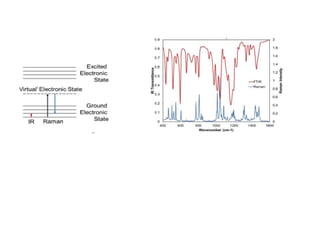
Difference between Raman and
IR Spectroscopy
Sr.
No
Raman Spectroscopy IR Spectroscopy
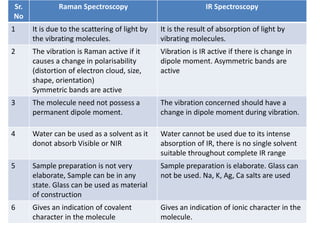
1 It is due to the scattering of light by
the vibrating molecules.
It is the result of absorption of light by
vibrating molecules.
2 The vibration is Raman active if it
causes a change in polarisability
(distortion of electron cloud, size,
shape, orientation)
Symmetric bands are active
Vibration is IR active if there is change in
dipole moment. Asymmetric bands are
active
3 The molecule need not possess a
permanent dipole moment.
The vibration concerned should have a
change in dipole moment during vibration.
4 Water can be used as a solvent as it
donot absorb Visible or NIR
Water cannot be used due to its intense
absorption of IR, there is no single solvent
suitable throughout complete IR range
5 Sample preparation is not very
elaborate, Sample can be in any
state. Glass can be used as material
of construction
Sample preparation is elaborate. Glass can
not be used. Na, K, Ag, Ca salts are used
6 Gives an indication of covalent
character in the molecule
Gives an indication of ionic character in the
molecule.
Sr.
No
Raman Spectroscopy IR Spectroscopy
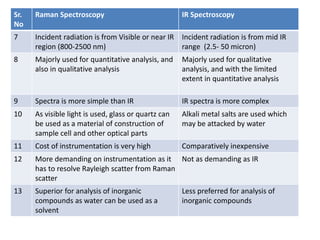
7 Incident radiation is from Visible or near IR
region (800-2500 nm)
Incident radiation is from mid IR
range (2.5- 50 micron)
8 Majorly used for quantitative analysis, and
also in qualitative analysis
Majorly used for qualitative
analysis, and with the limited
extent in quantitative analysis
9 Spectra is more simple than IR IR spectra is more complex
10 As visible light is used, glass or quartz can
be used as a material of construction of
sample cell and other optical parts
Alkali metal salts are used which
may be attacked by water
11 Cost of instrumentation is very high Comparatively inexpensive
12 More demanding on instrumentation as it
has to resolve Rayleigh scatter from Raman
scatter
Not as demanding as IR
13 Superior for analysis of inorganic
compounds as water can be used as a
solvent
Less preferred for analysis of
inorganic compounds
Sr.
No
Raman Spectroscopy IR Spectroscopy
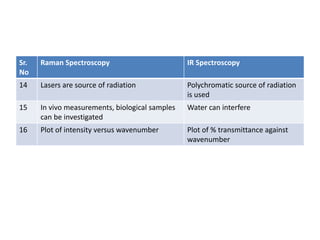
14 Lasers are source of radiation Polychromatic source of radiation
is used
15 In vivo measurements, biological samples
can be investigated
Water can interfere
16 Plot of intensity versus wavenumber Plot of % transmittance against
wavenumber
Difference in raman spectroscopy and ir spectroscopy

Difference in raman spectroscopy and ir spectroscopy

  • 1.
    Difference between Ramanand IR Spectroscopy
  • 2.
    Sr. No Raman Spectroscopy IRSpectroscopy 1 It is due to the scattering of light by the vibrating molecules. It is the result of absorption of light by vibrating molecules. 2 The vibration is Raman active if it causes a change in polarisability (distortion of electron cloud, size, shape, orientation) Symmetric bands are active Vibration is IR active if there is change in dipole moment. Asymmetric bands are active 3 The molecule need not possess a permanent dipole moment. The vibration concerned should have a change in dipole moment during vibration. 4 Water can be used as a solvent as it donot absorb Visible or NIR Water cannot be used due to its intense absorption of IR, there is no single solvent suitable throughout complete IR range 5 Sample preparation is not very elaborate, Sample can be in any state. Glass can be used as material of construction Sample preparation is elaborate. Glass can not be used. Na, K, Ag, Ca salts are used 6 Gives an indication of covalent character in the molecule Gives an indication of ionic character in the molecule.
  • 3.
    Sr. No Raman Spectroscopy IRSpectroscopy 7 Incident radiation is from Visible or near IR region (800-2500 nm) Incident radiation is from mid IR range (2.5- 50 micron) 8 Majorly used for quantitative analysis, and also in qualitative analysis Majorly used for qualitative analysis, and with the limited extent in quantitative analysis 9 Spectra is more simple than IR IR spectra is more complex 10 As visible light is used, glass or quartz can be used as a material of construction of sample cell and other optical parts Alkali metal salts are used which may be attacked by water 11 Cost of instrumentation is very high Comparatively inexpensive 12 More demanding on instrumentation as it has to resolve Rayleigh scatter from Raman scatter Not as demanding as IR 13 Superior for analysis of inorganic compounds as water can be used as a solvent Less preferred for analysis of inorganic compounds
  • 4.
    Sr. No Raman Spectroscopy IRSpectroscopy 14 Lasers are source of radiation Polychromatic source of radiation is used 15 In vivo measurements, biological samples can be investigated Water can interfere 16 Plot of intensity versus wavenumber Plot of % transmittance against wavenumber