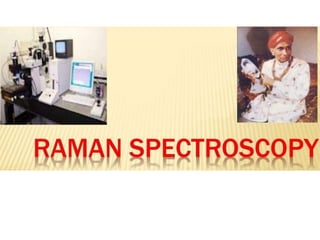
When light interacts with matter, most photons are elastically scattered (Rayleigh scattering) but a small fraction may be inelastically scattered (Raman scattering). Raman scattering occurs when photons from the incident light are absorbed by a molecule, exciting it to a virtual energy state, and are re-emitted at a different wavelength. This change in wavelength provides vibrational, rotational, and other low-frequency information about the molecular structure. Raman spectroscopy utilizes monochromatic light, usually from a laser in the visible, near infrared, or near ultraviolet range. Scattered light from the sample is collected and its properties measured.