Swift Heavy ion irradiation 
Prof. V. Krishnakumar 
Professor and Head 
Department of Physics 
Periyar University 
Salem – 636 011, India
HHiigghh eenneerrggyy iioonn iirrrraaddiiaattiioonn--IImmppoorrttaannccee 
 Energetic ion beams play a vital role in the field of 
research in Materials Science. 
 Energetic ions are suitable means for the modification 
of the surface and the bulk structure of solids. 
 All classes of materials can be modified and analyzed 
with ion beam in order to know about the 
improvements of their physico-chemical properties 
such as electrical, electronic, optical, mechanical, 
magnetic, catalytic structural and metallurgical etc.
When energetic ions passes through 
matter,it looses its energy in two ways 
Electronic energy loss due to inelastic collision 
with electrons(Se)[Electronic stopping] 
 Dominant at higher energies (few tens of MeV 
and higher)-Swift heavy ion Irradiation(SHI) 
Nuclear energy loss due to elastic collision with 
atoms of the solid(Sn)[Nuclear stopping] 
Dominant at low energies (few tens of KeV to 
MeV)
• Low energy ions <2MeV – elastic 
collision – nuclear energy loss 
• High energy ions > 2MeV – Inelastic 
collision – electronic energy loss - 
SHI.
EElleeccttrroonniicc ssttooppppiinngg 
 Interaction of heavily charged ions with 
electrons of the target material through 
Coulomb forces, produce track of ionization 
and highly kinetic electrons along the path of 
the primary ion - latent track (Se>Sth) – Sth 
depends on the material - Electronic energy 
loss.
 When SHI passes through the materials Se 
increases with energy and mass of the ions. The 
effect of Sn is very small( range of the particle > 
sample thickness). 
 The desirable defects can be generated in 
materials by locking sufficient energy into the 
lattice - favors huge possibilities in tailoring of 
materials.
Energy loss can be varied by choosing proper 
ions and doses. 
This remarkable flexibility coupled with new 
cluster beams provides new outlook in many 
fields. 
Ion implantation is a crucial method for dopant 
incorporation in device fabrication which 
produces lattice disorder – detrimental for device 
performance.
Crystal defects due to electronic 
stopping 
• If the heat conductivity is low enough (insulators), 
then the energy of the exited electrons is 
transferred to the target atoms in the vicinity of the 
ion trajectory. As a result crystal defects are 
formed. 
• This swift heavy ion collision displacement 
damage manifests itself in the form of 
1. Point defect (defect cluster) generation and 
2. dislocation loop formation at the periphery of the 
ion trajectory. 
3. Disordered and even amorphous ion track cores. 
4. High energy heavy ion collisions (elastic and 
inelastic) in a variety of solids create radiation 
damage on the target surface.
NNuucclleeaarr ssttooppppiinngg 
 Causes damage and dislocation of nuclei from 
their lattice sites due to elastic collisions 
 Always produce lattice defects 
(Interstitial atoms, anionic or cationic vacancies) 
 Damage areas – modify material properties 
 Ex: change of color of diamonds produce 
interesting alloys
Nature of materials modification depends on 
Properties of the target material 
o Electrical 
o Thermal 
o Structural 
Mass of the projectile ion 
Irradiation parameters 
o Ion energy 
o Fluence rate (ion concentration) 
o Ion species
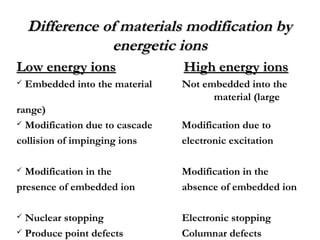
DDiiffffeerreennccee ooff mmaatteerriiaallss mmooddiiffiiccaattiioonn bbyy 
eenneerrggeettiicc iioonnss 
LLooww eenneerrggyy iioonnss HHiigghh eenneerrggyy iioonnss 
 Embedded into the material Not embedded into the 
material (large 
range) 
 Modification due to cascade Modification due to 
collision of impinging ions electronic excitation 
 Modification in the Modification in the 
presence of embedded ion absence of embedded ion 
 Nuclear stopping Electronic stopping 
 Produce point defects Columnar defects
Impacts of heavy ion irradiation 
• Ion beams play a significant role in engineering 
the properties of materials. 
• To alter and tailor many materials properties like 
electronic and optical 
• Energetic ions are suitable means for the 
modifications of the surface and the bulk 
structure of solids 
• Possible to create optical wave guides in organic 
crystals.
Ion induced eeffffeeccttss oonn NNLLOO mmaatteerriiaallss 
Irradiation of heavy ions is expected to bring 
following changes 
Formation of gray tracks (coloration) on the 
irradiated samples of high fluences irrespective of ion 
beam and its energy. 
Efficient generation of harmonic frequencies requires a 
non-linear medium with following desirable properties 
High Thermal stability 
Large transparency window 
High optical damage threshold 
High mechanical hardness
Due to these facts, wave guide structures can be obtained 
Light guidance demands adjacent regions of different 
refractive indices 
Two methods to create wave guide structures 
Heavy ion exchange- causes increased refractive 
indices 
MeV irradiation of light elements forms a layer of 
reduced refractive index due to high nuclear energy 
deposition
 This will increase the single mode spectral bandwidth 
for efficient SHG in wave guiding lasers. 
Modifications in the refractive index of the 
materials on ion irradiation leads to the formation 
of wave guides. 
Formation of wave guides will guide to modify the 
essential property of second harmonic generation, 
which widens their scope in photonic and opto-electronic 
applications.
Also, Post treatment after SHI irradiation into 
insulator leads to the nano-cluster formation and 
change of optical property. 
Dielectric constant of a material is related to 
polarizability (ionic, electronic, oriental and space 
charge)of the material. 
Disordering of the crystal lattice by ion 
irradiation causes increase in dielectric constant
Electro-optic co-efficient is directly proportional 
to dielectric constant of the material. 
o Ion irradiation enhances the electro-optic co-efficient 
of NLO crystals 
o Irradiated crystals can be a good EO modulator 
of light. 
Ion irradiation also affects the transmittance 
properties of crystals, hence, it is also expected 
to influence the SHG property.

Heavy ion irradiation on materials

  • 1.
    Swift Heavy ionirradiation Prof. V. Krishnakumar Professor and Head Department of Physics Periyar University Salem – 636 011, India
  • 2.
    HHiigghh eenneerrggyy iioonniirrrraaddiiaattiioonn--IImmppoorrttaannccee  Energetic ion beams play a vital role in the field of research in Materials Science.  Energetic ions are suitable means for the modification of the surface and the bulk structure of solids.  All classes of materials can be modified and analyzed with ion beam in order to know about the improvements of their physico-chemical properties such as electrical, electronic, optical, mechanical, magnetic, catalytic structural and metallurgical etc.
  • 3.
    When energetic ionspasses through matter,it looses its energy in two ways Electronic energy loss due to inelastic collision with electrons(Se)[Electronic stopping]  Dominant at higher energies (few tens of MeV and higher)-Swift heavy ion Irradiation(SHI) Nuclear energy loss due to elastic collision with atoms of the solid(Sn)[Nuclear stopping] Dominant at low energies (few tens of KeV to MeV)
  • 4.
    • Low energyions <2MeV – elastic collision – nuclear energy loss • High energy ions > 2MeV – Inelastic collision – electronic energy loss - SHI.
  • 5.
    EElleeccttrroonniicc ssttooppppiinngg Interaction of heavily charged ions with electrons of the target material through Coulomb forces, produce track of ionization and highly kinetic electrons along the path of the primary ion - latent track (Se>Sth) – Sth depends on the material - Electronic energy loss.
  • 6.
     When SHIpasses through the materials Se increases with energy and mass of the ions. The effect of Sn is very small( range of the particle > sample thickness).  The desirable defects can be generated in materials by locking sufficient energy into the lattice - favors huge possibilities in tailoring of materials.
  • 7.
    Energy loss canbe varied by choosing proper ions and doses. This remarkable flexibility coupled with new cluster beams provides new outlook in many fields. Ion implantation is a crucial method for dopant incorporation in device fabrication which produces lattice disorder – detrimental for device performance.
  • 8.
    Crystal defects dueto electronic stopping • If the heat conductivity is low enough (insulators), then the energy of the exited electrons is transferred to the target atoms in the vicinity of the ion trajectory. As a result crystal defects are formed. • This swift heavy ion collision displacement damage manifests itself in the form of 1. Point defect (defect cluster) generation and 2. dislocation loop formation at the periphery of the ion trajectory. 3. Disordered and even amorphous ion track cores. 4. High energy heavy ion collisions (elastic and inelastic) in a variety of solids create radiation damage on the target surface.
  • 9.
    NNuucclleeaarr ssttooppppiinngg Causes damage and dislocation of nuclei from their lattice sites due to elastic collisions  Always produce lattice defects (Interstitial atoms, anionic or cationic vacancies)  Damage areas – modify material properties  Ex: change of color of diamonds produce interesting alloys
  • 10.
    Nature of materialsmodification depends on Properties of the target material o Electrical o Thermal o Structural Mass of the projectile ion Irradiation parameters o Ion energy o Fluence rate (ion concentration) o Ion species
  • 11.
    DDiiffffeerreennccee ooff mmaatteerriiaallssmmooddiiffiiccaattiioonn bbyy eenneerrggeettiicc iioonnss LLooww eenneerrggyy iioonnss HHiigghh eenneerrggyy iioonnss  Embedded into the material Not embedded into the material (large range)  Modification due to cascade Modification due to collision of impinging ions electronic excitation  Modification in the Modification in the presence of embedded ion absence of embedded ion  Nuclear stopping Electronic stopping  Produce point defects Columnar defects
  • 12.
    Impacts of heavyion irradiation • Ion beams play a significant role in engineering the properties of materials. • To alter and tailor many materials properties like electronic and optical • Energetic ions are suitable means for the modifications of the surface and the bulk structure of solids • Possible to create optical wave guides in organic crystals.
  • 13.
    Ion induced eeffffeeccttssoonn NNLLOO mmaatteerriiaallss Irradiation of heavy ions is expected to bring following changes Formation of gray tracks (coloration) on the irradiated samples of high fluences irrespective of ion beam and its energy. Efficient generation of harmonic frequencies requires a non-linear medium with following desirable properties High Thermal stability Large transparency window High optical damage threshold High mechanical hardness
  • 14.
    Due to thesefacts, wave guide structures can be obtained Light guidance demands adjacent regions of different refractive indices Two methods to create wave guide structures Heavy ion exchange- causes increased refractive indices MeV irradiation of light elements forms a layer of reduced refractive index due to high nuclear energy deposition
  • 15.
     This willincrease the single mode spectral bandwidth for efficient SHG in wave guiding lasers. Modifications in the refractive index of the materials on ion irradiation leads to the formation of wave guides. Formation of wave guides will guide to modify the essential property of second harmonic generation, which widens their scope in photonic and opto-electronic applications.
  • 16.
    Also, Post treatmentafter SHI irradiation into insulator leads to the nano-cluster formation and change of optical property. Dielectric constant of a material is related to polarizability (ionic, electronic, oriental and space charge)of the material. Disordering of the crystal lattice by ion irradiation causes increase in dielectric constant
  • 17.
    Electro-optic co-efficient isdirectly proportional to dielectric constant of the material. o Ion irradiation enhances the electro-optic co-efficient of NLO crystals o Irradiated crystals can be a good EO modulator of light. Ion irradiation also affects the transmittance properties of crystals, hence, it is also expected to influence the SHG property.