laser
Laser: everywhere in your life 
Laser printer 
Laser pointer
What is Laser? 
Light Amplification by Stimulated 
Emission of Radiation 
• A device produces a coherent beam of 
optical radiation by stimulating electronic, 
ionic, or molecular transitions to higher 
energy levels 
• When they return to lower energy levels by 
stimulated emission, they emit energy.
Properties of Laser 
• Monochromatic 
Concentrate in a narrow range of wavelengths 
(one specific colour). 
• Coherent 
All the emitted photons bear a constant phase 
relationship with each other in both time and 
phase 
• Directional 
A very tight beam which is very strong and 
concentrated.
Basic concepts for a laser 
• Absorption 
• Spontaneous Emission 
• Stimulated Emission 
• Population inversion
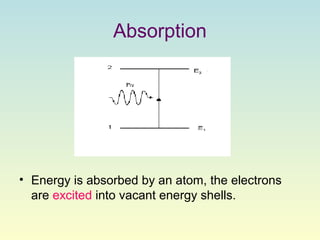
Absorption 
• Energy is absorbed by an atom, the electrons 
are excited into vacant energy shells.
Spontaneous Emission 
• The atom decays from level 2 to level 1 through 
the emission of a photon with the energy hv. It is 
a completely random process.
Stimulated Emission 
atoms in an upper energy level can be triggered 
or stimulated in phase by an incoming photon of 
a specific energy.
Stimulated Emission 
The stimulated photons have unique properties: 
– In phase with the incident photon 
– Same wavelength as the incident photon 
– Travel in same direction as incident photon
Population Inversion 
• A state in which a substance has been 
energized, or excited to specific energy levels. 
• More atoms or molecules are in a higher excited 
state. 
• The process of producing a population inversion 
is called pumping. 
• Examples: 
→by lamps of appropriate intensity 
→by electrical discharge
How a laser works?
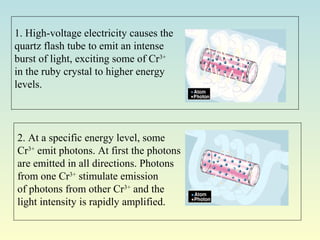
1. High-voltage electricity causes the 
quartz flash tube to emit an intense 
burst of light, exciting some of Cr3+ 
in the ruby crystal to higher energy 
levels. 
2. At a specific energy level, some 
Cr3+ emit photons. At first the photons 
are emitted in all directions. Photons 
from one Cr3+ stimulate emission 
of photons from other Cr3+ and the 
light intensity is rapidly amplified.
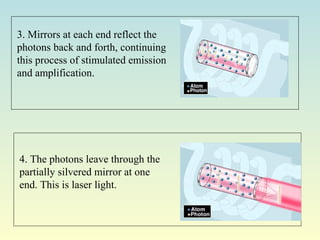
3. Mirrors at each end reflect the 
photons back and forth, continuing 
this process of stimulated emission 
and amplification. 
4. The photons leave through the 
partially silvered mirror at one 
end. This is laser light.
Two-level Laser System 
• Unimaginable 
as absorption and stimulated processes 
neutralize one another. 
• The material becomes transparent.
Three-level Laser System 
• Initially excited to a 
short-lived high-energy 
state . 
• Then quickly decay to 
the intermediate 
metastable level. 
• Population inversion is 
created between lower 
ground state and a 
higher-energy 
metastable state.
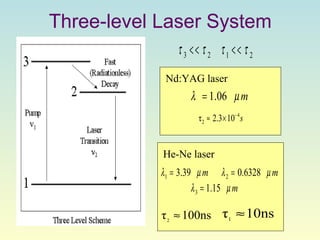
Three-level Laser System 
3 2 t < < t 1 2 t < < t 
Nd:YAG laser 
l = 1.06 m m 
τ » 2.3´ 10- 4 
s 
2 He-Ne laser 
1 l = 3.39 m m 2 l = 0.6328 m m 
3 l = 1.15 m m 
τ 100ns 2 » τ 10ns 1 »
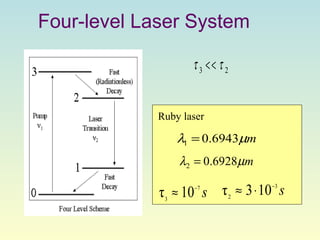
Four-level Laser System 
• Laser transition takes 
place between the 
third and second 
excited states. 
• Rapid depopulation of 
the lower laser level.
Four-level Laser System 
3 2 t << t 
l 0.6943mm 1 = 
l 0.6928mm 2 = 
τ » 10- 7 s 
τ » 3×10- 
3 s 
3 2 Ruby laser
Laser Construction 
• A pump source 
• A gain medium or laser medium. 
• Mirrors forming an optical resonator.
Laser Construction
Pump Source 
• Provides energy to the laser system 
• Examples: electrical discharges, flashlamps, 
arc lamps and chemical reactions. 
• The type of pump source used depends on 
the gain medium. 
→A helium-neon (HeNe) laser uses an 
electrical discharge in the helium-neon 
gas mixture. 
→Excimer lasers use a chemical reaction.
Gain Medium 
• Major determining factor of the wavelength of 
operation of the laser. 
• Excited by the pump source to produce a 
population inversion. 
• Where spontaneous and stimulated emission 
of photons takes place. 
• Example: 
solid, liquid, gas and semiconductor.
Optical Resonator 
• Two parallel mirrors placed around the 
gain medium. 
• Light is reflected by the mirrors back into 
the medium and is amplified . 
• The design and alignment of the mirrors 
with respect to the medium is crucial. 
• Spinning mirrors, modulators, filters and 
absorbers may be added to produce a 
variety of effects on the laser output.
Laser Types 
• According to the active material: 
solid-state, liquid, gas, excimer or 
semiconductor lasers. 
• According to the wavelength: 
infra-red, visible, ultra-violet (UV) or x-ray 
lasers.
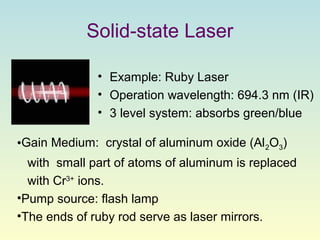
Solid-state Laser 
• Example: Ruby Laser 
• Operation wavelength: 694.3 nm (IR) 
• 3 level system: absorbs green/blue 
•Gain Medium: crystal of aluminum oxide (Al2O3) 
with small part of atoms of aluminum is replaced 
with Cr3+ ions. 
•Pump source: flash lamp 
•The ends of ruby rod serve as laser mirrors.
Liquid Laser 
• Example: dye laser 
• Gain medium: complex organic dyes, such 
as rhodamine 6G, in liquid solution or 
suspension. 
• Pump source: other lasers or flashlamp. 
• Can be used for a wide range of 
wavelengths as the tuning range of the 
laser depends on the exact dye used. 
• Suitable for tunable lasers.
dye laser 
Schematic diagram of a dye laser 
A dye laser can be considered to be basically a four-level system. 
The energy absorbed by the dye creates a population inversion, moving the 
electrons into an excited state.
Gas Laser 
• Example: Helium-neon laser (He-Ne laser) 
• Operation wavelength: 632.8 nm 
• Pump source: electrical discharge 
• Gain medium : ratio 5:1 mixture of helium and neon 
gases
He-Ne laser 
3.39μm 0.6328μm 1.15μm 1 2 3 l = l = l =
Applications of laser 
• 1. Scientific 
a. Spectroscopy 
b. Lunar laser ranging 
c. Photochemistry 
d. Laser cooling 
e. Nuclear fusion
2 Military 
Applications of laser 
a. Death ray 
b. Defensive applications 
c. Strategic defense initiative 
d. Laser sight 
e. Illuminator 
f. Rangefinder 
g. Target designator
• 3. Medical 
Applications of laser 
a. eye surgery 
b. cosmetic surgery
Applications of laser 
• 4. Industry & Commercial 
a. cutting, welding, marking 
b. CD player, DVD player 
c. Laser printers, laser pointers 
d. Photolithography 
e. Laser light display
Reference 
hhttttpp::////wwwwww..wwoorrddiiqq..ccoomm//ddeeffiinniittiioonn//LLaasseerr 
hhttttpp::////wwwwww..aassaammnneett..ddee//~~bbiirrnneerrss//ppuubblliicc__hhttmmll//llaasseerr..hhttmmll 
hhttttpp::////vvccss..aabbddnn..aacc..uukk//EENNGGIINNEEEERRIINNGG//llaasseerrss//llaasseerrss..hhttmmll
Some links: lasers for sale 
http://www.lasersurplus.com/lasers.htm 
http://www.midwest-laser.com/html/ilt5490a___ilt5470k.html 
http://www.hhr-lasers.com/ 
http://www.coherentinc.com/ 
http://www.spectra-physics.com/ 
http://www.continuumlasers.com/ 
How lasers work 
http://technology.niagarac.on.ca/courses/tech238g/Lasers.html 
http://www.clf.rl.ac.uk/Public/index.htm 
http://www.m2m.ecs.soton.ac.uk/Default.asp?id=283

LASER

  • 1.
  • 2.
    Laser: everywhere inyour life Laser printer Laser pointer
  • 3.
    What is Laser? Light Amplification by Stimulated Emission of Radiation • A device produces a coherent beam of optical radiation by stimulating electronic, ionic, or molecular transitions to higher energy levels • When they return to lower energy levels by stimulated emission, they emit energy.
  • 4.
    Properties of Laser • Monochromatic Concentrate in a narrow range of wavelengths (one specific colour). • Coherent All the emitted photons bear a constant phase relationship with each other in both time and phase • Directional A very tight beam which is very strong and concentrated.
  • 5.
    Basic concepts fora laser • Absorption • Spontaneous Emission • Stimulated Emission • Population inversion
  • 6.
    Absorption • Energyis absorbed by an atom, the electrons are excited into vacant energy shells.
  • 7.
    Spontaneous Emission •The atom decays from level 2 to level 1 through the emission of a photon with the energy hv. It is a completely random process.
  • 8.
    Stimulated Emission atomsin an upper energy level can be triggered or stimulated in phase by an incoming photon of a specific energy.
  • 9.
    Stimulated Emission Thestimulated photons have unique properties: – In phase with the incident photon – Same wavelength as the incident photon – Travel in same direction as incident photon
  • 10.
    Population Inversion •A state in which a substance has been energized, or excited to specific energy levels. • More atoms or molecules are in a higher excited state. • The process of producing a population inversion is called pumping. • Examples: →by lamps of appropriate intensity →by electrical discharge
  • 11.
  • 12.
    1. High-voltage electricitycauses the quartz flash tube to emit an intense burst of light, exciting some of Cr3+ in the ruby crystal to higher energy levels. 2. At a specific energy level, some Cr3+ emit photons. At first the photons are emitted in all directions. Photons from one Cr3+ stimulate emission of photons from other Cr3+ and the light intensity is rapidly amplified.
  • 13.
    3. Mirrors ateach end reflect the photons back and forth, continuing this process of stimulated emission and amplification. 4. The photons leave through the partially silvered mirror at one end. This is laser light.
  • 14.
    Two-level Laser System • Unimaginable as absorption and stimulated processes neutralize one another. • The material becomes transparent.
  • 15.
    Three-level Laser System • Initially excited to a short-lived high-energy state . • Then quickly decay to the intermediate metastable level. • Population inversion is created between lower ground state and a higher-energy metastable state.
  • 16.
    Three-level Laser System 3 2 t < < t 1 2 t < < t Nd:YAG laser l = 1.06 m m τ » 2.3´ 10- 4 s 2 He-Ne laser 1 l = 3.39 m m 2 l = 0.6328 m m 3 l = 1.15 m m τ 100ns 2 » τ 10ns 1 »
  • 17.
    Four-level Laser System • Laser transition takes place between the third and second excited states. • Rapid depopulation of the lower laser level.
  • 18.
    Four-level Laser System 3 2 t << t l 0.6943mm 1 = l 0.6928mm 2 = τ » 10- 7 s τ » 3×10- 3 s 3 2 Ruby laser
  • 19.
    Laser Construction •A pump source • A gain medium or laser medium. • Mirrors forming an optical resonator.
  • 20.
  • 21.
    Pump Source •Provides energy to the laser system • Examples: electrical discharges, flashlamps, arc lamps and chemical reactions. • The type of pump source used depends on the gain medium. →A helium-neon (HeNe) laser uses an electrical discharge in the helium-neon gas mixture. →Excimer lasers use a chemical reaction.
  • 22.
    Gain Medium •Major determining factor of the wavelength of operation of the laser. • Excited by the pump source to produce a population inversion. • Where spontaneous and stimulated emission of photons takes place. • Example: solid, liquid, gas and semiconductor.
  • 23.
    Optical Resonator •Two parallel mirrors placed around the gain medium. • Light is reflected by the mirrors back into the medium and is amplified . • The design and alignment of the mirrors with respect to the medium is crucial. • Spinning mirrors, modulators, filters and absorbers may be added to produce a variety of effects on the laser output.
  • 24.
    Laser Types •According to the active material: solid-state, liquid, gas, excimer or semiconductor lasers. • According to the wavelength: infra-red, visible, ultra-violet (UV) or x-ray lasers.
  • 25.
    Solid-state Laser •Example: Ruby Laser • Operation wavelength: 694.3 nm (IR) • 3 level system: absorbs green/blue •Gain Medium: crystal of aluminum oxide (Al2O3) with small part of atoms of aluminum is replaced with Cr3+ ions. •Pump source: flash lamp •The ends of ruby rod serve as laser mirrors.
  • 26.
    Liquid Laser •Example: dye laser • Gain medium: complex organic dyes, such as rhodamine 6G, in liquid solution or suspension. • Pump source: other lasers or flashlamp. • Can be used for a wide range of wavelengths as the tuning range of the laser depends on the exact dye used. • Suitable for tunable lasers.
  • 27.
    dye laser Schematicdiagram of a dye laser A dye laser can be considered to be basically a four-level system. The energy absorbed by the dye creates a population inversion, moving the electrons into an excited state.
  • 28.
    Gas Laser •Example: Helium-neon laser (He-Ne laser) • Operation wavelength: 632.8 nm • Pump source: electrical discharge • Gain medium : ratio 5:1 mixture of helium and neon gases
  • 29.
    He-Ne laser 3.39μm0.6328μm 1.15μm 1 2 3 l = l = l =
  • 30.
    Applications of laser • 1. Scientific a. Spectroscopy b. Lunar laser ranging c. Photochemistry d. Laser cooling e. Nuclear fusion
  • 31.
    2 Military Applicationsof laser a. Death ray b. Defensive applications c. Strategic defense initiative d. Laser sight e. Illuminator f. Rangefinder g. Target designator
  • 32.
    • 3. Medical Applications of laser a. eye surgery b. cosmetic surgery
  • 33.
    Applications of laser • 4. Industry & Commercial a. cutting, welding, marking b. CD player, DVD player c. Laser printers, laser pointers d. Photolithography e. Laser light display
  • 34.
  • 35.
    Some links: lasersfor sale http://www.lasersurplus.com/lasers.htm http://www.midwest-laser.com/html/ilt5490a___ilt5470k.html http://www.hhr-lasers.com/ http://www.coherentinc.com/ http://www.spectra-physics.com/ http://www.continuumlasers.com/ How lasers work http://technology.niagarac.on.ca/courses/tech238g/Lasers.html http://www.clf.rl.ac.uk/Public/index.htm http://www.m2m.ecs.soton.ac.uk/Default.asp?id=283