Terahertz frequency: A new 
addition to electromagnetic 
spectrum. 
Prof .V.Krishnakumar 
Professor and Head 
Department of physics 
Periyar University 
Salem, India.
Aim of the talk 
• Introduce the history of terahertz science. 
• Properties. 
• Application.
Terahertz spectrum 
Terahertz mean trillion cycle per second. Terahertz 
radiation is sometimes considered a subset of 
infrared radiation. i.e., terahertz waves lies between 
long-wavelength of infrared and short-wavelength of 
microwave radiation.
Terahertz E.M radiation / Rays / 
Waves ? 
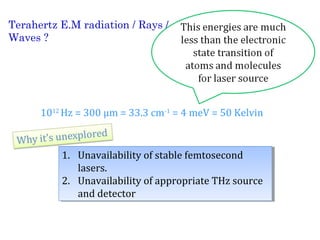
1012 Hz = 300 μm = 33.3 cm-1 = 4 meV = 50 Kelvin 
1. Unavailability of stable femtosecond 
lasers. 
lasers. 
2. Unavailability of appropriate THz source 
and detector 
and detector
Properties 
Terahertz waves can penetrate through 
materials opaque to other parts of the EM 
spectrum. 
Packaging materials - including paper, 
cardboard, textiles, plastics, wood, ceramics, 
semiconductors, and dried and frozen materials 
are transparent to some degree. 
Due to its comparatively low photon energy 
(4 meV at 1 THz), THz radiation does not initiate 
any changes in chemical structure, as opposed to 
UV radiation or X-rays for example. ... do not 
subject a biological tissue to harmful radiation.
 In the same way that visible light can create a 
photograph, radio waves can transmit sound and x-rays 
can view within the human body, terahertz 
waves can create images and transmit information. 
 Characteristic properties of THz radiation are 
high penetration depth and low scattering combined 
with good spatial resolution. Resolution of THz 
wave is 1 mm. 
 The unique rotational, vibrational and 
translational responses of materials (molecular, 
radicals and ions) within the THz range provide 
information that is generally absent in optical, x-ray 
and NMR images.
 Frequency of the THz wave is fall in the region 
of rotational frequencies of many gas molecules 
as well as the vibrational transition of weak 
bond. 
 Water has many strong absorption lines in the 
THz range.
Applications 
Terahertz imaging - new steps toward real-life 
applications 
 Radiation penetrates many common barrier 
materials enabling concealed objects to be seen. 
 Wavelengths are short enough to give adequate 
spatial resolution for imaging or localisation of 
threat objects. 
 Radiation at these frequencies is non-ionising and, 
at modest intensities, safe to use on people.
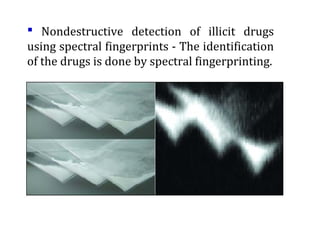
 Nondestructive detection of illicit drugs 
using spectral fingerprints - The identification 
of the drugs is done by spectral fingerprinting.
 Laser-terahertz emission microscope for semiconductor 
device under test. 
For inspecting electrical failures in large scale 
integration circuits (LSIs). The difference in pattern of 
laser and LTEM images shows the electrical failures in 
chips. 
visible image 
terahertz image
 Water content measurement in plants and seeds, 
Monitoring the leaf moisture level by measuring 
its transmission in the millimeter wave region is used in 
plant factory for monitoring the growing process. 
 Monitoring of water/ice state in food stuffs 
Using difference in absorption coefficients for 
water and ice (ice absorbs three order of magnitude 
less than water) one can monitor the water/ice state 
in foodstuffs.
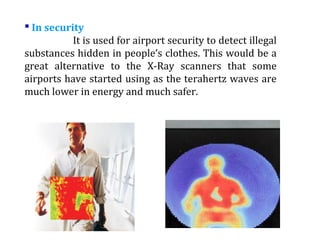
 In security 
It is used for airport security to detect illegal 
substances hidden in people’s clothes. This would be a 
great alternative to the X-Ray scanners that some 
airports have started using as the terahertz waves are 
much lower in energy and much safer.
Airport Scanners May Harm 
DNA, Not Just Privacy and Dignity
"It's passenger imaging technology, so it allows us to 
see the entire image of the passenger's body and anything 
that might be hidden on the person” 
The new technology includes new privacy protection 
also. The screener in the viewing room can't see the 
passenger's face and the images from the machine are 
deleted, once the traveler is cleared to fly.
 In medical 
Terahertz radiation can also detect differences in 
water content and density of a tissue. Such methods could 
allow effective detection of epithelial cancer with a safer 
and less invasive or painful system using imaging. Some 
frequencies of terahertz radiation can be used for 3D 
imaging of teeth and may be more accurate and safer than 
conventional X-ray imaging in dentistry. 
A mouse prostate section with tumor 
tissue (circle) as imaged with 
terahertz, optical, and staining 
techniques. The terahertz image 
shows significantly reduced 
absorption of terahertz radiation in 
this region compared to normal 
tissue, suggesting its usefulness for 
detecting tumors
 In Manufacturing 
Many possible uses of terahertz sensing and imaging are 
proposed in manufacturing, quality control, and process 
monitoring. These generally exploit the traits of plastics and 
cardboard being transparent to terahertz radiation, making it 
possible to inspect packaged goods. 
THz image of a chocolate bar contaminated with a buried 
glass, stone and metal splinter. Existing inspection systems 
such as ultrasound or X-ray may fail to detect such 
contaminants.
Moisture content in food is also of question, as the weight of 
food is increased if there is a higher moisture content. This is 
of particular concern with large quantities of dried foods, 
which could lead to significant changes to a company’s 
profitability and reputation. Thus new methods are needed 
in this case to increase safe food quality and production. 
 In Communication 
Current wireless systems utilise carrier waves less than 5 GHz 
which restrict their maximum data rate, 100’s Mbit/s typically. 
Higher frequency carriers enable high data rates and 
therefore 
1000’s Gbit/s dates rates are on offer with terahertz carrier 
waves.
Terahertz spectroscopy 
Explosive material may uniquely absorb at 1.15 THz 
and at 1.85 THz. Hence it is used to detect explosive 
material by sing its fingerprint images.
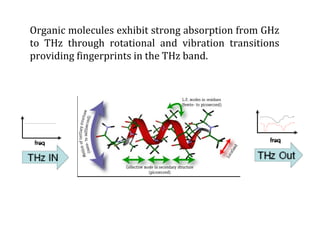
Organic molecules exhibit strong absorption from GHz 
to THz through rotational and vibration transitions 
providing fingerprints in the THz band.
 Sub millimeter astronomy 
THz detects cold matter (140 K or less), such as clouds of gas and dust in 
our and nearby galaxies. 
New stars beginning to form radiate heat as they contract and are clearly 
seen in the THz range. 
Image shows the beginning of new star formation
Safety of terahertz radiation 
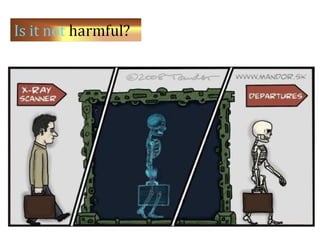
In contrast to X-ray radiation, terahertz radiation is non-ionizing 
and therefore safe for humans. X-rays are ionizing and 
therefore poses significant health risks. 
THz exhibits an extremely low photon energy so that 
there is no danger that chemical bonds are broken up and that 
the examined material is changed. 
The emitted power is very low leading to insignificant 
heating.
End note 
THz research will become one of the most promising research areas in 
the 21st century for transformational advances in imaging, as well as in 
other interdisciplinary fields. However, terahertz wave (T-ray) imaging 
is still in its infancy. 
Compared to the relatively well-developed science and technology at 
microwave, optical and x-ray frequencies, basic research, new 
initiatives and advanced technology developments in the THz band are 
very limited and remain relatively unexplored. 
Much of the equipment used in terahertz research is large and heavy, 
and requires special operating conditions— such as controlled 
temperature and humidity, and use of liquefied gasses— which make it 
hard to implement these systems in real-life applications. Research is 
under way to decrease the size and weight of sources and detectors, as 
well as to make terahertz systems less bulky and easier to manipulate 
and less demanding of special operating conditions.
Terahertz_An introduction

Terahertz_An introduction

  • 1.
    Terahertz frequency: Anew addition to electromagnetic spectrum. Prof .V.Krishnakumar Professor and Head Department of physics Periyar University Salem, India.
  • 2.
    Aim of thetalk • Introduce the history of terahertz science. • Properties. • Application.
  • 3.
    Terahertz spectrum Terahertzmean trillion cycle per second. Terahertz radiation is sometimes considered a subset of infrared radiation. i.e., terahertz waves lies between long-wavelength of infrared and short-wavelength of microwave radiation.
  • 4.
    Terahertz E.M radiation/ Rays / Waves ? 1012 Hz = 300 μm = 33.3 cm-1 = 4 meV = 50 Kelvin 1. Unavailability of stable femtosecond 1. Unavailability of stable femtosecond lasers. lasers. 2. Unavailability of appropriate THz source 2. Unavailability of appropriate THz source and detector and detector
  • 5.
    Properties Terahertz wavescan penetrate through materials opaque to other parts of the EM spectrum. Packaging materials - including paper, cardboard, textiles, plastics, wood, ceramics, semiconductors, and dried and frozen materials are transparent to some degree. Due to its comparatively low photon energy (4 meV at 1 THz), THz radiation does not initiate any changes in chemical structure, as opposed to UV radiation or X-rays for example. ... do not subject a biological tissue to harmful radiation.
  • 6.
     In thesame way that visible light can create a photograph, radio waves can transmit sound and x-rays can view within the human body, terahertz waves can create images and transmit information.  Characteristic properties of THz radiation are high penetration depth and low scattering combined with good spatial resolution. Resolution of THz wave is 1 mm.  The unique rotational, vibrational and translational responses of materials (molecular, radicals and ions) within the THz range provide information that is generally absent in optical, x-ray and NMR images.
  • 7.
     Frequency ofthe THz wave is fall in the region of rotational frequencies of many gas molecules as well as the vibrational transition of weak bond.  Water has many strong absorption lines in the THz range.
  • 8.
    Applications Terahertz imaging- new steps toward real-life applications  Radiation penetrates many common barrier materials enabling concealed objects to be seen.  Wavelengths are short enough to give adequate spatial resolution for imaging or localisation of threat objects.  Radiation at these frequencies is non-ionising and, at modest intensities, safe to use on people.
  • 9.
     Nondestructive detectionof illicit drugs using spectral fingerprints - The identification of the drugs is done by spectral fingerprinting.
  • 10.
     Laser-terahertz emissionmicroscope for semiconductor device under test. For inspecting electrical failures in large scale integration circuits (LSIs). The difference in pattern of laser and LTEM images shows the electrical failures in chips. visible image terahertz image
  • 11.
     Water contentmeasurement in plants and seeds, Monitoring the leaf moisture level by measuring its transmission in the millimeter wave region is used in plant factory for monitoring the growing process.  Monitoring of water/ice state in food stuffs Using difference in absorption coefficients for water and ice (ice absorbs three order of magnitude less than water) one can monitor the water/ice state in foodstuffs.
  • 12.
     In security It is used for airport security to detect illegal substances hidden in people’s clothes. This would be a great alternative to the X-Ray scanners that some airports have started using as the terahertz waves are much lower in energy and much safer.
  • 13.
    Airport Scanners MayHarm DNA, Not Just Privacy and Dignity
  • 16.
    "It's passenger imagingtechnology, so it allows us to see the entire image of the passenger's body and anything that might be hidden on the person” The new technology includes new privacy protection also. The screener in the viewing room can't see the passenger's face and the images from the machine are deleted, once the traveler is cleared to fly.
  • 17.
     In medical Terahertz radiation can also detect differences in water content and density of a tissue. Such methods could allow effective detection of epithelial cancer with a safer and less invasive or painful system using imaging. Some frequencies of terahertz radiation can be used for 3D imaging of teeth and may be more accurate and safer than conventional X-ray imaging in dentistry. A mouse prostate section with tumor tissue (circle) as imaged with terahertz, optical, and staining techniques. The terahertz image shows significantly reduced absorption of terahertz radiation in this region compared to normal tissue, suggesting its usefulness for detecting tumors
  • 18.
     In Manufacturing Many possible uses of terahertz sensing and imaging are proposed in manufacturing, quality control, and process monitoring. These generally exploit the traits of plastics and cardboard being transparent to terahertz radiation, making it possible to inspect packaged goods. THz image of a chocolate bar contaminated with a buried glass, stone and metal splinter. Existing inspection systems such as ultrasound or X-ray may fail to detect such contaminants.
  • 19.
    Moisture content infood is also of question, as the weight of food is increased if there is a higher moisture content. This is of particular concern with large quantities of dried foods, which could lead to significant changes to a company’s profitability and reputation. Thus new methods are needed in this case to increase safe food quality and production.  In Communication Current wireless systems utilise carrier waves less than 5 GHz which restrict their maximum data rate, 100’s Mbit/s typically. Higher frequency carriers enable high data rates and therefore 1000’s Gbit/s dates rates are on offer with terahertz carrier waves.
  • 20.
    Terahertz spectroscopy Explosivematerial may uniquely absorb at 1.15 THz and at 1.85 THz. Hence it is used to detect explosive material by sing its fingerprint images.
  • 21.
    Organic molecules exhibitstrong absorption from GHz to THz through rotational and vibration transitions providing fingerprints in the THz band.
  • 22.
     Sub millimeterastronomy THz detects cold matter (140 K or less), such as clouds of gas and dust in our and nearby galaxies. New stars beginning to form radiate heat as they contract and are clearly seen in the THz range. Image shows the beginning of new star formation
  • 23.
    Safety of terahertzradiation In contrast to X-ray radiation, terahertz radiation is non-ionizing and therefore safe for humans. X-rays are ionizing and therefore poses significant health risks. THz exhibits an extremely low photon energy so that there is no danger that chemical bonds are broken up and that the examined material is changed. The emitted power is very low leading to insignificant heating.
  • 25.
    End note THzresearch will become one of the most promising research areas in the 21st century for transformational advances in imaging, as well as in other interdisciplinary fields. However, terahertz wave (T-ray) imaging is still in its infancy. Compared to the relatively well-developed science and technology at microwave, optical and x-ray frequencies, basic research, new initiatives and advanced technology developments in the THz band are very limited and remain relatively unexplored. Much of the equipment used in terahertz research is large and heavy, and requires special operating conditions— such as controlled temperature and humidity, and use of liquefied gasses— which make it hard to implement these systems in real-life applications. Research is under way to decrease the size and weight of sources and detectors, as well as to make terahertz systems less bulky and easier to manipulate and less demanding of special operating conditions.