Crystal Growth 
Prof. V. Krishnakumar 
Professor and Head 
Department of Physics 
Periyar University 
Salem – 636 011, India
Crystal Growth 
Crystallization is the process through which the atoms, molecules or 
ions arrange themselves in a repeating pattern. There are numerous 
methods to obtain crystals, any number of which may be applicable to a 
given compound. While sometimes it may seem that crystallization is 
more of an art than a science, there are several methods that generally 
produce crystals. For small molecules, these methods are typically 
based on reducing the solubility of the sample. 
The solubility of most compounds 
decreases as the temperature is 
lowered thus the cooling of a 
saturated solution will often produce 
crystals. Since rapid cooling may 
cause the precipitation of 
amorphous solid or microscopic 
crystals, it is often wise to surround 
the flask with an insulating medium 
to slow the rate of cooling. 
Controlled cooling
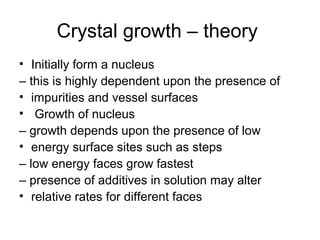
Crystal growth – theory 
• Initially form a nucleus 
– this is highly dependent upon the presence of 
• impurities and vessel surfaces 
• Growth of nucleus 
– growth depends upon the presence of low 
• energy surface sites such as steps 
– low energy faces grow fastest 
– presence of additives in solution may alter 
• relative rates for different faces
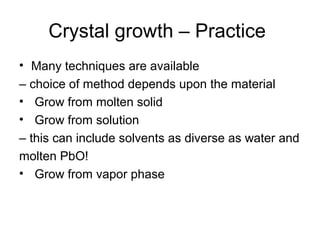
Crystal growth – Practice 
• Many techniques are available 
– choice of method depends upon the material 
• Grow from molten solid 
• Grow from solution 
– this can include solvents as diverse as water and 
molten PbO! 
• Grow from vapor phase
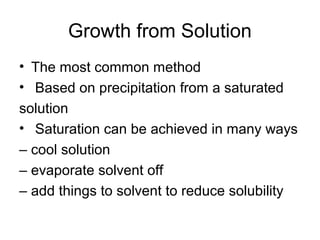
Growth from Solution 
• The most common method 
• Based on precipitation from a saturated 
solution 
• Saturation can be achieved in many ways 
– cool solution 
– evaporate solvent off 
– add things to solvent to reduce solubility
Basic requirements – solution 
growth 
• Pure materials 
• Suitable solvent 
• Glasswares 
• Perforated cover 
• Nylon thread for suspending seed 
crystals.
Solvent should be… 
• High solute solubility 
• High positive temperature coefficient of 
solute solubility 
• Low volatility 
• Small vapour pressure 
• Low viscosity 
• Less corrosion and non-toxicity
Solubility 
• Solubility of the solute – dissolving the 
solute in the solvent at a const. Temp. 
• Solubility of the material decides the 
amount of the material available for crystal 
growth
Supersaturation 
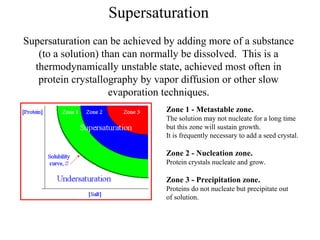
Supersaturation can be achieved by adding more of a substance 
(to a solution) than can normally be dissolved. This is a 
thermodynamically unstable state, achieved most often in 
protein crystallography by vapor diffusion or other slow 
evaporation techniques. 
Zone 1 - Metastable zone. 
The solution may not nucleate for a long time 
but this zone will sustain growth. 
It is frequently necessary to add a seed crystal. 
Zone 2 - Nucleation zone. 
Protein crystals nucleate and grow. 
Zone 3 - Precipitation zone. 
Proteins do not nucleate but precipitate out 
of solution.
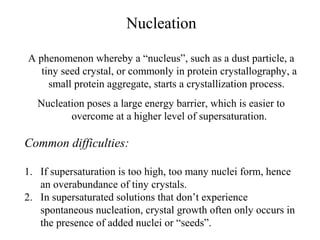
Nucleation 
A phenomenon whereby a “nucleus”, such as a dust particle, a 
tiny seed crystal, or commonly in protein crystallography, a 
small protein aggregate, starts a crystallization process. 
Nucleation poses a large energy barrier, which is easier to 
overcome at a higher level of supersaturation. 
Common difficulties: 
1. If supersaturation is too high, too many nuclei form, hence 
an overabundance of tiny crystals. 
2. In supersaturated solutions that don’t experience 
spontaneous nucleation, crystal growth often only occurs in 
the presence of added nuclei or “seeds”.
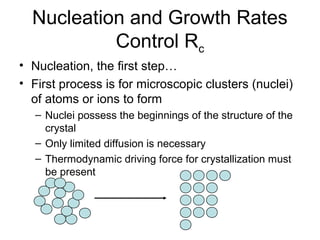
Nucleation and Growth Rates 
Control Rc 
• Nucleation, the first step… 
• First process is for microscopic clusters (nuclei) 
of atoms or ions to form 
– Nuclei possess the beginnings of the structure of the 
crystal 
– Only limited diffusion is necessary 
– Thermodynamic driving force for crystallization must 
be present
NUCLEATION 
water as example 
• initiation of freezing 
• formation of small nuclei -center of crystals 
• homogeneous or heterogeneous 
• homogeneous -water -random 
accumulation of water molecules 
• heterogeneous -small particles present in 
the solution act as nuclei
Crystal Growth 
water as example 
• can only occur after nuclei are formed 
• exceed the crystal size 
• function of : 
– rate at which the water molecules reacts 
at the crystal surface 
– diffusion rate of water molecules from the 
unfrozen solution to the crystal surface 
– rate heat is removed
Growth of crystals from nuclei 
• Growth processes then enlarge existing 
nuclei 
• Smallest nuclei often redissolve 
• Larger nuclei can get larger 
• Thermodynamics favors the 
• formation of larger nuclei
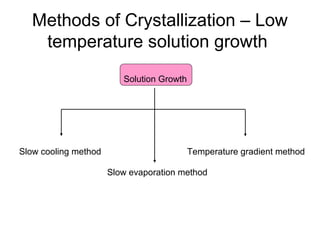
Methods of Crystallization – Low 
temperature solution growth 
Solution Growth 
Slow cooling method 
Temperature gradient method 
Slow evaporation method
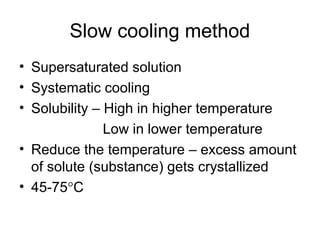
Slow cooling method 
• Supersaturated solution 
• Systematic cooling 
• Solubility – High in higher temperature 
Low in lower temperature 
• Reduce the temperature – excess amount 
of solute (substance) gets crystallized 
• 45-75°C
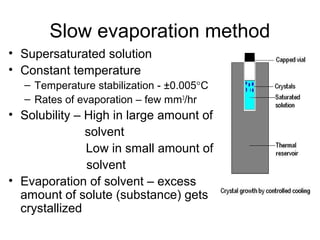
Slow evaporation method 
• Supersaturated solution 
• Constant temperature 
– Temperature stabilization - ±0.005°C 
– Rates of evaporation – few mm3/hr 
• Solubility – High in large amount of 
solvent 
Low in small amount of 
solvent 
• Evaporation of solvent – excess 
amount of solute (substance) gets 
crystallized
Temperature gradient method 
• Transport of the materials from hot 
(Source) to cold region 
Advantage 
Crystal grows at fixed temperature 
Insensitive to changes in temperature 
Economy of solvent and solute

Crystal Growth_Introduction

  • 1.
    Crystal Growth Prof.V. Krishnakumar Professor and Head Department of Physics Periyar University Salem – 636 011, India
  • 2.
    Crystal Growth Crystallizationis the process through which the atoms, molecules or ions arrange themselves in a repeating pattern. There are numerous methods to obtain crystals, any number of which may be applicable to a given compound. While sometimes it may seem that crystallization is more of an art than a science, there are several methods that generally produce crystals. For small molecules, these methods are typically based on reducing the solubility of the sample. The solubility of most compounds decreases as the temperature is lowered thus the cooling of a saturated solution will often produce crystals. Since rapid cooling may cause the precipitation of amorphous solid or microscopic crystals, it is often wise to surround the flask with an insulating medium to slow the rate of cooling. Controlled cooling
  • 3.
    Crystal growth –theory • Initially form a nucleus – this is highly dependent upon the presence of • impurities and vessel surfaces • Growth of nucleus – growth depends upon the presence of low • energy surface sites such as steps – low energy faces grow fastest – presence of additives in solution may alter • relative rates for different faces
  • 4.
    Crystal growth –Practice • Many techniques are available – choice of method depends upon the material • Grow from molten solid • Grow from solution – this can include solvents as diverse as water and molten PbO! • Grow from vapor phase
  • 5.
    Growth from Solution • The most common method • Based on precipitation from a saturated solution • Saturation can be achieved in many ways – cool solution – evaporate solvent off – add things to solvent to reduce solubility
  • 6.
    Basic requirements –solution growth • Pure materials • Suitable solvent • Glasswares • Perforated cover • Nylon thread for suspending seed crystals.
  • 7.
    Solvent should be… • High solute solubility • High positive temperature coefficient of solute solubility • Low volatility • Small vapour pressure • Low viscosity • Less corrosion and non-toxicity
  • 8.
    Solubility • Solubilityof the solute – dissolving the solute in the solvent at a const. Temp. • Solubility of the material decides the amount of the material available for crystal growth
  • 9.
    Supersaturation Supersaturation canbe achieved by adding more of a substance (to a solution) than can normally be dissolved. This is a thermodynamically unstable state, achieved most often in protein crystallography by vapor diffusion or other slow evaporation techniques. Zone 1 - Metastable zone. The solution may not nucleate for a long time but this zone will sustain growth. It is frequently necessary to add a seed crystal. Zone 2 - Nucleation zone. Protein crystals nucleate and grow. Zone 3 - Precipitation zone. Proteins do not nucleate but precipitate out of solution.
  • 10.
    Nucleation A phenomenonwhereby a “nucleus”, such as a dust particle, a tiny seed crystal, or commonly in protein crystallography, a small protein aggregate, starts a crystallization process. Nucleation poses a large energy barrier, which is easier to overcome at a higher level of supersaturation. Common difficulties: 1. If supersaturation is too high, too many nuclei form, hence an overabundance of tiny crystals. 2. In supersaturated solutions that don’t experience spontaneous nucleation, crystal growth often only occurs in the presence of added nuclei or “seeds”.
  • 11.
    Nucleation and GrowthRates Control Rc • Nucleation, the first step… • First process is for microscopic clusters (nuclei) of atoms or ions to form – Nuclei possess the beginnings of the structure of the crystal – Only limited diffusion is necessary – Thermodynamic driving force for crystallization must be present
  • 12.
    NUCLEATION water asexample • initiation of freezing • formation of small nuclei -center of crystals • homogeneous or heterogeneous • homogeneous -water -random accumulation of water molecules • heterogeneous -small particles present in the solution act as nuclei
  • 13.
    Crystal Growth wateras example • can only occur after nuclei are formed • exceed the crystal size • function of : – rate at which the water molecules reacts at the crystal surface – diffusion rate of water molecules from the unfrozen solution to the crystal surface – rate heat is removed
  • 14.
    Growth of crystalsfrom nuclei • Growth processes then enlarge existing nuclei • Smallest nuclei often redissolve • Larger nuclei can get larger • Thermodynamics favors the • formation of larger nuclei
  • 15.
    Methods of Crystallization– Low temperature solution growth Solution Growth Slow cooling method Temperature gradient method Slow evaporation method
  • 16.
    Slow cooling method • Supersaturated solution • Systematic cooling • Solubility – High in higher temperature Low in lower temperature • Reduce the temperature – excess amount of solute (substance) gets crystallized • 45-75°C
  • 17.
    Slow evaporation method • Supersaturated solution • Constant temperature – Temperature stabilization - ±0.005°C – Rates of evaporation – few mm3/hr • Solubility – High in large amount of solvent Low in small amount of solvent • Evaporation of solvent – excess amount of solute (substance) gets crystallized
  • 18.
    Temperature gradient method • Transport of the materials from hot (Source) to cold region Advantage Crystal grows at fixed temperature Insensitive to changes in temperature Economy of solvent and solute