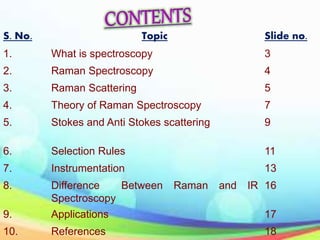
S. No. Topic Slide no.
1. What is spectroscopy 3
2. Raman Spectroscopy 4
3. Raman Scattering 5
4. Theory of Raman Spectroscopy 7
5. Stokes and Anti Stokes scattering 9
6. Selection Rules 11
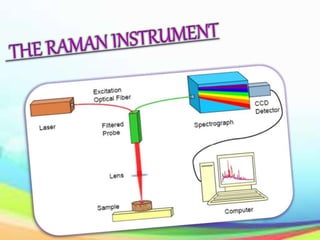
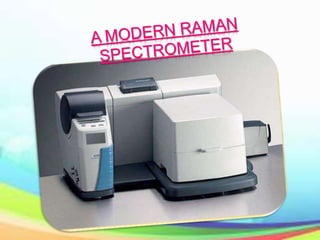
7. Instrumentation 13
8. Difference Between Raman and IR
Spectroscopy
16
9. Applications 17
10. References 18
The study of the interaction of electromagnetic
radiation in all its forms with matter.
When a beam of white light strikes a triangular
prism it is separated into its various components
(VIBGYOR). This is known as a spectrum.
The optical system which allows production and
viewing of the spectrum is called a spectroscope.
A spectroscopic technique used to observe
vibrational, rotational, and other low-frequency modes
in a system.
Commonly used in chemistry to provide a fingerprint
by which molecules can be identified.
It relies on inelastic scattering, or Raman
scattering, of monochromatic light, usually from
a laser in the visible, near infrared, or near
ultraviolet range.
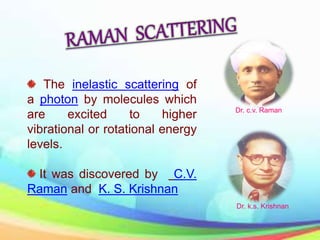
The inelastic scattering of
a photon by molecules which
are excited to higher
vibrational or rotational energy
levels.
It was discovered by C.V.
Raman and K. S. Krishnan
Dr. c.v. Raman
Dr. k.s. Krishnan
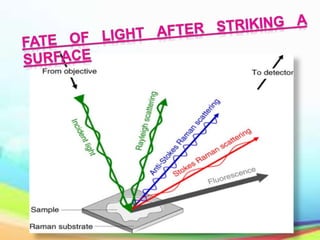
Phenomenon of inelastic light scattering.
Scattering of light at the same frequency as
incident light is called RAYLEIGH SCATTERING
Light scattered with different frequency is called
RAMAN SCATTERING
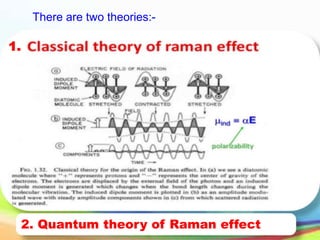
1.
There are two theories:-
2. Quantum theory of Raman effect
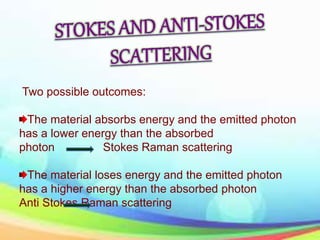
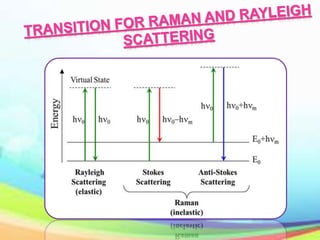
Two possible outcomes:
The material absorbs energy and the emitted photon
has a lower energy than the absorbed
photon Stokes Raman scattering
The material loses energy and the emitted photon
has a higher energy than the absorbed photon
Anti Stokes Raman scattering
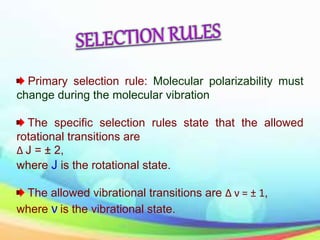
Primary selection rule: Molecular polarizability must
change during the molecular vibration
The specific selection rules state that the allowed
rotational transitions are
Δ J = ± 2,
where J is the rotational state.
The allowed vibrational transitions are Δ ν = ± 1,
where ν is the vibrational state.
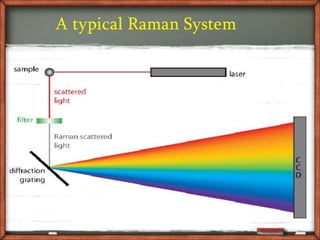
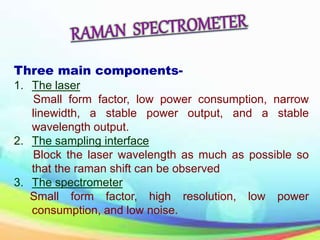
Three main components-
1. The laser
Small form factor, low power consumption, narrow
linewidth, a stable power output, and a stable
wavelength output.
2. The sampling interface
Block the laser wavelength as much as possible so
that the raman shift can be observed
3. The spectrometer
Small form factor, high resolution, low power
consumption, and low noise.
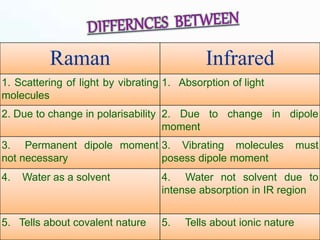
Raman Infrared
1. Scattering of light by vibrating
molecules
1. Absorption of light
2. Due to change in polarisability 2. Due to change in dipole
moment
3. Permanent dipole moment
not necessary
3. Vibrating molecules must
posess dipole moment
4. Water as a solvent 4. Water not solvent due to
intense absorption in IR region
5. Tells about covalent nature 5. Tells about ionic nature
To determine the nature of chemical bonds and
symmetry of molecules
As a fingerprint to identify molecules
In solid state physics to crystallographic orientation of
sample
To detect explosives for airport security
To investigate chemical composition of historical
documents
In medicine
https://en.wikipedia.org/wiki/Raman_spectrosco
py
https://en.wikipedia.org/wiki/Raman_scattering
https://www.slideshare.net/ajamilan12/raman-
spectroscopy-13063160
https://www.slideshare.net/krishslide/raman-
spectroscopy-39462565
https://www.slideshare.net/tzhang1999/Raman
online
Raman spectroscopy

Raman spectroscopy

  • 2.
    S. No. TopicSlide no. 1. What is spectroscopy 3 2. Raman Spectroscopy 4 3. Raman Scattering 5 4. Theory of Raman Spectroscopy 7 5. Stokes and Anti Stokes scattering 9 6. Selection Rules 11 7. Instrumentation 13 8. Difference Between Raman and IR Spectroscopy 16 9. Applications 17 10. References 18
  • 3.
    The study ofthe interaction of electromagnetic radiation in all its forms with matter. When a beam of white light strikes a triangular prism it is separated into its various components (VIBGYOR). This is known as a spectrum. The optical system which allows production and viewing of the spectrum is called a spectroscope.
  • 4.
    A spectroscopic techniqueused to observe vibrational, rotational, and other low-frequency modes in a system. Commonly used in chemistry to provide a fingerprint by which molecules can be identified. It relies on inelastic scattering, or Raman scattering, of monochromatic light, usually from a laser in the visible, near infrared, or near ultraviolet range.
  • 5.
    The inelastic scatteringof a photon by molecules which are excited to higher vibrational or rotational energy levels. It was discovered by C.V. Raman and K. S. Krishnan Dr. c.v. Raman Dr. k.s. Krishnan
  • 7.
    Phenomenon of inelasticlight scattering. Scattering of light at the same frequency as incident light is called RAYLEIGH SCATTERING Light scattered with different frequency is called RAMAN SCATTERING
  • 8.
    1. There are twotheories:- 2. Quantum theory of Raman effect
  • 10.
    Two possible outcomes: Thematerial absorbs energy and the emitted photon has a lower energy than the absorbed photon Stokes Raman scattering The material loses energy and the emitted photon has a higher energy than the absorbed photon Anti Stokes Raman scattering
  • 12.
    Primary selection rule:Molecular polarizability must change during the molecular vibration The specific selection rules state that the allowed rotational transitions are Δ J = ± 2, where J is the rotational state. The allowed vibrational transitions are Δ ν = ± 1, where ν is the vibrational state.
  • 14.
    Three main components- 1.The laser Small form factor, low power consumption, narrow linewidth, a stable power output, and a stable wavelength output. 2. The sampling interface Block the laser wavelength as much as possible so that the raman shift can be observed 3. The spectrometer Small form factor, high resolution, low power consumption, and low noise.
  • 16.
    Raman Infrared 1. Scatteringof light by vibrating molecules 1. Absorption of light 2. Due to change in polarisability 2. Due to change in dipole moment 3. Permanent dipole moment not necessary 3. Vibrating molecules must posess dipole moment 4. Water as a solvent 4. Water not solvent due to intense absorption in IR region 5. Tells about covalent nature 5. Tells about ionic nature
  • 17.
    To determine thenature of chemical bonds and symmetry of molecules As a fingerprint to identify molecules In solid state physics to crystallographic orientation of sample To detect explosives for airport security To investigate chemical composition of historical documents In medicine
  • 18.