Nuclear Magnetic 
Resonance Spectroscopy 
Prof. V. Krishnakumar 
Professor and Head 
Department of Physics 
Periyar University 
Salem 
India
Introduction 
• NMR is the most powerful tool available for 
organic structure determination. 
• It is used to study a wide variety of nuclei: 
– 1H 
– 13C 
– 15N 
– 19F 
– 31P 
=>
Nuclear Spin 
• A nucleus with an odd atomic number or 
an odd mass number has a nuclear spin. 
• The spinning charged nucleus generates 
a magnetic field. 
=>
External Magnetic Field 
When placed in an external field, spinning 
protons act like bar magnets. 
=>
Two Energy States 
The magnetic fields of 
the spinning nuclei 
will align either with 
the external field, or 
against the field. 
A photon with the right 
amount of energy 
can be absorbed 
and cause the 
spinning proton to 
flip. =>
DE and Magnet Strength 
• Energy difference is proportional to the 
magnetic field strength. 
"DE = hn = g h B0 
2p 
• Gyromagnetic ratio, g, is a constant for 
each nucleus (26,753 s-1gauss-1 for H). 
• In a 14,092 gauss field, a 60 MHz 
photon is required to flip a proton. 
• Low energy, radio frequency. =>
Magnetic Shielding 
• If all protons absorbed the same 
amount of energy in a given magnetic 
field, not much information could be 
obtained. 
• But protons are surrounded by 
electrons that shield them from the 
external field. 
• Circulating electrons create an induced 
magnetic field that opposes the external 
magnetic field. =>
Shielded Protons 
Magnetic field strength must be increased 
for a shielded proton to flip at the same 
frequency. 
=>
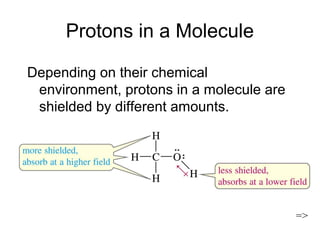
Protons in a Molecule 
Depending on their chemical 
environment, protons in a molecule are 
shielded by different amounts. 
=>
NMR Signals 
• The number of signals shows how many 
different kinds of protons are present. 
• The location of the signals shows how 
shielded or deshielded the proton is. 
• The intensity of the signal shows the 
number of protons of that type. 
• Signal splitting shows the number of 
protons on adjacent atoms. =>
TThhee ssppeeccttrroommeetteerr
The NMR Graph 
=>
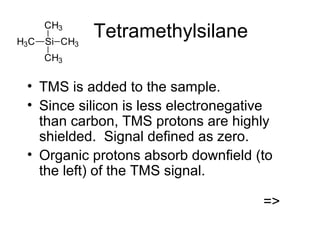
Tetramethylsilane 
CH3 
• TMS is added to the sample. 
• Since silicon is less electronegative 
than carbon, TMS protons are highly 
shielded. Signal defined as zero. 
• Organic protons absorb downfield (to 
the left) of the TMS signal. 
=> 
Si 
CH3 
CH3 
H3C
Chemical Shift 
• Measured in parts per million. 
• Ratio of shift downfield from TMS (Hz) to 
total spectrometer frequency (Hz). 
• Same value for 60, 100, or 300 MHz 
machine. 
• Called the delta scale. 
=>
Location of Signals 
• More electronegative 
atoms deshield more and 
give larger shift values. 
• Effect decreases with 
distance. 
• Additional electronegative 
atoms cause increase in 
chemical shift. 
=>
Typical Values 
=>
Aromatic Protons, d7-d8 
=>
Vinyl Protons, d5-d6 
=>
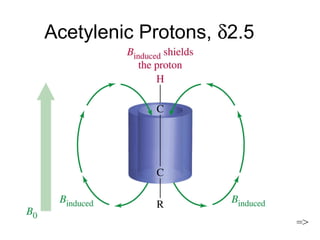
Acetylenic Protons, d2.5 
=>
Aldehyde Proton, d9-d10 
=> 
Electronegative 
oxygen atom
O-H and N-H Signals 
• Chemical shift depends on concentration. 
• Hydrogen bonding in concentrated 
solutions deshield the protons, so signal 
is around d3.5 for N-H and d4.5 for O-H. 
• Proton exchanges between the 
molecules broaden the peak. 
=>
Carboxylic Acid 
Proton, d10+ 
=>
Number of Signals 
Equivalent hydrogens have the same 
chemical shift. 
=>
Intensity of Signals 
• The area under each peak is 
proportional to the number of protons. 
• Shown by integral trace. 
=>
How Many Hydrogens? 
When the molecular formula is known, 
each integral rise can be assigned to a 
particular number of hydrogens. 
=>
Spin-Spin Splitting 
• Nonequivalent protons on adjacent carbons 
have magnetic fields that may align with or 
oppose the external field. 
• This magnetic coupling causes the proton 
to absorb slightly downfield when the 
external field is reinforced and slightly 
upfield when the external field is opposed. 
• All possibilities exist, so signal is split. =>
1,1,2-Tribromoethane 
Nonequivalent protons on adjacent carbons. 
=>
Doublet: 1 Adjacent Proton 
=>
Triplet: 2 Adjacent Protons 
=>
The N + 1 Rule 
If a signal is split by N equivalent protons, 
it is split into N + 1 peaks. 
=>
Range of Magnetic 
Coupling 
• Equivalent protons do not split each other. 
• Protons bonded to the same carbon will 
split each other only if they are not 
equivalent. 
• Protons on adjacent carbons normally will 
couple. 
• Protons separated by four or more bonds 
will not couple. 
=>
Splitting for Ethyl Groups 
=>
Splitting for 
Isopropyl Groups 
=>
Coupling Constants 
• Distance between the peaks of multiplet 
• Measured in Hz 
• Not dependent on strength of the external 
field 
• Multiplets with the same coupling 
constants may come from adjacent groups 
of protons that split each other. 
=>
Values for 
Coupling Constants 
=>
Complex Splitting 
c 
• Signals may be split by adjacent 
protons, different from each other, with 
different coupling constants. 
• Example: Ha of styrene which is split by 
an adjacent H trans to it (J = 17 Hz) and 
an adjacent H cis to it (J = 11 Hz). 
=> 
C C 
H 
H 
Ha 
b
Splitting Tree 
C C 
H 
H 
Ha 
c 
b 
=>
Spectrum for Styrene 
=>
Stereochemical Nonequivalence 
• Usually, two protons on the same C are 
equivalent and do not split each other. 
• If the replacement of each of the protons of 
a -CH2 group with an imaginary “Z” gives 
stereoisomers, then the protons are non-equivalent 
and will split each other. 
=>
Some Nonequivalent 
Protons 
C C 
H 
H 
Ha 
c 
b 
OH 
H 
H 
H 
a 
b 
c 
d 
CH3 
H Cl 
H H 
a b => 
Cl
Time Dependence 
• Molecules are tumbling relative to the 
magnetic field, so NMR is an averaged 
spectrum of all the orientations. 
• Axial and equatorial protons on 
cyclohexane interconvert so rapidly that 
they give a single signal. 
• Proton transfers for OH and NH may occur 
so quickly that the proton is not split by 
adjacent protons in the molecule. 
=>
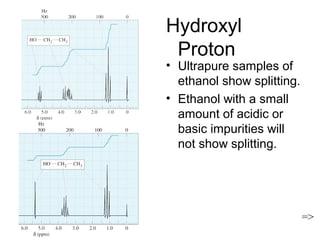
Hydroxyl 
Proton 
• Ultrapure samples of 
ethanol show splitting. 
• Ethanol with a small 
amount of acidic or 
basic impurities will 
not show splitting. 
=>
N-H Proton 
• Moderate rate of exchange. 
• Peak may be broad. 
=>
Identifying the O-H 
or N-H Peak 
• Chemical shift will depend on 
concentration and solvent. 
• To verify that a particular peak is due to 
O-H or N-H, shake the sample with D2O 
• Deuterium will exchange with the O-H 
or N-H protons. 
• On a second NMR spectrum the peak 
will be absent, or much less intense. 
=>
Carbon-13 
• 12C has no magnetic spin. 
• 13C has a magnetic spin, but is only 1% of 
the carbon in a sample. 
• The gyromagnetic ratio of 13C is one-fourth 
of that of 1H. 
• Signals are weak, getting lost in noise. 
• Hundreds of spectra are taken, averaged. 
=>
Fourier Transform NMR 
• Nuclei in a magnetic field are given a 
radio-frequency pulse close to their 
resonance frequency. 
• The nuclei absorb energy and precess 
(spin) like little tops. 
• A complex signal is produced, then 
decays as the nuclei lose energy. 
• Free induction decay is converted to 
spectrum. =>
Hydrogen and Carbon 
Chemical Shifts 
=>
Combined 13C 
and 1H Spectra 
=>
Differences in 
13C Technique 
• Resonance frequency is ~ one-fourth, 
15.1 MHz instead of 60 MHz. 
• Peak areas are not proportional to 
number of carbons. 
• Carbon atoms with more hydrogens 
absorb more strongly. 
=>
Spin-Spin Splitting 
• It is unlikely that a 13C would be adjacent to 
another 13C, so splitting by carbon is 
negligible. 
• 13C will magnetically couple with attached 
protons and adjacent protons. 
• These complex splitting patterns are 
difficult to interpret. 
=>
Proton Spin Decoupling 
• To simplify the spectrum, protons are 
continuously irradiated with “noise,” so 
they are rapidly flipping. 
• The carbon nuclei see an average of all 
the possible proton spin states. 
• Thus, each different kind of carbon gives a 
single, unsplit peak. 
=>
Off-Resonance Decoupling 
• 13C nuclei are split only by the protons 
attached directly to them. 
• The N + 1 rule applies: a carbon with N 
number of protons gives a signal with 
N + 1 peaks. 
=>
Interpreting 13C NMR 
• The number of different signals indicates 
the number of different kinds of carbon. 
• The location (chemical shift) indicates the 
type of functional group. 
• The peak area indicates the numbers of 
carbons (if integrated). 
• The splitting pattern of off-resonance 
decoupled spectrum indicates the 
number of protons attached to the 
carbon. =>
Two 13C NMR Spectra 
=>
MRI 
• Magnetic resonance imaging, noninvasive 
• “Nuclear” is omitted because of public’s 
fear that it would be radioactive. 
• Only protons in one plane can be in 
resonance at one time. 
• Computer puts together “slices” to get 3D. 
• Tumors readily detected. 
=>
Thank You

NMR Spectroscopy

  • 1.
    Nuclear Magnetic ResonanceSpectroscopy Prof. V. Krishnakumar Professor and Head Department of Physics Periyar University Salem India
  • 2.
    Introduction • NMRis the most powerful tool available for organic structure determination. • It is used to study a wide variety of nuclei: – 1H – 13C – 15N – 19F – 31P =>
  • 3.
    Nuclear Spin •A nucleus with an odd atomic number or an odd mass number has a nuclear spin. • The spinning charged nucleus generates a magnetic field. =>
  • 4.
    External Magnetic Field When placed in an external field, spinning protons act like bar magnets. =>
  • 5.
    Two Energy States The magnetic fields of the spinning nuclei will align either with the external field, or against the field. A photon with the right amount of energy can be absorbed and cause the spinning proton to flip. =>
  • 6.
    DE and MagnetStrength • Energy difference is proportional to the magnetic field strength. "DE = hn = g h B0 2p • Gyromagnetic ratio, g, is a constant for each nucleus (26,753 s-1gauss-1 for H). • In a 14,092 gauss field, a 60 MHz photon is required to flip a proton. • Low energy, radio frequency. =>
  • 7.
    Magnetic Shielding •If all protons absorbed the same amount of energy in a given magnetic field, not much information could be obtained. • But protons are surrounded by electrons that shield them from the external field. • Circulating electrons create an induced magnetic field that opposes the external magnetic field. =>
  • 8.
    Shielded Protons Magneticfield strength must be increased for a shielded proton to flip at the same frequency. =>
  • 9.
    Protons in aMolecule Depending on their chemical environment, protons in a molecule are shielded by different amounts. =>
  • 10.
    NMR Signals •The number of signals shows how many different kinds of protons are present. • The location of the signals shows how shielded or deshielded the proton is. • The intensity of the signal shows the number of protons of that type. • Signal splitting shows the number of protons on adjacent atoms. =>
  • 11.
  • 12.
  • 13.
    Tetramethylsilane CH3 •TMS is added to the sample. • Since silicon is less electronegative than carbon, TMS protons are highly shielded. Signal defined as zero. • Organic protons absorb downfield (to the left) of the TMS signal. => Si CH3 CH3 H3C
  • 14.
    Chemical Shift •Measured in parts per million. • Ratio of shift downfield from TMS (Hz) to total spectrometer frequency (Hz). • Same value for 60, 100, or 300 MHz machine. • Called the delta scale. =>
  • 15.
    Location of Signals • More electronegative atoms deshield more and give larger shift values. • Effect decreases with distance. • Additional electronegative atoms cause increase in chemical shift. =>
  • 16.
  • 17.
  • 18.
  • 19.
  • 20.
    Aldehyde Proton, d9-d10 => Electronegative oxygen atom
  • 21.
    O-H and N-HSignals • Chemical shift depends on concentration. • Hydrogen bonding in concentrated solutions deshield the protons, so signal is around d3.5 for N-H and d4.5 for O-H. • Proton exchanges between the molecules broaden the peak. =>
  • 22.
  • 23.
    Number of Signals Equivalent hydrogens have the same chemical shift. =>
  • 24.
    Intensity of Signals • The area under each peak is proportional to the number of protons. • Shown by integral trace. =>
  • 25.
    How Many Hydrogens? When the molecular formula is known, each integral rise can be assigned to a particular number of hydrogens. =>
  • 26.
    Spin-Spin Splitting •Nonequivalent protons on adjacent carbons have magnetic fields that may align with or oppose the external field. • This magnetic coupling causes the proton to absorb slightly downfield when the external field is reinforced and slightly upfield when the external field is opposed. • All possibilities exist, so signal is split. =>
  • 27.
  • 28.
  • 29.
  • 30.
    The N +1 Rule If a signal is split by N equivalent protons, it is split into N + 1 peaks. =>
  • 31.
    Range of Magnetic Coupling • Equivalent protons do not split each other. • Protons bonded to the same carbon will split each other only if they are not equivalent. • Protons on adjacent carbons normally will couple. • Protons separated by four or more bonds will not couple. =>
  • 32.
  • 33.
  • 34.
    Coupling Constants •Distance between the peaks of multiplet • Measured in Hz • Not dependent on strength of the external field • Multiplets with the same coupling constants may come from adjacent groups of protons that split each other. =>
  • 35.
    Values for CouplingConstants =>
  • 36.
    Complex Splitting c • Signals may be split by adjacent protons, different from each other, with different coupling constants. • Example: Ha of styrene which is split by an adjacent H trans to it (J = 17 Hz) and an adjacent H cis to it (J = 11 Hz). => C C H H Ha b
  • 37.
    Splitting Tree CC H H Ha c b =>
  • 38.
  • 39.
    Stereochemical Nonequivalence •Usually, two protons on the same C are equivalent and do not split each other. • If the replacement of each of the protons of a -CH2 group with an imaginary “Z” gives stereoisomers, then the protons are non-equivalent and will split each other. =>
  • 40.
    Some Nonequivalent Protons C C H H Ha c b OH H H H a b c d CH3 H Cl H H a b => Cl
  • 41.
    Time Dependence •Molecules are tumbling relative to the magnetic field, so NMR is an averaged spectrum of all the orientations. • Axial and equatorial protons on cyclohexane interconvert so rapidly that they give a single signal. • Proton transfers for OH and NH may occur so quickly that the proton is not split by adjacent protons in the molecule. =>
  • 42.
    Hydroxyl Proton •Ultrapure samples of ethanol show splitting. • Ethanol with a small amount of acidic or basic impurities will not show splitting. =>
  • 43.
    N-H Proton •Moderate rate of exchange. • Peak may be broad. =>
  • 44.
    Identifying the O-H or N-H Peak • Chemical shift will depend on concentration and solvent. • To verify that a particular peak is due to O-H or N-H, shake the sample with D2O • Deuterium will exchange with the O-H or N-H protons. • On a second NMR spectrum the peak will be absent, or much less intense. =>
  • 45.
    Carbon-13 • 12Chas no magnetic spin. • 13C has a magnetic spin, but is only 1% of the carbon in a sample. • The gyromagnetic ratio of 13C is one-fourth of that of 1H. • Signals are weak, getting lost in noise. • Hundreds of spectra are taken, averaged. =>
  • 46.
    Fourier Transform NMR • Nuclei in a magnetic field are given a radio-frequency pulse close to their resonance frequency. • The nuclei absorb energy and precess (spin) like little tops. • A complex signal is produced, then decays as the nuclei lose energy. • Free induction decay is converted to spectrum. =>
  • 47.
    Hydrogen and Carbon Chemical Shifts =>
  • 48.
    Combined 13C and1H Spectra =>
  • 49.
    Differences in 13CTechnique • Resonance frequency is ~ one-fourth, 15.1 MHz instead of 60 MHz. • Peak areas are not proportional to number of carbons. • Carbon atoms with more hydrogens absorb more strongly. =>
  • 50.
    Spin-Spin Splitting •It is unlikely that a 13C would be adjacent to another 13C, so splitting by carbon is negligible. • 13C will magnetically couple with attached protons and adjacent protons. • These complex splitting patterns are difficult to interpret. =>
  • 51.
    Proton Spin Decoupling • To simplify the spectrum, protons are continuously irradiated with “noise,” so they are rapidly flipping. • The carbon nuclei see an average of all the possible proton spin states. • Thus, each different kind of carbon gives a single, unsplit peak. =>
  • 52.
    Off-Resonance Decoupling •13C nuclei are split only by the protons attached directly to them. • The N + 1 rule applies: a carbon with N number of protons gives a signal with N + 1 peaks. =>
  • 53.
    Interpreting 13C NMR • The number of different signals indicates the number of different kinds of carbon. • The location (chemical shift) indicates the type of functional group. • The peak area indicates the numbers of carbons (if integrated). • The splitting pattern of off-resonance decoupled spectrum indicates the number of protons attached to the carbon. =>
  • 54.
    Two 13C NMRSpectra =>
  • 55.
    MRI • Magneticresonance imaging, noninvasive • “Nuclear” is omitted because of public’s fear that it would be radioactive. • Only protons in one plane can be in resonance at one time. • Computer puts together “slices” to get 3D. • Tumors readily detected. =>
  • 56.