OXIDATION-
REDUCTION
REACTIONS
Settle in, this is going to take a while…
What is redox?
 Reaction where there is a transfer of electrons
between reactants
 Oxidation involves the loss of electrons (OIL)
 Oxidation number/state of the element increases
 Oxidized element is the reducing agent
 Reduction involves the gain of electrons (RIG)
 Oxidation number/state of the element decreases
 Reduced element is the oxidizing agent
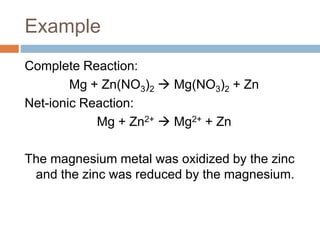
Example
Complete Reaction:
Mg + Zn(NO3)2  Mg(NO3)2 + Zn
Net-ionic Reaction:
Mg + Zn2+  Mg2+ + Zn
The magnesium metal was oxidized by the zinc
and the zinc was reduced by the magnesium.
Do what?!?!
 The oxidation state of the magnesium
changed from 0 to +2
 Oxidation state increased = oxidation
 Because magnesium gave its electrons away, it is
the reducing agent
 The oxidation state of zinc changed from +2 to
0
 Oxidation state decreased = reduction
 Because zinc took the electrons, it is the oxidizing
agent
How do you know oxidation
states?
 The oxidation number for any pure element is
zero.
 Group 1 metals form +1 ions, group 2 metals
form +2 ions, group 13 metals form +3 ions.
 Transition metals can be all kinds of oxidation
numbers (ranging from +1 to +7)
 Transition metal oxidation states can be
determined based on the nonmetal(s) it’s
bonded to…
Nonmetal oxidation states
 Fluoride is ALWAYS -1, the other halides are
usually -1.
 Oxide is usually -2, except when it’s in the
peroxide ion (-1) or bonded to fluorine (+2)
 Hydrogen is +1, unless it is the hydride ion (-1)
Putting it all together
 The total charge on a compound is zero, so all
oxidation numbers must cancel out.
 The total charge of elements in a polyatomic
ion must add to the charge on the ion
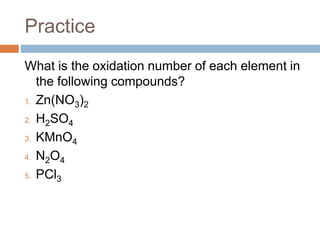
Practice
What is the oxidation number of each element in
the following compounds?
1. Zn(NO3)2
2. H2SO4
3. KMnO4
4. N2O4
5. PCl3
What’s the point?
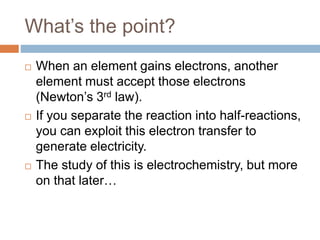
 When an element gains electrons, another
element must accept those electrons
(Newton’s 3rd law).
 If you separate the reaction into half-reactions,
you can exploit this electron transfer to
generate electricity.
 The study of this is electrochemistry, but more
on that later…
Half-Reactions?
 You can separate a redox reaction into the
reduction reaction and the oxidation reaction.
 First you have to identify which element is
oxidized and which is reduced.
 So let’s practice identification first:
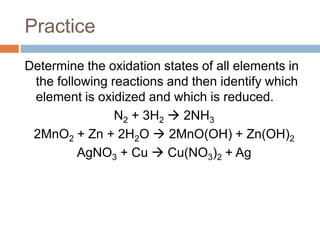
Practice
Determine the oxidation states of all elements in
the following reactions and then identify which
element is oxidized and which is reduced.
N2 + 3H2  2NH3
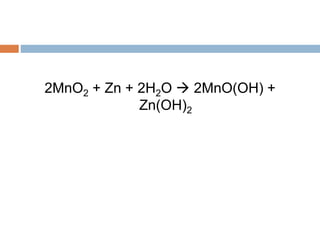
2MnO2 + Zn + 2H2O  2MnO(OH) + Zn(OH)2
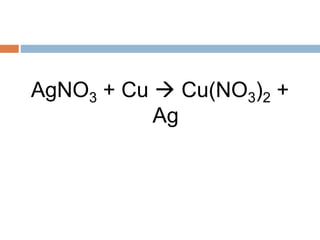
AgNO3 + Cu  Cu(NO3)2 + Ag
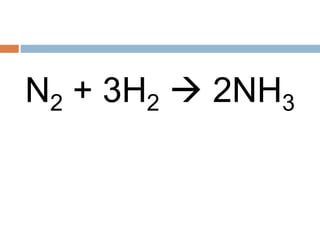
N2 + 3H2  2NH3
2MnO2 + Zn + 2H2O  2MnO(OH) +
Zn(OH)2
AgNO3 + Cu  Cu(NO3)2 +
Ag
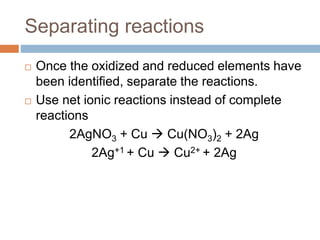
Separating reactions
 Once the oxidized and reduced elements have
been identified, separate the reactions.
 Use net ionic reactions instead of complete
reactions
2AgNO3 + Cu  Cu(NO3)2 + 2Ag
2Ag+1 + Cu  Cu2+ + 2Ag
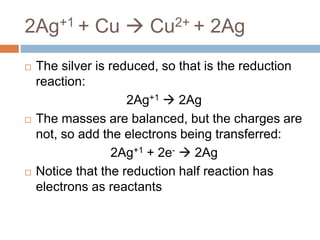
 The silver is reduced, so that is the reduction
reaction:
2Ag+1  2Ag
 The masses are balanced, but the charges are
not, so add the electrons being transferred:
2Ag+1 + 2e-  2Ag
 Notice that the reduction half reaction has
electrons as reactants
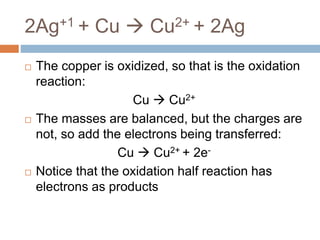
2Ag+1 + Cu  Cu2+ + 2Ag
 The copper is oxidized, so that is the oxidation
reaction:
Cu  Cu2+
 The masses are balanced, but the charges are
not, so add the electrons being transferred:
Cu  Cu2+ + 2e-
 Notice that the oxidation half reaction has
electrons as products

Oxidation reduction reactions honors

  • 1.
  • 2.
    What is redox? Reaction where there is a transfer of electrons between reactants  Oxidation involves the loss of electrons (OIL)  Oxidation number/state of the element increases  Oxidized element is the reducing agent  Reduction involves the gain of electrons (RIG)  Oxidation number/state of the element decreases  Reduced element is the oxidizing agent
  • 3.
    Example Complete Reaction: Mg +Zn(NO3)2  Mg(NO3)2 + Zn Net-ionic Reaction: Mg + Zn2+  Mg2+ + Zn The magnesium metal was oxidized by the zinc and the zinc was reduced by the magnesium.
  • 4.
    Do what?!?!  Theoxidation state of the magnesium changed from 0 to +2  Oxidation state increased = oxidation  Because magnesium gave its electrons away, it is the reducing agent  The oxidation state of zinc changed from +2 to 0  Oxidation state decreased = reduction  Because zinc took the electrons, it is the oxidizing agent
  • 5.
    How do youknow oxidation states?  The oxidation number for any pure element is zero.  Group 1 metals form +1 ions, group 2 metals form +2 ions, group 13 metals form +3 ions.  Transition metals can be all kinds of oxidation numbers (ranging from +1 to +7)  Transition metal oxidation states can be determined based on the nonmetal(s) it’s bonded to…
  • 6.
    Nonmetal oxidation states Fluoride is ALWAYS -1, the other halides are usually -1.  Oxide is usually -2, except when it’s in the peroxide ion (-1) or bonded to fluorine (+2)  Hydrogen is +1, unless it is the hydride ion (-1)
  • 7.
    Putting it alltogether  The total charge on a compound is zero, so all oxidation numbers must cancel out.  The total charge of elements in a polyatomic ion must add to the charge on the ion
  • 8.
    Practice What is theoxidation number of each element in the following compounds? 1. Zn(NO3)2 2. H2SO4 3. KMnO4 4. N2O4 5. PCl3
  • 9.
    What’s the point? When an element gains electrons, another element must accept those electrons (Newton’s 3rd law).  If you separate the reaction into half-reactions, you can exploit this electron transfer to generate electricity.  The study of this is electrochemistry, but more on that later…
  • 10.
    Half-Reactions?  You canseparate a redox reaction into the reduction reaction and the oxidation reaction.  First you have to identify which element is oxidized and which is reduced.  So let’s practice identification first:
  • 11.
    Practice Determine the oxidationstates of all elements in the following reactions and then identify which element is oxidized and which is reduced. N2 + 3H2  2NH3 2MnO2 + Zn + 2H2O  2MnO(OH) + Zn(OH)2 AgNO3 + Cu  Cu(NO3)2 + Ag
  • 12.
    N2 + 3H2 2NH3
  • 13.
    2MnO2 + Zn+ 2H2O  2MnO(OH) + Zn(OH)2
  • 14.
    AgNO3 + Cu Cu(NO3)2 + Ag
  • 15.
    Separating reactions  Oncethe oxidized and reduced elements have been identified, separate the reactions.  Use net ionic reactions instead of complete reactions 2AgNO3 + Cu  Cu(NO3)2 + 2Ag 2Ag+1 + Cu  Cu2+ + 2Ag
  • 16.
    2Ag+1 + Cu Cu2+ + 2Ag  The silver is reduced, so that is the reduction reaction: 2Ag+1  2Ag  The masses are balanced, but the charges are not, so add the electrons being transferred: 2Ag+1 + 2e-  2Ag  Notice that the reduction half reaction has electrons as reactants
  • 17.
    2Ag+1 + Cu Cu2+ + 2Ag  The copper is oxidized, so that is the oxidation reaction: Cu  Cu2+  The masses are balanced, but the charges are not, so add the electrons being transferred: Cu  Cu2+ + 2e-  Notice that the oxidation half reaction has electrons as products