By Dr. Alhaiqa Farooqi
R Ph , Pharm D , MS, FCPS ,
MCPS
Compounds that have same molecular
formula but differ from each other in
physical or chemical properties are called
ISOMERS & the phenomenon is called
ISOMERISM.
Isomers have same molecular formula but
difference in their properties must be due
to different modes of combination or
arrangement of atoms within a molecule.
Two main types
STRUCTURAL ISOMERISM
STEREOISOMERISM
When the isomerism is due to difference in
arrangement of atoms within the molecule,
without any reference to space, the
phenomenon is called Structural
isomerism.
Structural isomers are the compounds that
have same molecular formula but different
structural formulas.
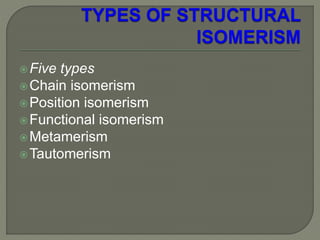
Five types
Chain isomerism
Position isomerism
Functional isomerism
Metamerism
Tautomerism
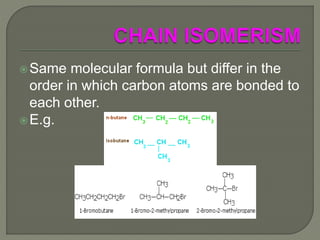
Same molecular formula but differ in the
order in which carbon atoms are bonded to
each other.
E.g.
Same molecular formula but differ in the
position of functional group on carbon
chain.
Same molecular formula but different
functional groups.
This type of isomerism arises due to
unequal distribution of carbon atoms on
either side of the functional group.
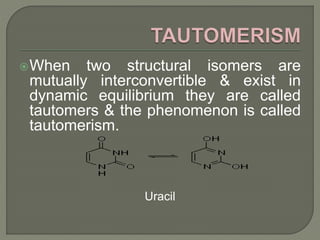
When two structural isomers are
mutually interconvertible & exist in
dynamic equilibrium they are called
tautomers & the phenomenon is called
tautomerism.
Uracil
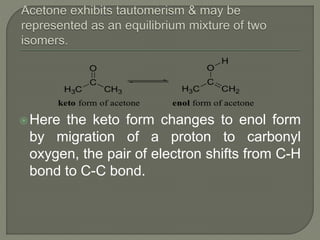
Here the keto form changes to enol form
by migration of a proton to carbonyl
oxygen, the pair of electron shifts from C-H
bond to C-C bond.
Tautomerism involves equilibrium between
structures & different tautomeric forms
have real existence.
Tautomerism involves movement of both
electrons & atoms whereas resonance
structures differ in respect of position of
electrons only.
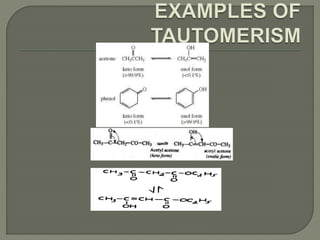
 Aldehydes, ketones & other carbonyl
compounds ( e.g. esters) exhibit this special
type of tautomerism.
 It involves migration of proton from α- carbon
to carbonyl oxygen.
 The tautomer containing carbonyl group is
designated as Keto form & the other
containing hydroxy group attached to doubly
bonded carbon is referred to as Enol
form(alkENe+alcohOL)
Ethyl acetoacetate
Isomerism

Isomerism

  • 1.
    By Dr. AlhaiqaFarooqi R Ph , Pharm D , MS, FCPS , MCPS
  • 2.
    Compounds that havesame molecular formula but differ from each other in physical or chemical properties are called ISOMERS & the phenomenon is called ISOMERISM. Isomers have same molecular formula but difference in their properties must be due to different modes of combination or arrangement of atoms within a molecule.
  • 3.
    Two main types STRUCTURALISOMERISM STEREOISOMERISM
  • 5.
    When the isomerismis due to difference in arrangement of atoms within the molecule, without any reference to space, the phenomenon is called Structural isomerism. Structural isomers are the compounds that have same molecular formula but different structural formulas.
  • 6.
    Five types Chain isomerism Positionisomerism Functional isomerism Metamerism Tautomerism
  • 7.
    Same molecular formulabut differ in the order in which carbon atoms are bonded to each other. E.g.
  • 8.
    Same molecular formulabut differ in the position of functional group on carbon chain.
  • 9.
    Same molecular formulabut different functional groups.
  • 10.
    This type ofisomerism arises due to unequal distribution of carbon atoms on either side of the functional group.
  • 11.
    When two structuralisomers are mutually interconvertible & exist in dynamic equilibrium they are called tautomers & the phenomenon is called tautomerism. Uracil
  • 12.
    Here the ketoform changes to enol form by migration of a proton to carbonyl oxygen, the pair of electron shifts from C-H bond to C-C bond.
  • 13.
    Tautomerism involves equilibriumbetween structures & different tautomeric forms have real existence. Tautomerism involves movement of both electrons & atoms whereas resonance structures differ in respect of position of electrons only.
  • 14.
     Aldehydes, ketones& other carbonyl compounds ( e.g. esters) exhibit this special type of tautomerism.  It involves migration of proton from α- carbon to carbonyl oxygen.  The tautomer containing carbonyl group is designated as Keto form & the other containing hydroxy group attached to doubly bonded carbon is referred to as Enol form(alkENe+alcohOL)
  • 15.