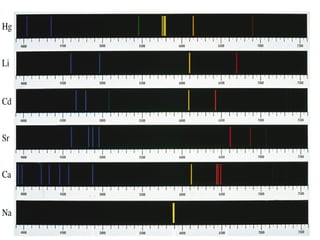
Emission and Absorption of
Electromagnetic Energy
copper sodium lithium strontium
BOHR MODEL OF
HYDROGEN ATOM
 Electron circles the nucleus in fixed energy
ranges called orbits (energy levels)
 An electron can move from one energy level to
another by gaining discrete amounts of energy.
 Electron can not be found between energy levels
(energy levels are like rungs on a ladder…..)
 The lowest energy level is the closest to the
nucleus.
BOHR MODEL OF
HYDROGEN ATOM
 Electron circles the nucleus in fixed energy
ranges called orbits (energy levels)
 An electron can move from one energy level to
another by gaining discrete amounts of energy.
 Electron can not be found between energy levels
(energy levels are like rungs on a ladder…..)
 The lowest energy level is the closest to the
nucleus.
energy absorbed
=
energy released
=
energy of light produced
*some of this light is part of the visible
spectrum, and can be seen as unique colors for
different elements
 Bohr model helped us to understand the
movement of electrons around the
nucleus.
 However, the model does not account for
behavior of larger atoms with more than
one electron.
Bohr model from reference
table
When an electron
falls from
n = 6 to n = 2, what
wavelength of light
will be emitted?
What is the
region of the
spectrum that
corresponds to this
wavelength?
When an electron falls from
n = 6 to n = 2, what color of light will
be emitted?
Wavelength vs Frequency
 Inversely proportional (i.e. when one goes
up, the other goes down)
 http://amazing-
space.stsci.edu/resources/explorations/light/
makewaves-frames.html
Wave-Particle Duality of
Electrons
 Electrons act as waves as well as particles
 Energy can act as particles as well as waves
Unit 3 p pt electromagnetic e

Unit 3 p pt electromagnetic e

  • 1.
    Emission and Absorptionof Electromagnetic Energy
  • 2.
  • 3.
    BOHR MODEL OF HYDROGENATOM  Electron circles the nucleus in fixed energy ranges called orbits (energy levels)  An electron can move from one energy level to another by gaining discrete amounts of energy.  Electron can not be found between energy levels (energy levels are like rungs on a ladder…..)  The lowest energy level is the closest to the nucleus.
  • 4.
    BOHR MODEL OF HYDROGENATOM  Electron circles the nucleus in fixed energy ranges called orbits (energy levels)  An electron can move from one energy level to another by gaining discrete amounts of energy.  Electron can not be found between energy levels (energy levels are like rungs on a ladder…..)  The lowest energy level is the closest to the nucleus.
  • 5.
    energy absorbed = energy released = energyof light produced *some of this light is part of the visible spectrum, and can be seen as unique colors for different elements
  • 6.
     Bohr modelhelped us to understand the movement of electrons around the nucleus.  However, the model does not account for behavior of larger atoms with more than one electron.
  • 7.
    Bohr model fromreference table When an electron falls from n = 6 to n = 2, what wavelength of light will be emitted? What is the region of the spectrum that corresponds to this wavelength?
  • 8.
    When an electronfalls from n = 6 to n = 2, what color of light will be emitted?
  • 9.
    Wavelength vs Frequency Inversely proportional (i.e. when one goes up, the other goes down)  http://amazing- space.stsci.edu/resources/explorations/light/ makewaves-frames.html
  • 10.
    Wave-Particle Duality of Electrons Electrons act as waves as well as particles  Energy can act as particles as well as waves